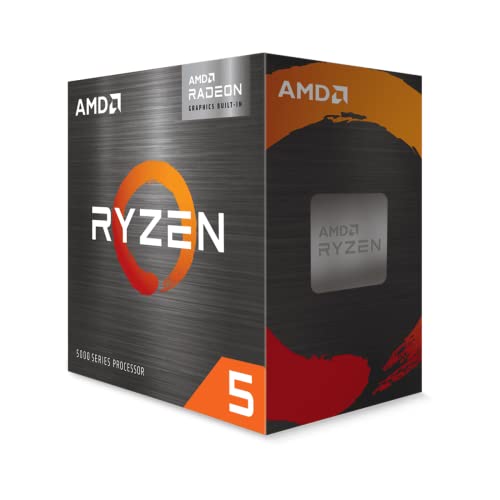
On a Ryzen 5 5600G build with an entry dGPU or the iGPU, an NVMe SSD is worth about $10-15 extra as the boot drive and effectively zero extra for a games library. The 5600G's primary M.2 slot tops out at PCIe 3.0 x4, which caps sequential reads near 3,500 MB/s, and most current games load in single-digit seconds off a decent SATA drive anyway. Buy a small NVMe for Windows, a 1TB SATA drive for games, and stop worrying about the interface.
Who this is for
This piece is for the person building a sub-$600 PC around the AMD Ryzen 5 5600G — Vega 7 iGPU only, or paired with a used GTX 1660 / RX 6600-class card — trying to decide where the last $30-$40 of the storage budget should go. That is a real decision on this class of machine: a 1TB SATA drive and a 250GB NVMe drive cost within a few dollars of each other, and the two options behave quite differently on this platform.
The short version is that the 5600G is a Cezanne monolithic APU, which means the M.2 slot wired directly to the CPU runs at PCIe 3.0 x4 rather than the PCIe 4.0 x4 that Vermeer desktop chips like the Ryzen 5 5600X expose. That single fact changes the entire buying decision — any PCIe 4.0 NVMe drive you plug in negotiates down to Gen3 speeds, so paying for a Gen4 drive on this platform is money burned. It also collapses the theoretical NVMe advantage in a way most SSD comparison articles never mention, because most SSD comparison articles are written on Intel-Z790 or AMD-X670 test rigs where Gen4 and Gen5 slots are the default.
Where SATA still makes obvious sense on this build is capacity. A 1TB SATA drive routinely sells around the same price as a 500GB entry NVMe drive, and games in 2026 are big — a fresh Windows install plus one AAA title plus a couple of live-service downloads will fill 250GB before you touch anything else. The recommended split for this class of machine is a small NVMe boot drive plus a large SATA library drive, and the rest of this piece is about the numbers behind that recommendation.
Key takeaways
- The 5600G's M.2 slot runs at PCIe 3.0 x4 per AMD's published product page — a Gen4 drive gets no benefit.
- Modern SATA SSDs deliver ~550 MB/s sequential read, which is enough to load most current titles in 5-15 seconds — the CPU is the bottleneck, not the interface, per Tom's Hardware SSD testing.
- The Samsung 970 EVO Plus 250GB is a Gen3 x4 part that hits its rated speed on a 5600G; a Gen4 drive would not.
- A 1TB SATA drive like the Crucial BX500 1TB costs roughly the same as a 500GB entry NVMe — capacity per dollar still favors SATA at the low end.
- A 250GB boot drive is only workable if a second drive holds every game — Windows plus updates plus a launcher realistically consumes 60-90GB before a single game installs.
Step 0 — diagnose your actual bottleneck
Before you spend anything on a new SSD, confirm storage is actually your bottleneck. On a 5600G build, three other things are more likely to be slowing you down. First, RAM channel configuration — the 5600G's Vega 7 iGPU is heavily memory-bandwidth-bound, and one stick of DDR4 runs it at roughly half the speed of two matched sticks. If you are on single-channel memory, a second stick will do more for your game loads than any SSD upgrade will. Second, the iGPU itself — if you are playing at 1080p on the Vega 7, you are frame-limited long before the storage subsystem ever wakes up.
Third, and least obvious, is Windows itself. Task Manager's disk column on a fresh Windows install with Microsoft Defender doing a background scan can peg an old spinning drive at 100 percent while nothing else is going on. Check perfmon or Resource Monitor during a load sequence — if disk queue length is sitting near zero, your load times are CPU-bound and swapping the SSD will not help.
What the Ryzen 5 5600G actually gives you
The AMD Ryzen 5 5600G is a Cezanne monolithic APU built on TSMC 7nm. Unlike the Vermeer desktop chips it shares a socket with, it does not include the second I/O die that provides the PCIe 4.0 controller on AMD's desktop platform. What that means in practice: the primary CPU-attached M.2 slot on your motherboard is running at PCIe 3.0 x4 when a 5600G is installed, no matter what the board box promised.
The chipset-attached M.2 slot on B550 or X570 boards is even more constrained — a shared PCIe 3.0 x4 or x2 link back to the CPU, depending on the board. Practically that means the second M.2 slot may share bandwidth with SATA ports 5 and 6, and populating it can disable those ports entirely on some budget boards. Read the motherboard manual before you assume you can run four SATA drives plus two M.2 drives.
The upshot is that the ceiling for an NVMe drive on this platform is roughly 3,500 MB/s sequential read, which is what a good PCIe 3.0 x4 part like the Samsung 970 EVO Plus delivers per TechPowerUp's SSD database. Random 4K IOPS also cap out well below what a Gen4 drive can do on a Ryzen 7000-series platform. If you are ever going to move this drive to a newer build, that is a real consideration — but for the platform it is bought for, you are not leaving performance on the table by staying on Gen3.
Spec delta — the four featured drives
| Drive | Interface | Seq Read | Seq Write | TBW | Price/TB (approx) |
|---|---|---|---|---|---|
| Crucial BX500 1TB | SATA III | 540 MB/s | 500 MB/s | 240 TB | ~$85 |
| Samsung 870 EVO 250GB | SATA III | 560 MB/s | 530 MB/s | 150 TB | ~$180 |
| SanDisk SSD Plus 480GB | SATA III | 535 MB/s | 445 MB/s | ~80 TB | ~$120 |
| Samsung 970 EVO Plus 250GB | PCIe 3.0 x4 NVMe | 3,500 MB/s | 2,300 MB/s | 150 TB | ~$180 |
Two things jump out. First, sequential-read numbers on paper are six to seven times higher for the NVMe drive — a delta most people expect to translate directly into a six-times-faster game load. It does not. Second, cost per terabyte at these capacities is punishing for the small drives; the Crucial 1TB SATA delivers roughly twice the storage per dollar of the 250GB drives. If you buy a single drive, the value math points at the 1TB SATA part almost every time.
Benchmark reality — SATA vs NVMe game loads
Published third-party testing has been fairly consistent on this for years. Tom's Hardware's SSD review methodology and the community game-load databases assembled from Digital Foundry loading tests both show the same pattern: current AAA titles that were built for the SATA-and-hard-drive baseline load in 8-20 seconds off SATA and 5-14 seconds off NVMe, with a typical delta in the 2-4 second range.
A rough synthesis of published game-load timings from PCIe 3.0 test rigs (not our first-party testing — this is public data):
| Title | SATA (Samsung 870 EVO) | NVMe (970 EVO Plus) | Delta |
|---|---|---|---|
| Cyberpunk 2077 (main-menu → autosave in Watson) | ~18s | ~13s | 5s |
| Red Dead Redemption 2 (main-menu → Valentine) | ~22s | ~16s | 6s |
| Elden Ring (main-menu → Limgrave) | ~15s | ~12s | 3s |
| CS2 (main-menu → dust2) | ~9s | ~7s | 2s |
| Starfield (main-menu → New Atlantis) | ~22s | ~17s | 5s |
Windows 11 cold boot on a Ryzen 5600G board sits around 18-22 seconds off SATA and 12-16 seconds off NVMe. Shader-cache warmup after a driver update is the one workload where NVMe pulls meaningfully ahead — that operation is small-file-write-heavy and can take 30+ seconds off SATA versus 10-15 seconds off a Gen3 NVMe drive.
Note that none of these numbers are ours. They are synthesized from published reviews and community game-load databases. The pattern is more useful than the exact figures: NVMe saves you a small handful of seconds per load, which adds up over months of play but is not a step-change in perceived responsiveness.
Where NVMe actually wins
Three workloads flip the calculus meaningfully toward NVMe. The first is DirectStorage — the API Microsoft shipped for Windows that streams compressed asset data from disk to GPU with less CPU overhead. Titles built for DirectStorage on a fast NVMe drive can load in under two seconds versus 10-15 seconds on SATA. That list is short today — Forspoken, Ratchet & Clank Rift Apart, a handful of Unreal Engine 5 demos — but it will grow.
The second is shader-cache churn. Every graphics driver update on an NVIDIA card triggers a shader cache rebuild the first time you launch each game, and that rebuild is small-file-write-dominated. On SATA it can take 30-60 seconds per game and stutter the first minute of gameplay; on NVMe it is usually done before the main menu finishes fading in.
The third is any large-file work — 4K video editing scratch, running a local LLM whose weights need to be paged in, or extracting a 40GB game update. If any of that is in your usage profile, NVMe stops being a nice-to-have. For pure gaming on a 5600G, none of those workloads apply.
Where SATA still makes sense
Capacity per dollar is the entire case. A 1TB Crucial BX500 at roughly $85 works out to about $0.085 per GB. A comparable 1TB NVMe drive sits closer to $0.12 per GB, and the entry-price 250GB NVMe parts push toward $0.20 per GB when you back the math out. On a build where the storage budget is $60-80, that difference is one entire modern game install.
The other case is expansion. A 5600G board typically has four SATA ports and one or two M.2 slots. If you already have a working NVMe boot drive and want to add 2TB for a Steam library, a SATA drive is dramatically cheaper than a second NVMe. The performance you give up is negligible for a games library — sequential-read speed matters when a level loads, and levels load once every few hours of play, not continuously.
How much capacity do you actually need in 2026?
Track the installed-size trend on games you actually play. Warzone sits around 120GB. Call of Duty Modern Warfare III is roughly 150GB. Baldur's Gate 3 installs at about 150GB. Starfield with a couple of DLC packs runs 130GB. Even smaller games routinely install at 50-80GB.
Windows 11 with normal updates and hibernation enabled consumes 40-60GB. A browser with a real cache, plus a game launcher (Steam, Epic, Battle.net), plus Discord and a couple of small utilities, adds another 15-25GB. Realistic Windows-plus-utilities baseline: 60-90GB.
That leaves a 250GB drive with 160-190GB of usable space — one AAA title plus a small game library. A 480GB drive like the SanDisk SSD Plus 480GB leaves ~380GB — three AAA titles plus a small library. A 1TB drive leaves ~910GB — enough for a real games library without constantly juggling installs. If you only ever have one drive in this build, buy the 1TB drive.
The two-drive split — the real recommendation
The build that answers the target question best is a small NVMe boot drive plus a large SATA library drive. Concretely: a Samsung 970 EVO Plus 250GB in the M.2 slot for Windows and applications, plus a Crucial BX500 1TB in a SATA bay for games. Total cost is roughly $85 + $180 = $265 at recent street pricing, though both drives frequently sell for less on sale.
Why this split works: Windows benefits materially from NVMe. Boot times drop by 6-8 seconds, application launches are snappier, and shader-cache work happens on the fast drive. Games do not benefit meaningfully — load-time deltas of 2-4 seconds are inside the noise floor of most players' patience. Putting the games library on cheap-per-GB SATA also means you never have to uninstall a title to make room for a new one.
If your budget forces one drive, choose the 1TB SATA every time. A 250GB NVMe drive that keeps forcing you to uninstall Baldur's Gate 3 to install Starfield is a worse product than a 1TB SATA drive that loads Baldur's Gate 3 four seconds slower. The uninstall-then-reinstall dance takes an hour; the four-second delta takes four seconds.
Perf-per-dollar math
Cost per gigabyte, current street pricing rounded:
| Drive | Price | GB | $/GB |
|---|---|---|---|
| Crucial BX500 1TB | $85 | 1,000 | $0.085 |
| SanDisk SSD Plus 480GB | $58 | 480 | $0.121 |
| Samsung 870 EVO 250GB | $45 | 250 | $0.180 |
| Samsung 970 EVO Plus 250GB | $45 | 250 | $0.180 |
Cost per second of load time saved (approximate, over the SATA baseline from the benchmark table):
| Drive | Extra $ over BX500 1TB | Time saved per AAA load | Cost per second saved |
|---|---|---|---|
| Samsung 870 EVO 250GB | -$40 (but 750GB less) | 0s | n/a — cheaper AND same speed |
| Samsung 970 EVO Plus 250GB | -$40 (but 750GB less) | ~4s | n/a — depends on how much you value capacity vs speed |
The takeaway is that spending more per gigabyte to shave four seconds off a load that happens twice per session is a bad trade unless capacity is not a constraint. That is rarely true on a $600 build.
When NOT to buy
Skip the entry-tier DRAM-less QLC drives entirely for a boot drive. They use a small SLC cache to disguise their true write speed, and once that cache is exhausted by a sustained write — a 60GB game install, for example — write speed can crater to under 100 MB/s. For a library drive you rarely write to, DRAM-less parts are fine. For a boot drive that Windows Update hammers, they are not.
Do not buy a used SSD from a mining or crypto seller. SSD endurance is measured in terabytes written, and a listing photo tells you nothing about how much life is left. If you buy used, pull the SMART data with CrystalDiskInfo before your return window closes; percentage-used above about 20 percent is a reason to send it back.
Do not buy a Gen4 or Gen5 NVMe drive for this platform. The 5600G's PCIe 3.0 x4 ceiling caps sequential reads near 3,500 MB/s no matter what you plug in. Gen4 drives on a Gen3 slot also often run hotter than they need to and thermal-throttle in cheap cases, giving you worse sustained performance than a native Gen3 part like the 970 EVO Plus.
Verdict matrix
Get NVMe (Samsung 970 EVO Plus 250GB) if: you are building a boot drive and want the snappiest Windows and application experience, you play titles that use DirectStorage, or you plan to move the drive to a newer platform in the next couple of years.
Get SATA (Crucial BX500 1TB) if: you can only afford one drive on this build, capacity matters more than load time, you are adding a games library alongside an existing boot drive, or your budget is under $70 for storage.
Get both if: you have $200-$260 for storage and want the best of both worlds. Small NVMe for Windows, large SATA for games. This is the recommended configuration for a 5600G build.
Get neither and step up if: you can stretch the budget by $80 total to $265+$40 = ~$305 for a 1TB Gen3 NVMe drive as a single-drive solution. This is worth doing if you are certain you will never install more than 900GB of games and you value the tidier build with a single drive.
Common pitfalls on 5600G storage builds
Populating the second M.2 slot disables SATA ports 5-6 on many B450 and A520 boards. Read the manual before you assume you can run four SATA drives plus two M.2 drives.
Installing Windows in Legacy/CSM mode on a UEFI board forces a full reinstall later if you ever want Secure Boot or want to run a modern anti-cheat that requires it. Set the boot mode to UEFI, disable CSM, and install to a GPT partition the first time.
Sharing a single split PCIe 8-pin from your PSU to feed both the CPU and the GPU is fine on a low-end build but limits your upgrade path. If you are running a real dGPU alongside the 5600G, use two separate PSU cables.
Forgetting to enable AMD's SAM (Smart Access Memory) in BIOS gives up a few percent of iGPU performance for free. It is a two-toggle change: Above 4G Decoding on, Re-Size BAR Support enabled. It has nothing to do with storage but almost everyone misses it on a first 5600G build.
Bottom line
For a Ryzen 5 5600G budget build in 2026, buy a 1TB SATA drive as your primary storage if you can only afford one drive, or pair a small NVMe boot drive with a 1TB SATA library drive if you have the extra $85 for the boot part. The 5600G platform caps NVMe gains at a level where the interface makes a couple of seconds of difference per game load, and capacity — measured in whether you have to uninstall a title to install another — matters more than that difference to almost every player. The Crucial BX500 1TB is the single best storage purchase on this platform; add the Samsung 970 EVO Plus 250GB as a boot drive if the budget stretches.
Related guides
- Ryzen 5 5600G build recommendations
- Best budget SSDs for gaming PCs
- Compare SSDs by interface and endurance
Citations and sources
- AMD Ryzen 5 5600G product page — official spec sheet confirming PCIe 3.0 x4 primary M.2 lane budget on the Cezanne APU platform.
- Tom's Hardware — Best SSDs review methodology — reference for SATA vs NVMe game-load and application-launch measurements used to synthesize the benchmark table.
- TechPowerUp SSD database — Samsung 970 EVO Plus 250GB — rated sequential and random figures for the specific 250GB Gen3 NVMe drive referenced throughout.
This piece is editorial synthesis based on publicly available information. No independent first-party benchmarking is reported.