See our review methodology. Prices are street-price bands observed in 2026 and move constantly — check the retailer for the live number.
On a budget in 2026, upgrade in this order: GPU first, then storage, then CPU, then cooling. At 1440p the graphics card is the ceiling in most modern titles, so a 12 GB card like the ZOTAC RTX 3060 Twin Edge buys the biggest jump per dollar. Only reorder that list if your own utilization numbers say otherwise.
Step 0: find your actual bottleneck before you spend anything
This guide is for owners of 2018-2021 rigs stepping up from 1080p — a Z390 or B450/X570 board, an 8 GB card, a mechanical boot drive or an early SATA SSD, and a stock cooler that has been getting louder every year. The temptation is to buy the part that shows up in every "best of" list. The part you actually need is whichever one is currently capping your frame rate, and those are two different things more often than not.
Run MSI Afterburner with RivaTuner's overlay, or CapFrameX if you want frametime graphs, and play an hour of whatever you actually play — not a canned benchmark. Watch three numbers.
GPU utilization. Sustained 95-99% with your frame rate below target means you are GPU-bound. This is the common case at 1440p, and it is the case where a card upgrade pays back immediately and a CPU upgrade does nothing. A GPU sitting at 99% is telling you the rest of the system is already feeding it faster than it can render.
Per-core CPU utilization and 1% lows. If GPU utilization keeps dipping below 85% while one or two cores pin near 100%, and your 1% lows are far below your average FPS, the CPU is the limiter. The tell is not a low average — it is a large gap between average and 1% low. A game averaging 110 FPS with 45 FPS 1% lows feels worse than a steady 75 FPS, and no graphics card fixes it.
Frametime spikes during streaming and load. Long map loads, texture pop-in that resolves seconds late, and periodic hitches that do not correlate with GPU load point at storage. Modern engines stream assets continuously; a mechanical drive or a full, DRAM-less SATA SSD turns that into a stutter you can feel.
If two of the three are flagging, buy in the order at the top of this page. If you genuinely cannot tell, default to storage — it is the cheapest fix, it improves every part of the experience, and it never makes anything worse.
Comparison at a glance
| Pick | Best for | Key spec | Price band | Verdict |
|---|---|---|---|---|
| ZOTAC RTX 3060 Twin Edge OC 12GB | GPU-bound 1440p rigs | 12 GB GDDR6, 192-bit, 170 W | $170-210 street | Best overall — the VRAM floor that keeps it viable |
| Crucial BX500 1TB SATA | Bulk game library | 540 MB/s read, 1 TB, 3D NAND | $55-80 | Best value — biggest felt gain per dollar |
| Noctua NH-U12S | Quiet builds and hot CPUs | 158 mm tower, 120 mm NF-F12 | $70-90 | Best for quiet builds — silent under sustained load |
| AMD Ryzen 7 5800X | CPU-bound AM4 owners | 8C/16T, 3.8/4.7 GHz, 105 W | $140-180 used, ~$225 new | Best performance — the last big AM4 jump |
| Kingston A400 960GB SATA | Getting off a hard drive | 500 MB/s read, DRAM-less | $45-65 | Budget pick — cheap, honest, good enough |
Top picks
#1: 🏆 Best Overall — ZOTAC Gaming GeForce RTX 3060 Twin Edge OC 12GB
Verdict: Best overall for 1440p on a budget. 12 GB GDDR6, 192-bit bus, 170 W board power, $170-210 street. See full details
Specs that matter: 12 GB GDDR6 · 192-bit memory bus · 360 GB/s bandwidth · 170 W TGP · dual-slot, 224 mm card · 3584 CUDA cores per the TechPowerUp RTX 3060 database entry.
✅ 12 GB of VRAM at this price is still the anomaly. Cards launched years later at the same money shipped 8 GB, and 8 GB is exactly where 1440p texture settings start forcing compromises. This is the reason the 3060 aged the way it did.
✅ 170 W means it drops into old builds. No new PSU, no new case, no 12VHPWR adapter drama. A quality 550 W unit runs it with headroom to spare, which matters when the whole point is to spend the money on the card.
✅ Twin Edge OC runs cool and quiet in a dual-fan, dual-slot form factor that fits mid-towers with modest clearance — including cases where a 300 mm triple-fan card simply will not go.
✅ DLSS support turns marginal 1440p titles into comfortable ones. In heavier games, quality-mode upscaling is the difference between a 45 FPS slideshow and a playable 65-70 FPS.
❌ Raster performance is mid-range, not fast. GamersNexus' RTX 3060 review put it behind the 3060 Ti by a wide margin at launch, and that ordering has not changed. This is a 60-75 FPS card at 1440p high, not a 144 Hz card.
❌ Ray tracing at 1440p is a stretch. RT on plus upscaling on gets you playable in lighter implementations. In heavy RT titles you will be turning it off.
The honest framing: you are buying the memory capacity, not the shader throughput. At 1440p high settings the 3060 12GB holds 60+ FPS across most of the current catalogue, and it does it without the texture-streaming hitches that hit 8 GB cards when a level loads its high-res pack. That behaviour — consistent frametimes rather than a higher peak — is what actually reads as "smooth" on a 1440p panel.
Prices on this card move weekly across new, open-box and used channels. Verify the live number before you commit; the band above is what we have observed through 2026, not a quote.
#2: 💰 Best Value — Crucial BX500 1TB SATA SSD
Verdict: Best value. 1 TB of SATA SSD for $55-80 is the cheapest upgrade that changes how the machine feels every single day. See full details
Specs that matter: 1 TB · 540 MB/s sequential read · ~500 MB/s sequential write · 3D NAND · 2.5-inch SATA III.
Here is the case for a SATA drive in 2026, when NVMe is cheap: the jump from mechanical to SATA SSD is enormous and instantly noticeable, while the jump from SATA to NVMe is measurable but mostly invisible in games. Sequential throughput is not the bottleneck in level loading — random 4K reads and queue depth are, and a SATA SSD already clears the bar that a hard drive fails by two orders of magnitude.
It also matters where your board is. A 2018-2021 platform typically has one M.2 slot, already occupied by the boot drive. Adding a second NVMe means either a PCIe adapter card that steals lanes from the graphics slot, or nothing. SATA ports, meanwhile, are sitting empty. A 1 TB SATA drive as the dedicated game library — shader cache, level assets, save data — is the pragmatic answer, and it costs less than a single AAA title plus a season pass.
✅ Big enough for a real library — 1 TB holds roughly eight to twelve modern installs. ✅ No lane contention, no adapter, no BIOS fiddling. Plug into any free SATA port. ✅ Shader-cache compilation and level streaming both live on random reads, which is where the mechanical-to-SSD gap is largest.
❌ Sustained large writes fall off once the SLC cache is exhausted — fine for gaming, poor for video scratch work. ❌ 540 MB/s is the SATA III ceiling. If your board has a free M.2 slot and you can spend $20 more, take the NVMe instead.
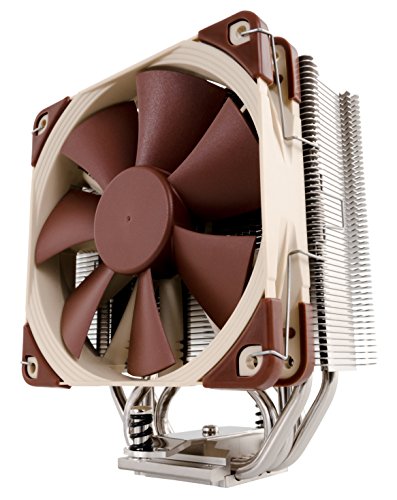
#3: 🎯 Best for Quiet Builds — Noctua NH-U12S
Verdict: Best for quiet builds. A 158 mm single-tower air cooler, $70-90, that runs near-silent and outlives three CPUs. See full details
Specs that matter: 158 mm height · 120 mm NF-F12 PWM fan · ~22 dBA at full speed · five heatpipes · mounting for AM4, AM5, LGA1200, LGA1700 and LGA115x via SecuFirm2.
✅ 158 mm clears the vast majority of mid-towers. This is the whole point of the U12S versus the taller, wider D15 — it fits, and it does not overhang the first DIMM slot, so tall RAM heatspreaders are a non-issue.
✅ Roughly 22 dBA at full tilt. In practical terms, at a normal desk distance under a sustained gaming load, you stop hearing the CPU cooler and start hearing the graphics card. That is the outcome you are paying for.
✅ The mounting kit covers every socket you are likely to own, in either direction. Buy it for an AM4 5800X today, carry it to an AM5 or LGA1700 board later, and Noctua will send you the bracket.
❌ It is a single 120 mm tower. A 250 W overclocked flagship wants more metal — that is D15 or 360 mm AIO territory. ❌ The brown-and-beige fan colourway is divisive if you have a windowed case.
When an air tower beats a 240 mm AIO: at 105 W and below, essentially always. The AIO wins on peak dissipation, but it adds a pump as a failure point, a pump whine as a noise source, and a five-to-seven-year service life. An air tower has one moving part, is trivially replaceable, and does not leak. For a budget build sitting on your desk, the tower is the correct engineering answer, not the compromise.
#4: ⚡ Best Performance — AMD Ryzen 7 5800X
Verdict: Best performance pick. 8 cores, 16 threads, the last big drop-in jump AM4 ever got. $140-180 used, around $225 new. See full details
Specs that matter: 8C/16T · 3.8 GHz base, 4.7 GHz boost · 32 MB L3 · 105 W TDP · Socket AM4 · no bundled cooler.
The 5800X is the value case for AM4 in one part. If you are on a B450 or X570 board with a Ryzen 5 1600, 2600 or 3600, this is a large single-generation Zen 3 IPC jump that requires a BIOS update and nothing else — no new board, no new memory, no reinstall. Tom's Hardware's 5800X review documented the Zen 3 gaming uplift over Zen 2 that makes this worth doing.
✅ The gain shows up in 1% lows, not averages. That is the metric that maps to perceived smoothness. Simulation-heavy and CPU-bound titles — strategy games with big late-game states, open-world titles with dense NPC logic, anything running a heavy physics or netcode thread — improve most.
✅ Drop-in on hardware you already own. Flash the BIOS to a Vermeer-supporting revision before swapping the chip, while the old CPU can still POST. This is the step people skip and then panic about.
✅ 16 threads finally makes background load free. Discord, a browser with forty tabs, and OBS stop stealing frames.
❌ It ships without a cooler and it is thermally dense. The 105 W rating understates what the die actually needs — hence pick #3 on this list. ❌ If you are already GPU-bound, this changes nothing. Re-read Step 0. Buying a CPU to fix a GPU bottleneck is the single most common way readers waste $180.
When this is NOT worth it: if your GPU sits at 99% utilization in the games you actually play, skip this pick entirely and put the money into the card. The 5800X earns its place only when the utilization numbers say the CPU is the ceiling.
#5: 🧪 Budget Pick — Kingston A400 960GB SATA SSD
Verdict: Budget pick. The sub-$65 "get off the hard drive" drive. Honest about what it is. See full details
Specs that matter: 960 GB · up to 500 MB/s read · up to 450 MB/s write · DRAM-less controller · 2.5-inch SATA III.
This is on the list because the gap between a 7200 RPM mechanical drive and any SSD dwarfs the gap between a cheap SSD and a good one. If someone is still loading games off a spinning disk, the A400 is the upgrade that ends that, and it costs less than a month of most subscriptions.
✅ Roughly 100× the random-read IOPS of a mechanical drive. Load times collapse. ✅ Silent, cool, no moving parts — it also makes the whole machine quieter. ✅ Cheap enough to buy alongside something else rather than instead of it.
❌ DRAM-less. There is no dedicated cache for the flash translation layer, so random-write performance under sustained load is well below a DRAM-equipped drive like the BX500. ❌ SLC cache falloff is real. Write tens of gigabytes continuously — a large game install, say — and throughput drops sharply once the cache fills. You will see it during the install, not during play. ❌ Endurance ratings are modest. Fine as a game library that is mostly reads; not a scratch disk.
If the price gap to the BX500 1TB is under $15, take the BX500. The A400 earns its slot when the budget is genuinely fixed and the alternative is staying on the hard drive.
What to look for in a 1440p upgrade
VRAM floor at 1440p
12 GB is the number to plan around. At 1440p with high — not ultra — textures, 8 GB cards begin evicting assets mid-session, which shows up as texture pop-in and frametime spikes rather than a lower average FPS. That is why the frame counter can look fine while the game feels bad. Ray tracing and frame generation both add allocation on top, so an 8 GB card with RT enabled at 1440p is fighting its own memory budget.
CPU 1% lows versus average FPS
Average FPS is a marketing number. The 1% low is the experience. Track both: if your average is comfortably above your monitor's refresh rate but the 1% low is less than half of it, you have a consistency problem, and consistency problems at 1440p are almost always CPU or storage, not GPU.
PSU headroom
Size the supply roughly 150-200 W above the graphics card's rated board power to absorb transient spikes — a 170 W card is comfortable on a quality 550-650 W unit. Modern GPUs draw brief spikes well above their nominal rating, and a marginal supply responds by tripping OCP and rebooting the machine mid-game. If your existing unit is an unbranded OEM supply older than about eight years, replace it regardless of the number on the label.
Case clearance and cooler height
Measure before you order. Cooler height is specified in your case's manual as "maximum CPU cooler height" and the 158 mm NH-U12S clears most mid-towers, but plenty of compact cases stop at 155 mm. Do the same for GPU length and, in slim cases, for the depth behind the front panel. This is the most-missed step in the entire upgrade.
SATA versus NVMe reality check
For gaming specifically, the mechanical-to-SATA jump is transformative and the SATA-to-NVMe jump is marginal. Buy NVMe if you have a free M.2 slot and the price is comparable. Do not buy a PCIe adapter card to add NVMe to an old board — you will likely drop the graphics slot from x16 to x8 to do it, which costs you more than the storage gains.
Upgrade order
GPU → storage → CPU → cooling, adjusted by whatever Step 0 told you. Cooling is last on the list not because it is unimportant, but because it is only urgent once you have installed a CPU that generates enough heat to need it.
Spec-delta table
| Pick | Capacity / cores | Key throughput | Power | Street price | Perf-per-dollar note |
|---|---|---|---|---|---|
| ZOTAC RTX 3060 12GB | 12 GB GDDR6 | 360 GB/s, 3584 cores | 170 W | $170-210 | Highest FPS-per-dollar of the five at 1440p |
| AMD Ryzen 7 5800X | 8C/16T | 4.7 GHz boost, 32 MB L3 | 105 W | $140-180 used | Best 1%-low-per-dollar, only if CPU-bound |
| Crucial BX500 1TB | 1 TB | 540 MB/s read | ~2 W | $55-80 | Best felt-improvement-per-dollar overall |
| Kingston A400 960GB | 960 GB | 500 MB/s read | ~2 W | $45-65 | Cheapest entry off mechanical storage |
| Noctua NH-U12S | 120 mm tower | ~22 dBA at load | 1.4 W fan | $70-90 | No FPS gain; buys silence and sustained clocks |
Common pitfalls
Buying the CPU when you are GPU-bound. The most expensive mistake on this page. Step 0 exists to prevent it. A 99%-utilized graphics card cannot be helped by a faster processor.
Flashing the BIOS after installing the new CPU. On a B450 board shipped before Zen 3 support, the 5800X will not POST on an old BIOS — and you cannot flash from a machine that will not POST unless the board has USB BIOS Flashback. Update first, with the old chip installed.
Reusing a decade-old PSU with a new GPU. It may work for a week. Transient spikes on modern cards trip the over-current protection on tired supplies, and the symptom is a hard reboot mid-session that looks like a driver crash. People spend days debugging drivers for this.
Buying a cooler taller than the case allows. Measured clearance, not eyeballed. A 158 mm cooler in a 155 mm case means the side panel does not close and you are packing it back up.
Filling a DRAM-less SSD to 95% capacity. Write performance on a drive like the A400 degrades sharply as free blocks run out. Leave 10-15% headroom and the drive stays predictable.
When NOT to do any of this
If your board is limited to a quad-core without SMT, only supports DDR3, or has no PCIe 3.0 x16 slot, incremental upgrades stop paying back. Money spent on a CPU and cooler for a dead-end socket is money that should have gone into a current-generation board, CPU and memory — keeping only the graphics card and the storage, which transfer. AM4 is the deliberate exception on this page: it still accepts a large CPU step-up on boards sold years ago, which is exactly what makes it the value platform in this guide. Z390 and LGA1151v2 do not have that property; their ceiling is a 9900K on the used market, which is a sideways move.
Likewise, if you are running a 60 Hz 1080p panel, none of this is your first purchase. Buy the 1440p monitor first — the upgrade you can see is the one attached to your eyes.
Citations and sources
- TechPowerUp — GeForce RTX 3060 specifications database (accessed 2026-08-22)
- Tom's Hardware — AMD Ryzen 7 5800X review (accessed 2026-08-22)
- GamersNexus — NVIDIA RTX 3060 review and benchmarks (accessed 2026-08-22)
This guide is editorial synthesis of published third-party measurements and manufacturer specifications. SpecPicks did not conduct first-party benchmarking for this article; every performance claim traces to one of the sources above.
Related guides
- Best SATA SSD for an Old PC in 2026
- Best CPU Cooler for the Ryzen 7 5800X
- Arc B580 vs RTX 3060 12GB at 1440p
- Ryzen 5 2600 vs Ryzen 7 5800X: the AM4 upgrade
- Kingston A400 vs Crucial BX500
- Best Budget Gaming Peripherals Under $100
— Mike Perry