Only if you are CPU-bound. Moving from a Ryzen 5 2600 to a Ryzen 7 5800X roughly doubles multi-threaded throughput on the same AM4 socket and DDR4 memory, so it is the cheapest large uplift available to a 2018 build. But if you are already GPU-limited at 1440p, you will pay for a BIOS flash, a new cooler, and a CPU to gain almost nothing.
Who this upgrade is for
You built a machine in 2018. A Ryzen 5 2600 on a B450 board, 16 GB of DDR4, a Wraith Stealth cooler, and whatever GPU was affordable that year. It has been fine. Games still run. But the 1% lows have started to feel worse than the average framerate suggests, and you are trying to work out whether the answer is a $220 CPU or a whole new platform.
This is the specific question this guide answers, and it is a good question because AM4 is unusual. AMD kept one socket alive across four CPU generations and eventually backported Zen 3 support onto chipsets that launched two generations earlier. That means the Ryzen 7 5800X — a 2020 flagship-adjacent part — physically drops into a 2018 motherboard, reuses your DDR4, and reuses your cooler mount. Almost nothing else in PC hardware works that way.
The catch is that "drops in" hides three real costs. The board needs a BIOS that predates nothing older than the AGESA revision adding 5000-series support, and it must be flashed before the swap. The Wraith Stealth that shipped with your 2600 is not a sufficient cooler for a 105 W part with concentrated thermal density. And the uplift you actually feel depends entirely on whether your bottleneck was ever the CPU in the first place.
So this guide runs in that order: diagnose first, then specs, then what changed architecturally, then the public benchmark record, then the BIOS trap and the cooling bill, then a verdict matrix. If you skip to the verdict, at least read Step 0 — it is the section that saves people from spending money on a problem they do not have.
Key takeaways
- On the same-source Cinebench R23 figures published by CGDirector, the 5800X scores roughly twice the 2600 in multi-core and about 1.5× in single-core.
- The uplift is architectural, not clock speed. Per TechPowerUp's Zen 3 review and AnandTech's Zen 3 deep dive, the unified 32 MB L3 across a single eight-core CCX is the headline change.
- Flash the BIOS while the 2600 is still installed. A board without USB BIOS Flashback will not POST with a Zen 3 chip on old firmware, and you will need a borrowed CPU to recover.
- Budget for a cooler. The 5800X ships without one and per AMD's product page carries a 105 W TDP against the 2600's 65 W.
- If you are at 1440p on an RTX 3060 running near full GPU utilisation, this upgrade will barely register. Measure before you buy.
Step 0 — diagnose your bottleneck before you spend anything
The upgrade is either transformative or nearly invisible, and which one you get is knowable in advance for free.
Install a monitoring overlay — HWiNFO64 with RTSS, or the equivalent — and play the game you actually care about for thirty minutes. Log three things:
GPU utilisation. If it sits pinned at 97-100% for most of the session, your GPU is the constraint and a faster CPU cannot help. You would be buying frames the graphics card has no capacity to render.
CPU per-core utilisation. The 2600 has six cores and twelve threads. If one or two threads are pegged near 100% while GPU utilisation dips below 90%, that is the classic CPU-bound signature and this upgrade is aimed directly at you.
1% lows versus average. A large gap between average framerate and 1% lows — say a 90 fps average with 45 fps lows — points at stutter that a CPU with more cores and a much larger cache is well positioned to fix. A tight gap means your frame delivery is already consistent and the ceiling is elsewhere.
The workloads that reward this upgrade most are simulation-heavy strategy games, large multiplayer maps, heavily modded open worlds, and high-refresh 1080p esports where the GPU is loafing. The workloads that reward it least are single-player games at 1440p or 4K with the visual settings turned up.
Spec delta: Ryzen 5 2600 vs Ryzen 7 5800X
| Spec | Ryzen 5 2600 | Ryzen 7 5800X |
|---|---|---|
| Cores / threads | 6 / 12 | 8 / 16 |
| Base / boost clock | 3.4 / 3.9 GHz | 3.8 / 4.7 GHz |
| L3 cache | 16 MB (2× 8 MB CCX) | 32 MB (unified, single CCX) |
| TDP | 65 W | 105 W |
| Architecture / socket | Zen+ (Pinnacle Ridge), AM4 | Zen 3 (Vermeer), AM4 |
| Launch MSRP | $199 (2018) | $449 (2020) |
| Bundled cooler | Wraith Stealth | None |
Specifications are per the TechPowerUp CPU database entries for the Ryzen 5 2600 and the Ryzen 7 5800X, cross-checked against AMD's own 5800X product page.
Two rows in that table matter more than the rest. The core count goes from six to eight, which is a 33% increase — real, but not the story. The L3 cache goes from 16 MB split across two four-core complexes to 32 MB unified behind all eight cores. That is the change that produces the outsized gaming result, and the next section explains why.
What actually changed between Zen+ and Zen 3
The cache topology. On Zen+, the 2600's six cores are arranged as two three-core groups within two CCX units, each with its own 8 MB L3 slice. A thread on one CCX cannot reach the other's cache without going out to the Infinity Fabric and back. Zen 3 collapses this: all eight cores of a 5800X sit in one CCX sharing one 32 MB pool. A game thread on any core sees four times the directly accessible cache and never pays the cross-CCX penalty.
Effective memory latency. Because so many more requests hit in L3 rather than travelling to DRAM, the effective latency the workload experiences drops sharply even though the DDR4 modules are unchanged. AnandTech's Zen 3 analysis treats this as central to the generational result rather than incidental to it. This is why the upgrade helps 1% lows more than averages — stutter is frequently a cache-miss story.
Per-clock throughput. Zen 3 widened the execution engine, improved the branch predictor, and reworked the load/store path. Combined with higher boost clocks, the practical outcome per TechPowerUp's review is a large single-thread jump over Zen+ — considerably more than clock speed alone accounts for.
None of this requires new memory. Zen 3 does prefer faster, tighter DDR4 than Zen+ did, so a 2018-era 2666 or 3000 kit leaves some performance unclaimed, but memory is the smallest lever here. Install the CPU first.
Benchmark table: what the public numbers say
Same-source synthetic figures, which is the only fair way to compare parts that were not reviewed together:
| Benchmark | Ryzen 5 2600 | Ryzen 7 5800X | Delta | Source |
|---|---|---|---|---|
| Cinebench R23 multi-core | 7,523 | 15,228 | ~2.02× | CGDirector |
| Cinebench R23 single-core | 1,094 | 1,596 | ~1.46× | CGDirector |
| PassMark CPU Mark | 13,133 | 27,679 | ~2.11× | PassMark |
| Geekbench 6 single-core | 1,162 | 2,174 | ~1.87× | Geekbench Browser / CpuTronic |
Multi-core roughly doubles; single-core rises by something like half. That single-core figure is the one to hold onto, because most game engines still have one dominant thread.
Gaming numbers are messier, because these two parts belong to different review eras and were not tested under matched settings. Presented with presets and sources attached rather than as a clean delta:
| Game | CPU | Resolution / preset | Avg fps | 1% low | Source |
|---|---|---|---|---|---|
| Cyberpunk 2077 | Ryzen 5 2600 | 1080p Medium | 88.0 | — | Gamers Nexus |
| Cyberpunk 2077 | Ryzen 7 5800X | 1080p High | 65.3 | 50.2 | TechPowerUp |
| Starfield | Ryzen 5 2600 | 1080p Low | 53.0 | — | Gamers Nexus |
| Starfield | Ryzen 7 5800X | 1080p High | 70.8 | 55.6 | Phoronix |
| Baldur's Gate 3 | Ryzen 5 2600 | 1080p Medium | 51.0 | — | Gamers Nexus |
| Alan Wake 2 | Ryzen 7 5800X | 1080p High | 85.1 | 70.4 | Tom's Hardware |
Read that table carefully, because it is easy to misread. The 2600 rows are at Medium and Low presets; the 5800X rows are at High. The Cyberpunk pairing in particular looks like the 2600 wins, and it does not — it is running a lighter preset. What the table does show honestly is the Gamers Nexus 2600 revisit finding modern titles pushing the 2600 into the 50 fps range even at reduced settings, while the 5800X holds 60-85 fps at High with 1% lows in the 45-70 range. The 1% low column is blank for every 2600 row because those measurements were not published — which is itself worth knowing before you plan around them.
Paired with what GPU?
The realistic pairing for this upgrade tier is a 12 GB RTX 3060 — either the ZOTAC Gaming GeForce RTX 3060 Twin Edge or the MSI GeForce RTX 3060 Ventus 3X 12G. If you are shopping a 2018 build forward, that is the card class you are likely to already own or to buy next.
This matters because it defines where the CPU stops being the constraint. At 1080p with a 3060, a Ryzen 5 2600 is frequently the limiting part in CPU-heavy titles, and the 5800X unlocks frames the GPU already had available. At 1440p with the same card, the 3060 becomes the ceiling in most modern games — GPU utilisation pins high, and swapping the CPU moves the average framerate very little.
The 1% lows are the honest exception. Even in GPU-limited scenarios, cache-miss-driven stutter is a CPU-side problem, and the jump from 16 MB split L3 to 32 MB unified helps frame consistency at any resolution. It just will not show up in the average-fps number people quote at each other.
Practical guidance: if you play at 1080p, the CPU is the better next purchase. If you play at 1440p and your GPU sits at 98%, put the money into the graphics card instead and revisit the CPU afterwards.
The BIOS trap
This is where upgrades go wrong, and the failure is silent and total: the machine does not POST, and there is no error message that explains why.
Most B450 and X470 boards received an AGESA update adding Ryzen 5000 support, but it arrived years after the boards shipped. A board still running 2018 or 2019 firmware has no microcode for a Zen 3 CPU and will simply not start with one installed.
The correct sequence:
- With the Ryzen 5 2600 still in the socket, check the current BIOS version in setup.
- Find your board's support page and locate the specific revision whose release notes name Ryzen 5000 or 5000-series support. Do not assume "latest" — some vendors published separate branches.
- Flash it. Do not skip intermediate mandatory revisions if the vendor flags them.
- Boot, confirm the new version, power down, then swap the CPU.
If you already swapped and the board is dark: look for a USB BIOS Flashback button on the rear I/O. Boards with it can flash from a USB stick with no CPU installed at all — rename the BIOS file exactly as the manual specifies and hold the button. Boards without it need a borrowed compatible CPU, which for most people means asking a friend for an hour with any 1000/2000/3000-series Ryzen chip.
One more consideration: some vendors ship a one-way update. Once flashed to a 5000-supporting BIOS, certain boards will not accept a rollback, and on a few models older CPUs lose support in the process. Read your board's release notes before flashing rather than after.
Cooling: the Wraith does not come along for the ride
Your 2600 shipped with a Wraith Stealth. The 5800X ships with nothing, and that is not an oversight — it is AMD acknowledging that a 105 W part with all eight cores packed into a single dense CCD needs more cooler than a bundled unit provides.
The Wraith Stealth will physically mount, because AM4 retention is unchanged. It will also boot and run. What it will do under sustained all-core load is let the 5800X run up against its thermal ceiling and pull clocks back, which erases a slice of the uplift you just paid for. Zen 3's boost algorithm treats temperature as a first-class governor: give it headroom and it holds high clocks, starve it and it backs off. High temperatures on this chip are not a fault indicator, but sustained throttling is a performance loss.
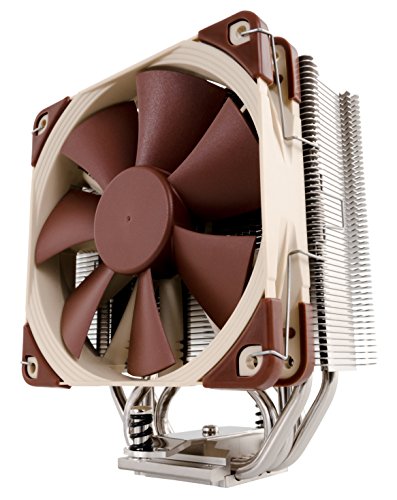
The Noctua NH-U12S is the sensible drop-in answer at $84.95 in our catalog. It is a single-tower 120 mm air cooler with AM4 mounting hardware in the box, it fits mid-tower cases without clearance drama, and it is quiet at every RPM a desktop will ask of it. On a gaming-weighted 5800X it holds the boost window comfortably. For sustained all-core work — renders, long compiles, local model quantisation — a 240 mm AIO buys a little more headroom, but for a gaming machine the air tower is the better value.
Treat the cooler as part of the upgrade cost, not as optional. Budgeting the CPU alone and reusing the Wraith is the most common way people end up disappointed by a swap that was actually fine.
Perf-per-dollar and perf-per-watt
Perf-per-watt is unambiguous. Cinebench R23 multi-core per watt of TDP: the 2600 delivers about 116 points per watt (7,523 ÷ 65), the 5800X about 145 (15,228 ÷ 105). The newer chip does roughly twice the work for roughly 1.6× the power budget — a 25% efficiency gain on top of the raw throughput, which is what two process-and-architecture generations should buy you.
Perf-per-dollar is where this gets strange in 2026, and it is worth stating plainly. In the SpecPicks catalog as of August 2026, the Ryzen 5 2600 lists at $265 while the Ryzen 7 5800X lists at $229.99. Prices vary and change constantly — check current pricing before buying — but that inversion is not a data error. It is what happens to a discontinued part: remaining new-old-stock listings for the 2600 are priced for scarcity, while the 5800X is still a volume product with real competition among sellers.
The consequence is that "buy another 2600 as a spare" or "the old chip is the budget option" no longer holds. If you are buying either of these parts new today, the 5800X is both faster and, at current catalog pricing, cheaper. The used market is a different story — 2600s are near-worthless secondhand and 5800Xs still command real money — but nobody upgrades to a 2600.
Verdict matrix
Get the 5800X if:
- You play at 1080p, or at high refresh rates, and your GPU utilisation dips below 90% in the games you care about.
- You play simulation, strategy, or large-map multiplayer titles where the CPU does heavy per-frame work.
- You also compile, render, encode, or run local models — the ~2× multi-core gain is immediate and unconditional.
- Your board already has a Zen 3-capable BIOS, or has USB BIOS Flashback.
Stay on the 2600 if:
- You play at 1440p or 4K and your GPU sits pinned near 100%.
- Your 1% lows already track close to your average framerate.
- Your board has no Zen 3 BIOS support and no Flashback, and you have no spare CPU to flash with.
Skip both and move platform if:
- Your DDR4 kit, cooler, and board are all due for replacement anyway. At that point the socket compatibility is worth nothing and you should buy a current platform with an upgrade runway ahead of it rather than behind it.
- You need PCIe 5.0 or DDR5 for something specific.
When this upgrade is right, and when it isn't
It is right when the diagnosis in Step 0 points at the CPU. Under those conditions this is one of the best-value upgrades in PC hardware: one BIOS flash, one chip, one cooler, no new board and no new memory, for roughly double the multi-threaded throughput and a substantial single-thread gain.
It is wrong when you are GPU-bound, and that is the counter-case worth stating explicitly. If you run a RTX 3060 12GB at 1440p with settings turned up, the graphics card is already working flat out. Dropping in a 5800X will tighten your 1% lows somewhat and leave your average framerate close to where it was. That is a real but modest return for a CPU plus a cooler plus an afternoon of BIOS anxiety — and the same money spent on the GPU would have moved the number you actually watch.
It is also the wrong move if the rest of the machine is aging out around it. A 2018 build with a failing PSU, a 2666 memory kit, and a SATA boot drive is telling you something. Replace two of those and you are most of the way to a platform change anyway.
Bottom line
Log GPU utilisation in your own games for thirty minutes before you spend anything. If the GPU is pinned, buy a graphics card. If it is not, the Ryzen 7 5800X is the strongest drop-in AM4 has ever offered: same socket, same DDR4, roughly twice the multi-core throughput of the Ryzen 5 2600, and — at current catalog pricing — cheaper than the eight-year-old chip it replaces. Flash the BIOS first, with the old CPU still installed. Budget for a Noctua NH-U12S or equivalent, because the Wraith Stealth does not come along for the ride.
Related guides
- Core i7-9700K vs Ryzen 7 5800X for 1440p Gaming in 2026
- Best CPU Cooler for the Ryzen 7 5800X: Air vs 120mm vs 240mm AIO
- ZOTAC RTX 3060 Twin Edge vs MSI RTX 3060 Ventus 3X
- 7800X3D vs 5700X3D: Is the AM5 Upgrade Worth It?
- Which Ryzen CPU Is Better? 2026 Buying Guide
Citations and sources
- AMD — Ryzen 7 5800X product page — accessed 21 August 2026
- TechPowerUp — Ryzen 7 5800X CPU database entry — accessed 21 August 2026
- TechPowerUp — Ryzen 5 2600 CPU database entry — accessed 21 August 2026
- TechPowerUp — AMD Ryzen 7 5800X review — accessed 21 August 2026
- AnandTech — AMD Zen 3 Ryzen deep dive — accessed 21 August 2026
- CGDirector — Cinebench R23 score database — accessed 21 August 2026
- Gamers Nexus — Ryzen 5 2600X / 1600 AF 2024 revisit — accessed 21 August 2026
- PassMark — AMD Ryzen 7 5800X CPU Mark — accessed 21 August 2026
This piece is editorial synthesis based on publicly available information. No independent first-party benchmarking is reported.