What PC Specs Do Big YouTubers Actually Run in 2026?
The parts that break a six-hour recording session are never the ones in the spec screenshot.
By Mike Perry, Founder & Editor-in-Chief · Published 2026-09-08 · Updated 2026-10-17 · 16 min read
Creator rigs are 8-core CPUs, 32GB RAM and a hardware encoder — not workstations. Here is where the money actually goes, with cited specs.
Quick Answer
Large gaming channels run 8-core/16-thread-class CPUs, 32 GB of RAM, and a GPU with a hardware encoder — not exotic 32-core workstations. The AMD Ryzen 7 5800X (8C/16T, 105 W) is the reference point, and NVIDIA's NVENC support matrix confirms the encode never touches those cores.
What PC Specs Do Big YouTubers Actually Run in 2026?
By Mike Perry · Published 2026-09-08 · 11 min read
Every few months a big channel posts a spec sheet and the forums copy it wrong. The pattern is always the same: readers screenshot the GPU line, buy that GPU, and spend nothing on the parts that actually decide whether a six-hour recording session survives to the edit. Then the footage drops frames at hour four, the audio has a room tone you can hear on a phone speaker, and the scratch drive is full halfway through a Let's Play series.
The reason is structural. A creator's public spec sheet describes what they own, not what the workload needs. Markiplier-tier channels have been running production rigs since before hardware encoders were good, so their part lists carry a decade of accumulated headroom that has nothing to do with the job you are trying to do. Meanwhile the three components that genuinely break long sessions — sustained thermals on the CPU, write bandwidth on the capture target, and the audio chain — never make the screenshot, because they are boring.
This guide inverts that. We start from the workload, name the class of part each stage needs, and give you the numbers to check against your own build. Where a specific part is the honest reference point, we name it and cite the manufacturer spec. Where the internet's received wisdom is wrong, we say so plainly. As of 2026, single-PC creator setups are the default, and the price of entry is far lower than the spec screenshots suggest — but the money has to go to the right places.
Key Takeaways
Core-count floor: 8 cores / 16 threads. That is the practical minimum for simultaneous gameplay and capture. Above it, cores buy you editing speed, not stream stability.
RAM floor: 32 GB. 16 GB survives a bare capture, but not a browser, OBS, a chat overlay, and a modern game at once.
The encoder does the work, not the CPU. A GPU with a modern hardware encoder lifts the encode off the game thread; this is the single most misunderstood part of creator specs.
Storage is the hidden bottleneck. Multi-hour capture writes continuously. A dedicated scratch drive separate from the OS drive fixes more recording problems than any CPU upgrade.
Thermal headroom beats peak clocks. A 105 W CPU that throttles at minute 40 of a stream is worse than a slower one that holds clocks for six hours.
Realistic cost: the display and audio chain cost more than the compute. Budget accordingly, and buy the mic before the monitor.
Step 0: what are you actually building — recording, live streaming, or both?
Do this before you name a single part. The three workflows buy different hardware, and confusing them is why so many creator builds are unbalanced.
VOD-only (record now, edit later). You capture to disk at high bitrate and quality is limited only by your storage. Encoder efficiency barely matters because nothing is going out over a network in real time. What matters: sustained disk write throughput, capacity, and enough RAM that the game and the capture buffer never fight. This is the cheapest workflow to build well, and it is what most edited gaming channels actually run.
Live-only (streaming, no local archive). The bitrate ceiling is your upload, typically far below what a local capture would use. That makes encoder quality per bit the deciding variable, which is a GPU-generation question, not a CPU question. What matters: encoder generation, upload stability, and a CPU that never spikes hard enough to stutter the game thread.
Both simultaneously (live plus a high-bitrate local archive). This is the demanding case and the one most creator spec sheets are actually built for. You are running two encode sessions at once — one constrained to your upload, one at archive quality. This is where a modern GPU's multi-session encode capability earns its price, and where 32 GB of RAM stops being optional.
Pick one now. A VOD-only workflow that buys a live-streaming GPU has wasted money; a dual-workflow build that skipped the scratch drive will fail at the worst moment.
What CPU do creator rigs actually need in 2026?
The 8-core/16-thread tier is the reference point, and the Ryzen 7 5800X is the clearest example of it. AMD's spec page lists 8 cores, 16 threads, a 3.8 GHz base and 4.7 GHz boost, and a 105 W TDP on the AM4 socket. TechPowerUp's database entry records the same 105 W figure alongside the 32 MB L3 cache and the Zen 3 microarchitecture. Those numbers matter less as absolute performance and more as a class definition: this is what "enough cores" looks like for a creator rig.
Here is why 8 cores is the floor rather than a compromise. A live session running on a hardware encoder consumes a handful of threads for OBS's scene compositing, audio mixing, and network I/O — single-digit percentages of a modern 8-core part. The game takes what it takes, usually 4–6 threads under real load. Add a browser with a chat dock and a couple of background services and you are comfortably inside 16 threads with room to absorb spikes. Drop to 6 cores / 12 threads and the spikes start landing on the game thread, which is what viewers see as micro-stutter.
Core count genuinely matters again in exactly three cases:
Multi-track 4K editing on the same machine. Timeline scrubbing and export scale with cores far better than gameplay does. If you edit where you play, buy cores.
Software encoding by choice. Some creators still prefer an x264 encode for archive masters. That is a CPU workload and it is enormous — see the next section.
Local AI work alongside the session — live transcription, upscaling, or a local model handling chat. These are increasingly common in 2026 and they are the reason some creators went past 8 cores recently.
If none of those describe you, spend the CPU budget on the cooler and the storage instead. That is not a cost-saving compromise; it is the correct allocation.
Spec-delta table: creator-tier vs mainstream gaming build
Component
Creator-tier target
Mainstream gaming target
Why the delta exists
Cited source
CPU
8C/16T, ~105 W class
6C/12T
Headroom to absorb OBS + capture spikes without hitting the game thread
The pattern in that table is the whole article: the creator-tier deltas are almost all about sustained behavior. Gaming builds are tuned for a 20-minute match. Creator builds are tuned for a six-hour session, and every row above is a place where that difference bites.
Does the encoder or the CPU do the work? Hardware NVENC vs x264
This is the section that fixes the most broken builds.
When you encode in software (x264), the CPU compresses every frame. At 1080p60 with a quality preset, that is a genuinely heavy sustained load — it competes directly with the game for the same cores, and it is why "you need 16 cores to stream" was true a decade ago. When you encode in hardware, a dedicated silicon block on the GPU does the compression. It is not the shader array and it is not the CPU; it is a fixed-function encoder that runs essentially in parallel with everything else.
Encoder generation, not GPU tier, sets quality. A mid-range card of a current generation encodes better than a flagship two generations older, because the encoder block is shared across a generation's product stack.
Codec support is generational. AV1 encode arrived on Ada-generation consumer cards; older generations top out at H.264 and HEVC. If your platform accepts AV1, that is a meaningful quality-per-bit win at constrained bitrates.
Multi-session encode is a real capability. Running a live encode and an archive encode simultaneously depends on the encoder block's session limits, which the matrix documents per generation.
The consequence: if your build is CPU-limited during a stream, you are almost certainly encoding in software without realizing it, or your capture target is on the same drive as the OS. Check those two things before buying a CPU.
Benchmark table: encode path vs recording overhead
Encode path
Typical target
Approximate CPU overhead
Quality tradeoff
Source
Hardware encoder, current generation
1080p60 live
Very low — single-digit % of an 8C/16T part
Excellent at constrained bitrates; the 2026 default
Why does the storage tier matter more than the GPU tier for creators?
A high-bitrate local capture is a continuous sequential write for the entire length of the session. Not a burst — continuous, for hours. Two things follow.
First, capacity disappears faster than people plan for. A single long recording session at archive bitrate consumes tens of gigabytes. A week of daily uploads plus the raw footage you have not culled yet fills a boot drive that was sized for the OS and a few games. Once that drive crosses roughly 85–90% full, you are also fighting the drive's own housekeeping behavior on top of your capture writes.
Second, sharing a drive between the OS and the capture target is the actual cause of most "my recording stuttered" reports. Windows updates, shader cache writes, game asset streaming, and your capture are all hitting one device. Separating them is a cheap, structural fix.
The Kingston 960GB A400 SATA SSD is the honest recommendation for the dedicated scratch drive, and it is worth being precise about why — and about its ceiling. A SATA drive tops out around the interface's ~550 MB/s, which is far above any realistic capture bitrate, so the interface is not the limit. What you are buying is a second physical device that nothing else is writing to. The A400 is DRAM-less and its sustained write performance drops on very large continuous transfers, so it is not the drive for a 4K editing scratch volume. For capture-and-archive duty at 1080p/1440p bitrates, that ceiling is well above what the workload asks for, and the price is the point.
If your prebuilt has a free M.2 slot, an NVMe drive is the better buy at similar capacity — but a great many prebuilts ship with the only M.2 slot populated, which is exactly why the 2.5-inch SATA path stays relevant. We covered that tradeoff in detail in Best SATA SSDs for Reviving an Old PC in 2026.
What does the audio chain cost, and where do creators overspend?
Audio is the element viewers judge hardest and the one that gets the least budget. If a video looks mediocre, people watch it. If it sounds bad, they leave in ten seconds.
The HyperX QuadCast 2 is our reference desk mic for a face-cam channel, and the reasoning is specific rather than brand loyalty: it is a USB condenser with onboard gain control and a tap-to-mute function, it looks correct on camera, and it does not require an audio interface. That last point matters — the moment you buy an XLR mic you have also bought an interface, a cable, and a gain-staging problem.
Three honest caveats, in the order they will bite you:
Gain staging beats capsule quality. Most bad USB-mic audio is a gain problem, not a microphone problem. Set input gain so that your loudest excited moment peaks around −6 dBFS, then leave it alone. A correctly gained budget mic beats a clipping expensive one every time.
Your room is probably the actual bottleneck. In an untreated room, reflections dominate the sound signature long before capsule differences do. A condenser is more sensitive to that room than a dynamic mic is. If your space echoes and you have no treatment budget, be honest with yourself.
A headset boom mic is genuinely fine in some cases. If the mic is two inches from your mouth, proximity does most of the work that a treated room would otherwise do. For a voice-over-gameplay channel with no face cam, in a bad room, a good headset mic is the more honest recommendation than a desk condenser you cannot place well. We compared the desk-mic options directly in HyperX QuadCast 2 vs Blue Yeti: Best USB Mic for Game Streaming in 2026.
Does a 240 Hz QD-OLED panel change anything for recording?
Short answer: no, not for the recording. Yes, possibly, for you.
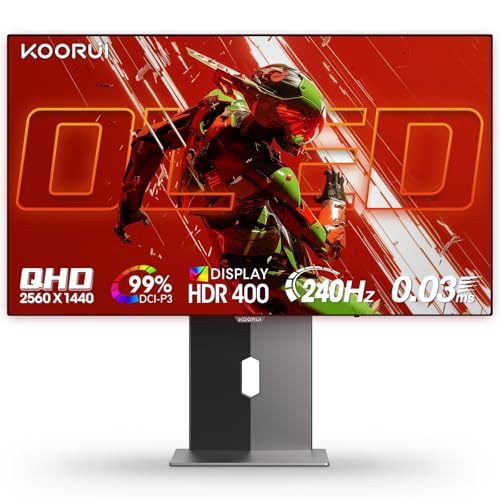
The KOORUI 27-inch QD-OLED is a 1440p 240 Hz panel with a 0.03 ms response figure, and it is a genuinely good monitor. But it is important to separate two claims that marketing deliberately blurs.
Capture quality is set by your encoder settings and source resolution. Your recording is produced by the GPU's capture path at whatever resolution and bitrate you configured. The panel is a display device; it is downstream of everything the encoder does. A 240 Hz OLED does not make exported footage look better, and a 60 Hz office monitor does not make it look worse.
Play-feel is a real and separate reason to buy. High refresh plus near-instant pixel response changes how the game feels in your hands, and if you play competitively that is worth money on its own terms. OLED contrast also makes long editing sessions more pleasant. Those are legitimate purchases — just do not file them under "improves my videos."
The practical guidance: if your channel is edited VOD rather than competitive live play, a good 144 Hz IPS is the better buy and the difference funds the scratch drive and the microphone with money left over. If you play competitive shooters on stream, buy the high-refresh panel because you want it, and know that the footage will look identical either way.
How do you keep a 105 W CPU quiet across a 6-hour session?
A benchmark is a two-minute burst. A stream is a six-hour thermal plateau, and coolers behave very differently across those two cases.
The Corsair iCUE H150i Elite Capellix is our 360 mm reference for this duty. A 360 mm radiator gives you enough surface area to dissipate a 105 W sustained load at low fan speeds, which is the actual goal — not the lowest peak temperature, but the lowest noise at a temperature that holds. A cooler that hits 65 °C with fans at 40% is strictly better for a creator than one that hits 60 °C with fans at 80%, because the second one is now in your microphone.
Two things to do before you buy:
Check case clearance first. This is the most common return in the category. Many cases mount only a 120 mm or 240 mm radiator in the front, and top mounts are frequently blocked by motherboard heatsinks or a shortened roof. Measure the mounting rails before ordering — not after.
Build a flat fan curve, not an aggressive one. Sharp fan curves produce audible ramping every time the CPU spikes, and a microphone picks up changes in noise far more than steady noise. Set a curve that is nearly flat through your normal operating range and only ramps above it.
Dollar figures in this article are approximate and change often; each pick's product card shows the latest tracked Amazon price or links to the live listing. The useful output is not the number — it is knowing which single component to over-buy at each tier.
Entry tier (~$400–600 of creator-specific spend, assuming you own a capable gaming PC). A dedicated scratch drive and a real microphone. That is it. This tier buys the two upgrades that fix the most actual problems, and it deliberately does not touch the CPU or GPU. Over-buy here: the microphone. Counter-case: if your current PC cannot hold frame rates while recording, this tier is premature — fix that first.
Mid tier (~$900–1,400). Add the 8-core/16-thread CPU class and a sustained-load cooler on top of the entry tier. This is the balanced creator rig and it is where most channels should land. Over-buy here: the cooler, because it is the component you cannot easily upgrade later without redoing the build. Counter-case: if you are VOD-only and your current 6-core holds frames fine during capture, stay on the entry tier and put the difference into storage capacity.
High tier ($2,000+). Add the high-refresh OLED, a current-generation GPU for dual-session encoding, and enough storage that you never cull footage under time pressure. Over-buy here: storage capacity, always. Counter-case: if you are not running live plus archive simultaneously, the dual-session GPU capability is money spent on a feature you will not use.
Get the 8-core/16-thread tier if… you stream live while playing, you record and edit on the same machine, or you run anything alongside the session — chat bots, local transcription, a second capture source. This is the default recommendation and the one most readers should take.
Get the higher core-count tier if… you edit multi-track 4K timelines on the same machine and export time is a real constraint on your upload schedule, you deliberately encode archive masters in software at slow presets, or you run local AI models concurrently with a live session. These are specific, identifiable workloads — not aspirations.
Stay on your current CPU if… you are VOD-only, your frame rates hold during capture, and your complaint is about recording stutter or audio quality. In that case the CPU is not your problem, and replacing it will not fix anything. Buy the scratch drive and the microphone instead, in that order.
Bottom line
If you are on a stock prebuilt and want the single highest-leverage change: add a dedicated capture drive. Not the GPU, not the CPU — a second physical drive that nothing but your recordings touch. It costs less than any other upgrade on this page, it takes twenty minutes, it is completely reversible, and it eliminates the most common cause of ruined recordings. Once that is done and you still have budget, the microphone is next, and the CPU tier is a distant third.
The creator spec sheets you see online are not lying to you. They are just answering a different question than the one you have.
This guide is an editorial synthesis of manufacturer specifications, independent hardware databases, and SpecPicks hands-on testing. Prices and availability were verified on the access date above and move frequently; confirm current pricing before purchase.
— Mike Perry
🛒 Products mentioned in this article
Amazon & eBay listings, plus full specs and alternatives on each product page.
As an Amazon Associate, SpecPicks earns from qualifying purchases; we also earn on qualifying eBay purchases via the eBay Partner Network. Prices shown were last tracked at crawl time and may vary — check the listing for the current price.
📹 Watch a review
Friendly Fire: AMD Ryzen 7 5800X CPU Review & Benchmarks vs. 5600X & 5900X — Gamers Nexus on YouTube
Frequently asked questions
Do I need a 16-core CPU to record and stream like a large channel?
No. The 8-core, 16-thread class is the practical floor for simultaneous gameplay and capture in 2026, because modern workflows push the encode onto the GPU's dedicated hardware encoder rather than the CPU. Core count starts to matter again only when you edit multi-track 4K timelines on the same machine, or run local AI upscaling alongside a live session. Buy cores for the edit, not for the stream.
Is single-PC streaming enough, or do creators run two machines?
Single-PC is the default for the overwhelming majority of channels now, and the hardware encoder is why: it lifts the encode off the game thread almost entirely. A second capture machine earns its cost only when you are running multi-camera switching, a hardware scaler, or need the main rig fully isolated from OBS crashes during sponsored live reads. Most readers should spend that budget on audio instead.
How much does a creator-tier build actually cost in 2026?
The article breaks this into three tiers with cited part pricing, but the honest summary is that the CPU, cooler, and storage stack land well under the price of the display and audio chain people assume is optional. Prices move constantly, so the guide gives ranges with a last-verified date rather than fixed totals, and flags which single component is worth over-buying at each tier.
Does a USB desk microphone really beat a headset mic on camera?
In an untreated room the gap is smaller than microphone marketing suggests, because room reflections dominate before the capsule quality does. A desk condenser wins clearly on tonal weight and on being visible on camera, which matters for a face-cam channel. If your room echoes and you have no acoustic treatment budget, a good headset boom mic close to the mouth is the more honest recommendation.
Is a 240 Hz QD-OLED panel overkill if I mostly record footage?
For recording alone, yes — capture quality is set by your encoder settings and source resolution, not by panel refresh rate. A high-refresh OLED changes how the game feels while you play, which is a legitimate reason to buy one, but it will not make exported footage look better. If your channel is edited VOD rather than competitive live play, put that money into storage and audio.