Introduction: who this comparison is for
This piece is for builders who already own one 12 GB card, most often an RTX 3060, and want to run Meta's Llama 3.3 70B at home. You can spend the next few hundred dollars on a second GPU, or on system RAM so a Ryzen 7 5800X host carries the layers the card can't hold.
Llama 3.3 70B is worth the effort. Meta released it on December 6, 2024 with a 128k context window, per the official model card. It remains a strong dense 70B-class model that runs on llama.cpp, Ollama and LM Studio without special builds. It is also big: the model configuration lists 80 transformer layers, a hidden size of 8,192 and 8 key-value heads. Every generated token has to read most of those weights from memory.
Both upgrade paths use parts you can buy today. A second card such as the MSI Gaming GeForce RTX 3060 12GB or the ZOTAC Gaming GeForce RTX 3060 Twin Edge OC 12GB is sold new, and used RTX 3060 cards traded at about $295 on eBay as of September 12, 2026, per getpcparts' sold-listing tracker. On the CPU side, the AMD Ryzen 7 5800X is a common AM4 host with 8 cores, 16 threads, a 105 W TDP and official DDR4-3200 support, per AMD's product page.
This article is editorial synthesis. No first-party testing is reported. Every throughput figure below either comes from a linked public benchmark or is labelled as an estimate, with the arithmetic shown so you can check it against your own hardware.
Key takeaways
- Q4_K_M needs 42.52 GB for weights alone, per bartowski's GGUF file list. That is about 18.5 GB more than two 12 GB cards hold.
- CPU-only generation is capped near 1.2 tok/s. A Ryzen 9 5950X with DDR4-3600 generated Llama 3 70B Q4_K_M at 1.21 tok/s and processed prompts at about 10 tok/s, per llamafile discussion #450.
- Two RTX 3060s give 720 GB/s of combined memory bandwidth (2 × 360 GB/s, per the GeForce RTX 30 series spec table). Dual-channel DDR4-3200 gives about 51.2 GB/s (2 × PC4-25600, per Wikipedia's DDR4 entry).
- Full-VRAM 70B on two 3060s means IQ2_XS (21.14 GB). On Llama 3 70B that quant adds +103% perplexity over FP16, while Q4_K_M adds +4.83%, per the perplexity table in XiongjieDai's benchmark repo.
- The fast reference is 48 GB of VRAM. Two RTX 3090s generated Llama 3 70B Q4_K_M at 16.29 tok/s, per the same repo. A single 24 GB card ran out of memory.
How much VRAM does Llama 3.3 70B actually need?
Weights come first, then the KV cache, then a compute buffer. File sizes below are summed from bartowski's Llama 3.3 70B GGUF repository. Quality deltas are Llama 3 70B wiki.test perplexity versus FP16, taken from the table in XiongjieDai's benchmark README. Llama 3 70B shares Llama 3.3 70B's architecture.
The KV cache is easy to calculate from the config.json: 80 layers × 8 KV heads × 128 head dimension × 2 (keys and values) × 2 bytes at FP16 = 327,680 bytes per token. That is about 1.34 GB at 4k context, 5.24 GB at 16k and 10.5 GB at 32k.
| Quant | Weights file | Weights + 4k KV (approx.) | What it fits on | Perplexity vs FP16 (Llama 3 70B) |
|---|---|---|---|---|
| IQ2_XS | 21.14 GB | ~22.5 GB | Two RTX 3060 12GB, fully in VRAM at short context | +103.07% |
| Q2_K | 26.38 GB | ~27.7 GB | Two 3060s plus a few GB of system RAM | +68.73% |
| Q3_K_M | 34.27 GB | ~35.6 GB | Two 3060s plus ~12 GB RAM, or 64 GB RAM CPU-only | +18.75% |
| Q4_K_M | 42.52 GB | ~43.9 GB | Two 3060s plus ~20 GB RAM, or 64 GB RAM CPU-only | +4.83% |
| Q5_K_M | 49.95 GB | ~51.3 GB | 64 GB RAM system with GPU offload | +1.23% |
| Q6_K | 57.89 GB | ~59.2 GB | 96 GB RAM class, or 64 GB with two 3060s carrying layers | +0.47% |
| Q8_0 | 74.98 GB | ~76.3 GB | 96-128 GB RAM class | +0.03% |
| FP16 | 141.12 GB | ~142.5 GB | Not practical on either path | baseline |
Plan for roughly 1 GB per card on top of this for CUDA context and compute buffers. That overhead is why IQ2_XS at 4k context is about the largest 70B quant that stays fully on two 12 GB cards.
Path A: two 12GB cards — what a 24GB split gets you
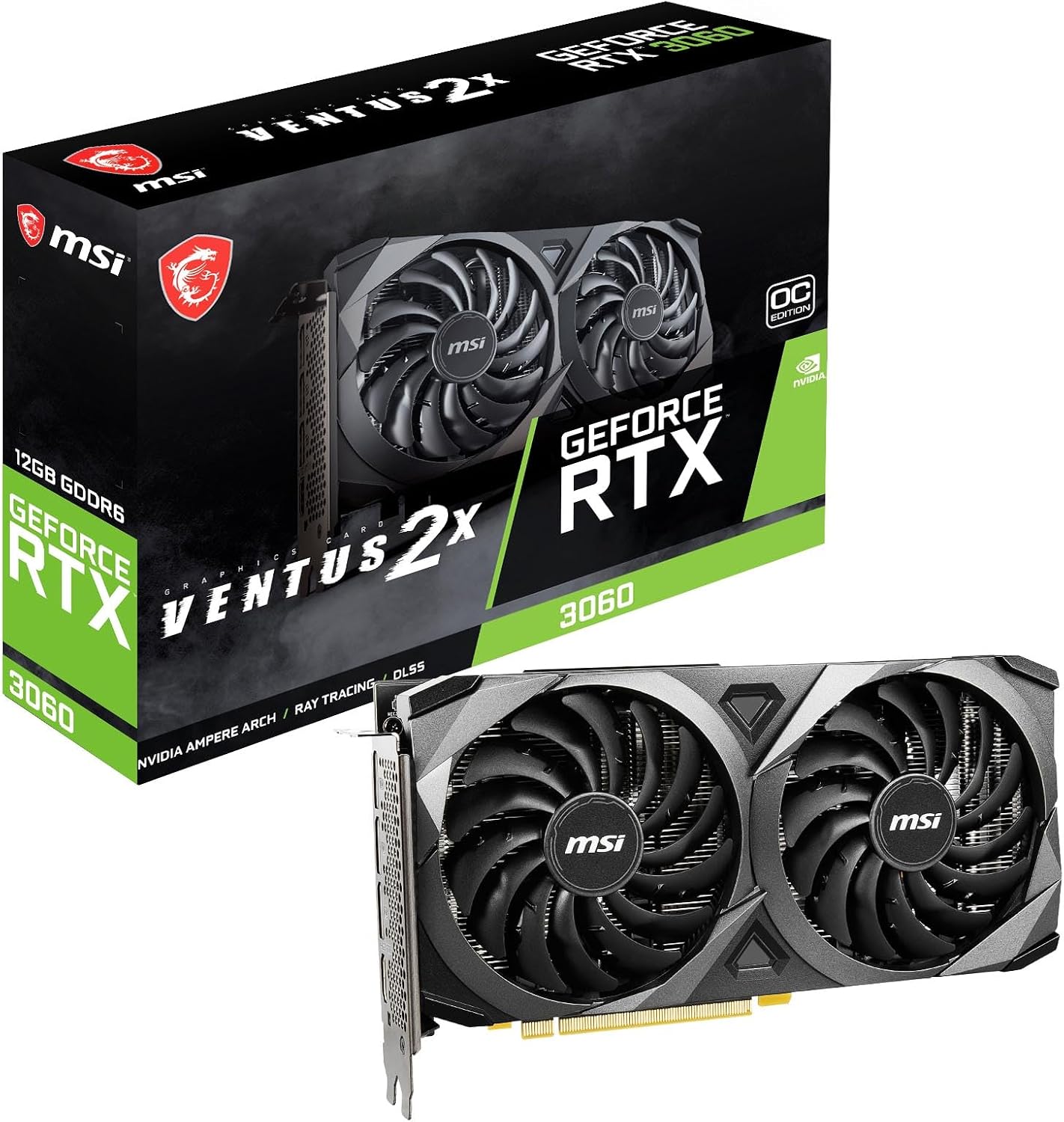
Path A adds a second RTX 3060 12GB, so llama.cpp can put half the layers on each card. The two concrete cards here are the MSI Gaming GeForce RTX 3060 12GB (Torx twin-fan cooler) and the ZOTAC Gaming GeForce RTX 3060 Twin Edge OC 12GB, a shorter card that is easier to fit next to a first GPU. Both use the same RTX 3060 12 GB silicon: 192-bit GDDR6, 360 GB/s memory bandwidth and a 170 W board power, per the RTX 30 series spec table.
How the split works. llama.cpp's default multi-GPU mode is --split-mode layer, pipeline parallelism where "each GPU holds a contiguous slice of layers", per the llama.cpp multi-GPU documentation. The same document says layer mode "can tolerate slow interconnect speeds between GPUs". That matters because only a small activation tensor crosses the bus between the two halves of the model.
PCIe x8/x8 versus x16/x4. Many B550 and X570 boards wire the second full-length slot as x4 from the chipset. For a single RTX 3060, lanes barely matter. A published comparison measured Llama 3 8B Q4_K_M at 55.02 tok/s generation on a PCIe x1 mining riser versus 57.01 tok/s at x16, and 1,531 versus 1,581 tok/s for 1,024-token prompt processing, per this RTX 3060 x1 vs x16 gist. The gap is only about 3%. A x4 second slot is fine for layer-split generation, but it slows model loading and any mode that syncs tensors between cards.
PSU headroom and spacing. Two 170 W cards plus the 5800X's 105 W TDP come to about 445 W of GPU and CPU power before drives, fans and board losses. A quality 750 W unit covers that with room for transients. Physical spacing is the harder part. Two dual-slot coolers in adjacent slots starve the top card of air, so a board with one empty slot between the cards, or a case with a strong front intake, matters more than extra PSU wattage.
What 24 GB buys for Llama 3.3 70B. It holds IQ2_XS entirely on GPU, which is fast but has a clear quality cost. It holds about half of Q4_K_M, with the rest on the host. Path A only avoids system RAM completely if you accept the 2-bit quant.
Path B: CPU offload — what a Ryzen 7 5800X plus 64-128GB DDR4 gets you
Path B keeps one GPU (or none) and gives the host enough RAM for the whole model. For Q4_K_M, 64 GB is the practical floor. For Q6_K or Q8_0, you need 96-128 GB.
The bandwidth ceiling. Generating one token from a dense model means reading most of its weights once. The Ryzen 7 5800X officially supports DDR4-3200. Two channels of DDR4-3200 move about 25.6 GB/s each, per Wikipedia's DDR4 table, or 51.2 GB/s together. Divide by the 42.52 GB Q4_K_M file and the theoretical ceiling is about 1.2 tok/s. The measured figure agrees: a Zen 3 Ryzen 9 5950X with 128 GB of DDR4-3600 generated Llama 3 70B Q4_K_M at 1.21 tok/s in llamafile's CPU benchmark thread.
Core-count scaling. Extra cores don't raise that ceiling. In the same thread, a Ryzen 9 7940HS generated Llama 3 70B Q4_K_M at 1.30 tok/s with 4 threads, 1.37 with 8 and 1.37 with 12 (llamafile #450). Prompt processing did scale, from 2.73 to 4.86 tok/s between 4 and 8 threads. Cores help prefill. Memory bandwidth decides generation.
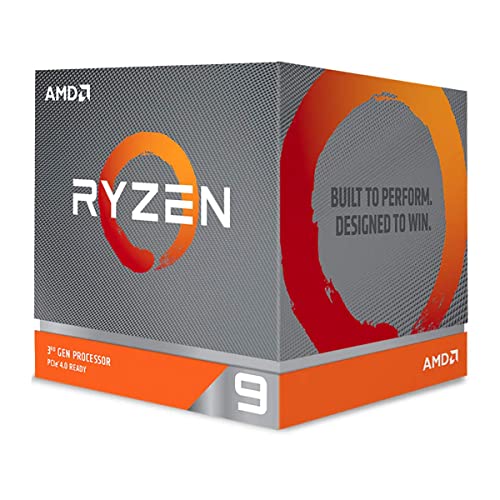
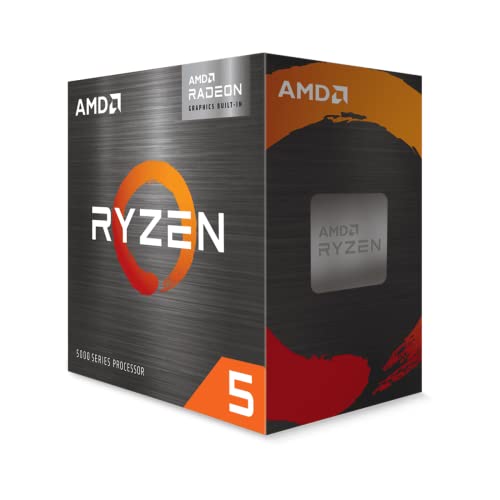
Where the Ryzen 9 3900X and Ryzen 5 5600G land. They sit on the same curve. The Ryzen 9 3900X has twelve cores and the Ryzen 5 5600G has six, but both run dual-channel DDR4. Their 70B generation ceilings are therefore set by DIMM speed, not by the chip. The 3900X's extra cores will shorten prefill. The 5600G's 65 W TDP, per AMD's 5600G spec page, makes it the cheaper host to leave running. Neither changes the roughly 1.2 tok/s generation ceiling.
Adding a single RTX 3060. Moving about 10 GB of Q4_K_M layers onto a 360 GB/s card removes about a quarter of the slow reads, not all of them. The rough time per token is 32.5 GB ÷ 51 GB/s + 10 GB ÷ 360 GB/s ≈ 0.67 s, or about 1.5 tok/s. Treat that as an estimate, not a measurement.
Benchmark table: Llama 3.3 70B throughput by configuration
Measured rows are marked with their source. Estimated rows use the bandwidth model above: time per token = (GB in system RAM ÷ ~51 GB/s) + (GB in VRAM ÷ 360 GB/s). The ~51 GB/s effective host figure comes from the measured 1.21 tok/s × 42.5 GB. For the dual-card IQ2_XS row, the 17 tok/s theoretical ceiling is scaled by the 74% efficiency the dual-3090 system achieved (16.29 measured ÷ 22.0 theoretical).
| Configuration | Quantization | Prompt eval (tok/s) | Generation (tok/s) | Source |
|---|---|---|---|---|
| CPU-only, Zen 3 (5950X, DDR4-3600) | Q4_K_M | ~10.1 (pp1024) | 1.21 | Measured, llamafile #450 |
| CPU-only, Ryzen 7 5800X (DDR4-3200) | Q4_K_M | not publicly measured | ~1.2 | Estimate from the 51.2 GB/s ceiling |
| One RTX 3060 12GB + DDR4 offload | Q4_K_M | not publicly measured | ~1.5 | Estimate (10 GB VRAM / 32.5 GB RAM) |
| Two RTX 3060 12GB + DDR4 offload | Q4_K_M | not publicly measured | ~2.1 | Estimate (21 GB VRAM / 21.5 GB RAM) |
| Two RTX 3060 12GB, all in VRAM | IQ2_XS | not publicly measured | ~12 | Estimate (21.14 GB at 360 GB/s × 0.74) |
| Two RTX 3090 24GB (48 GB reference) | Q4_K_M | 393.89 (pp1024) | 16.29 | Measured, XiongjieDai |
| One RTX 3090 24GB | Q4_K_M | OOM | OOM | Measured, XiongjieDai |
| One RTX 3090 24GB | Q2 quant | — | ~10 | Reported, Mustafa.net |
The pattern is clear. Any configuration that leaves 20+ GB of a dense 70B in DDR4 stays in low single digits, whether or not a GPU is present. Getting interactive speed takes either a 2-bit quant that fits in 24 GB, or 48 GB of real VRAM.
Spec-delta table: the two paths side by side
Prices are SpecPicks catalog prices checked on 2026-09-17 and may vary. Wattages are manufacturer ratings, not measured wall draw.
| Metric | Path A: second RTX 3060 12GB | Path B: Ryzen 7 5800X + 64 GB DDR4 |
|---|---|---|
| Total VRAM | 24 GB | 12 GB (existing card) or 0 |
| System RAM needed for Q4_K_M | ~32 GB | 64 GB |
| Incremental hardware | MSI RTX 3060 12GB at $479.99 new, or ~$295 used (getpcparts) | 64 GB DDR4 kit (price varies); Ryzen 7 5800X at $254.90 if you need the host |
| Rated power added | +170 W board power | +0 W GPU; CPU rated 105 W TDP |
| Best Llama 3.3 70B generation | ~12 tok/s at IQ2_XS (estimate) | ~1.2 tok/s at Q4_K_M |
| Best-quality usable quant | IQ2_XS fully in VRAM | Q4_K_M to Q8_0, slowly |
| Estimated tok/s per $100 (used card vs RAM-only) | ~4.1 at IQ2_XS ($295) | Depends on kit price; ~1.2 tok/s total |
| Energy per token at full load (rated) | ~340 W ÷ 12 tok/s ≈ 28 J/token, GPUs only | ~105 W ÷ 1.2 tok/s ≈ 88 J/token, CPU package only |
Idle draw depends too much on the board, PSU and cards to quote one figure. At the U.S. residential average of 18.34¢/kWh for June 2026, per the EIA Electric Power Monthly, every 100 W of continuous draw costs about $13 a month.
Prefill vs generation: why the two paths diverge on long prompts
Generation is limited by memory bandwidth. Prefill, which processes your prompt before the first output token, is limited by compute. That difference decides which path feels usable.
On the CPU path, a Zen 3 host processed Llama 3 70B Q4_K_M prompts at about 10 tok/s (llamafile #450). A 4k-token prompt, such as a pasted document or a coding agent's context, takes about 400 seconds before the first word appears. At 16k it takes over 26 minutes, before counting the slowdown that longer context adds. By comparison, the dual-3090 reference processed 1,024-token prompts at 393.89 tok/s (XiongjieDai), so a 4k prompt takes about 10 seconds.
The KV cache compounds the problem. At FP16 it grows by 327,680 bytes per token (from config.json):
| Context | KV cache (FP16) | Effect on two RTX 3060s | Effect on the CPU path |
|---|---|---|---|
| 4k | ~1.34 GB | IQ2_XS still fits in VRAM | Negligible vs 64 GB RAM |
| 16k | ~5.24 GB | Pushes IQ2_XS layers into RAM; speed collapses toward offload rates | Fits; prefill takes tens of minutes |
| 32k | ~10.5 GB | Not practical fully on GPU | Fits in 64 GB alongside Q4_K_M, barely |
Quantizing the KV cache to q8_0 (-ctk q8_0 -ctv q8_0 in llama.cpp) roughly halves those figures. The trade-off is that the multi-GPU documentation notes quantized KV isn't supported in the experimental tensor-split mode. Both paths handle short chats. Anything with long prompts rules out the CPU path.
Does a second GPU actually scale?
A second GPU scales capacity much more than speed. Under --split-mode layer, "pipeline-parallel runs different layers on different GPUs and processes tokens sequentially through the pipeline", per the llama.cpp multi-GPU guide. For one user generating one reply, only one card works at any moment. Two RTX 3060s do not produce twice the tokens per second of one. They let a model stay on fast memory that would otherwise sit in DDR4.
The dual-3090 data shows the same thing at a larger scale. Going from two to four RTX 3090s moved Llama 3 70B Q4_K_M generation from 16.29 to 16.89 tok/s, per XiongjieDai's tables. Once the model fits, extra cards add almost nothing for a single stream. A knightli write-up on llama.cpp multi-GPU behaviour gives a "conservative expectation" that two 16 GB cards run 10% to 40% slower than one 32 GB card on single-user chat.
A single larger card beats two small ones when the model fits on it. A used 24 GB card holds a 32B-class model at Q4 with room for context and avoids the split overhead. For Llama 3.3 70B specifically, though, one 24 GB card still has to offload or drop to a 2-bit quant, so it doesn't escape the problem. Two 3060s and one 3090 end up in similar positions.
Which upgrade should you buy first?
| If this describes you… | Buy |
|---|---|
| You want Llama 3.3 70B at conversational speed today and accept visible quality loss | Get the second RTX 3060 and run IQ2_XS fully in VRAM at 4k context |
| You need Q4_K_M-or-better quality and can wait minutes per answer (batch summaries, overnight jobs) | Go the Ryzen 7 5800X plus 64 GB RAM route and run CPU-only or single-GPU offload |
| Your prompts are long (documents, agents, coding context) | Do neither for 70B. Run a 27-32B-class model instead |
| You plan to keep scaling toward 48 GB | Get the second RTX 3060 now and add RAM later; the cards keep resale value |
Do neither and run a 32B-class model if… your workload is chat, coding help or summarization with short-to-medium prompts. The same two RTX 3060s that crawl on Q4_K_M 70B hold a 32B model entirely in VRAM. That shape is covered in Dual RTX 3060 12GB vs RTX 3090 24GB for Qwen2.5 32B. Measured single-card figures show the scale of the gap: an RTX 3060 generated Qwen3 14B at 31.2 tok/s at 4k context, per Hardware Corner's RTX 3060 12GB benchmarks.
Recommended pick. If you already own one RTX 3060 12GB, buy a second one, ideally used near the ~$295 sold price tracked by getpcparts. Also make sure the host has 64 GB of dual-channel DDR4. That setup gives you both options: IQ2_XS for speed when quality allows it, and two-GPU Q4_K_M offload at roughly 2 tok/s when it doesn't. The CPU-only route is cheaper to start but caps generation near 1.2 tok/s, and no amount of cores changes that.
Bottom line
For Llama 3.3 70B on a 2026 budget, the recommended configuration is two RTX 3060 12GB cards on a Ryzen 7 5800X host with 64 GB of DDR4. That's about $295 more if you already own one card and buy the second used. Expect roughly 12 tok/s at IQ2_XS fully in VRAM (estimate) and about 2 tok/s at Q4_K_M with offload (estimate). The only measured way to get 16+ tok/s at Q4_K_M is 48 GB of real VRAM, which the dual RTX 3090 benchmark shows at 16.29 tok/s.
Related guides
- Best GPU for Llama 3.1 70B
- Best Parts for a Dual RTX 3060 24GB Local-LLM Build in 2026
- gpt-oss 120B at Home: RTX 3060 12GB Offload vs Ryzen 7 5800X CPU-Only
- Best Parts for a CPU-Offload Local LLM Build
- RTX 3060 12GB benchmark page and Ryzen 7 5800X benchmark page
Live price comparison
Current prices and availability for every part named here:
- MSI Gaming GeForce RTX 3060 12GB: the Path A card
- ZOTAC Gaming GeForce RTX 3060 Twin Edge OC 12GB: the shorter second-slot option
- AMD Ryzen 7 5800X: the Path B host
- AMD Ryzen 9 3900X: more cores for faster prefill
- AMD Ryzen 5 5600G: the low-power host
Prices shift daily; the product pages show the latest listing.
Citations and sources
- Meta — Llama 3.3 70B Instruct model card (accessed 2026-09-17)
- Llama 3.3 70B Instruct config.json (accessed 2026-09-17)
- bartowski — Llama 3.3 70B Instruct GGUF quantizations (accessed 2026-09-17)
- XiongjieDai — GPU Benchmarks on LLM Inference (throughput and Llama 3 70B perplexity tables) (accessed 2026-09-17)
- mozilla-ai/llamafile — CPU benchmarks discussion #450 (accessed 2026-09-17)
- llama.cpp — Multi-GPU documentation (accessed 2026-09-17)
- RTX 3060 PCIe x1 vs x16 results gist (accessed 2026-09-17)
- knightli — llama.cpp multi-GPU offload performance (accessed 2026-09-17)
- Wikipedia — GeForce RTX 30 series specifications (accessed 2026-09-17)
- Wikipedia — DDR4 SDRAM (accessed 2026-09-17)
- AMD — Ryzen 7 5800X product page (accessed 2026-09-17)
- AMD — Ryzen 5 5600G specifications (accessed 2026-09-17)
- getpcparts — Used RTX 3060 market prices (accessed 2026-09-17)
- Mustafa.net — LLM tokens/sec benchmarks (accessed 2026-09-17)
- Hardware Corner — RTX 3060 12GB LLM benchmarks (accessed 2026-09-17)
- U.S. EIA — Electric Power Monthly, average price by sector (accessed 2026-09-17)
This piece is editorial synthesis based on publicly available information. No independent first-party benchmarking is reported.