Why an MoE changes the arithmetic
A dense 70B model has to read every weight in the file once per generated token. A mixture-of-experts model does not. Scout's config declares 16 local experts with one expert routed per token, across 48 layers — so of 109B total parameters, only about 17B are touched to produce any given token.
That single fact is why a 12GB card plus system RAM is a viable host for a model with more raw knowledge than Llama 3 70B, while the dense 70B on the same box is a slideshow. Capacity still has to come from somewhere — the whole 42 GB has to live in addressable memory — but the bandwidth bill per token is roughly what a 17B dense model would cost, not what a 109B one would.
The trap is that people read "17B active" and expect 17B-dense speed. It does not work that way, because you still pay for the weights the router picks, and those live in DDR4 at 51.2 GB/s rather than GDDR6 at 336 GB/s. The rest of this piece is the arithmetic of that gap.
Key takeaways
- 64GB of RAM is the practical floor. The 2.71-bit Q2_K_XL build is 42.2 GB; the 4.5-bit Q4_K_XL is 65.6 GB and will not fit a 64GB kit at all.
- The GPU's job is prefill, not generation. The 3060's 336 GB/s handles attention and prompt processing; generation speed is set by DDR4 bandwidth.
- Expect roughly 3–5 tok/s on this class of hardware, extrapolated from measured Zen 3 DDR4 MoE runs — not the ~20 tok/s Unsloth reports for a 24GB card.
- Dual-channel is not optional. One DIMM halves your throughput ceiling, and this is the most-missed step in every build thread.
- A dense 8B or 14B on the 3060 alone will feel dramatically faster. Hardware Corner measures Qwen3 8B Q4_K at 55.2 tok/s on the 3060 — ten times what an offloaded Scout will give you.
What you'll need
- System RAM: 64GB minimum, 96–128GB comfortable. Q2_K_XL at 42.2 GB plus a KV cache plus the OS is tight on 64GB and fine on 96GB. Q3_K_XL at 52.9 GB needs 96GB to be pleasant.
- A llama.cpp build with expert-offload flags. These are in mainline: <code>common/arg.cpp</code> defines <code>-ot, --override-tensor</code>, <code>-cmoe, --cpu-moe</code> ("keep all Mixture of Experts (MoE) weights in the CPU") and <code>-ncmoe, --n-cpu-moe N</code> ("keep the Mixture of Experts (MoE) weights of the first N layers in the CPU").
- An NVMe drive with 50–70GB free. Loading a 42 GB file off a SATA SSD adds a minute or more to every cold start.
- An AM4 board with both memory channels populated by a matched kit, XMP/DOCP enabled in BIOS.
- A PSU with a spare PCIe 8-pin if you are adding the GPU. NVIDIA specifies one 8-pin connector and a 550 W system supply for the RTX 3060.
VRAM and quantization requirements
Unsloth publishes both the file sizes and an accuracy grade for each dynamic quant of Scout. The disk sizes below are verbatim from their Llama 4 run-and-fine-tune guide; the full unquantized BF16 release is 113 GB.
| Quant | MoE bits | File size | Accuracy grade | Fits 64GB RAM? | Fits 128GB RAM? |
|---|---|---|---|---|---|
| UD-IQ1_S | 1.78-bit | 33.8 GB | Ok | yes, comfortably | yes |
| UD-IQ1_M | 1.93-bit | 35.4 GB | Fair | yes | yes |
| UD-IQ2_XXS | 2.42-bit | 38.6 GB | Better | yes | yes |
| UD-Q2_K_XL | 2.71-bit | 42.2 GB | Suggested | yes, tight | yes |
| UD-Q3_K_XL | 3.5-bit | 52.9 GB | Great | no, with KV cache | yes |
| UD-Q4_K_XL | 4.5-bit | 65.6 GB | Best | no | yes |
| BF16 | 16-bit | 113 GB | reference | no | no |
The split-file standard quants line up: the Hugging Face repository listing shows Q4_K_M as two shards totalling 65.36 GB and Q2_K as a single 39.56 GB file.
Note what the 12GB of VRAM does and does not buy here. It never holds the model. It holds the attention and non-expert layers — which is exactly what -ot ".ffn_.*_exps.=CPU" arranges — plus the KV cache. Unsloth's own note is that this flag "effectively allows you to fit all non MoE layers on 1 GPU, improving generation speeds."
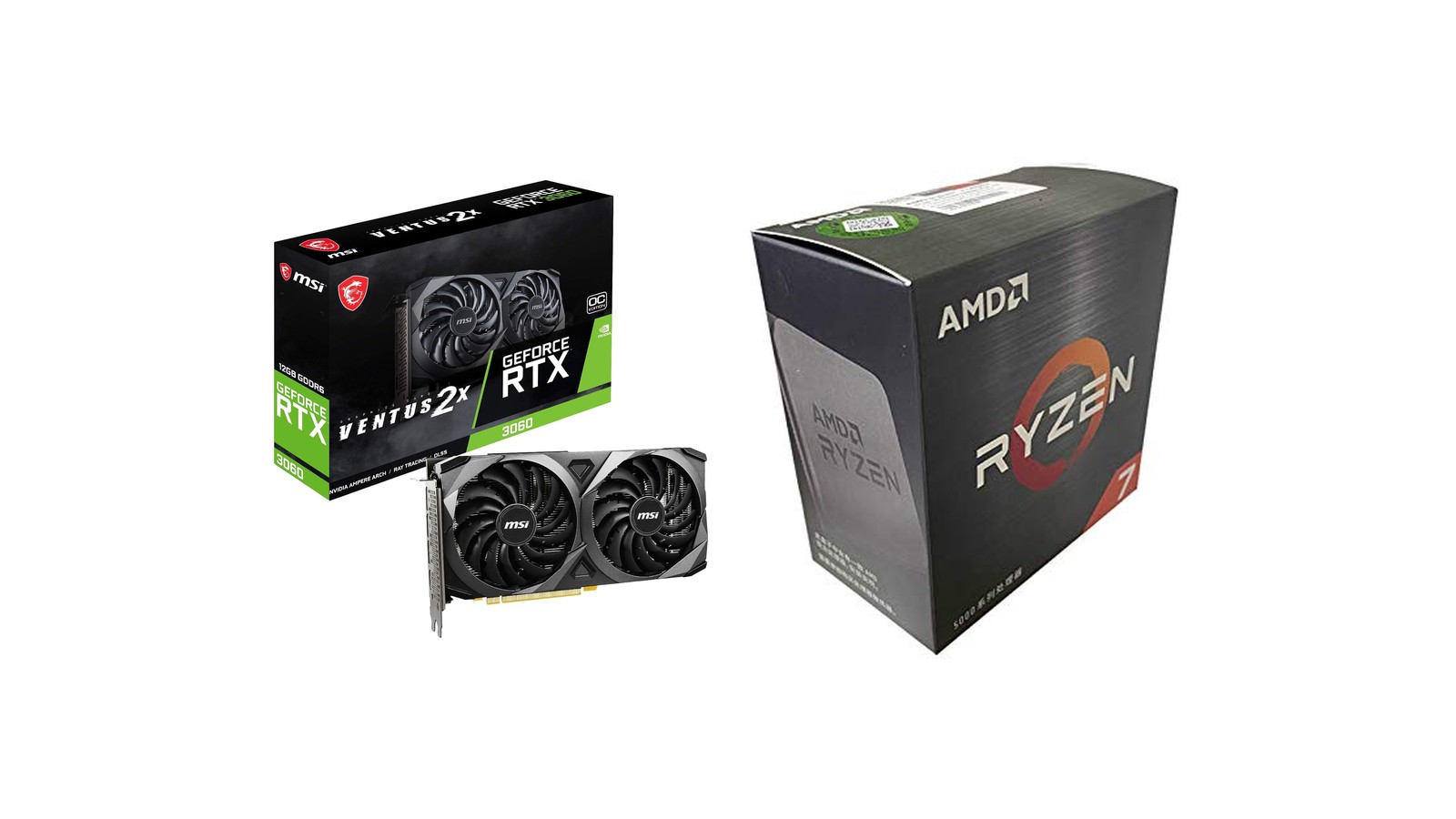
Spec delta: MSI RTX 3060 12GB vs Ryzen 7 5800X
| Spec | RTX 3060 12GB | Ryzen 7 5800X | Delta | Why it matters |
|---|---|---|---|---|
| Memory bandwidth | 336 GB/s GDDR6 | 51.2 GB/s DDR4-3200 dual-channel | GPU 6.6× | Sets the token-generation ceiling |
| Memory capacity | 12 GB fixed | up to 128 GB | CPU 10× | Decides whether Scout loads at all |
| Compute units | 3,584 CUDA cores | 8 cores / 16 threads | — | Prefill scales with this |
| Board / package power | 170 W | 105 W default TDP | — | Combined ~275 W under load |
| Cache | — | 32 MB L3 | — | Helps prefill, not streaming weights |
| Launch MSRP | $329 | $449 | — | Both are used-market parts now |
The bandwidth column is the article. Per the Nvidia GPU list the RTX 3060 12GB runs a 192-bit bus at 336 GB/s with a 170 W board power and a $329 launch price; AMD's 5800X page lists 8 cores, 16 threads, 32 MB L3, a 105 W default TDP and DDR4 support "Up to 3200 MT/s". Two channels of DDR4-3200 is 51.2 GB/s of theoretical bandwidth, and real-world figures land lower.
Every expert tensor that lives in system RAM is read at the 51.2 GB/s number, not the 336 GB/s one.
How many tokens per second does each setup deliver?
There is no published llama-bench run of Llama 4 Scout on an RTX 3060 plus a Ryzen 7 5800X. Rather than invent one, here are the closest measured anchors, and what they imply.
Upper anchor. Unsloth reports that "Scout 1.78-bit fits in a 24GB VRAM GPU for fast inference at ~20 tokens/sec." That is the 33.8 GB IQ1_S build on a card with twice the 3060's VRAM and roughly three times its bandwidth — a ceiling, not a target.
Lower anchor — measured MoE on Zen 3 DDR4. The llamafile CPU benchmark thread has llama-bench rows for Mixtral 8x7B, an MoE with about 12.9B active parameters, on desktop Zen 3 parts with DDR4:
| CPU / memory | Model | File size | pp512 | tg16 |
|---|---|---|---|---|
| Ryzen 5 5600X, DDR4-3000 | Mixtral 8x7B Q5_K_M | 30.95 GiB | 31.70 | 5.02 |
| Ryzen 5 5600X, DDR4-3000 | Mixtral 8x7B Q6_K | 35.74 GiB | 33.88 | 4.20 |
| Ryzen 5 5600X, DDR4-3000 | Mixtral 8x7B Q8_0 | 46.22 GiB | 19.82 | 3.31 |
| Ryzen 9 5950X, DDR4-3600 | Mixtral 8x7B Q4_K_M | 26.49 GiB | 58.34 | 6.23 |
| Ryzen 9 5950X, DDR4-3600 | Mixtral 8x7B Q5_K_M | 30.95 GiB | 56.64 | 5.42 |
| Ryzen 9 5950X, DDR4-3600 | Mixtral 8x22B Q6_K | 107.61 GiB | 19.66 | 1.57 |
Scout activates about 17B parameters per token against Mixtral 8x7B's ~12.9B — roughly 32% more work per token at a comparable bit width. Scaling the 5600X's 5.02 tok/s by that ratio lands around 3.8 tok/s, and the 5950X's 5.42 lands around 4.1. Expect 3–5 tok/s from a 5800X-class box on Scout at Q2_K_XL to Q3_K_XL, with the GPU shaving prefill rather than generation. That is an extrapolation from measured neighbours, not a measurement of Scout.
GPU-resident dense comparison. On the same 3060, models that fit entirely in VRAM are an order of magnitude quicker. Hardware Corner's RTX 3060 12GB page measures Qwen3 8B Q4_K at 55.2 tok/s at 4k context and 42.0 at 16k, and Qwen3 14B Q4_K at 31.2 and 22.7. LocalScore's RTX 3060 entry puts Llama 3.1 8B Q4_K_M at 51.3 tok/s generation with 882 ms to first token.
That is the honest framing: Scout on this hardware is a knowledge appliance, not a chat companion.
Prefill vs generation on an offloaded MoE
The llamafile table above contains the cleanest evidence of why the GPU earns its slot. Compare the 5600X and the 5950X on the identical Mixtral 8x7B Q5_K_M file:
| Metric | Ryzen 5 5600X (6C) | Ryzen 9 5950X (16C) | Ratio |
|---|---|---|---|
| Prompt processing (pp512) | 31.70 tok/s | 56.64 tok/s | 1.79× |
| Token generation (tg16) | 5.02 tok/s | 5.42 tok/s | 1.08× |
Going from six cores to sixteen — a 2.7× increase — buys 79% more prefill and 8% more generation. Prefill is compute-bound and parallelises. Generation is memory-bound and does not.
This is precisely the asymmetry an RTX 3060 exploits. Prompt processing is the part that maps onto a GPU, and the 3060 posts 2,407.67 tok/s of pp512 on Llama-2 7B Q4_0 in the llama.cpp CUDA reference thread — two orders of magnitude past what a 5800X does on CPU. So on a long RAG prompt, adding the card takes time-to-first-token from tens of seconds to a few, while barely touching the tok/s of the answer that follows.
If your usage is long documents in and short answers out, the GPU is transformative. If it is short prompts and long generations, the GPU changes very little and the RAM kit is the upgrade that matters.
How does context length affect Scout's memory footprint?
Scout's config declares 48 layers, 8 key-value heads and a head dimension of 128. An FP16 KV cache therefore costs 2 × 48 × 8 × 128 × 2 = 196,608 bytes — 0.1875 MiB — per token:
| Context | KV cache (FP16) | KV cache (Q8_0) | Fits in 12GB VRAM alongside attention layers? |
|---|---|---|---|
| 8K | 1.5 GiB | 0.75 GiB | yes, easily |
| 16K | 3.0 GiB | 1.5 GiB | yes |
| 32K | 6.0 GiB | 3.0 GiB | yes, getting tight |
| 128K | 24.0 GiB | 12.0 GiB | no — spills to system RAM |
Those are upper bounds. Unsloth notes that "Llama 4 also now uses chunked attention — it's essentially sliding window attention, but slightly more efficient by not attending to previous tokens over the 8192 boundary," which means the local-attention layers do not accumulate cache linearly the way a fully global model does. The practical effect is that long contexts are cheaper on Scout than the naive table suggests, but the naive table is what you should size a 12GB card against.
Unsloth's own reference command uses --ctx-size 16384, and notes Scout's architectural limit is 10M tokens. 16K is a sane starting point on a 12GB card; 32K works with a quantized KV cache.
Is a Ryzen 5 5600X or 5600G enough as the offload host?
Largely, yes — and that is an argument for spending the difference on RAM.
All three chips share the same Zen 3 dual-channel DDR4 memory controller, which is the binding constraint on generation. The Ryzen 5 5600X posts 5.02 tok/s on Mixtral 8x7B Q5_K_M against the 16-core 5950X's 5.42 in the llamafile data above; a 5800X sits between them and will land within a tok/s of either. Where the extra cores show up is prefill, and on a box with a GPU doing prefill, that advantage largely evaporates.
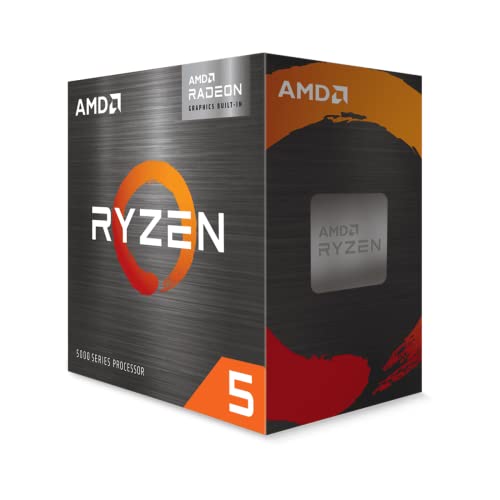
The Ryzen 5 5600G is the interesting budget case. Its integrated Radeon graphics will not meaningfully accelerate llama.cpp on this workload, but it means the machine boots and displays without a discrete card — so the PCIe x16 slot stays free for an RTX 3060 added later. For a build that starts CPU-only and grows, that is a real convenience. The 5600G also runs PCIe Gen 3 rather than Gen 4, which matters less than you would think: expert offload streams over the memory bus, not the PCIe link.
The honest ranking for this workload is: memory capacity first, memory speed second, core count a distant third. A 5600X with 128GB of DDR4-3600 will run Scout better than a 5800X with 64GB of DDR4-2666.
Perf-per-dollar: add a GPU, or add RAM?
Suppose you own a 5800X box with 32GB and want to run Scout. Two upgrade paths:
| Upgrade | Rough cost | What it buys | What it does not buy |
|---|---|---|---|
| 64GB more DDR4 (to 96GB) | modest | Q3_K_XL at 52.9 GB becomes comfortable; Q4_K_XL becomes possible at 128GB | Almost no generation speed |
| ZOTAC RTX 3060 Twin Edge OC 12GB | ~$329 MSRP class | Prefill from tens of seconds to a few; dense 8B–14B at 30–55 tok/s | Barely any Scout generation speed |
| Both | sum of the above | Best quant and usable time-to-first-token | Still 3–5 tok/s on Scout |
If Scout specifically is the goal, RAM first — the quant tier you can load determines output quality, and no GPU fixes a model that will not load. If the box is also going to run dense 8B–14B models day to day, the GPU is the better single purchase, because that is where it delivers 30–55 tok/s instead of single digits.
The ZOTAC Twin Edge is the compact two-fan variant worth noting for small cases; the MSI Gaming GeForce RTX 3060 12GB is the more common triple-slot-free dual-fan card. Both are the same GA106 silicon at the same 336 GB/s. Prices on 30-series cards move constantly on the used market — the figures here are launch MSRPs, so check the live listing before buying.
Common pitfalls
- Single-channel memory. The single most expensive mistake in this build. One DIMM halves 51.2 GB/s to 25.6 GB/s and roughly halves generation. Populate both channels with a matched kit and confirm dual-channel in CPU-Z before benchmarking anything.
- Leaving XMP/DOCP off. A kit rated DDR4-3200 boots at 2133 MT/s by default on many AM4 boards — a 33% bandwidth loss you will never notice unless you check.
- Quoting the "17B active" number as a speed promise. It sets the per-token work, not the memory tier that work runs in. DDR4 is 6.6× slower than the 3060's GDDR6.
- Loading from a SATA SSD. A 42 GB file at 500 MB/s is 84 seconds of cold start, every restart. NVMe cuts that to well under 20.
- Sizing the PSU from the GPU alone. A 170 W card plus a 105 W CPU plus drives is why NVIDIA specifies 550 W system power for the RTX 3060 and one PCIe 8-pin connector. Many older office-tower AM4 builds ship 400 W units with no 8-pin cable at all.
When NOT to run Scout on this hardware
If the job is interactive chat, coding autocomplete, or anything where you watch tokens appear, 3–5 tok/s is unusable and no flag fixes it. A dense model that fits entirely in the 3060's 12GB is the right answer: Qwen3 8B Q4_K at 55.2 tok/s, or Qwen3 14B Q4_K at 31.2 tok/s per Hardware Corner. Both feel instant by comparison.
Scout makes sense when throughput does not matter and breadth does — overnight batch summarisation, document extraction against a long corpus, or a research assistant you query a handful of times a day and are willing to wait on. It also makes sense if you already own 64GB+ of DDR4 and the marginal cost of trying it is a download.
Verdict matrix
Go CPU-only if… you have 64GB+ of DDR4 already, no spare PCIe slot or PSU headroom, and your prompts are short. You lose prefill speed and little else on generation.
Add the RTX 3060 12GB if… your prompts are long (RAG, document analysis), or you also want to run dense 8B–14B models at usable interactive speed. It is the difference between a 40-second wait before the first token and a 4-second one.
Skip Scout for a dense 14B if… you need interactive response, you have under 64GB of RAM, or your questions are narrow enough that a 14B model's knowledge is sufficient. This covers most people most of the time.
Recommended pick
For a reader who already owns a Ryzen 7 5800X box, the right sequence is RAM to 96GB or 128GB first, then the MSI Gaming GeForce RTX 3060 12GB second. The RAM decides which quant you can run, and Q3_K_XL at 52.9 GB is a meaningfully better model than Q2_K_XL at 42.2 GB per Unsloth's own accuracy grading. The card then makes the machine pleasant to use for everything that is not Scout.
If you are building from scratch and Scout is the target, the Ryzen 5 5600X plus 128GB is a better allocation than the Ryzen 7 5800X plus 64GB — the measured core-scaling data says you lose about 8% of generation and gain a whole quant tier. It is not worth chasing the 5800X's extra cores on a box that has a GPU doing prefill.
Bottom line
Llama 4 Scout runs on an RTX 3060 12GB and a Ryzen 7 5800X, but only as a pair, and only at 3–5 tok/s. The 12GB card never holds the model — it holds attention layers and the KV cache while -ot ".ffn_.*_exps.=CPU" pushes 42 GB of expert tensors into DDR4. What you buy with that arrangement is access to a 109B-parameter knowledge base on a six-year-old desktop, at the cost of a conversation that moves slower than you read.
For anything interactive, put a dense 8B or 14B entirely in the 3060's VRAM and enjoy 30–55 tok/s instead.
Related guides
- Best Hardware for Running MoE LLMs Locally in 2026
- Best Parts for a CPU-Offload Local LLM Build in 2026
- CPU Offload for Local LLMs: Does a Ryzen 7 5800X Help?
- RTX 3060 12GB benchmark data and Ryzen 7 5800X benchmark data
Live price comparison
Specs and pricing side by side: RTX 3060 12GB vs Ryzen 7 5800X, and the two featured 3060 cards head-to-head at MSI RTX 3060 12GB vs ZOTAC Twin Edge OC. Every price in this article is a launch MSRP; used-market prices for both the card and the CPU move weekly, so check the live listing.
Citations and sources
- Unsloth — Llama-4-Scout-17B-16E-Instruct-GGUF model card — mirrors Meta's model card ("17B Activated / 109B Total", 16 experts), publishes the per-quant disk-size table and the split-file listings. Accessed 23 September 2026.
- Unsloth — Llama 4: How to Run & Fine-tune — 113 GB BF16 size, the
-ot ".ffn_.*_exps.=CPU"offload recipe, the ~20 tok/s figure on a 24GB card, and the chunked-attention note. Accessed 23 September 2026. - llama.cpp — common/arg.cpp — canonical definitions of
-ot/--override-tensor,-cmoe/--cpu-moeand-ncmoe/--n-cpu-moe. Accessed 23 September 2026. - llamafile discussion #450 — Lots of CPU benchmarks — measured Mixtral 8x7B and 8x22B prefill and generation on Ryzen 5 5600X and Ryzen 9 5950X with DDR4. Accessed 23 September 2026.
- Hardware Corner — RTX 3060 12GB Local LLM Benchmarks — Qwen3 8B and 14B Q4_K generation and prefill at 4k/16k/32k. Accessed 23 September 2026.
- LocalScore — RTX 3060 accelerator page — Llama 3.2 1B, Llama 3.1 8B and Qwen2.5 14B prompt speed, generation speed and TTFT. Accessed 23 September 2026.
- llama.cpp discussion #15013 — Performance of llama.cpp on Nvidia CUDA — RTX 3060 12GB pp512 2,407.67 / tg128 76.92 on Llama-2 7B Q4_0. Accessed 23 September 2026.
- AMD — Ryzen 7 5800X product page — 8 cores / 16 threads, 32 MB L3, 105 W default TDP, DDR4 up to 3200 MT/s. Accessed 23 September 2026.
- NVIDIA — GeForce RTX 3060 / 3060 Ti page — 12 GB GDDR6, 192-bit, 170 W graphics card power, 550 W required system power, one PCIe 8-pin. Accessed 23 September 2026.
- Wikipedia — List of Nvidia graphics processing units — RTX 3060 12GB bandwidth (336.0 GB/s), launch date and $329 MSRP. Accessed 23 September 2026.
This piece is editorial synthesis based on publicly available information. No independent first-party benchmarking is reported.