Best Parts for a CPU-Offload Local LLM Build in 2026
When a model outgrows your VRAM, memory bandwidth, not core count, decides how fast the offloaded half runs.
By Mike Perry, Founder & Editor-in-Chief · Published 2026-09-11 · Updated 2026-10-21 · 13 min read
Run LLMs bigger than your VRAM: Ryzen 7 5800X, 12GB RTX 3060 and 64GB DDR4, with the 51 GB/s bandwidth math and a one-click Amazon parts cart.
Quick Answer
To run a model bigger than your VRAM, you need three parts that work together. The first is a 12 GB GPU for the layers that fit. The second is enough dual-channel RAM for the rest, which means 64 GB for 70B-class Q4. The third is a CPU that keeps that RAM saturated. Dual-channel DDR4-3200 delivers about 51 GB/s, per InsiderLLM's CPU inference guide, against 360 GB/s on an RTX 3060 12GB, so offloaded layers set your speed.
Hardware at a Glance
Median generation throughput at 7–9B models (Llama 3.1 8B, Qwen 3 8B), Q4 quantization, from community-reported runs SpecPicks tracks. Each row pools runs from different sources, runtimes and models in that class, so the rows are not a matched head-to-head; where the article compares cards on the same rig, its own figures are the like-for-like result. Street price is the second-lowest listing priced within the last 24 hours at 0.5–2× launch MSRP, so no single listing sets it, and a street figure well above MSRP says so in its cell; where too few listings pass that check the cell shows a dash and the launch MSRP, which is not comparable with the street figures. Rows marked for comparison are not the cards this article is about — they are included so the throughput column has something to be read against.
Step 0: are you VRAM-limited or bandwidth-limited?
Diagnose before you buy anything, because the two problems have opposite fixes. Load your model in llama.cpp or Ollama and read two things: the loader's report of how many layers were offloaded to the GPU, and your generation speed in tokens per second.
If every layer is on the GPU and speed is still disappointing, you are bandwidth-limited. The GPU is streaming weights as fast as its memory bus allows, and nothing in this guide will help. A faster CPU, more RAM, or a faster SSD changes nothing; only a card with more memory bandwidth does. For reference, LocalScore measured an RTX 3060 12GB at 26.4 tok/s on Qwen2.5 14B at Q4_K_M, fully resident. That is roughly what a healthy 12 GB card delivers on the largest model that fits.
If some layers are on the CPU, you are VRAM-limited, and this guide is for you. Every layer that lives in system RAM is read at DDR4 speed instead of GDDR6 speed, about seven times slower, and those layers dominate the time per token. Per InsiderLLM's Qwen hardware guide, a dense 32B model at Q4 "lands around 2-3 tok/s" when split between a 12 GB card and system RAM. That is slow, but it is the difference between running a model and not running it at all.
The hybrid build is a capability unlock, not a speed upgrade. It lets a 12 GB card reach models that would otherwise need 24-48 GB of VRAM. The parts that matter, in order, are memory bandwidth, RAM capacity, a 12 GB accelerator, and a CPU with enough cores to keep the memory busy. The pick that balances all of that best is an eight-core Zen 3 chip, the Ryzen 7 5800X.
The picks at a glance
Pick
Best For
Key Spec
Price Range
Verdict
AMD Ryzen 7 5800X
🏆 Best Overall host
8C/16T, 105 W, DDR4-3200, PCIe 4.0
~$255 listed
Saturates dual-channel DDR4; more cores buy little
ZOTAC RTX 3060 Twin Edge OC 12GB
💰 Best Value accelerator
12 GB GDDR6, 360 GB/s, 170 W
~$295 used / ~$500 listed
Most VRAM per dollar keeps the most layers off the CPU
Listed prices are SpecPicks catalog snapshots from September 11, 2026 (the memory kit's from October 19, 2026), and the used RTX 3060 figure is from getpcparts' eBay sold-listing tracker. Prices change often; the price may vary from what is shown here.
The parts list, priced
The table below lists the parts this guide ranks, with current Amazon prices. The memory row names one in-stock 64 GB (2 × 32 GB) DDR4-3200 desktop kit so the cart covers the 64 GB this guide is built around; any matched 2 × 32 GB non-ECC DDR4-3200 kit fills that slot equally well. The motherboard, power supply and case rows name one in-stock pick each so the cart covers a complete build; any AM4 B550 board, quality 550-650 W unit and ATX case fills those slots equally well, and the checks under "What to look for" below cover channel population, PCIe lanes and PSU headroom.
Total for the 7 parts priced on Amazon in the last 24 hours: $1,630.23 (1 part has no current price and is not included).
🛒 Add this build to your Amazon cart (7 parts)Adds the 7 Amazon-priced parts above in one step; you review the cart on Amazon before buying. The other part is left out because Amazon has no current price for it; use its row above. Alternative picks for the same slot are not added.
*Prices sourced from Amazon.com, read 2026-10-25 to 2026-10-26 PT (each row shows its own date). Price and availability subject to change.
🏆 Best Overall: AMD Ryzen 7 5800X
8 cores / 16 threads · 105 W TDP · Socket AM4 · DDR4 up to 3200 MT/s · PCIe 4.0
Pros
Eight Zen 3 cores are enough to keep dual-channel DDR4 saturated during offloaded generation.
PCIe 4.0 x16 to the GPU, per AMD's product page, speeds model loads and hybrid prompt processing.
The AM4 platform is cheap to buy used, and boards commonly support 64-128 GB of DDR4.
A 32 MB L3 cache on a single CCD helps the latency-sensitive parts of CPU inference.
Cons
The 105 W TDP runs warm under sustained all-core load; plan on a real tower cooler.
No integrated graphics, so the desktop display takes a slice of your GPU's VRAM.
DDR4 caps memory bandwidth well below current DDR5 platforms.
The AMD Ryzen 7 5800X sits at the top because it matches the real bottleneck of CPU offload: memory bandwidth, not arithmetic. When a layer lives in system RAM, the CPU spends most of its time waiting for weights to arrive from DDR4. Once enough cores are issuing memory requests to keep both channels busy, extra cores mostly wait in line.
The published numbers show the scale. InsiderLLM puts dual-channel DDR4-3200 at about 51 GB/s and pure-CPU generation on a 7B Q4 model at about 8-10 tok/s on that memory. It also puts a 70B Q4 model at about 2 tok/s even on faster dual-channel DDR5. With a 12 GB card carrying part of the model, you keep the GPU's half fast and only pay DDR4 speed on the rest.
For layers that stay on the GPU, the CPU barely matters. Puget Systems measured only about a 5% token-generation spread across very different CPUs on GPU-resident llama.cpp inference, so the 5800X is not leaving performance on the table there either. It is the most CPU this job can actually use.
The accelerator half of a hybrid build should be judged on VRAM per dollar, not on speed. In a split model, the GPU layers finish quickly and the CPU layers set the pace. Every extra gigabyte of VRAM moves more layers off the slow path, so a 12 GB card beats a faster 8 GB card for this workload.
The arithmetic makes the case. Qwen2.5 32B at Q4_K_M is 19.85 GB spread across 64 layers, per bartowski's GGUF release, which is about 0.31 GB per layer. A 12 GB card with roughly 2 GB reserved for KV cache and runtime overhead holds about 32 of those layers, half the model. Per token, the GPU reads its ~9.9 GB at 360 GB/s in about 28 ms, while the CPU reads its ~9.9 GB at about 51 GB/s in about 195 ms, before any inefficiency. Those are theoretical floors, which put the ceiling near 4 tok/s. That is consistent with the 2-3 tok/s InsiderLLM reports in practice. An 8 GB card would push roughly 13 more layers onto the CPU and drag that number down further.
The ZOTAC Gaming GeForce RTX 3060 Twin Edge OC 12GB is the cheapest route to 12 GB with full CUDA support, and TechPowerUp rates it at 170 W. Used RTX 3060 cards sold for about $295 on eBay as of September 5, 2026. One trap: an 8 GB RTX 3060 with a narrower bus also exists, so confirm "12GB" in any listing title.
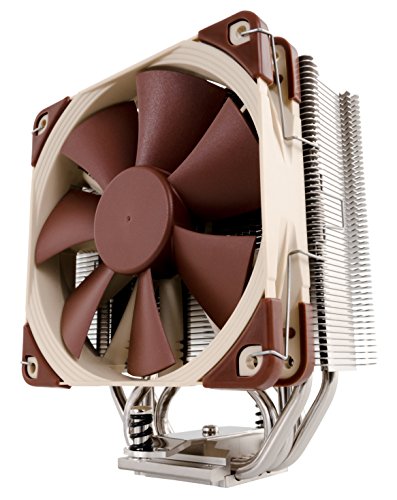
120 mm single-tower air cooler · no pump · AM4 via Noctua mounting kit
CPU offload is the rare desktop workload that pins every core for as long as a generation runs. A long document summary or an overnight batch job can keep the CPU at full load for hours. That is the thermal condition to design for, and the 5800X's rated 105 W TDP, per AMD, is the heat load the cooler has to move continuously.
The Noctua NH-U12S is a single-tower air cooler, so there is no pump to wear out in a machine meant to run unattended, and its 120 mm fan keeps noise down under sustained load. It carries 5,255 ratings in the SpecPicks catalog, one of the deepest review bases of any cooler listed. Two practical notes. First, confirm your unit includes AM4 mounting hardware: older NH-U12S boxes predate the socket, and Noctua supplies an AM4 kit for them. Second, a single-tower cooler is a comfortable match for a 105 W part, but it is not the right choice if you step up to a higher-TDP chip.
The AMD Ryzen 9 3900X is the pick when the machine does more than one thing at a time. Per TechPowerUp's Ryzen 9 3900X entry, it pairs 12 Zen 2 cores with 64 MB of L3 cache on the same AM4 socket and the same dual-channel DDR4 memory controller as the 5800X.
Twelve cores beat eight in two situations. The first is prompt processing on CPU-resident layers, which is compute-bound, so a long prompt split across more cores finishes sooner. The second is concurrency: running inference while compiling code, serving a vector database, or transcoding media, without the model's threads fighting everything else.
Twelve cores do not buy faster token generation. Both chips feed from the same ~51 GB/s of dual-channel DDR4, so once eight cores saturate the memory, cores nine through twelve wait on RAM like everyone else. This is the point of diminishing returns, and it is why the 3900X is the "performance" pick rather than the default. Pick it for headroom, not for tokens per second.
The AMD Ryzen 5 5600G is the sub-$200 entry into hybrid inference, listed at $199.99 in the SpecPicks catalog on September 11, 2026 (price may vary). Per TechPowerUp's Ryzen 5 5600G entry, it is a six-core Zen 3 APU on the same dual-channel DDR4 platform. For memory-bound generation, that means offloaded layers run at essentially the same bandwidth ceiling as on the 5800X.
Its integrated Radeon graphics are an underrated advantage for this build. Plug your monitor into the motherboard and the discrete GPU's full 12 GB goes to the model instead of the desktop compositor.
The honest ceiling has three parts. The 5600G's GPU link is PCIe 3.0, half the bandwidth of the 5800X's PCIe 4.0, which slows model loads and hybrid prompt processing, where llama.cpp can stream CPU-resident weights across the bus. Six cores leave less room for anything else the box has to do. And its smaller 16 MB L3 is a modest penalty on CPU-side work. For a first hybrid build or a quiet always-on box, none of those is a dealbreaker.
The ceiling on generation speed is roughly memory bandwidth divided by the bytes read per token. Dual-channel DDR4-3200 moves 2 channels × 8 bytes × 3,200 MT/s, or 51.2 GB/s, matching InsiderLLM's ~51 GB/s figure. InsiderLLM also notes that token generation "scales almost linearly with memory bandwidth." Faster DIMMs your platform supports stably help directly; extra cores beyond saturation do not.
Dual-channel population rules
Always install RAM in matched pairs in the slots your board manual marks for dual-channel operation. One DIMM halves your bandwidth, and every offloaded layer pays for it. In the llama.cpp CPU performance discussion, one user reported generation rising from 1.5 to 4 tok/s just by adding a second memory stick. Four DIMMs keep dual-channel bandwidth but can reduce the maximum stable memory speed on some boards, so two large DIMMs are usually the cleaner path to 64 GB.
Why 64 GB is the 2026 target for 70B-class Q4
InsiderLLM notes a 70B model at Q4 needs 48 GB or more of system RAM. Add the operating system, a KV cache for real context, and any other services, and 64 GB is the practical target for that tier. 32 GB covers 32B-class models comfortably, since Qwen2.5 32B at Q4_K_M is 19.85 GB of weights.
PCIe generation and lane count
Fully resident inference barely touches PCIe. Hybrid inference uses it more: model loading, and prompt processing where CPU-side weights can be streamed to the GPU in large batches. Prefer a CPU and board that give the GPU PCIe 4.0 x16 (5800X, 3900X), and accept PCIe 3.0 (5600G) only as a budget trade.
Model-library storage
Storage affects load time and nothing else. The Kingston 960GB A400 is a sensible bulk tier for a shelf of GGUF files, since the workload is a few large sequential reads per day. Put the money you would spend on a faster NVMe drive into RAM capacity instead.
PSU headroom
The RTX 3060 12GB is rated at 170 W per TechPowerUp and the 5800X at 105 W TDP per AMD, which puts the two main components at about 275 W. A quality 550-650 W unit gives comfortable headroom for transients and a future GPU upgrade.
Common mistakes
Populating one DIMM slot. This is the most-missed step and the most expensive: it halves memory bandwidth, and offloaded generation slows almost proportionally.
Over-buying cores. A 12- or 16-core chip on the same dual-channel platform generates offloaded tokens at about the same speed as eight cores. Buy cores for concurrency, not for tokens per second.
Treating an NVMe upgrade as an inference speedup. Once weights are in RAM or VRAM, the SSD is idle. A faster drive shortens load time only.
Buying the 8 GB version of a "12 GB" card. The RTX 3060 ships in both sizes, and the 8 GB variant pushes more layers onto the slow CPU path. Read the full listing title.
Setting GPU layers too high. Asking llama.cpp for more GPU layers than fit, with your context size included, triggers out-of-memory errors or silent slowdowns. Leave headroom for the KV cache, and re-check whenever you raise the context length.
Ignoring the thread count. Oversubscribing CPU threads on offloaded layers can reduce throughput. Start with the physical core count and adjust from there.
As an Amazon Associate, SpecPicks earns from qualifying purchases; we also earn on qualifying eBay purchases via the eBay Partner Network. Prices shown were last tracked at crawl time and may vary — check the listing for the current price.
📹 Watch a review
I had given up on AMD… until today - Ryzen 9 3900X & Ryzen 7 3700X Review — Linus Tech Tips on YouTube
Frequently asked questions
How much system RAM do I need for CPU offload?
Size it to the largest model you intend to run, plus roughly 25 percent for KV cache and OS overhead. A 70B model at q4_K_M puts about 40 GB of weights in play, so 64 GB is the practical 2026 target for that tier; 32 GB covers 32B-class models comfortably. Always populate matched pairs — a single DIMM halves your effective memory bandwidth, and bandwidth is the binding constraint on every offloaded layer.
Does a faster CPU actually speed up token generation?
Less than buyers expect. Once you have enough cores to saturate available memory bandwidth — typically six to eight on a dual-channel desktop platform — additional cores return very little, because offloaded layers are waiting on RAM rather than on arithmetic. That is why the Ryzen 7 5800X sits at the top of this guide rather than the 12-core 3900X: the step up buys headroom for concurrent work, not meaningfully more tokens per second.
Is CPU offload worth it, or should I just buy a bigger GPU?
If the model you want fits in a single affordable card's VRAM, buy the card — fully-resident inference is several times faster than any hybrid split. Offload earns its place when the model you need genuinely exceeds consumer VRAM tiers, when you run large models occasionally rather than constantly, or when you already own a 12 GB card and want to stretch it. It is a capability unlock, not a performance upgrade.
Will a faster SSD make my models run faster?
No. Storage speed determines how long a model takes to load into RAM or VRAM the first time, and nothing after that — once weights are resident, the SSD is idle. A budget SATA drive like the Kingston A400 is a perfectly rational model-library tier because the workload is bulk sequential reads a few times a day. Spend the difference on RAM capacity, which does affect what you can run at all.
Can I do this on an older platform I already own?
Often yes, and it is the cheapest path. Any AM4 or LGA1151-era board with dual-channel DDR4 and a PCIe x16 slot can host a hybrid build; the platform mostly determines your memory-bandwidth ceiling, not whether it works. Check two things before buying anything: that your board supports the RAM capacity you need across two or four slots, and that your PSU has the PCIe connectors your chosen card requires.