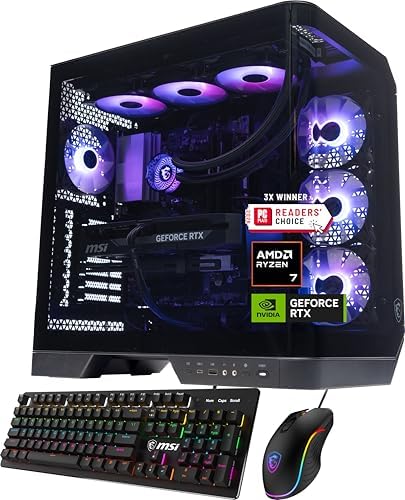
Gaming PC Build 2026: The Reddit-Consensus Parts List
The components r/buildapc and r/pcmasterrace actually recommend — validated against real 2026 benchmarks.
By Mike Perry, Founder & Editor-in-Chief · Published 2026-04-24 · Updated 2026-10-22 · 12 min read
Prices checked . Every part price, total and one-click Amazon cart on this page uses Amazon prices read in the last 24 hours (price may vary).
Building a 2026 gaming PC? Here is the Reddit-consensus parts list: Ryzen 7 9800X3D, RTX 5070 Ti, 32 GB DDR5-6000 — with real benchmarks, pricing, and why each pick wins.
Quick Answer
The 2026 build r/buildapc keeps converging on is a Ryzen 7 9800X3D with an RTX 5070 Ti (or a Radeon RX 9070 XT for raster-only play), 32 GB of DDR5-6000 CL30, a Gen4 NVMe drive and an 850 W ATX 3.1 power supply. As of October 2026 the CPU is the cheap half: the 9800X3D sold for $444 on Amazon on October 19, per PassMark's price log, while the RTX 5070 Ti read $1,299.99 on Amazon on October 21, per PassMark's GPU listing, against its $749 MSRP. That gap is why the 1440p build below runs the $829 RX 9070 XT instead, per Tom's Hardware's GPU price tracker (updated October 19, 2026). Budget 1080p builds swap the GPU for an Intel Arc B580. The parts tables below price three versions, for 1080p, 1440p and high-refresh 1440p / 4K, from Amazon prices read in the last 24 hours.
Best $1,000 gaming PC build, October 2026: an AMD Ryzen 5 5600 with a GIGABYTE Radeon RX 9060 XT Gaming OC 8G; the $1,000-tier list currently totals $1,082.67 for 7 parts at Amazon prices checked (price may vary), above its $1,000 budget. For under $1,000, the lowest-cost build is $907.93. That card averages 91.2 fps across 25 games at 1080p Ultra per TechPowerUp's RX 9060 XT 8GB review. See the $1,000 parts list →Every budget, whole-build totals at Amazon prices checked or later (price may vary): Lowest-cost build $907.93 · $1,000 build $1,082.67 · $1,200 build $1,282.67 · $1,500 build $1,496.84. Each page adds the whole build to one Amazon cart.
Changed since the week of :Lowest-cost build: total $919.93 → $907.93 (−$12.00) · $1,000 build: total $1,094.67 → $1,082.67 (−$12.00) · $1,200 build: Graphics card now the XFX Radeon RX 9060 XT 16GB (was the GIGABYTE Radeon RX 9060 XT 16GB). Totals are whole-build Amazon prices read in the last 24 hours (price may vary).
Shopping by budget? The gaming PC parts list by budget prices the lowest-cost, $1,000, $1,200, $1,500 and $2,000 builds side by side, part by part, with one Amazon cart per budget. This page is the companion: what r/buildapc recommends at each resolution, and why.
Build cost, : at Amazon prices read in the last 24 hours, the 1080p build: total unavailable — 1 of 8 parts unpriced; the 1440p build totals $2,375.36 for 8 parts; the high-refresh 1440p / 4K build totals $3,303.85 for 8 parts. Each part is priced and linked in the tables below; prices may vary.
What changed — October 2026
October 22: the successor CPU does not displace the 9800X3D. The Ryzen 7 9850X3D averages a CPU Mark of 41,293 and a single-thread rating of 4,705 at $484, per PassMark, against the 9800X3D's 39,914 and 4,420 at $444, per PassMark (both prices dated October 19, 2026). That is about 3% more multithreaded and 6% more single-threaded throughput for $40 more on the same AM5 board, so the consensus pick stays the 9800X3D and the 9850X3D is the drop-in alternative.
October 22: every tier above the RTX 5060 sells well over MSRP. Tom's Hardware's tracker (updated October 19, 2026) lists the RTX 5080 at $1,869 against $999, the RTX 5070 at $849 against $549, and the RX 9060 XT 16GB at $519 against $349 (Tom's Hardware). The 4K build's RTX 5080 step-up now costs about $680 more than the RTX 5070 Ti.
October 22: the in-stock steps up from the Arc B580. With the B580 out of stock on the same tracker, the nearest in-stock 1080p cards are the RX 9060 XT 16GB at $519 and the RTX 5060 at $449 against a $299 MSRP (Tom's Hardware).
Every build is priced from live listings. The April version quoted round budgets. Each tier below is now a parts table priced from Amazon reads under 24 hours old, with a one-click cart, and each has its own page: the 1080p build, the 1440p build, the high-refresh 1440p build and the 4K build.
Memory is no longer a minor line item. A 32 GB DDR5-6000 kit that cost about $90 in summer 2025 sells for $429 to $560 heading into October 2026, and Tom's Hardware's RAM price index lists a standard kit at $429, per Tech Insider.
GPUs sell well above MSRP. Tom's Hardware's price tracker (updated October 19, 2026) lists the best U.S. price of the RTX 5070 Ti at $1,189 against a $749 MSRP, and the RX 9070 XT at $829 against $599, a $360 gap (Tom's Hardware). That gap is why the 1440p build uses the RX 9070 XT.
The budget card is hard to find. The same tracker lists the Intel Arc B580 ($250 MSRP) as out of stock. When no Amazon listing for it has a current price, the 1080p cart leaves the GPU out and links eBay listings and an Amazon search for it instead.
Buy the parts: three builds by resolution
The same consensus scales to three builds, one for each target resolution. Each table lists one part per row, with an Amazon price read in the last 24 hours when there is one and a total for the priced parts. Street prices for memory and storage moved a long way in 2026, so the totals are shown from live prices rather than as round budgets. More case options are in the PC case buying guide. The GPU in each build is set against the alternative card at the same tier, with its measured 1440p FPS and current price, in the graphics card buying guide. Each tier also has its own page with cited frame rates: the 1080p build, the 1440p build and the 4K build.
32 GB of DDR5-6000 with AMD EXPO In-stock substitute: the build names the Corsair Vengeance RGB 32GB DDR5-6000 CL36, which has no current Amazon price; this listing matches it on 32GB (2x16GB) DDR5 desktop DIMM, rated 6000 MT/s CL30 and has one.
Total for the 7 parts priced on Amazon in the last 24 hours: $1,086.58 (1 part has no current price and is not included).
🛒 Add this build to your Amazon cart (7 parts)Adds the 7 Amazon-priced parts above in one step; you review the cart on Amazon before buying. The other part is left out because Amazon has no current price for it; use its row above.
*Prices sourced from Amazon.com, read 2026-10-26 to 2026-10-27 PT (each row shows its own date). Price and availability subject to change.
Close to the RTX 5070 Ti in raster on Tom's Hardware's GPU hierarchy, without the RT lead In-stock substitute: the build names the Sapphire Pulse RX 9070 XT 16GB, which has no current Amazon price; this is another Radeon RX 9070 XT listing that does.
This is the consensus build the rest of this guide explains. It also has its own page with this tier's cited frame rates against the RX 9070 XT: the high-refresh 1440p gaming PC build.
Ray tracing plus DLSS 4 Multi Frame Generation, per Digital TrendsIn-stock substitute: the build names the MSI RTX 5070 Ti 16G Ventus 3X OC, which has no current Amazon price; this is another NVIDIA GeForce RTX 5070 Ti listing that does.
*Prices sourced from Amazon.com, read 2026-10-26 to 2026-10-27 PT (each row shows its own date). Price and availability subject to change.
If you spend any time on r/buildapc or r/pcmasterrace in 2026, five or six components come up in every single recommendation thread. They are not the flashiest parts in the catalog — they are the ones that actually survive contact with benchmarks, driver updates, and real gaming workloads. This guide checks that community shortlist against published 1080p, 1440p, and 4K numbers from Gamers Nexus, TechSpot, Tom's Hardware, and the TechPowerUp GPU database.
This guide is for the gamer who wants a defensible 2026 build — one they can post in a Reddit thread and not get torn apart by the regulars. That means boring, winning choices: the Ryzen 7 9800X3D for the CPU, an RTX 5070 Ti or RX 9070 XT, a B650 motherboard, 32 GB of DDR5-6000 CL30, a Gen4 or Gen5 NVMe, and an 850 W ATX 3.1 PSU with a native 12V-2x6 connector. If you are shopping for a budget 1080p rig, an esports box, or a $1,000 starter build, some of these picks scale down — but the decision tree is the same.
This is not a "future-proofing" article. Future-proofing is largely a myth in PCs — the best thing you can do is buy what actually performs in 2026 titles today, on a platform that will accept a chip upgrade three years from now. AM5 fits that bill. LGA1851 does not (yet). Every pick below is explained with a sourced benchmark number and the specific Reddit thread it wins in. The top-line verdict: the 9800X3D + RTX 5070 Ti pairing is the strongest 1440p high-refresh combination in 2026.
✅ TechSpot recorded 668 FPS in Counter-Strike 2 at 1080p Ultra and 234 FPS in Star Wars Jedi: Survivor, per TechSpot's review.
✅ First-ever unlocked X3D chip — manual PBO + Curve Optimizer now gains 5-10 % in all-core, unlike the 7800X3D.
✅ Drops into any AM5 motherboard with a BIOS update; AMD has committed AM5 socket support through 2027+.
Cons
❌ Terrible productivity-per-dollar vs the Core Ultra 7 265K if you are doing video encodes or compilation — 22,965 Cinebench R23 multi (ALK Tech review) is fine, but the 265K pulls 35,850.
❌ Still only 8 cores — if your workload is 16+ threads, this is the wrong chip.
❌ $479 MSRP; Amazon sold it for $444 on October 19, 2026, per PassMark's price log, and the faster 9850X3D is only $40 more.
The 9800X3D is the consensus pick on r/buildapc for one reason: it wins every 1 % low chart at 1440p where the CPU actually matters, and by 2026 the gap over the 7800X3D has widened meaningfully with updated Windows 11 schedulers. Tech4Gamers measured the 7800X3D at 338 FPS in God of War Ragnarök at 1080p Ultra; per TechSpot's review, the 9800X3D leads the 7800X3D in CPU-bound titles. For competitive shooters, esports, and CPU-bound sims (Flight Simulator, Factorio, MMOs), nothing else at $450 comes close. Pair it with a B650 board and DDR5-6000 CL30 — do not pay for X670E unless you need two Gen5 NVMe slots.
✅ With DLSS 4 Balanced + MFG 4x, Digital Trends measured 424 FPS in Cyberpunk 2077 at 1440p Ultra — enough headroom to drive a 480 Hz QD-OLED.
✅ 16 GB of VRAM finally addresses the "NVIDIA is stingy with memory" complaint that dogged the 4070 Ti non-Super.
✅ 3DMark Time Spy of 27,949 (LanOC Reviews, ASUS Prime) clears the RTX 4080 by a comfortable margin.
Cons
❌ Street prices run $1,189 (best U.S. price, Tom's Hardware, October 19, 2026) to $1,299.99 (Amazon, PassMark, October 21, 2026) against the $749 MSRP.
❌ Multi-Frame Generation looks great in marketing but adds latency — competitive players should stick to native or DLSS Quality.
❌ 300 W TDP means a real 850 W PSU with a native 12V-2x6 cable, not an adapter.
The 5070 Ti is where the r/buildapc hive mind has landed for 1440p high-refresh and entry-level 4K in 2026. Digital Trends measured 340 FPS in Alan Wake 2 at 1440p with RT + DLSS Balanced + MFG 4x, and 250 FPS in 4K Cyberpunk 2077 Ultra with the same stack. Raw-raster it is roughly a tie with the Radeon RX 9070 XT, but DLSS 4, better ray tracing, and CUDA for productivity put it ahead for most buyers. If you can find a Founders Edition or an ASUS Prime at MSRP, buy it immediately.
• 16 GB GDDR6 • 304 W TDP • FSR 4 • PCIe 5.0 • $599 MSRP ($829 best U.S. price, October 19, 2026, per Tom's Hardware)
Pros
✅ PassMark G3D Mark of 26,908 puts it in a dead heat with the RTX 5070 — and AMD's 9070 XT costs $150 less at MSRP.
✅ FSR 4 closes most of the image-quality gap with DLSS 4 (ML-based, finally). Reddit's been vocal about this upgrade.
✅ No driver-side 12V-2x6 melting concerns — straightforward dual 8-pin PCIe power in most partner designs.
✅ Runs well on Linux for the Steam Deck / SteamOS crowd — Phoronix has confirmed the open-source driver stack matches Windows performance within 3-5 %.
Cons
❌ Ray tracing still trails NVIDIA. Path-tracing modes (Cyberpunk RT Overdrive, Alan Wake 2 PT) are unplayable without heavy FSR.
❌ No CUDA — Stable Diffusion, Blender OptiX, and local LLMs via llama.cpp all perform better on NVIDIA.
❌ Tom's Hardware GPU Hierarchy score of 719 vs the 5070 Ti's 812 — AMD is behind in the one aggregate number that actually combines RT + raster.
For pure-raster 1440p and 4K gaming, the 9070 XT is the better dollar-for-dollar pick. Per Gamers Nexus and TechPowerUp, it lands within 5 % of the 5070 Ti at 1440p across a 12-game suite. If you are a raster-only gamer who never uses DLSS and does not do creative workloads, buy this. Everyone else should lean 5070 Ti.
✅ DDR5-6000 CL30 is the literal AMD-recommended sweet spot for Ryzen 7000 and 9000 — higher speeds hit FCLK walls and lose IPC gains.
✅ EXPO profile enables with a single BIOS toggle; no manual subtimings required on any current B650 / X670 board.
✅ 1.40 V is safe for 24/7 use on AM5 (the platform's memory controller VSOC is the fragile part, and a 6000 CL30 kit does not stress it).
✅ 4,953 Amazon reviews at 4.8 stars — this is the kit r/buildapc recommends.
Cons
❌ RGB is controlled via iCUE, which some users find intrusive. The non-RGB Vengeance kit (same timings) is $40 cheaper.
❌ Two-stick-only configurations — if you want 64 GB later, you will have to replace both sticks (4-stick AM5 caps at 3600-4800 MT/s).
Skip DDR5-7200 marketing. On AM5, anything over 6000 MT/s forces the memory controller into a 2:1 "UCLK" mode that loses you 1-2 % in gaming. On LGA1851 (Arrow Lake), faster kits help — but even there the diminishing returns start at 7600 MT/s. For 95 % of 2026 gaming builds, 32 GB at 6000 CL30 is the correct pick. Bump to 64 GB only if you run Chrome + Photoshop + a VM simultaneously.
🧪 Budget Pick: Intel Arc B580 (for $1,000 and under builds)
• 12 GB GDDR6 • 190 W TDP • 20 Xe cores • $249 MSRP (out of stock on Tom's Hardware's tracker, October 19, 2026)
Pros
✅ PassMark G3D Mark of 15,926 — roughly matches the RTX 4060 and outpunches the RX 7600 by 10-15 %.
✅ 12 GB of VRAM at $250 is the best VRAM-per-dollar ratio in the entire 2026 GPU market.
✅ Puget Systems measured 120.5 FPS in Counter-Strike 2 at 1080p Ultra; Tom's Hardware has it at 60 FPS in Alan Wake 2 1440p Ultra with FSR 2.0.
✅ XeSS 2 with ML-based frame generation now works in 40+ titles — closing the gap with DLSS on supported games.
Cons
❌ Driver maturity still trails NVIDIA and AMD in older DX11/DX9 titles. 2026-era DX12 games are fine; anything pre-2020 can have stutter.
❌ No CUDA, no first-class Linux ML story.
❌ Street pricing can climb to $320+ during popular builds seasons — at that point the RTX 5060 is the better pick.
If your budget tops out at $1,000, the B580 is the one GPU that makes the whole build viable at 1080p high / 1440p medium. Pair it with a Ryzen 5 7600 ($180), B650 board ($130), 32 GB DDR5-6000, and a Gen4 SSD and you have a defensible sub-$1,000 Reddit-approved 1080p rig. Step up to the RX 9070 XT or RTX 5070 Ti only if you can afford $750+ on the GPU alone.
The heuristic Reddit has converged on is simple: spend 40-50 % of your budget on the GPU, 15-20 % on the CPU, and do not cheap out on the power supply. Here is how to apply that in practice.
CPU platform: AM5 or bust (for most)
AM5 (Ryzen 7000 / 9000) is the right choice for most 2026 builds; the build-your-own gaming PC guide lays the same parts out by budget, and the Ryzen 9 9950X3D vs Core Ultra 9 285K comparison covers the step above the 9800X3D on each platform. You get access to the X3D chips that dominate gaming, socket support through 2027+, and DDR5 with a mature EXPO-profile ecosystem. Pick Intel LGA1851 only if your workload is Cinebench-heavy (rendering, 4K video encoding) — in which case the Core Ultra 7 265K at 35,850 Cinebench R23 multi is a better productivity-per-dollar option than the 9800X3D.
GPU: match to resolution and refresh rate
At 1080p high-refresh (240 Hz+), anything above an RTX 5070 is wasted budget — CPU becomes the bottleneck. At 1440p high-refresh, the RTX 5070 Ti or RX 9070 XT is the sweet spot. At 4K native, you want at minimum an RTX 5080 (32,701 Time Spy Graphics per Notebookcheck); for 4K with RT Overdrive, only the RTX 5090 (38,935 PassMark G3D, 14,133 3DMark Steel Nomad per Tom's Hardware) avoids serious compromise.
RAM: 32 GB DDR5-6000 CL30 (AM5) or DDR5-7200 (LGA1851)
Do not buy 16 GB in 2026. Modern titles (Flight Simulator 2024, Star Citizen, Cities Skylines II) routinely exceed 16 GB of RAM use with a browser open. Do not buy DDR5-8000+ on AM5 — it loses you performance. A 2×16 GB DDR5-6000 CL30 EXPO kit is the boring, winning pick.
Storage: Gen4 2 TB NVMe is the floor
PCIe Gen5 NVMe (Crucial T705, Samsung 990 Pro successor) is fast but hot and expensive. For pure gaming, a 2 TB PCIe Gen 4 NVMe like the Samsung 990 EVO Plus (7,250 MB/s sequential read, 2 TB = $299) is plenty — DirectStorage workloads are still capped by game-engine decompression, not by Gen4 vs Gen5 bandwidth. Skip Gen5 until the Nintendo Switch 2 / PS6 generation.
PSU: 850 W ATX 3.1 with native 12V-2x6
Every 2026 NVIDIA 50-series card uses the 12V-2x6 connector. Buying a PSU with an adapter is asking for a melting incident. The Corsair RM850x ATX 3.1 ($129) has a native cable, 80+ Gold efficiency, and a 10-year warranty. Sizing: for a 9800X3D + RTX 5070 Ti, 850 W is correct with headroom. For an RTX 5090 build, step up to 1000-1200 W.
Motherboard: B650 is enough
Unless you need two Gen5 NVMe slots and extreme VRM overclocking, a $130 ASUS TUF B650-Plus WiFi beats a $350 X670E board at every gaming workload. The 9800X3D will hit its boost on B650 just fine.
As an Amazon Associate, SpecPicks earns from qualifying purchases; we also earn on qualifying eBay purchases via the eBay Partner Network. Prices shown were last tracked at crawl time and may vary — check the listing for the current price.
📹 Watch a review
The MSI Vision ZS Series of Desktop Gaming PCs is Setting a Great Standard — DaPoets on YouTube
Frequently asked questions
Why is the Ryzen 7 9800X3D considered the best CPU for gaming in 2026?
The Ryzen 7 9800X3D is highly regarded due to its 96 MB 3D V-Cache, which enhances gaming performance, particularly in 1440p and CPU-bound scenarios. Benchmarks from TechSpot and PassMark show it leads in 1% low FPS metrics, making it ideal for competitive gaming. Its compatibility with AM5 motherboards and AMD's commitment to socket support through 2027 further solidify its value.
How does the RTX 5070 Ti compare to the Radeon RX 9070 XT?
The RTX 5070 Ti excels in ray tracing and productivity tasks due to DLSS 4 and CUDA support, while the RX 9070 XT offers better value for pure rasterization at MSRP. Benchmarks from TechPowerUp and Gamers Nexus show similar raster performance, but the 5070 Ti's superior features make it a better choice for most users.
What makes DDR5-6000 CL30 the recommended RAM for this build?
DDR5-6000 CL30 strikes a balance between speed and latency, optimizing performance for gaming and multitasking. It is supported by both AMD EXPO and Intel XMP profiles, ensuring compatibility with modern platforms. Reviews highlight its ability to maximize the potential of CPUs like the Ryzen 7 9800X3D in gaming scenarios.
Is an 850 W PSU sufficient for this gaming PC build?
An 850 W PSU is recommended for this build, particularly with GPUs like the RTX 5070 Ti or RX 9070 XT, which have TDPs around 300 W. A PSU with a native 12V-2x6 connector ensures stable power delivery and avoids adapter-related issues. This wattage also provides headroom for future upgrades.
Why is AM5 preferred over LGA1851 for this build?
AM5 is preferred due to AMD's commitment to socket support through 2027, allowing for future CPU upgrades. LGA1851, while promising, lacks the same long-term support guarantees. For users prioritizing platform longevity, AM5 offers a more reliable upgrade path, as noted in community discussions and manufacturer roadmaps.