As an Amazon Associate, SpecPicks earns from qualifying purchases. Prices shown are catalog prices at the time of writing and may vary.
Who this comparison is for
You want to run a 70B-class model at home, and you have noticed that no single consumer card has enough memory for it. There are two common routes. One is a pair of RTX 3060 12GB cards: cheap, everywhere on the used market, and running NVIDIA's CUDA stack, which every inference tool supports first. The other is Maxsun's Arc Pro B60 Dual 48G Turbo: two Intel Battlemage workstation GPUs on one board, with twice the memory in a single slot.
Pooled VRAM is the whole decision. Two 3060s give you 24 GB, which is enough for a 32B model at 4-bit and not for a 70B model at any quality most people accept. The B60 Dual gives you 48 GB, which clears the 42.5 GB Llama 3.3 70B Q4_K_M file. Everything else, including software maturity, motherboard compatibility, power and price, decides whether that extra 24 GB is worth the friction. This synthesis compares both setups using published specs, the few public measurements that exist, and file-size arithmetic.
Key takeaways
- VRAM ceiling: 48 GB (2 × 24 GB) on the B60 Dual vs 24 GB (2 × 12 GB) on two 3060s. Only the B60 Dual holds a 70B model at Q4.
- Per-GPU bandwidth: 456 GB/s per B60 GPU vs 360 GB/s per 3060, about 27% more per device.
- Software: the 3060 runs CUDA, which every runtime supports first. The B60 runs SYCL, Vulkan and Intel's vLLM/IPEX tooling. It works, but you should expect more setup time.
- Motherboard: the B60 Dual has no onboard PCIe bridge. Your x16 slot must support x8/x8 bifurcation, which LTT Labs calls "not a widely supported bifurcation configuration on consumer motherboards" (LTT Labs review).
- Price: the B60 Dual launched at a $1,200 MSRP but was selling for "$2000+" in April 2026 (Wccftech). Used RTX 3060s averaged $293 over 30 days as of September 2026 (getpcparts).
Step 0 — which model size are you actually running?
- 8B–14B (Llama 3.1 8B, Qwen3 8B/14B): fits on one 12 GB card. You don't need either dual setup. See Intel Arc Pro B60 vs RTX 3060 12GB for the single-card comparison.
- 20B–32B (gpt-oss 20B, Qwen3 32B): gpt-oss-20b is a 12.1 GB file (ggml-org GGUF) and Qwen3 32B Q4_K_M is 19.76 GB (Qwen3-32B-GGUF). Both fit in 24 GB split across two 3060s, with modest context. Here the 3060 pair is the value route.
- 70B (Llama 3.3 70B): Q4_K_M is 42.5 GB (bartowski's GGUF repo). You need roughly 44 GB with runtime buffers, before any context. Only the 48 GB side qualifies.
If your honest answer is "32B at most," stop here and buy two 3060s, or a single 24 GB card. The B60 Dual only makes sense on the 70B row.
Spec-delta table
| Spec | Arc Pro B60 Dual 48GB | 2× RTX 3060 12GB | Winner | Why it matters |
|---|---|---|---|---|
| Total VRAM | 48 GB GDDR6 (2 × 24 GB) | 24 GB GDDR6 (2 × 12 GB) | B60 Dual | Decides whether 70B fits at all |
| Bandwidth per GPU | 456 GB/s | 360 GB/s | B60 Dual | Sets the decode tok/s ceiling |
| Bus width per GPU | 192-bit | 192-bit | Tie | — |
| Board power | 400 W total | 340 W total (2 × 170 W) | 3060 pair | PSU sizing and heat |
| Slots used | 1 slot position (x8/x8 bifurcated) | 2 physical x16 slots | B60 Dual | Density; but needs bifurcation |
| Power connectors | 1 × 12V-2x6 | 1 × 8-pin per card | — | Check your PSU cables |
| Price | $1,200 MSRP; $2,000+ street (Apr 2026) | ~$590 used pair (Sept 2026 averages) | 3060 pair | 3–4× cheaper |
Sources: Maxsun's B60 Dual product page (per-GPU memory, bandwidth, PCIe 5.0 x8, 400 W TBP, 12V-2x6); Intel ARK's Arc Pro B60 specifications (20 Xe cores, 200 W TBP per GPU); NVIDIA's RTX 3060 family page (12 GB, 192-bit, 170 W).
What does the B60 Dual need from your motherboard?
This is the first thing to check. Most of the unhappy buyer reports come from here.
- Two GPUs, one slot. Each GPU gets its own PCIe 5.0 x8 link. The card has no PCIe switch, so the slot itself must split into x8/x8. Per LTT Labs, without bifurcation you only see one GPU, which means you've paid for 48 GB and get 24.
- The OS sees two devices. The card is not one 48 GB GPU. llama.cpp, vLLM and other runtimes treat it exactly like two separate cards and split the model between them. LTT Labs passed each GPU through to a different virtual machine, which only works because they enumerate separately.
- BIOS support varies. Wccftech needed "a BIOS update, and the PCIe lanes had to be set to x8/x8 mode" before all 48 GB appeared (Wccftech). Workstation boards are the most likely to expose the option; many budget consumer boards do not. Search your manual for "PCIe bifurcation" or "x8/x8" before you buy.
- Cooling is a blower. Wccftech reported "memory running at 80C+ and the fan blowing really loud" under load. That's typical of a 400 W blower card: good for multi-card workstations, noisy on a desk.
Two RTX 3060s have the opposite problem: they need two physical x16-length slots with enough spacing for two dual-fan coolers. Most ATX boards can do that, and on many boards the second slot runs at x4 electrically. That is fine for inference with a layer split, because very little data crosses the bus per token.
Which models fit on each setup?
File sizes are from the Hugging Face tree API. "Fits" means the file plus about 1.5 GB of runtime buffers plus a 4K–8K context fits in pooled VRAM (SpecPicks arithmetic).
| Model / quant | File size | Fits 2× RTX 3060 (24 GB)? | Fits B60 Dual (48 GB)? |
|---|---|---|---|
| gpt-oss 20B MXFP4 | 12.1 GB | Yes | Yes, long context |
| Qwen3 32B Q4_K_M | 19.8 GB | Yes, ~8K context | Yes, long context |
| Qwen3 32B Q8_0 | 34.8 GB | No | Yes |
| Llama 3.3 70B IQ2_XS | 21.1 GB | Barely, short context, heavy quality loss | Yes |
| Llama 3.3 70B Q2_K | 26.4 GB | No | Yes |
| Llama 3.3 70B Q3_K_M | 34.3 GB | No | Yes, ~32K context |
| Llama 3.3 70B Q4_K_M | 42.5 GB | No | Yes, ~8–12K context |
| Llama 3.3 70B Q5_K_M | 49.9 GB | No | No |
| Llama 3.3 70B Q6_K | 57.9 GB | No | No |
| Llama 3.3 70B Q8_0 | 75.0 GB | No | No |
The pattern is clear. On 24 GB, a 70B model is a 2-bit experiment. On 48 GB, it's a usable 3- or 4-bit daily driver. Neither setup reaches Q5 or above on 70B. Quality loss also rises steeply below 3 bits. The XiongjieDai benchmark README tabulates perplexity deltas by quant for Llama 3 70B, and the 2-bit rows are far worse than Q4_K_M.
How fast is each for tokens per second?
Public measurements for both setups are thin, so treat this section as the best available evidence rather than a controlled head-to-head.
Single-GPU baseline, same harness (llama.cpp Vulkan back-end, Llama 2 7B Q4_0, no flash attention; llama.cpp discussion #10879):
| GPU | Prompt pp512 (tok/s) | Generation tg128 (tok/s) |
|---|---|---|
| Intel Arc Pro B60 | 522.36 | 68.55 |
| Intel Arc B580 | 620.94 | 70.14 |
| NVIDIA RTX 3060 12GB | 1,815.70 | 75.94 |
On CUDA, the RTX 3060 does even better on prompt processing: 2,407.67 tok/s pp512 and 76.92 tok/s tg128 with flash attention (llama.cpp discussion #15013). Per GPU, generation speed is roughly level despite the B60's bandwidth edge. The 3060 processes prompts 3–4× faster.
70B measurements:
| Setup | Model | Measured generation | Source |
|---|---|---|---|
| Arc Pro B60 Dual (48 GB) | Llama 3.3 70B (LM Studio, Windows, quant not stated) | 8.4 tok/s | Wccftech |
| Arc Pro B60, one GPU (24 GB, with offload) | Llama 3.3 70B | 2.4 tok/s | Wccftech |
| 2× RTX 3090 (48 GB) | Llama 3 70B Q4_K_M | 16.29 tok/s | XiongjieDai |
| 2× RTX 3060 (24 GB) | Llama 3.3 70B | No public measurement found | — |
The dual-3060 70B row is empty on purpose: a search of llama.cpp discussions, forum threads and benchmark repos found no published run. A bandwidth estimate (SpecPicks arithmetic): with a layer split, the two cards take turns, so each token streams the whole 21.1 GB IQ2_XS file through 360 GB/s. That gives a theoretical ceiling near 17 tok/s, and real runs typically land at 50–60% of the ceiling, or about 8–10 tok/s. That is roughly the B60 Dual's measured speed, but at a 2-bit quant that makes the model noticeably worse.
Wccftech also measured Qwen3 30B-A3B at 64.4 tok/s on the full 48 GB vs 38.3 tok/s on one 24 GB GPU. That shows the dual board helps even on mid-size MoE models once a single GPU starts spilling.
Prefill vs generation
- Generation is bandwidth-bound. The B60's 456 GB/s per GPU should beat the 3060's 360 GB/s, but on the Vulkan scoreboard the two are within 10% of each other, because Intel's kernels don't yet extract as much of the theoretical bandwidth.
- Prefill is compute- and kernel-bound, and CUDA's mature kernels dominate here. The 3060 processes a 512-token prompt 3.5× faster on Vulkan and 4.6× faster on CUDA than the B60 does on Vulkan.
- Back-end matters on Arc. In a Level1Techs thread running Qwen3.5 9B on one B60, SYCL generated faster (23.01 vs 17.82 tok/s) while Vulkan processed prompts faster (559.62 vs 328.71 tok/s). Try both builds before you settle on one.
For chat, where you type a short prompt and read a long answer, prefill speed hardly matters. For RAG and coding agents that paste 20K tokens of context into every request, the 3060 pair's prefill advantage is real, provided the model fits in 24 GB.
How does context length change the picture?
Llama 3.3 70B uses 80 layers, 8 key-value heads and a 128-dim head (config.json). At FP16 the KV cache costs 2 × 80 × 8 × 128 × 2 bytes = 320 KiB per token (SpecPicks arithmetic).
| Context | KV cache (FP16) | 70B Q4_K_M + KV + buffers | Fits 48 GB? |
|---|---|---|---|
| 8K | ~2.7 GB | ~46.7 GB | Yes, just |
| 16K | ~5.4 GB | ~49.4 GB | Only with Q8 KV cache |
| 32K | ~10.7 GB | ~54.7 GB | No; drop to Q3_K_M |
| 128K | ~42.9 GB | ~86.9 GB | No |
So even on 48 GB, a 4-bit 70B is a short-context setup. If you need 32K context on 70B, run Q3_K_M (34.3 GB + 10.7 GB KV ≈ 46.5 GB). On the 3060 pair the same arithmetic leaves only ~2–3 GB for KV cache next to a 2-bit 70B model, which means a few thousand tokens at best.
Software stack reality
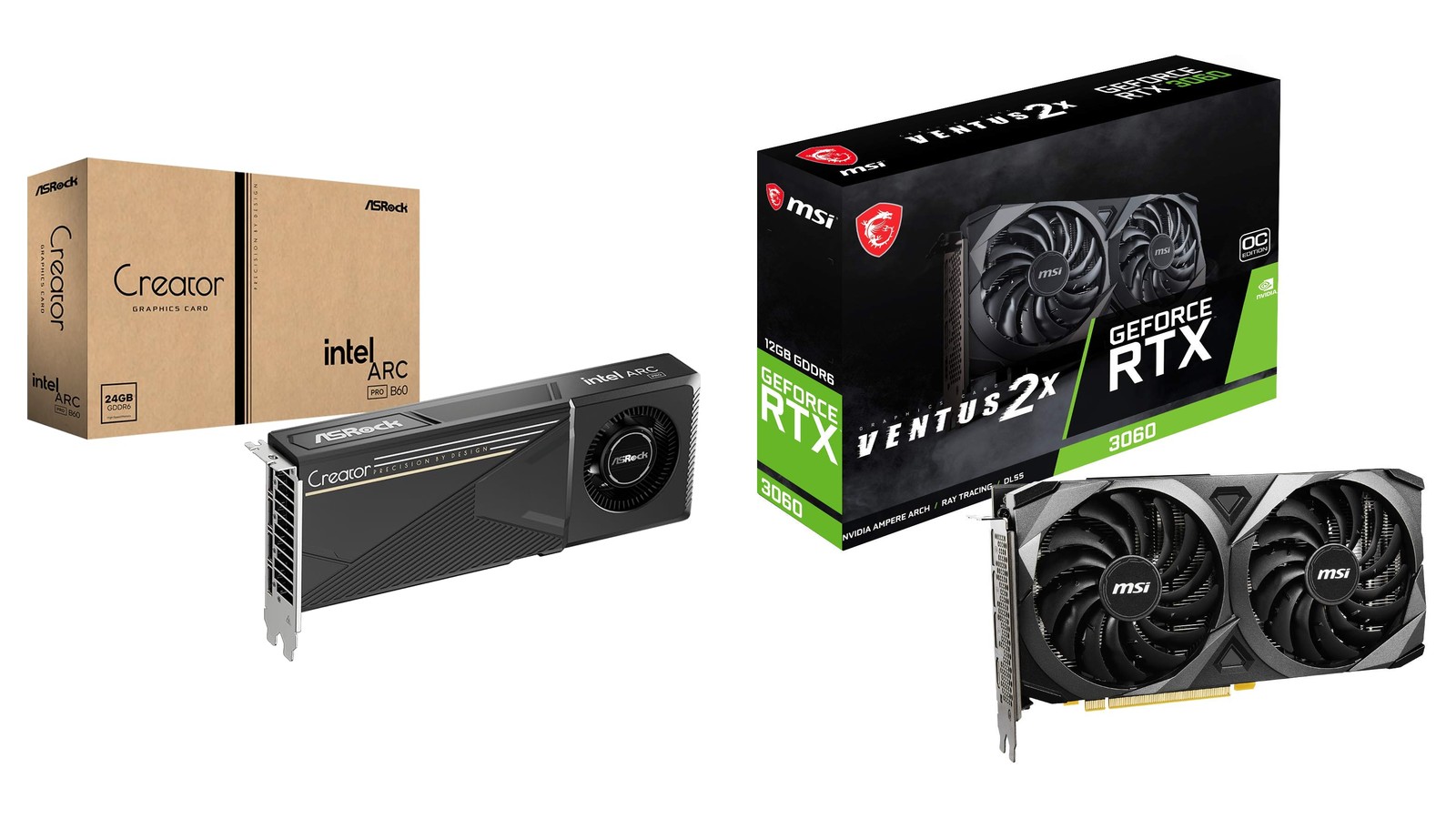
On the RTX 3060 (MSI Gaming RTX 3060 12GB, ZOTAC RTX 3060 Twin Edge OC 12GB), CUDA is the default path for llama.cpp, Ollama, vLLM, ExLlamaV2 and LM Studio. Multi-GPU layer splitting works out of the box in llama.cpp (--tensor-split) and Ollama. Prebuilt Docker images exist for everything.
On Arc, llama.cpp has SYCL and Vulkan back-ends, and Intel maintains vLLM XPU support plus its IPEX-LLM tooling. It works, but expect to pin versions, build from source more often, and wait longer for new model architectures to land.
"Intel Arc AI Boost" isn't a separate software product you install. It's Intel's marketing umbrella for XMX matrix engines and the software that uses them. For local LLMs, what matters is whether your runtime's SYCL or Vulkan build has kernels tuned for Battlemage.
Where the Arc B580 fits
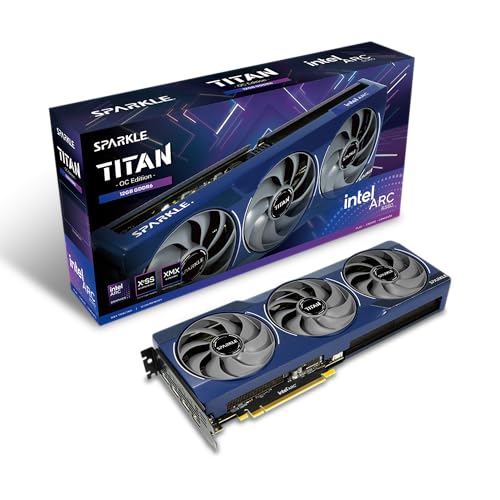
If you want to try Battlemage without committing $2,000, the consumer ASRock Arc B580 Steel Legend 12GB uses the same BMG-G21 GPU class and the same 456 GB/s, 192-bit memory configuration, with 12 GB instead of 24 GB. On the Vulkan scoreboard it generates at 70.14 tok/s on Llama 2 7B, essentially identical to the Arc Pro B60's 68.55. The Sparkle Arc B580 Titan OC 12GB is an alternative board. A single B580 is a 12 GB card, so it competes with one RTX 3060, not with either dual setup. If you want a single 24 GB Battlemage card instead of the Dual, the ASRock Arc Pro B60 Creator 24GB is in the catalog.
Perf-per-dollar and perf-per-watt
All SpecPicks arithmetic, using the prices and figures cited above:
- Cost per GB of VRAM: B60 Dual at $2,000 street = $41.7/GB (at the $1,200 MSRP, $25/GB). Two used 3060s at ~$590 = $24.6/GB. At MSRP they're level; at 2026 street prices the 3060s are about 40% cheaper per GB.
- Cost to run 70B at Q4: the 3060 pair can't do it, so its cost is effectively "a different setup." The cheapest measured 48 GB route in this synthesis, two used RTX 3090s, depends on current 3090 prices, but its 16.29 tok/s beats the B60 Dual's 8.4.
- Power: the B60 Dual's 400 W TBP vs 340 W for two 3060s. At the Wccftech 70B figure, the B60 Dual delivers about 0.021 tok/s per rated watt. Idle draw matters more for an always-on box, and blower cards rarely idle as quietly as dual-fan consumer cards.
Common pitfalls
- Buying the B60 Dual for a board without x8/x8 bifurcation. You'll see 24 GB. Check the manual first.
- Expecting the 3060 pair to "combine" into a 24 GB card for 70B. It pools memory, but 24 GB still can't hold a 42.5 GB Q4 file.
- Forgetting the KV cache. A 70B Q4 file that loads on 48 GB can still fail at 16K context.
- Mixing back-ends blindly on Arc. SYCL and Vulkan builds differ by 30%+ in either direction, depending on the phase.
- Paying scalper prices. The Dual's $1,200 MSRP and $2,000–$3,000 listings (TweakTown) change the value math completely.
Verdict matrix
Get the Arc Pro B60 Dual 48GB if…
- You need Llama 3.3 70B (or similar) at Q3/Q4 and refuse 2-bit quants.
- Your motherboard supports x8/x8 bifurcation and you have a 12V-2x6-capable PSU.
- You can find it near its $1,200 MSRP, and you're comfortable with SYCL/Vulkan tooling.
Get two RTX 3060 12GB cards if…
- Your largest daily model is 32B at Q4 or smaller.
- You want the CUDA ecosystem, fast prefill and prebuilt containers.
- You're on a budget: a used pair costs a fraction of the Dual's street price.
Get neither if…
- You mostly run 8B–14B models; one 12 GB card is enough.
- You need fast 70B. Two used RTX 3090s measured about 2× the B60 Dual's 70B speed in the public data.
Recommended pick
If 70B at 4-bit is the goal, the Arc Pro B60 Dual is the only option in this comparison that runs it entirely in VRAM, and at its $1,200 MSRP it costs about $25 per GB of VRAM. Buy it only after confirming bifurcation support, and expect Wccftech-class speeds (~8 tok/s), not 3090-class speeds. The counter-case: if you'd be satisfied with a 32B model, the RTX 3060 pair costs about a third as much, runs faster prefill on CUDA, and avoids every motherboard caveat above.
Bottom line
The Arc Pro B60 Dual 48GB beats two RTX 3060 12GB cards on the one metric that decides 70B: 48 GB vs 24 GB of pooled VRAM. The 3060 pair wins on price, software maturity and prefill speed, which makes it the better buy for anything 32B and below.
Related guides
- Intel Arc Pro B60 vs RTX 3060 12GB for Local LLMs
- Dual RTX 3060 vs Single GPU for Llama 70B
- Best Parts for a Dual RTX 3060 24GB Local LLM Build
- RTX 3060 12GB benchmarks
Live price comparison
Current prices: MSI RTX 3060 12GB · ZOTAC RTX 3060 Twin Edge 12GB · ASRock Arc B580 Steel Legend · ASRock Arc Pro B60 Creator 24GB. Prices change daily; the B60 Dual itself is not stocked by Amazon at the time of writing.
Citations and sources
- Maxsun, Intel Arc Pro B60 Dual 48G Turbo product page — per-GPU specs, 400 W TBP, 12V-2x6. Accessed September 24, 2026.
- Intel, Arc Pro B60 Graphics specifications (ARK) — 24 GB GDDR6, 192-bit, 456 GB/s, 20 Xe cores, 200 W TBP, PCIe 5.0 x8. Accessed September 24, 2026.
- LTT Labs, Maxsun Intel Arc Pro B60 Dual 48G Turbo review — bifurcation requirement, blower cooling. Accessed September 24, 2026.
- Wccftech, Maxsun Arc Pro B60 Dual 48G Turbo hands-on — MSRP and street price, LM Studio 70B and 30B-A3B results, BIOS notes. Accessed September 24, 2026.
- TweakTown, B60 Dual listed in the US for $3,000. Accessed September 24, 2026.
- NVIDIA, GeForce RTX 3060 family and Wikipedia, GeForce 30 series — 12 GB, 192-bit, 360 GB/s, 170 W. Accessed September 24, 2026.
- ggml-org, llama.cpp Vulkan scoreboard #10879 and CUDA scoreboard #15013. Accessed September 24, 2026.
- Level1Techs forum, Arc Pro B60 for local LLMs — SYCL vs Vulkan results. Accessed September 24, 2026.
- XiongjieDai, GPU Benchmarks on LLM Inference — 2× RTX 3090 70B Q4_K_M and quant perplexity table. Accessed September 24, 2026.
- Hugging Face: Llama 3.3 70B GGUF, Llama 3.3 70B config, Qwen3-32B-GGUF, gpt-oss-20b GGUF. Accessed September 24, 2026.
- getpcparts, RTX 3060 used market prices — eBay sold-listing averages as of September 19, 2026 (the page does not split 8 GB and 12 GB variants). Accessed September 24, 2026.
This piece is editorial synthesis based on publicly available information. No independent first-party benchmarking is reported. VRAM-fit, KV-cache, cost-per-GB and dual-3060 throughput estimates are SpecPicks arithmetic from the cited specifications.