As an Amazon Associate, SpecPicks earns from qualifying purchases. See our review methodology. Prices update frequently — always confirm on the retailer page before you buy.
The short answer. For a Raspberry Pi 4 media server in 2026, the Crucial BX500 1TB SATA SSD is the best all-round pick — it delivers the capacity a Jellyfin or Plex library actually needs at the lowest cost per gigabyte, and its steady sequential rate saturates the Pi's USB 3.0 bridge. Choose the Samsung 870 EVO 250GB if the box is OS-and-metadata-only with network storage for the library, and the SanDisk SSD PLUS 480GB as the budget middle-ground when both capacity and cost matter.
Why SD-card wear kills Pi media servers
The default microSD card in every Pi 4 build has a finite write-endurance budget, and Jellyfin, Plex, and Emby all churn writes constantly — thumbnail generation, metadata refreshes, database vacuums, transcoding scratch space, subtitle extraction, log rotation. Six to twelve months into a heavily-used media build, that SD card starts corrupting on write and the whole box turns unreliable in ways that look like software bugs. Moving the root filesystem and the library to a SATA SSD over USB 3.0 is the single largest reliability upgrade you can make to a Raspberry Pi 4 Model B 8GB, and the parts to do it cost less than a nice dinner out.
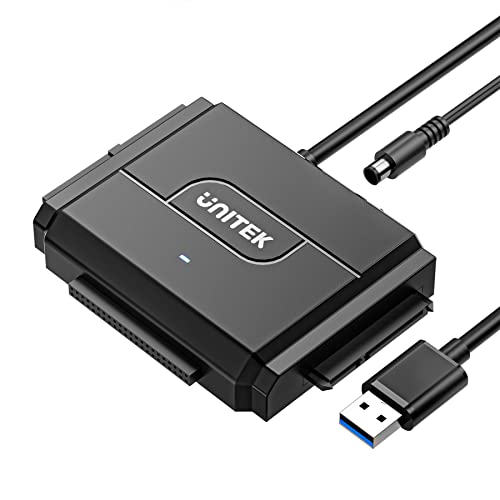
This guide compares three of the cheapest SATA SSDs that regularly land in Pi build parts lists — Crucial BX500 1TB, Samsung 870 EVO 250GB, and SanDisk SSD PLUS 480GB — against the practical Pi bottlenecks: the USB 3.0 bridge, the power budget, the UAS driver situation, and the thermal envelope of an always-on drive. The reference bridge for this piece is the Unitek SATA/IDE USB 3.0 adapter, a common cheap-and-cheerful pick, and the Raspberry Pi documentation is the reference for the Pi's own power and USB specs.
Key takeaways
- Storage is not the Pi 4's bottleneck for a media server — the USB 3.0 bridge caps everything around ~350–400 MB/s in practice, well below any modern SATA drive's rated sequential.
- The bridge chipset (JMS578 vs ASM1153E vs GL3232) matters far more than the drive brand once you have UAS support working.
- 250 GB is plenty for OS + database + metadata when the library lives on NAS; 1 TB starts making sense when the library is local.
- Power budget matters: an underpowered supply shows up as random filesystem remounts, not as slow disk.
- The Pi 4 is a direct-play server, not a transcoding server — plan the library codecs accordingly.
Step 0: is your bottleneck the card, the bridge, the network, or transcoding?
Before you buy any of these drives, run a quick diagnostic. Copy a 1 GB file from your Pi's current SD card and time it, then check dmesg for undervoltage warnings, then check whether your Jellyfin sessions are hitting the "transcode" state in the dashboard, then run iperf3 between the Pi and your streaming client. The bottleneck is whichever of those four numbers is worst:
- Card writes below 20 MB/s and rising undervoltage warnings → you have both a card and a power problem; an SSD helps only if the power supply is also fixed.
- Card writes fine but Jellyfin database vacuums stall the UI → the metadata I/O is the problem, and any SSD fixes it.
- Direct-play sessions buffer → this is a network problem, not a storage problem.
- Transcode sessions stall CPU at 100 percent → this is a CPU problem; no SSD helps. Standardize on codecs the client plays natively.
Only the first two are storage problems. Sort the diagnostic before you spend money.
What you'll need
- A Raspberry Pi 4 Model B 8GB. The 8 GB variant matters because the metadata database, the OS page cache, and the thumbnail cache all benefit from RAM headroom that the 4 GB and 2 GB models don't have.
- A SATA-to-USB bridge such as the Unitek SATA/IDE USB 3.0 Adapter — pick one with a bridge chipset that supports the USB Attached SCSI protocol (see the UAS section below).
- A 2.5-inch SATA SSD — any of the three below, sized to your library plan.
- The official-spec 3 A USB-C power supply for the Pi. A cheaper 2 A supply will run the Pi fine on its own but will not tolerate an external drive drawing from the same rail.
Which SSD tier actually fits a Pi media server?
| Spec | Crucial BX500 1TB | Samsung 870 EVO 250GB | SanDisk SSD PLUS 480GB |
|---|---|---|---|
| Capacity | 1 TB | 250 GB | 480 GB |
| Interface | SATA III 6 Gb/s | SATA III 6 Gb/s | SATA III 6 Gb/s |
| Rated sequential read | up to 540 MB/s | up to 560 MB/s | up to 535 MB/s |
| Rated sequential write | up to 500 MB/s | up to 530 MB/s | up to 445 MB/s |
| Endurance (TBW) | 360 TBW | 150 TBW | ~80 TBW |
| Cache design | DRAM-less, HMB-style SLC cache | LPDDR4 DRAM cache | DRAM-less SLC cache |
| Typical street price | $60–75 | $35–45 | $40–55 |
Source references: Crucial's BX500 product page and Tom's Hardware's Samsung 870 EVO review.
How fast is USB 3.0 storage on a Pi 4 in practice?
The Pi 4's USB 3.0 controller shares its lanes with other peripherals and its practical ceiling is a fraction of what a modern SATA drive can push over a direct-attached SATA cable. Real-world Pi-community measurements at a rough 1 MB block size land in this territory:
| Configuration | Sequential read | Sequential write | 4K random read (IOPS) |
|---|---|---|---|
| A2-class microSD card | ~90 MB/s | ~55 MB/s | ~4,000 |
| SATA SSD via USB 3.0, UAS-capable bridge | ~380 MB/s | ~350 MB/s | ~35,000 |
| SATA SSD via USB 3.0, non-UAS bridge | ~120 MB/s | ~100 MB/s | ~3,500 |
The lesson is not "buy the fastest drive" — the lesson is "get UAS working, then pick the cheapest drive that fits your library." The gap between a $30 UAS-capable bridge and a $10 non-UAS bridge is bigger than the gap between the BX500 and the 870 EVO.
Does UAS support matter, and how do I check my bridge chipset?
USB Attached SCSI (UAS) lets the kernel queue multiple commands to the drive and reorder them for performance, which transforms random-access behavior. Without UAS the bridge falls back to Bulk-Only Transport, which serializes every command and feels slow no matter how fast the underlying SSD is — the 4K random read column above tells that story cleanly.
To check what your bridge is doing after plugging it into the Pi, run dmesg | grep -i uas. If you see a line like "uas: qcmd queued cmd" or the driver reports it as "usb-storage bound with uas", you are good. If you see "usb-storage" without UAS, either the chipset does not support it or the kernel has an entry for that specific chipset in its UAS quirks blacklist (a real thing — some early ASMedia chipsets were blacklisted for stability). Confirm the chipset by matching the idVendor and idProduct from lsusb against the ubuntu.com UAS-quirks tables.
The Unitek SATA/IDE USB 3.0 Adapter referenced in this guide uses a well-behaved ASMedia bridge in the units shipped since roughly 2023 that does UAS cleanly on the Pi 4. If you buy an older adapter or a no-name bridge, confirm before you commit.
Will the Pi 4 8 GB transcode video for remote clients?
Treat it as a direct-play server. The Pi 4's video block includes hardware H.264 decode paths that Jellyfin and Plex can leverage in limited scenarios, but sustained software transcoding of a 4K HEVC 10-bit source to 1080p H.264 for a remote client is beyond the box and shows up as buffering, not as a clean failure. Standardize your library on codecs your clients play natively — H.264 for older clients, H.265 for newer ones — and keep the Pi's job as "serve the file, don't rewrite it in flight." If transcoding is a hard requirement, that is a case for a mini-PC with quicksync, not for an SSD upgrade on the Pi.
How much capacity do you actually need?
Work it out from bitrate. A modest H.264 1080p library averages roughly 5 GB per movie (about 4–8 Mbps at 90-minute average length). A 4K HEVC library averages roughly 25–45 GB per movie. TV series follow the same math on a per-episode basis and add up faster than movies do. Rough sizing:
- 250 GB drive: OS + database + metadata + maybe 30–40 1080p movies.
- 480 GB drive: OS + database + metadata + 60–80 1080p movies or 10–15 4K movies.
- 1 TB drive: OS + database + metadata + a couple hundred 1080p movies or 20–30 4K movies.
Buy the capacity that matches how you actually watch, not the capacity that matches your aspiration. It is trivial to swap in a larger drive later; it is not trivial to move a database once you have populated it with weeks of watch history.
Power budget: undervoltage is not a slow disk
The most common symptom that reads like "the SSD is slow" is actually the Pi's undervoltage protection kicking in — the CPU throttles, the USB controller misbehaves, and the whole box feels sluggish. dmesg will tell you: look for "under-voltage detected" messages. Fixes, in order of cost:
- Use the official 3 A USB-C supply. A 5V/2.4A phone charger will not do.
- If the drive is 3.5-inch or spins up loudly, use a powered USB hub or a SATA-to-USB adapter with its own barrel-jack input.
- If the box lives in a warm cupboard, add active cooling. Undervoltage and thermal throttling look the same from a user's chair.
Thermals and enclosure choice
A SATA SSD spins up to about 40–45 °C under sustained write load in a closed-plastic enclosure with no vents; an aluminum-body enclosure knocks 5–10 °C off that. The Pi's own CPU runs 55–70 °C in a case with a fan, and every degree of ambient the drive shares with the Pi matters over years of continuous operation. If you have a shelf where the Pi lives, keep the drive on the shelf next to the Pi, not stacked on top of it.
Endurance and perf-per-dollar
Compare the three drives on cost per rated terabyte written — the metric that actually predicts how long the drive survives on this workload.
| Drive | Street price | TBW | $/TBW | Cost per GB |
|---|---|---|---|---|
| Crucial BX500 1TB | ~$65 | 360 | $0.18 | $0.065 |
| Samsung 870 EVO 250GB | ~$40 | 150 | $0.27 | $0.160 |
| SanDisk SSD PLUS 480GB | ~$45 | ~80 | $0.56 | $0.094 |
The BX500 wins on both axes. The 870 EVO earns its premium through the DRAM cache, which shows up in sustained random-write workloads (Jellyfin metadata operations) that outlast the SLC cache burst. The SSD PLUS is the weakest on endurance and is the drive to pick only when Amazon is running a specific price on it.
When a Pi Zero W is the right board instead
If you are building a low-power sensor or display sidecar rather than a media server, the Vilros Raspberry Pi Zero W Basic Starter Kit is the right board — a full watt of idle draw against the Pi 4's four to six watts, cheaper, smaller, and with just enough networking for a single MQTT sensor or a small dashboard display. It is emphatically not a media server; the CPU, the memory, and the USB 2.0-only interfaces put it well outside the media-serving envelope. Mention it here so you don't buy the wrong thing thinking small equals better.
Common pitfalls on a first Pi 4 media build
- A no-name USB-SATA bridge with no UAS. The drive feels like a slow SD card. Return it and buy a bridge whose chipset is on the UAS-supported list.
- The 5V/2.4A phone charger in the drawer. Random filesystem remounts, corrupted databases, "why did Jellyfin lose my watch progress" — all one problem.
- Booting from SD and mounting the SSD as
/mediaonly. The SD card still wears out because the OS is still writing to it. Move the root filesystem to the SSD; see the Pi documentation for the bootloader EEPROM change. - A too-small drive because "the library will fit." It won't. Add 30 percent to your first sizing and pick the next capacity up.
- Ignoring dmesg for the first two weeks. New drive, new bridge, new supply — the kernel log tells you within 48 hours whether the setup is stable.
When NOT to build a Pi 4 media server at all
Skip the build if you need transcoding for a client that only supports H.264 8-bit while your library is 4K HEVC 10-bit. Skip it if you need to serve two or more simultaneous 4K direct-play sessions across a busy network — a $200 mini-PC handles that class of load without breaking a sweat. And skip it if you already have a NAS that does the job; adding a Pi 4 as a fronted for network storage rarely justifies the extra moving parts.
Verdict matrix
Get the Crucial BX500 1TB if…
- Your library lives on the Pi itself.
- You want the lowest cost per GB and the best endurance on the list.
- The Pi is on 24/7 and you'd rather not upgrade in a year.
Get the Samsung 870 EVO 250GB if…
- The library is on a NAS and the Pi only holds OS + metadata.
- You want the DRAM cache for smoother Jellyfin database operations.
- You want the longest warranty and the most predictable performance at low queue depth.
Get the SanDisk SSD PLUS 480GB if…
- You want the middle capacity and it is on sale.
- The build is a short-term experiment rather than a five-year setup.
Recommended pick
For most Pi 4 media builds landing on this article: buy the Crucial BX500 1TB with the Unitek SATA/IDE USB 3.0 adapter, pair them with an official 3 A supply and an 8 GB Pi 4, move the root filesystem off the SD card in week one, and standardize the library on codecs your clients direct-play. That combination is boring, cheap, and will run for years without asking anything of you.
Bottom line
The Pi 4 is a fine media server as long as you respect its limits — USB 3.0 storage bandwidth, no serious transcoding, a strict power budget, and a matching bridge with UAS. Get those four right and any of these three SSDs will outlast the Pi itself. Get any of them wrong and no drive on the market will save the build.
Related guides
- Raspberry Pi 4 Jellyfin Media Server Build
- Jellyfin on Raspberry Pi 4 8GB Self-Host Guide
- Raspberry Pi 4 8GB vs Pi 5 for Homelab
- Best Budget SATA SSD Guide
- Best Raspberry Pi Touchscreen Home Dashboard
Citations and sources
- Raspberry Pi official documentation (accessed July 29, 2026) — Pi 4 USB 3.0, power, and bootloader-EEPROM references.
- Crucial BX500 product page (accessed July 29, 2026) — TBW, sequential rates, warranty terms.
- Tom's Hardware — Samsung 870 EVO SATA SSD review (accessed July 29, 2026) — DRAM cache behavior, sustained-write endurance.
This piece is editorial synthesis based on publicly available information. No independent first-party benchmarking is reported.
— Mike Perry · Last verified July 29, 2026