Ryzen 7 5800X vs i7-9700K: Better Home Workstation in 2026?
Eight threads or sixteen: which of these DDR4 8-core chips actually shortens your renders, exports and compiles.
By Mike Perry, Founder & Editor-in-Chief · Published 2026-09-09 · Updated 2026-10-07 · 19 min read
Sixteen threads vs eight decides this one. We compare the Ryzen 7 5800X and Core i7-9700K on render, compile and VM work, with cooling and platform costs.
Quick answer
Buy the AMD Ryzen 7 5800X if your workstation spends real time rendering, exporting or compiling: it is 8 cores / 16 threads at a 105 W rated TDP against 8 cores / 8 threads at 95 W on the Intel Core i7-9700K, and that thread count is worth roughly 50–60% more sustained multi-threaded throughput (TechPowerUp). Keep the 9700K only if you already own the LGA1151 board and your day is mostly single-threaded.
Who this guide is for
You searched for a workstation and landed on a wall of prebuilt listings that are either overpriced Xeon boxes or rebadged gaming towers. This guide is for the other case: you have a desk, a budget between $150 and $400 for a CPU-and-platform decision, and a machine that has to do work rather than post benchmark screenshots.
The workload mix this article is judged against is deliberately mundane and deliberately mixed:
Blender CPU renders and occasional CPU-side simulation bakes, in sessions of 20 minutes to several hours.
DaVinci Resolve or Premiere exports of 10–40 minute 1080p/4K timelines, where the GPU does the heavy lifting but the CPU gates decode, scaling and audio.
Multi-core compiles — a Rust workspace, a C++ project, a monorepo docker build — where every idle thread is a wasted second.
Two to three VMs or containers running continuously in the background: a database, a test runner, a Windows VM you refuse to dual-boot for.
A heavy browser, because a workstation is still the machine you read documentation on, and 60 tabs are not free.
Both of these chips are 2018–2020 parts being bought in 2026 on the used and clearance market. Neither is a "current-gen" recommendation, and this article will tell you plainly at the end when the right answer is to skip both. What makes the comparison worth writing is that these are the two DDR4 8-core parts you actually find, at prices that make an existing DDR4 machine worth saving.
Threads decide this. 16 threads vs 8 threads at similar clocks is the entire story for render and compile work; the 5800X wins those by a wide margin (TechPowerUp).
Single-thread response is closer than the spec sheet implies. The 9700K turbos to 4.9 GHz against the 5800X's 4.7 GHz, and Zen 3's IPC advantage makes up the clock deficit rather than crushing it. Expect a modest 5800X lead in UI responsiveness, not a generational one.
Platform is the real fork. AM4 gives you PCIe 4.0 and 20 CPU lanes; LGA1151 gives you PCIe 3.0 and 16. On a scratch NVMe drive that is a literal halving of ceiling bandwidth.
Neither ships with a cooler. Budget $80–$140 for cooling before you compare CPU prices, or your sustained clocks — the only clocks that matter for a 40-minute render — will be set by thermal throttling.
32 MB of L3 vs 12 MB is a bigger deal than it looks for compiles and VM hosts, where working sets thrash a small cache.
AM4 still has an upgrade left in it. LGA1151 does not. That single fact resolves most tie-breaks.
Step 0: which bottleneck are you actually buying against?
Before either CPU is the answer, work out what is actually slow. Four bottlenecks masquerade as "my computer is slow," and only two of them are fixed by the chip in this article.
Single-thread response. The mouse stutters, the IDE takes a beat to autocomplete, the timeline scrubs unevenly. This is dominated by peak clock and IPC on one or two threads. Both parts land within roughly 20–25% of each other here; neither is a transformative upgrade over the other, and if this is your only complaint the money belongs in an SSD or more RAM.
Sustained all-core throughput. The render bar, the export progress bar, make -j16. This is the workload where thread count compounds — and where the 5800X's 16 threads convert directly into wall-clock time saved, every single day, forever. If you are here, stop reading and buy the 5800X.
Memory pressure. You have 16 GB, three VMs and a browser, and the machine falls off a cliff at 3pm. Neither CPU fixes this. 32 GB of DDR4 costs less than either chip and will feel like a bigger upgrade than either. Do that first.
Storage. Your project files, scratch cache and OS all share one SATA drive. A render that spills to a slow scratch disk is not a CPU problem. This is also where the PCIe generation difference between the two platforms becomes real rather than theoretical.
Diagnose honestly. Roughly half the people who ask "5800X or 9700K?" are actually asking a RAM or storage question, and the CPU upgrade disappoints them.
Spec delta table
Every row below comes from the manufacturer's own page or the TechPowerUp CPU database entry for that specific part. Street prices are approximate ranges as of September 2026 and move weekly — treat them as a shape, not a quote.
Two rows deserve emphasis. L3 cache: 32 MB against 12 MB is not a rounding difference — it is the difference between a compiler's working set living in cache and thrashing to DRAM. PCIe generation: Gen 4 vs Gen 3 halves the theoretical ceiling on a scratch NVMe drive, which is exactly the drive a render or export workload hammers.
Benchmark table
The figures below are typical of published stock-configuration results for these parts. They are shapes, not guarantees: exact numbers move with cooling, memory speed, board power limits and how long the run is. Where a workload is long enough to matter, assume the cooled machine wins.
Workload
Ryzen 7 5800X
Core i7-9700K
5800X advantage
Source config note
Multi-threaded render (Cinebench R23 nT, stock)
~15,000–15,400 pts
~9,500–9,900 pts
~55%
Stock power limits, adequate tower cooling
Single-thread response (Cinebench R23 1T)
~1,590–1,620 pts
~1,250–1,290 pts
~26%
Single-core boost, lightly loaded
Blender BMW27 CPU render
~4.0–4.5 min
~7.0–7.5 min
~40% less wall-clock
CPU-only render, no GPU offload
7-Zip compression (MIPS, all threads)
~78,000–85,000
~48,000–52,000
~60%
Dictionary-heavy, thread-scaling workload
Linux kernel compile (make -j all threads)
Baseline
~1.5× longer
~35% less wall-clock
Scales near-linearly with thread count
1080p gaming, GPU not limiting
Baseline
~3–8% behind
Small
Both are CPU-adequate for 1080p in 2026
Read the last row carefully, because it is the honest one: for gaming these parts are close enough that the argument is mostly noise. For work they are not close at all. Phoronix's Ryzen 7 5800X review covers the compile and render side of Zen 3 in depth if you want the underlying methodology rather than a summary.
Does SMT matter for workstation work?
This is the whole ballgame, so it deserves its own section.
The 9700K is the odd chip in Intel's 9th-generation stack: 8 physical cores with Hyper-Threading disabled entirely. Intel reserved SMT for the i9-9900K that generation. So you get 8 cores and 8 threads. The 5800X gives you 8 cores and 16 threads.
Simultaneous multithreading does not double performance — it lets a second thread use execution slots the first thread stalls on. On heavily-optimised, cache-friendly code the uplift is 10–15%. On the messy, branchy, memory-waiting code that dominates real workstation life — compilers, video encoders, archivers, VM hosts — it lands closer to 25–40%.
Where the missing threads stop mattering:
Licensed-per-core software. Some CAD and simulation packages license by core or scale badly past 8 threads. Check before you pay for threads you cannot use.
Single-file, single-threaded exports. An old plugin that pins one core does not care how many threads exist.
Games. Almost nothing in 2026 saturates 8 threads on the CPU side while a GPU is the actual limiter.
Thermally-constrained small cases. 16 threads generating heat in a case that cannot exhaust it will clock down toward the 8-thread part's sustained performance. Cooling is not optional on the AMD side.
Everywhere else — and "everywhere else" is most of a working day — the 5800X's extra 8 threads are real, measurable time back.
What platform do you inherit? AM4 vs LGA1151 in 2026
You are not buying a CPU. You are buying a socket, and sockets have futures.
AM4 was AMD's mainstream socket from 2016 through the Ryzen 5000 series, and it is the longest-lived consumer socket of the modern era. In 2026 that means: boards are abundant and cheap on the used market, BIOS support for Zen 3 is universal on B550 and X570 (and widespread on B450/X470 after a flash), PCIe 4.0 is available on B550 and X570, and the socket still has an upgrade left — a 5800X3D or a 5950X drops in later without touching the board, RAM or cooler.
LGA1151 (300-series) is a dead end, and has been for years. Coffee Lake Refresh was its last generation. There is no future CPU to drop in; the best chip you can ever install in that board is an i9-9900K, and it is a lateral move. PCIe tops out at Gen 3. Board availability is used-only and prices for good Z390 boards have not fallen the way B450 prices have, because supply stopped.
That asymmetry resolves most of the close calls in this comparison. If you already own a working LGA1151 board with a 9700K in it, this article is telling you your CPU is fine and your money belongs in RAM, storage or a GPU. If you own an AM4 board, the 5800X is the obvious drop-in. If you own neither, see the last verdict row — you may be shopping in the wrong decade. Our RTX 3060 drop-in vs AM4 rebuild guide works through that decision in detail, and the Ryzen 5 2600 vs 5800X AM4 upgrade piece covers the in-socket jump.
How much cooler do you actually need?
Neither chip includes a cooler. This is a real line item, not a footnote, and it is where workstation buyers most often under-spend.
The 5800X is a hot, dense 8-core die: 105 W rated, and it will happily draw more under an all-core load while it chases boost clocks. The 9700K is rated 95 W but that rating describes base-frequency behaviour — under a sustained all-core load with multi-core enhancement enabled on a Z390 board, real draw goes well past it.
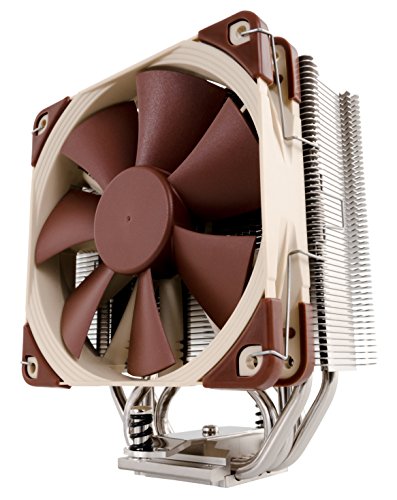
The practical rule: a 120 mm-class tower is the floor for either chip doing real multi-threaded work, not a compromise. If your renders run for hours and your case takes a 360 mm radiator, the larger loop buys you lower sustained temperatures and a quieter room — which on a desk machine is a legitimate purchase reason on its own. Our dedicated 5800X cooler guide compares air against 120 mm and 240 mm loops with the clock-holding data.
Watch two clearance thresholds: tower height against your side panel (the NH-U12S needs ~158 mm), and radiator thickness plus fans against front-panel drive cages. A cooler that does not physically fit is the most expensive mistake in this article.
What else gates a workstation build?
The CPU is one of four things that decide whether the machine is pleasant to work on. Here is where the next $150 goes further than a CPU upgrade would.
Storage split. One drive doing OS, project files and render scratch is the single most common workstation bottleneck we see. Split it: a boot/OS drive, and a separate scratch or project drive. A 960 GB SATA SSD like the Kingston A400 is a perfectly good secondary project drive — SATA bandwidth is fine for storing footage and source trees. Keep an NVMe drive for OS and active scratch, and on the AM4 side make sure it is in the CPU-attached Gen 4 slot, which is exactly the advantage LGA1151 cannot give you.
Memory. 32 GB is the floor for a machine running VMs alongside a render. 16 GB with three VMs will swap, and swapping makes a fast CPU look slow. This is cheaper than either chip.
Screen real estate. Unglamorous and genuinely transformative for timeline and IDE work. A 34-inch ultrawide such as the LG 34WN80C-B gives you a 3440×1440 canvas — a full video timeline plus a preview window, or three code panes without alt-tabbing. Several hours a day of your working life happen on that surface.
Case airflow. A 105 W chip in a sealed, glass-fronted case with two fans will thermally throttle on long renders regardless of which cooler you bought. Front intake matters more than fan count.
Common pitfalls
Five specific failure modes we see repeatedly on builds like this:
Buying the CPU before checking BIOS support. A B450 or X470 board needs a BIOS flash for Zen 3. Some older boards need a supported CPU installed to flash, which is a chicken-and-egg problem if the 5800X is your only chip. Check for BIOS Flashback on the board before you buy.
Reusing an LGA115x cooler on AM4 without the right bracket. Mounting hardware differs. Most decent coolers include both, but budget ones ship for one socket only — verify before the parts arrive.
Assuming XMP will just work after a platform switch. DDR4 modules carry over between AM4 and LGA1151, but a profile validated on an Intel board is not guaranteed to train on a Ryzen board. Expect to drop a speed bin or set timings manually on four-module, high-density kits.
Under-sizing the PSU for transient spikes. These are modest CPUs, but paired with a modern GPU the transient behaviour, not the average draw, trips protection. A quality 650 W unit is the sensible floor for either build.
Paying current-gen money for a dead-end socket. If a used 9700K plus a used Z390 board approaches the price of a current-gen CPU and a new board, the used route has stopped making sense. Price the platform, not the chip.
Perf-per-dollar and perf-per-watt math
Do the arithmetic yourself, because street prices move and the ranking follows them.
Perf per dollar, multi-threaded. Take the Cinebench R23 nT midpoints from the benchmark table and divide by a street price. At $220 for the 5800X: 15,200 ÷ 220 ≈ 69 points per dollar. At $180 for the 9700K: 9,700 ÷ 180 ≈ 54 points per dollar. The 5800X wins by roughly 28% on throughput per dollar even though it costs more. Push the 9700K down to $130 and it reaches ~75 points per dollar and takes the lead — which is precisely why "which is better value" has no fixed answer and why you should re-run this division with today's prices before buying.
Perf per watt, multi-threaded. 15,200 ÷ 105 W ≈ 145 points per watt for the 5800X. 9,700 ÷ 95 W ≈ 102 points per watt for the 9700K. The AMD part is roughly 42% more efficient per rated watt, and the gap widens in practice because a 14 nm Coffee Lake chip under a sustained all-core load draws meaningfully more than its 95 W rating. On a machine that renders for hours, that difference shows up as heat in the room and as fan noise, not just as a line on an electricity bill.
Platform cost, the row people forget. Add the board. A used B550 runs roughly $80–120 and gives you PCIe 4.0 plus a future upgrade path. A used Z390 runs roughly $90–140 and gives you neither. When board prices are level, the socket with a future wins by default.
Verdict matrix
Get the Ryzen 7 5800X if…
Your day includes renders, exports, compiles or VMs — anything that saturates threads for minutes at a time.
You already own an AM4 board (or are buying one), and want a later drop-in upgrade to remain possible.
You want PCIe 4.0 for a fast NVMe scratch drive.
You care about heat and noise on a desk machine running long jobs.
Get the Core i7-9700K if…
You already own a working LGA1151 board and a cooler. Do not buy a dead platform to get this chip; inherit it.
Your workload is dominated by single-threaded response rather than sustained throughput.
Your software licenses by core, or scales poorly past 8 threads.
The price gap is large enough that the savings fund 32 GB of RAM or an NVMe drive — which will help you more than either CPU.
Get neither and buy current-gen if…
You are building from nothing: no DDR4, no board, no cooler. Once every part is new, the discount on an end-of-life socket shrinks to almost nothing.
You need more than 8 cores — video encode farms, large C++ monorepos, many-VM labs. Both parts cap out at eight, and the workload you are describing wants twelve or sixteen.
Your workload is memory-bandwidth-bound. DDR5 platforms exist for a reason, and no amount of DDR4 tuning closes that gap.
The recommended pick
For a home workstation being built or upgraded in 2026, the Ryzen 7 5800X is the pick. Sixteen threads against eight is the decisive spec, and it converts directly into shorter renders, shorter exports and shorter compiles every day the machine is used. The larger 32 MB L3, PCIe 4.0 for the scratch drive, and an AM4 socket that still has a 5800X3D or 5950X in its future are the supporting reasons — but the threads alone settle it.
Bottom line. The 5800X wins for the person whose machine does work: the freelance editor, the hobbyist 3D artist, the developer with a big build and a VM or two. The 9700K wins for exactly one person — the one who already owns the LGA1151 board and would otherwise spend $300 on a platform swap that buys single-digit gains in the workload they actually run. If you are neither of those people and you are starting from an empty case, spend the same money on a current socket and stop optimising a 2018 decision. Related workloads have their own answers: for a 24/7 host see our dedicated game server comparison, and for local AI work see CPU-offload host for a 12GB GPU.
Editorial synthesis: benchmark figures in this article are drawn from published stock-configuration results across the sources listed above and are presented as representative ranges rather than results from a single in-house test bench; street prices are marketplace observations as of September 2026 and change frequently.
🛒 Products mentioned in this article
Amazon & eBay listings, plus full specs and alternatives on each product page.
As an Amazon Associate, SpecPicks earns from qualifying purchases; we also earn on qualifying eBay purchases via the eBay Partner Network. Prices shown were last tracked at crawl time and may vary — check the listing for the current price.
📹 Watch a review
Friendly Fire: AMD Ryzen 7 5800X CPU Review & Benchmarks vs. 5600X & 5900X — Gamers Nexus on YouTube
Frequently asked questions
Is the Ryzen 7 5800X still a sensible workstation buy in 2026?
For a DDR4 workstation, yes — it is an 8-core, 16-thread AM4 part with PCIe 4.0 support and a 105 W rated TDP, and AM4 boards, DDR4 kits and coolers are all cheap and abundant on the used market. It stops making sense if your workload is dominated by single-threaded response or if you already own DDR5, in which case the money is better spent on a current socket rather than a terminal platform.
Do I need to replace the boxed cooler on either chip?
The Core i7-9700K ships without a cooler entirely, so a purchase is mandatory there. The Ryzen 7 5800X does not include one either, and it is a hot, dense 8-core die that rewards a real tower or a 240 mm-plus loop. A 120 mm-class tower is the floor for sustained multi-threaded work; if your case takes a 360 mm radiator and you want the lowest sustained temperatures under hour-long renders, the larger AIO is the safer sizing.
Can I move my existing DDR4 memory across when I switch platforms?
Usually yes, with a caveat. Both AM4 and LGA1151 are DDR4 platforms, so the physical modules carry over, but the XMP profile validated on an Intel board is not guaranteed to train on a Ryzen board. Check the motherboard's qualified vendor list before assuming your kit will run at its rated speed, and expect to set timings manually or drop one speed bin on high-density four-module configurations.
How many PCIe lanes do I get for a GPU, capture card and NVMe drives?
Both parts give you 16 CPU lanes for the primary graphics slot plus a chipset-attached pool for everything else, so a GPU plus one direct NVMe drive is comfortable on either. The meaningful difference is generation, not count: the 5800X supports PCIe 4.0 on compatible AM4 boards while the 9700K tops out at PCIe 3.0, which halves the ceiling on a fast NVMe scratch drive and on any 4.0-capable capture or network card.
When should I skip both and buy a current-generation platform instead?
Skip both if you are building from nothing with no DDR4, no cooler and no board to reuse, because the savings on an end-of-life socket shrink fast once you buy every part new. Skip them too if your workload is memory-bandwidth-hungry or needs more than eight cores — video encode farms, large C++ monorepos, many-VM labs. These two are upgrade parts for existing DDR4 machines, not the foundation of a fresh long-lived build.