

Timetec
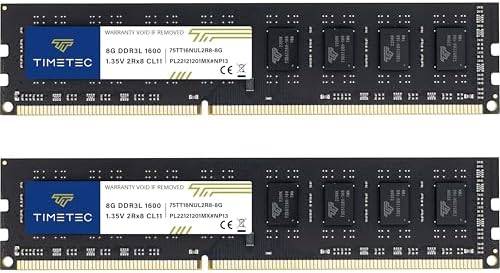
Timetec 8GB KIT(2x4GB) DDR3 / DDR3L 1333MHz PC3-10600 Non-ECC Unbuffered 1.5V / 1.35V CL9 2Rx8 Low Density Dual Rank 240 Pin UDIMM Desktop PC Computer Memory RAM Module Upgrade (8GB KIT(2x4GB))
Bottom line: The Timetec 8GB KIT: Dual voltage: runs at 1.5V on DDR3 boards or 1.35V on DDR3L; main trade-off: 1333MHz PC3-10600 is the slow end of DDR3 speeds.
As an Amazon Associate, SpecPicks earns from qualifying purchases. Full disclosure →
Pros & Cons
Pros
- ✓ Dual voltage: runs at 1.5V on DDR3 boards or 1.35V on DDR3L
- ✓ Low-density 2Rx8 dual rank works on older boards that reject high-density
- ✓ Lifetime warranty from purchase date with US-based tech support
- ✓ Matched 2x4GB kit avoids mixing mismatched single sticks
Cons
- ✗ 1333MHz PC3-10600 is the slow end of DDR3 speeds
- ✗ CL9 latency is looser than CL7 or CL8 enthusiast DDR3
- ✗ Desktop 240-pin UDIMM only, will not fit any laptop
- ✗ PCB color varies between black and green by production batch
Manufacturer description
Each module runs at 1333MHz PC3-10600 with CL9 timings in a 2Rx8 dual-rank, low-density configuration, which matters if you are reviving an older Core 2, first-gen Core i-series, or AM3 board that rejects high-density chips. The dual-voltage design is the practical win here: the same stick operates at 1.5V on legacy DDR3 boards or drops to 1.35V on DDR3L platforms, so you do not have to guess which spec your motherboard wants before ordering. The modules are non-ECC and unbuffered, matching what consumer desktop chipsets expect from Intel and AMD alike. Timetec backs the kit with a lifetime…
SpecPicks Verdict
SpecPicks has no buyer-rating or benchmark data for Timetec 8GB KIT(2x4GB) DDR3 / DDR3L 1333MHz PC3-10600 Non-ECC…, so this read rests on the manufacturer's listed specs (how we evaluate). Compare with similarly-priced alternatives in the memory & ram category before committing. On the listing's own facts, the case for it is "Dual voltage: runs at 1.5V on DDR3 boards or 1.35V on DDR3L"; the main trade-off is "1333MHz PC3-10600 is the slow end of DDR3 speeds". If those two points fit how you will use it, put it beside one or two close alternatives in the Compare tool to confirm the price.
Common buyer scenarios for memory & ram of this kind: matching it to an existing build, replacing a failing part, or upgrading from a previous-generation equivalent. Check the spec table below against your current setup — particularly socket / form-factor / power-rating fields — and confirm compatibility on the retailer's listing before purchase. Prices and stock are set by the retailer and may have moved since this page was last updated.
Frequently Asked Questions
Will this work in a laptop?
No. These are 240-pin UDIMM desktop modules. Timetec states the kit is for DDR3 desktops with Intel or AMD CPUs, not for laptops, which use 204-pin SO-DIMMs.
Is this DDR3 or DDR3L?
Both. The modules are dual voltage and meet the JEDEC 1.35V standard, so they operate at either 1.35V on DDR3L boards or 1.5V on standard DDR3 boards.
What is low density and why does it matter?
Low density refers to the 2Rx8 dual-rank, 256x8 chip layout. Many older DDR3 motherboards only post with low-density modules, so this configuration improves compatibility with legacy boards.
What warranty comes with these modules?
Timetec lists a guaranteed lifetime warranty from the purchase date, plus free technical support based in the United States.
Why is the PCB a different color than pictured?
Timetec notes the PCB may arrive black or green depending on the production batch. Both colors are the same part with the same 1333MHz CL9 specification.
Key Features
Quoted from the manufacturer's listing. Where it differs from the pros and cons above, those note the conditions the listing leaves out.
- DDR3 / DDR3L 1333MHz PC3-10600 240-Pin Non-ECC Unbuffered 1.5V / 1.35V CL9 Dual Rank 2Rx8 based 256x8
- Module Size: 8GB KIT(2x4GB Modules) Package: 2x4GB ; JEDEC standard 1.35V, this is a dual voltage piece and can operate at 1.35V or 1.5V
- PCB Color may be different (Black or Green) due to different production batches; all Timetec products are high quality and rigorously tested to meet stringent standards
- For DDR3 Desktop Compatible with Intel and AMD CPU, Not for Laptop
- Guaranteed Lifetime warranty from Purchase Date and Free technical support based on United States
Full Specifications
| Brand | Timetec |
|---|---|
| Voltage | 1.5 Volts |
| RAM Size | 8 GB |
| Model Name | 75TT13NU2R8-4G |
| Form Factor | DIMM |
| Module Size | 8GB KIT(2x4GB Modules) Package: 2x4GB ; JEDEC standard 1.35V, this is a dual voltage piece and can operate at 1.35V or 1.5V |
| Memory Speed | 1333 MHz |
| Model Number | 75TT13NU2R8-4G |
| Compatibility | PC |
| Number of Pins | 240 |
| Mfr Part Number | 75TT13NU2R8-4G |
| Memory Generation | DDR3 |
| Compatible Devices | Desktop |
| Data Transfer Rate | 10664 Megabits Per Second |
| Memory Form Factor | UDIMM |
| Additional Features | DDR3 |
| Computer Memory Size | 8 GB |
| Warranty Description | Lifetime |
| RAM Memory Technology | DDR3 |
| Column Address Strobe Latency | CL9 |
Ready to buy?
Timetec 8GB KIT(2x4GB) DDR3 / DDR3L 1333MHz PC3-10600 Non-ECC Unbuffered 1.5V / 1.35V CL9 2Rx8 Low Density Dual Rank 240 Pin UDIMM Desktop PC Computer Memory RAM Module Upgrade (8GB KIT(2x4GB)) is listed on Amazon. Price, availability, shipping and returns are set by Amazon and its sellers — check the listing for current terms. SpecPicks earns a small commission on qualifying purchases — thank you for supporting independent review work.
Related Memory & RAM


More guides & deep dives from the SpecPicks archive
Browse all articles & guides →- Best Retro Handhelds in 2026: Pocket, Mid-Tier and FPGA Picks
- RTX 4070 Super vs RX 7800 XT — Which to Buy in 2026
- Best Budget Gaming PC Build 2026 — ~$1,000 Parts List
- Emulation Hardware in 2026: FPGA, Software, and Cart-Reader Ecosystems
- The Complete Voodoo5 5500 AGP Driver Guide (2026 Edition)
- How to Build a Windows 98 Retro PC in 2026
- Best 1440p Gaming GPUs in 2026
More reviews from the SpecPicks archive
Browse all reviews →- Win98 SE on 1GB+ RAM: The vcache Fix Every Retro Builder Needs
- VRAM calculator: what can you actually run on your GPU?
- AI-Driven Sound Blaster Driver Install on WinXP via Vision LLM
- Intel Arc Pro B60 Creator 24GB: Workstation GPU Guide
- MSI MPG 322UR QD-OLED X24: 4K 240Hz Performance Analyzed
- Local 13B LLM Inference on a $700 Used Build: Ryzen 7 3700X + RTX 3060 12GB Benchmarked
- Retro Nintendo Switch 2 Dock Channels the N64 and Holds Six Game Cards
- Best CPU for Streaming and Gaming Under $300: Ryzen 7 5800X vs 5700X vs 5600G
- Build a Silent Pi 4 NVMe Homelab: Cooling, VESA, SSD Boot
- Best Home Office Monitor Under $200 (2026)
- Best SSDs for a Raspberry Pi homelab NAS in 2026
- Black Friday KVM Switch Deals: 5 Picks for Two-PC Desks
- RTX 3060 12GB vs RTX 4060 Ti 16GB for Gemma 3 12B (2026)
- Best Coding LLM Stack for an RTX 3060 12GB and 32GB RAM
- Qwen 3.6 27B vs Sonnet 4.6: Local Agentic Benchmarks
- Best Budget SATA SSD for a Retro PC Build in 2026
- Local Image Generation AI in 2026: AMD Hardware Performance & Setup Guide
- Transcend CF133 CompactFlash as a Retro PC Boot Drive: Setup + Gotchas
- Best GPU for ComfyUI & Stable Diffusion Under $300 in 2026
- Etched's Transformer-Only Inference Chip vs Your GPU: What Changes for Local Builders
- 768GB Optane vs RTX 3060 12GB: The Trillion-Param LLM Reality
- Gemma 4 31B Uncensored on a 12GB RTX 3060: What Fits, How Fast
- Gemma 4 Tool-Calling Fix: Re-test Function Calls Locally
- 768GB Intel Optane DIMMs Running a 1-Trillion-Parameter LLM: How the Build Actually Works
Earliest SpecPicks reviews
Browse full archive →- Best GPU for Llama 3.1 8B (2026)
- Best GPU for Qwen 3 14B (2026)
- Best GPU for Qwen 3 32B (2026)
- Best GPU for Llama 3.1 70B (2026)
- Best GPU for DeepSeek-R1 32B (2026)
- Best GPU for Llama 3.1 405B (2026)
- How to run Llama 3.1 8B on NVIDIA GeForce RTX 5090
- How to run Qwen 3 14B on NVIDIA GeForce RTX 5090
- How to run Qwen 3 32B on NVIDIA GeForce RTX 5090
- How to run Llama 3.1 70B on NVIDIA GeForce RTX 5090
- How to run DeepSeek-R1 32B on NVIDIA GeForce RTX 5090
- How to run Llama 3.1 8B on NVIDIA GeForce RTX 4090