

Google Coral
Google Coral USB Edge TPU ML Accelerator coprocessor
Status: Google Coral USB Edge TPU ML Accelerator…: Unavailable on Amazon as of . SpecPicks has no in-stock listing with matching specs on file; the search below lists current offers. eBay sellers may still list this model new or used.
Bottom line: The Google Coral USB Edge TPU ML Accelerator coprocessor: Edge TPU coprocessor takes ML inference work off the host CPU; main trade-off: host must run Debian Linux; the listing names no other operating systems.
As an Amazon Associate, SpecPicks earns from qualifying purchases. Full disclosure →
Currently unavailable on Amazon. Not the same product — 3 in-stock alternatives:
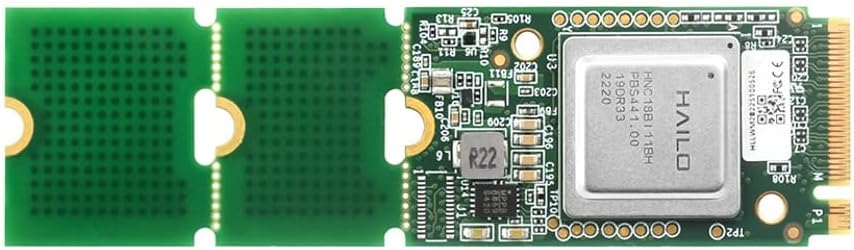
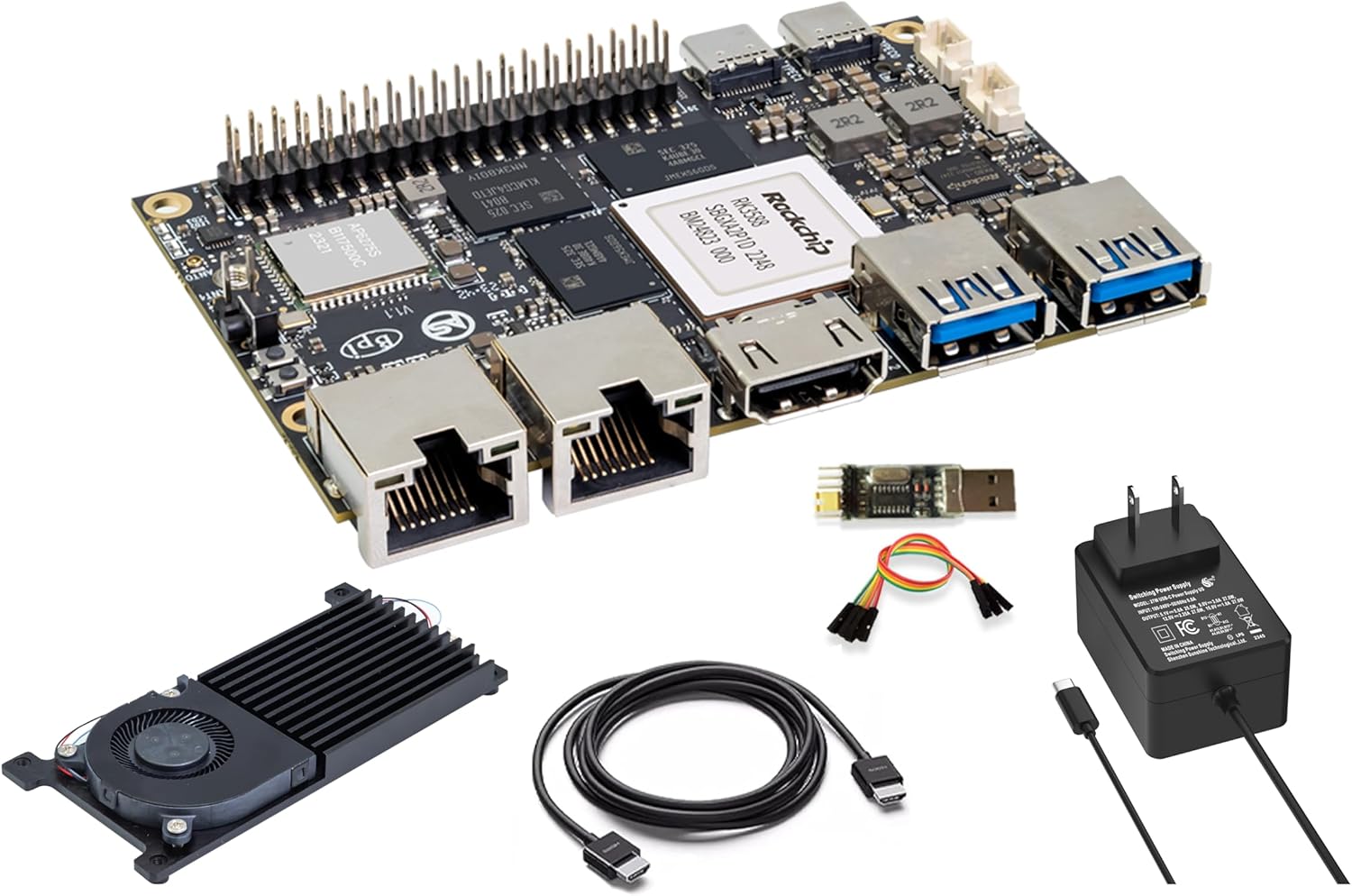
Similar: G950-01456-01/ G950-06809-01Coral USB Edge TPU… — $116.95 on Amazon as of 2026-10-22 10:14 UTC (price may vary).
Similar: Geekworm 11mm Thickness Embedded Heatsink — $7.50 on Amazon as of 2026-10-22 10:29 UTC (price may vary).
Similar: ZDE ZP590B PCIe to M.2 E Key HAT PCIE to WiFi7 6… — $16.99 on Amazon as of 2026-10-22 10:29 UTC (price may vary).
Pros & Cons
Pros
- ✓ Edge TPU coprocessor takes ML inference work off the host CPU
- ✓ USB 3.1 Gen 1 link at up to 5Gb/s for moving model input data
- ✓ Plugs into a Raspberry Pi or other SBC over USB, no HAT or soldering
- ✓ Full support for MobileNet and Inception; custom architectures possible
- ✓ Runs TensorFlow-built models and is compatible with Google Cloud
Cons
- ✗ Host must run Debian Linux; the listing names no other operating systems
- ✗ Listing names TensorFlow only; other ML frameworks are not covered
- ✗ Onboard Cortex-M0+ MCU has just 16 KB flash and 2 KB RAM
- ✗ Needs a USB 3 host port to use its full 5Gb/s link
Manufacturer description
The Google Coral USB Edge TPU ML Accelerator adds dedicated machine-learning hardware to a Raspberry Pi or another embedded single-board computer. It is a USB coprocessor built around Google's Edge TPU. Your board's CPU runs the application while the Edge TPU handles the neural-network inference. Setup is plug-in. The accelerator connects through a USB 3.0 Type-C socket, and the included USB 3.1 (Gen 1) cable carries data at up to 5Gb/s, so there is no HAT to fit and nothing to solder. The host must run Debian Linux. Inside, an Arm 32-bit Cortex-M0+ microcontroller running at up to 32 MHz…
SpecPicks Verdict
SpecPicks scored Google Coral USB Edge TPU ML Accelerator coprocessor using a rating × review-volume × price-fit model applied to published specs and reviews across the single-board computers category. Google Coral's single-board computers lineup sits within the broader category mid-tier; price and specs are the deciding factors over brand loyalty here. Judge it on the specification table and the price rather than on sentiment: check the figures that decide your use case, then put it side-by-side with two or three close alternatives in the Compare tool before clicking through.
Common buyer scenarios for single-board computers of this kind: matching it to an existing build, replacing a failing part, or upgrading from a previous-generation equivalent. Check the spec table below against your current setup — particularly socket / form-factor / power-rating fields — and confirm compatibility on the retailer's listing before purchase. Prices and stock are set by the retailer and may have moved since this page was last updated.
Frequently Asked Questions
Does the Google Coral USB Accelerator work with a Raspberry Pi?
Yes. It is designed for the Raspberry Pi and other embedded single-board computers. It connects over USB through its USB 3.0 Type-C socket, and the host CPU must run Debian Linux.
What kind of USB connection does it use?
The device has a USB 3.0 Type-C female socket and comes with a USB 3.1 (Gen 1) cable rated for SuperSpeed transfers of up to 5Gb/s.
Which machine learning models can I run on it?
Models are built with TensorFlow. MobileNet and Inception architectures are fully supported, and custom architectures are possible. Check Google Coral's documentation for model compilation requirements.
What hardware is inside besides the Edge TPU?
Alongside the Google Edge TPU coprocessor, it has an Arm 32-bit Cortex-M0+ microcontroller that runs at up to 32 MHz, with 16 KB of flash memory with ECC and 2 KB of RAM.
Does it work with Windows or macOS hosts?
The listing only confirms Debian Linux on the host CPU. Check Google Coral's official documentation for current support on other operating systems before you buy.
Key Features
- Specifications: Arm 32-bit Cortex-M0+ microprocessor (MCU): up to 32 MHz max 16 KB flash memory with ECC 2 KB RAM connections: USB 3.1 (Gen 1) port and cable (SuperSpeed, 5Gb/s transfer speed)
- Features: Google Edge TPU ML acceleration coprocessor, USB 3.0 Type-C female, supports Debian Linux to host CPU, models are built with TensorFlow Supports MobileNet and Inception architectures through custom architectures are possible. Compatible with Google Cloud
- Specifications: Arm 32-bit Cortex-M0+ Microprocessor (MCU): Up to 32 MHz max 16 KB Flash memory with ECC 2 KB RAM Connections: USB 3.1 (gen 1) port and cable (SuperSpeed, 5Gb/s transfer speed)
- Features: Google Edge TPU ML accelerator coprocessor, USB 3.0 Type-C socket, Supports Debian Linux on host CPU, Models are built using TensorFlow. Fully supports MobileNet and Inception architectures through custom architectures are possible. Compatible with Google Cloud.
- Features: Google Edge TPU ML accelerator coprocessor, USB 3.0 Type-C socket, Supports Debian Linux on host CPU, Models are built using TensorFlow. Full supports MobileNet and Inception architectures through custom architectures are possible. Compatible with Google Cloud.
Full Specifications
| Brand | Google Coral |
|---|---|
| Model | Coral-USB-Accelerator |
| Manufacturer | Google Coral |
| ItemPartNumber | Coral-USB-Accelerator |
| Full listing title | Google Coral USB Edge TPU ML Accelerator coprocessor for Raspberry Pi and Other Embedded Single Board Computers |
Ready to buy?
Amazon shows no buyable offer for Google Coral USB Edge TPU ML Accelerator… at the last check. A similar in-stock product is G950-01456-01/ G950-06809-01Coral USB Edge TPU…. SpecPicks earns a small commission on qualifying purchases — thank you for supporting independent review work.
Read our analysis
SpecPicks coverage that features this Single-Board Computer.
Related Single-Board Computers



Google Coral USB Edge TPU ML Accelerator… head-to-head
Side-by-side specs, prices, and a pick for each matchup — no tab-switching.
More guides & deep dives from the SpecPicks archive
Browse all articles & guides →- The Complete Voodoo5 5500 AGP Driver Guide (2026 Edition)
- Best 1440p Gaming GPUs in 2026
- Best Retro Handhelds in 2026 — From $35 to $500
- How to Build a Windows 98 Retro PC in 2026
- Best Budget Gaming PC Build 2026 — ~$1,000 Parts List
- Emulation Hardware in 2026: FPGA, Software, and Cart-Reader Ecosystems
- RTX 4070 Super vs RX 7800 XT — Which to Buy in 2026
More reviews from the SpecPicks archive
Browse all reviews →- GPT-5.6 Sol Reportedly Cracks a 30-Year Statistics Conjecture in 90 Minutes
- Best SSDs and Adapters for Retro PC Builds in 2026
- Local LLM Use Cases in 2026: What a 12GB Rig Actually Delivers
- Arc A770 vs B580 for Local LLM Inference: 2025 Comparison
- RTX 3060 12GB vs Arc B580 for 1080p Gaming: Which Wins?
- Best AM4 Gaming CPU in 2026: Ryzen 7 5800X vs 3700X vs 3900X vs Intel i7-9700K
- Best Storage for a Raspberry Pi 4 Home Server: microSD vs SATA SSD vs NVMe
- Best Home Office Monitor Under $200 (2026)
- Best Controller for Emulation and Fighting Games in 2026
- Ryzen 7 5800X vs Ryzen 7 5700X: Which 8-Core AM4 Chip to Buy in 2026
- Why Preassembled PCs Beat DIY Builds in 2026
- Local Coding Agents: 87% HumanEval with a 4B-Parameter Model
- Asus ROG Xreal R1 Brings 240 Hz to AR Glasses — What PC Gamers Should Know
- Upgrading From an RTX 3080 in 2026: What to Buy
- Running GLM-5.2 Locally on an RTX 3060: Ollama VRAM + tok/s
- RTX 3060 12GB vs Ryzen 5 5600G iGPU for Entry Local LLM Inference
- Prime Intellect's $130M raise: build your own agent rig
- Best 27-inch 1440p Monitor for Ryzen 7 5800X Esports Builds (2026)
- Logitech G920 vs HORI Racing Wheel: Best First Sim Wheel?
- Forza Horizon 6 Is the Highest-Rated Game of 2026: What Metacritic's 94 Says About Where Racing Sims Are Going
- RTX 5070 Ti vs 4070 Ti SUPER
- Intel Arc AI Image Generator: 2025 Setup & Performance Guide
- Running Local LLMs on a Raspberry Pi 5 in 2026: What Works, What Doesn't
- Is the Ryzen 7 7800X3D Worth It in 2026?
Earliest SpecPicks reviews
Browse full archive →- Best GPU for Llama 3.1 8B (2026)
- Best GPU for Qwen 3 14B (2026)
- Best GPU for Qwen 3 32B (2026)
- Best GPU for Llama 3.1 70B (2026)
- Best GPU for DeepSeek-R1 32B (2026)
- Best GPU for Llama 3.1 405B (2026)
- How to run Llama 3.1 8B on NVIDIA GeForce RTX 5090
- How to run Qwen 3 14B on NVIDIA GeForce RTX 5090
- How to run Qwen 3 32B on NVIDIA GeForce RTX 5090
- How to run Llama 3.1 70B on NVIDIA GeForce RTX 5090
- How to run DeepSeek-R1 32B on NVIDIA GeForce RTX 5090
- How to run Llama 3.1 8B on NVIDIA GeForce RTX 4090