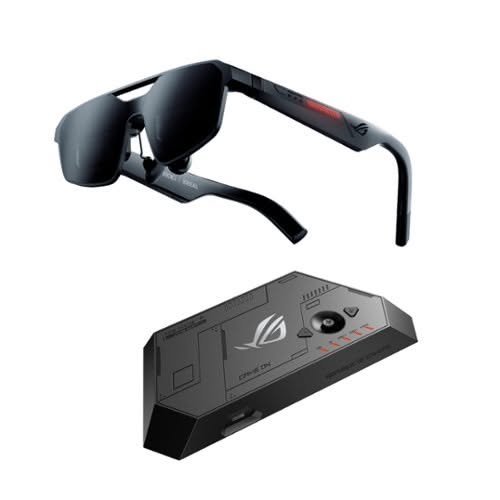
Asus announced the ROG Xreal R1 this week — AR glasses with 240 Hz refresh, aimed squarely at PC gamers who want a screenless second display for competitive titles. Per Asus ROG's product announcements and Xreal's product line, the R1 is the fastest-refresh AR eyewear announced to date, and the first to explicitly market to esports-adjacent audiences. Here's what changes for PC gamers, what stays the same, and what to pair it with.
What Asus and Xreal actually announced
The ROG Xreal R1 is a co-branded set of AR glasses combining Xreal's optical stack with Asus's ROG-branded control software and industrial design. The headline spec is the 240 Hz refresh rate — 4x the 60 Hz of most consumer AR glasses on the market as of 2026, and matching the refresh rate of high-end gaming monitors. Resolution, field-of-view, and price have not yet been officially confirmed as of this writing; expect 1080p per eye based on prior Xreal generations, with a 45-50° FOV consistent with their optical bench.
The pitch is clear: for esports-adjacent titles where refresh rate is the difference between winning and losing a frame trade — CS2, Valorant, Apex Legends, Rocket League — AR glasses have historically been unusable because 60 Hz introduces perceptible input lag on top of whatever your monitor already does. 240 Hz on your face changes that math. If the optical stack keeps up (a big "if" pending independent measurement), the R1 could plausibly serve as a competitive gaming display in scenarios where you couldn't or wouldn't use a monitor — travel, LAN events, hotel rooms, co-op with a friend on the couch.
Coverage from Tom's Hardware frames the R1 as a proof-of-concept for the "AR glasses as a real gaming display" thesis. Whether that thesis holds up depends on latency numbers we don't yet have.
Key takeaways
- 240 Hz on face is a first. The next-fastest AR glasses on the market are 90 Hz; the mainstream is 60 Hz.
- Optical resolution likely matches prior Xreal generations. 1080p per eye, ~45-50° FOV — no reason to expect a leap here.
- Latency is the open question. 240 Hz refresh only helps if end-to-end latency (game engine → cable → glasses optics → eye) stays under one frame period (~4.2 ms at 240 Hz). Independent measurement will tell.
- USB-C DisplayPort Alt Mode is the connection story. Same as prior Xreal glasses — plug into a USB-C port that supports DP Alt Mode; your PC/console/handheld sees a second display.
- Compatible with modern controllers. Pair with a GameSir G7 SE Hall-effect controller, a Sony DualSense, or a HORI HORIPAD for couch-and-glasses gaming without a monitor at all.
Who should care
Three overlapping audiences have real reason to pay attention:
- Competitive PC gamers who travel. Hotel-room gaming has been a rough experience — TVs are 60 Hz, laptop screens are OK but small. AR glasses at 240 Hz would replace the hotel TV entirely and remove refresh rate as a variable.
- Steam Deck / Legion Go / ROG Ally handheld owners. These handhelds have 90-120 Hz screens but limited real estate. A 240 Hz AR display connected via USB-C turns them into portable-but-full-display machines.
- Multi-monitor esports coaches and analysts. Being able to run a mirrored feed of a match on your face while your workstation displays continue to show scouting notes is a workflow win.
The R1 is not for the person who plays 4K single-player RPGs at their desk. That user has a better display option (their existing 4K OLED). AR glasses win in scenarios where a monitor isn't practical.
What pairs well: controllers for glasses-based gaming
The moment you commit to AR glasses as your primary display, you're not sitting at a mouse-and-keyboard setup anymore — you're on a couch or a plane. That means a good controller matters more than usual.
- GameSir G7 SE Wired Controller — Hall-effect joysticks (no stick drift, ever), 3.5mm audio for headphones, wired-only (which means zero wireless latency to add to whatever the glasses introduce). If you're competing seriously with the R1, this is the controller pick.
- Sony DualSense Wireless Controller — the ergonomic gold standard, great haptics, wide game support. Wireless adds a few ms of latency, which matters less in couch/casual scenarios and might not matter at all in the competitive scenarios depending on your Bluetooth implementation.
- HORI HORIPAD Wireless Pro Controller — Nintendo Switch-focused but works with PC. Interesting choice if you're pairing the R1 with a Switch dock via USB-C.
What we don't know yet
- Price. Asus/Xreal haven't disclosed. Prior high-end Xreal generations landed in the $500-800 range; the ROG-branded R1 could plausibly push to $800-1000.
- End-to-end latency measurement. Independent reviews (Rtings, Hardware Unboxed, Linus Tech Tips) will measure this. Until then, "240 Hz" is a marketing spec, not a lived experience.
- Field of view. Wider FOV would be a real differentiator; if it's still 45-50°, the R1 is a spec bump rather than a category shift.
- Battery expectations. AR glasses draw from the host device via USB-C. Running a Steam Deck driving a 240 Hz display will hammer the Deck's battery — expect maybe 90 minutes of gameplay vs the Deck's normal 3+ hours.
- Prescription-lens compatibility. Historically requires a prescription-insert accessory. Details on the R1 haven't been confirmed.
- Passthrough vs full-VR. AR glasses show the real world through the lenses. This is fine for gaming but means ambient light matters — bright rooms wash out the display.
Latency math: does 240 Hz actually help?
For 240 Hz to matter competitively, end-to-end latency has to fit inside one 240 Hz frame period — about 4.2 ms per frame. Breaking that budget:
- Game engine input-to-render latency: ~5-15 ms typical, engine-dependent
- Cable/DisplayPort processing: ~1-2 ms
- Glasses optical stack processing: unknown for R1, ~5-10 ms typical for prior AR glasses
- Human perception threshold: ~10-15 ms is where competitive players start noticing
Even if the R1's optics are best-in-class, the game engine dominates the latency budget. 240 Hz on the display side lets you see a new frame every 4.2 ms; whether the game produces one that fast is a separate question. For CS2 or Valorant on a fast PC, yes. For Apex Legends on a mid-tier setup, closer to a coin flip.
The practical implication: 240 Hz is not a magic bullet, but it removes the display as the bottleneck, which is the right architectural move even if the immediate win is modest.
Common questions
Can it replace my monitor entirely? For competitive gaming in scenarios where a monitor isn't practical (travel, LAN, couch), potentially yes. For general desktop use (spreadsheets, code, browsing), no — text sharpness at ~1080p per eye on AR glasses isn't as good as any modern desktop monitor.
Does it work with a PS5 or Xbox Series X? Historically Xreal glasses have worked with anything that outputs USB-C DP Alt Mode. Consoles typically don't. You'd need an HDMI-to-USB-C adapter (adds latency) or a compatible dock. Confirm before buying.
Will it work with the Steam Deck / ROG Ally / Legion Go? Yes, USB-C DP Alt Mode is the standard interface all three handhelds use for external displays. Battery drain will be significant.
Do I need a special GPU? No. Any GPU that can drive a 240 Hz external display can drive the R1. RTX 3060 12GB tier and up will handle it comfortably at 1080p per eye.
Is there head tracking? Prior Xreal glasses have offered 3-DOF head tracking (rotation only, no positional tracking) as an optional feature. Whether the R1 keeps or upgrades this is TBD.
Common pitfalls to watch for
- USB-C port isn't DP Alt Mode capable. Not all USB-C ports carry video. Check your PC's / handheld's manual before buying.
- Latency stacking with wireless controllers. If you pair the R1 with a wireless controller and a Bluetooth headset, you can accumulate 30+ ms of latency across the chain. Wired is worth the tradeoff for competitive play.
- Prescription lens gotchas. AR glasses fit over some prescriptions poorly. Verify the R1's fit accommodation before committing.
- Bright rooms wash out the display. Direct sunlight or bright overhead lights degrade AR image quality noticeably. Plan for controlled lighting.
- Motion sickness risk. Some people don't tolerate AR gaming well, especially in fast-motion titles like Rocket League. Verify with a demo before going all-in.
When to wait
If you already have a fast gaming monitor at your primary setup and don't travel or handheld-game much, wait for the independent reviews. If the R1 turns out to have great optics + true low-latency 240 Hz, jumping in a few months later after real reviews land costs you nothing. If it turns out to be a 240 Hz refresh with a laggy optical stack, you'll be glad you waited.
If you're a Steam Deck owner who's tried to game on a plane, though, this announcement is genuinely exciting. The R1 could be the first AR display that competitive-feels-competitive on a portable.
The competitive gaming case, in detail
The R1's target audience is people who care about competitive shooter or racing gameplay. In those genres, the difference between a 60 Hz monitor and a 240 Hz monitor is measurable — reaction times drop by 5-15 ms on typical player samples in aim-training benchmarks, and hit registration on fast-moving targets improves. Whether the same applies to AR glasses depends on optical stack latency, but the ceiling is at least there.
For CS2 specifically, professional players target 240-360 Hz displays and reject anything below 144 Hz for match play. The R1 at true 240 Hz (if latency measures up) would put AR glasses inside pro-viable territory for the first time. Valorant, Apex Legends, and Overwatch 2 are similar stories at slightly relaxed refresh-rate expectations.
For sim racing (iRacing, Assetto Corsa Competizione), 240 Hz matters less than field of view. The R1's ~45-50° FOV is narrower than a triple-monitor setup, so the R1 is a "portable practice" solution rather than a "replaces my rig" one.
For MOBAs (League, Dota 2), refresh rate matters at the margin but 144 Hz is genuinely enough. The R1's 240 Hz is overkill here.
Handheld pairing: the strongest use case
The strongest early-adopter case for the R1 is Steam Deck / ROG Ally / Legion Go pairing. All three handhelds have USB-C DP Alt Mode capable ports. Plug the R1 in, and you have a full-refresh display on your face while the handheld's built-in screen goes dark (or acts as a controller/status display). This turns a 7" handheld experience into a full-immersion desktop-like session without carrying a monitor.
Battery drain is significant — expect the handheld's internal battery to run down 2-3x faster than screen-only play, because it's now powering both the SoC and the external display. A USB-C PD power bank is close to mandatory for sessions over 90 minutes.
For competitive handheld play at LANs or events, this pairing could genuinely change the ergonomic story. A Steam Deck + R1 combo weighs less than a mid-tier gaming laptop, packs into a backpack, and delivers competitive-refresh-rate gameplay in any location that has a power outlet.
Bottom line
The ROG Xreal R1's 240 Hz refresh rate is a real spec advancement for AR glasses, but the win depends on end-to-end latency numbers we haven't seen yet. Watch for independent measurement in the next 4-8 weeks. In the meantime, if you're building a couch or travel gaming rig, pairing a fast Hall-effect controller like the GameSir G7 SE, Sony DualSense, or HORI HORIPAD is the right move whether you buy the R1 or a competitor.
Related guides
Citations and sources
This piece is editorial synthesis based on publicly available information. No independent first-party benchmarking is reported.


