

FebSmart
FebSmart 2X 5Gbps USB-C Ports PCI Express to USB 3.0 Expansion Card for Windows 11
Bottom line: The FebSmart 2X 5Gbps USB-C Ports PCI Express to USB 3.0 Expansion Card ($17.99 on Amazon as of 2026-10-06): Self-powered design needs no SATA or Molex cable from the PSU.
As an Amazon Associate, SpecPicks earns from qualifying purchases. Full disclosure →
*Price sourced from Amazon.com. Last updated 2026-10-06. Price and availability subject to change.
Pros & Cons
Pros
- ✓ Self-powered design needs no SATA or Molex cable from the PSU
- ✓ 5V/3A per port, 5V/6A total for USB-C SSD and HDD enclosures
- ✓ Renesas uPD720201 controller works on Intel, AMD, and ARM desktops
- ✓ Ships with both full-height and low-profile brackets
- ✓ Driver support back to Windows XP suits legacy and retro builds
Cons
- ✗ Price, stock, shipping and returns are set by the retailer and may have changed since this page was last updated
Manufacturer description
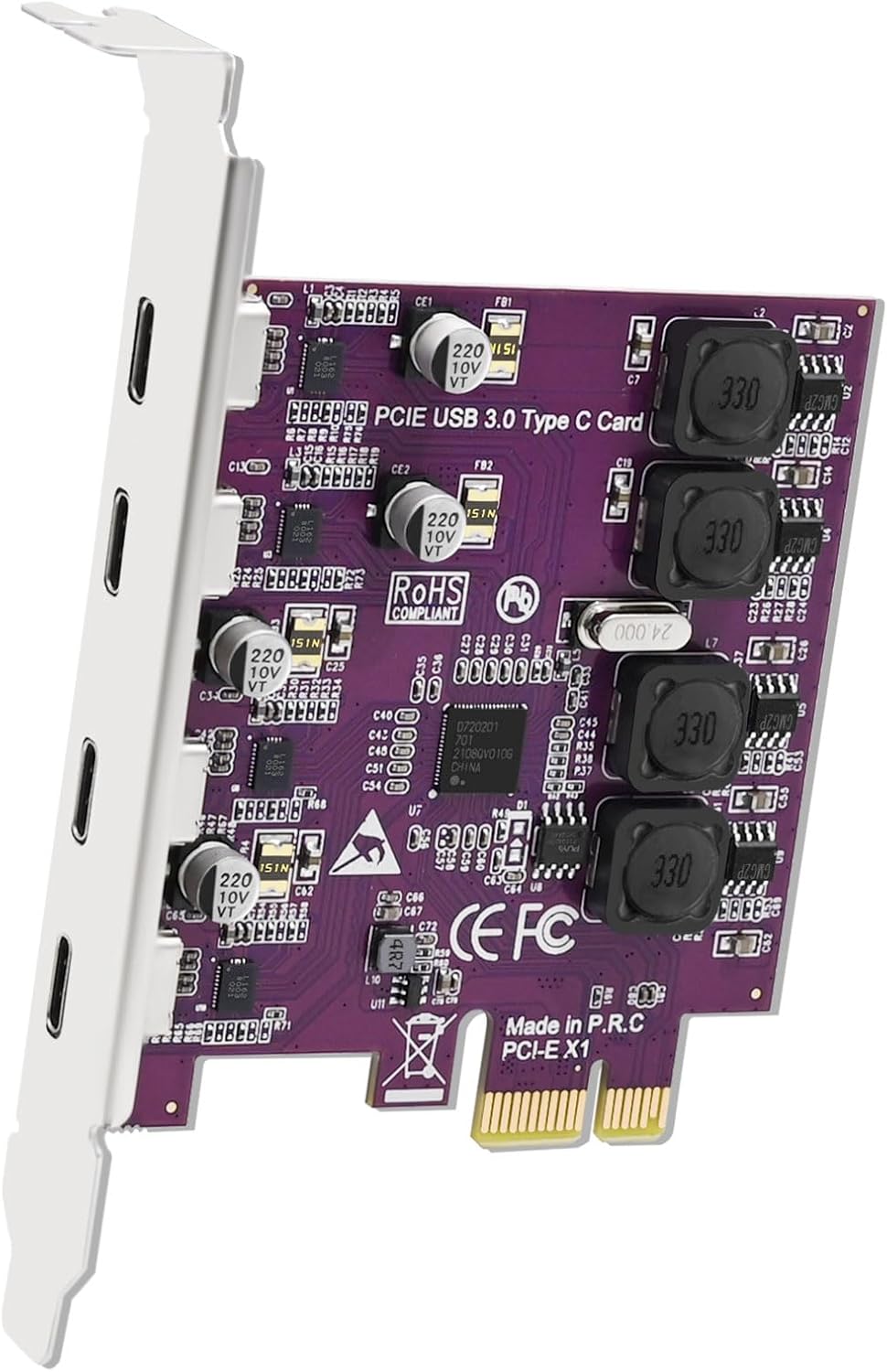
The FebSmart FS-U302C-Pro is a PCIe x1 expansion card that adds two 5Gbps USB-C ports to a desktop, workstation, or NAS build without running a SATA or Molex power lead. FebSmart's Self-Powered Technology handles that: two onboard voltage transformers step motherboard 12V down to 5V, delivering 5V/3A per port and 5V/6A total, so higher-draw USB-C peripherals like NVMe and SATA enclosures, industrial cameras, VR headsets, and docking stations get real current rather than a starved bus. The controller is a Renesas uPD720201, a widely supported USB 3.0 host chip that works across Intel, AMD…
SpecPicks Verdict
SpecPicks scored FebSmart 2X 5Gbps USB-C Ports PCI Express to USB 3.0 Expansion Card using a rating × review-volume × price-fit model applied to published specs and reviews across the expansion cards category. FebSmart's expansion cards lineup sits within the broader category mid-tier; price and specs are the deciding factors over brand loyalty here. Judge it on the specification table and the price rather than on sentiment: check the figures that decide your use case, then put it side-by-side with two or three close alternatives in the Compare tool before clicking through.
Common buyer scenarios for expansion cards of this kind: matching it to an existing build, replacing a failing part, or upgrading from a previous-generation equivalent. Check the spec table below against your current setup — particularly socket / form-factor / power-rating fields — and confirm compatibility on the retailer's listing before purchase. Prices and stock are set by the retailer and may have moved since this page was last updated.
Frequently Asked Questions
Does this card need a power cable from my power supply?
No. FebSmart's Self-Powered Technology uses two onboard voltage transformers to pull 12V from the PCIe slot and convert it to 5V, so no SATA or Molex lead is required.
Will this work on a Mac?
No. FebSmart lists macOS X as unsupported. Plug and play works on Windows 11, 10, 8.x, Server 2012-2022, and most Linux kernels; Windows 7, Vista, and XP require the bundled driver.
How much power does each USB-C port deliver?
Each port supplies up to 5V/3A, for 5V/6A combined. That covers USB-C NVMe and SATA enclosures, docking stations, and VR systems, but the card does not support fast charging.
What PCIe slot do I need for the FS-U302C-Pro?
It is a PCIe x1 card built to the PCIe 2.0 standard, and it fits x1, x2, x4, x8, or x16 slots on PCIe 1.x through 4.x boards. It will not work in an old-style PCI slot.
Can I install it in a slim or small-form-factor case?
Yes. The card ships with the full-height bracket attached and a low-profile bracket in the box, which you swap by hand for slim desktops.
Key Features
- 1. This FS-U302C-Pro is a PCIE X1 interface to 2X 5Gbps USB-C ports USB 3.0 expansion card. Allow users add 2X 5Gbps max USB-C ports on Desktop PCs, Working Stations, and NAS Data Centers for large data transfers. It will light up 2X USB 3.0 Type-C devices which including USB-C keyboards, USB-C mice, USB-C speakers, USB-C KVM switches, USB-C HUBs, USB-C flash drives, printers, gaming pad, smartphone, tablet, and more USB-C devices.
- 2. Built in FebSmart Self-Powered Technology, users do not need to plug any additional power cable from PCs power supply unit. Allow each 5Gbps USB-C port get 5V/3A (5V/6A in total) max power supply for high-power consuming USB-C devices (NOT support fast charging) such as USB-C industrial cameras, USB-C VR-Systems, USB-C NVME enclosures, USB-C SATA HDD/SSD enclosures, USB-C live broadcast devices, USB-C Video adapters and USB-C universal docking stations.
- 3. Based on RENESAS UPD720201 5Gbps USB 3.0 host controller, will compatible with ARM, AMD, and Intel hardware platform Desktop PCs. FebSmart built in 2X voltage transformers to pick up 12V power from motherboard and covert to 5V/6A in total power supply for 2X USB 3.0 Type-C devices power consumption. Febsmart also designed 2X electronic safety fuse, 2X voltage stable capacitor and 2X voltage stable inductance to protect USB 3.0 devices and users’ data safety.
- 4. Compatible System: 1. Plug and Play on Windows 11, 10, 8.x (32/64bit) and Windows Server 2012, 2012R2, 2016, 2019, 2022 systems. 2. Need to Install Driver on Windows XP, Vista, 7 (32/64bit) and Windows Server 2003, 2003R2, 2008, 2008R2 (32/64bit) systems. 3. Plug and Play on most Linux kernels. 4. NOT support MAC OS X.
- 5. PCIE X1 interface design, will works on PCIE X1, X2, X4, X8, X16 slot, do not work on PCI slot. Based on PCIE 2.0 standard, will compatible with PCIE 1.x, 2.x, 3.x, 4.x PCIE slot. The full height bracket mounted on this PCIE USB 3.0 Type-C expansion card, will works on standard size PCs. The low-profile bracket in the package, will supports slim PCs.
- 6. ATTENTION: 1. Must make sure Desktop PCs have one empty PCIE X1 slot before purchase. 2. Must install driver on Windows 7 (32/64bit) and previous systems. 3. Slim PC users need change to low profile bracket by hand. 4. Please use USB 3.0 devices test connection speed, or cannot get the peak speed.
Full Specifications
| Brand | FebSmart |
|---|---|
| Style | FS-U302C-Pro |
| Style Name | FS-U302C-Pro |
| Connectivity | USB-C |
| Model Number | FS-U302C-Pro |
| Compatibility | PC, Mac, Linux |
| Item Type Name | PCIE X1 to 2X USB 3.0 Type-C Expansion Card |
| Mfr Part Number | FS-U302C-Pro |
| Hardware Interface | PCIE x 1 |
| Warranty Description | 1 Year Limited Warranty. |
| Item Dimensions L x W x H | 4.72"L x 2.64"W x 0.71"H |
| Full listing title | 2X 5Gbps USB-C Ports PCI Express to USB 3.0 Expansion Card for Windows 11, 10, 8.x, 7, Vista, XP Desktop PCs, Built in Self-Powered Technology, No Need Additional Power Supply (FS-U302C-Pro) |
Ready to buy?
2X 5Gbps USB-C Ports PCI Express to USB 3.0 Expansion Card for Windows 11, 10, 8.x, 7, Vista, XP Desktop PCs, Built in Self-Powered Technology, No Need Additional Power Supply (FS-U302C-Pro) is listed on Amazon. Price, availability, shipping and returns are set by Amazon and its sellers — check the listing for current terms. SpecPicks earns a small commission on qualifying purchases — thank you for supporting independent review work.
*Price sourced from Amazon.com. Last updated 2026-10-06. Price and availability subject to change.
Related Expansion Cards



More guides & deep dives from the SpecPicks archive
Browse all articles & guides →- RTX 4070 Super vs RX 7800 XT — Which to Buy in 2026
- Emulation Hardware in 2026: FPGA, Software, and Cart-Reader Ecosystems
- Best 1440p Gaming GPUs in 2026
- How to Build a Windows 98 Retro PC in 2026
- Best Budget Gaming PC Build 2026 — ~$1,000 ($800 on Sale)
- Best Retro Handhelds in 2026 — From $35 to $500
- The Complete Voodoo5 5500 AGP Driver Guide (2026 Edition)
More reviews from the SpecPicks archive
Browse all reviews →- Qwen3.6-27B at 72 Tok/s on RTX 3090: What's Real
- KOORUI 27" 4K vs Samsung Odyssey 27" 4K for PS5 and PC Gaming
- Network-Wide Ad Blocking with Pi-hole on a Raspberry Pi 4 8GB (2026 Setup)
- Best SATA SSD for a PS4 Slim and Emulation Box in 2026
- Best GPU for an AI rig in 2026 — the shortlist
- Cursor vs Cline vs Aider for Local-First AI Coding in 2026
- ChatGPT Full-Duplex Voice: What Real-Time Speech Needs on Your Desk
- vLLM 0.21 Adds Intel GPU Support: What It Means for Budget AI Rigs
- Lenovo G02 Retro Handheld Reportedly Ships Preloaded With Pirated Games
- Jellyfin on Raspberry Pi 4 8GB with an SSD (2026 Guide)
- Private Smart Home: Running a Local LLM Voice Assistant in 2026
- Zero-CPU-Overhead OV7725 Camera Streaming on RP2350
- Best Gaming Gifts Under $60 in 2026
- Best CPU for Streaming and Gaming Under $300: Ryzen 7 5800X vs 5700X vs 5600G
- RTX 5080 vs RX 7900 XTX: Which GPU Wins in 2026?
- Ryzen AI Max 400 'Gorgon Halo': 192GB Unified Memory vs an RTX 3060 for Local LLMs
- RTX 5090 vs Mac Studio M4 Max for AI — which wins in 2026?
- RTX 5090 AI Build Guide: CPU, RAM, PSU & Cooling for Local Inference
- Hailo-8 vs Hailo-8L vs Coral TPU: Which AI Accelerator Wins on Raspberry Pi 5?
- BOSGAME VTA-439: A Linux-Friendly Ryzen AI 9 HX 470 Mini PC
- Best Controller for Forza Horizon 6 on PC (2026)
- Best Budget SSD for a Steam Library: NVMe vs SATA Game Load Times
- Claude Code Telemetry Flap: Why a Local RTX 3060 Rig Is the Privacy Play
- AMD Ryzen 7 7700X3D Review: 7800X3D's OEM-Only Rival
Earliest SpecPicks reviews
Browse full archive →- Best GPU for Llama 3.1 8B (2026)
- Best GPU for Qwen 3 14B (2026)
- Best GPU for Qwen 3 32B (2026)
- Best GPU for Llama 3.1 70B (2026)
- Best GPU for DeepSeek-R1 32B (2026)
- Best GPU for Llama 3.1 405B (2026)
- How to run Llama 3.1 8B on NVIDIA GeForce RTX 5090
- How to run Qwen 3 14B on NVIDIA GeForce RTX 5090
- How to run Qwen 3 32B on NVIDIA GeForce RTX 5090
- How to run Llama 3.1 70B on NVIDIA GeForce RTX 5090
- How to run DeepSeek-R1 32B on NVIDIA GeForce RTX 5090
- How to run Llama 3.1 8B on NVIDIA GeForce RTX 4090