Prices quoted were current at publication and may vary. See our review methodology.
Only if you race disciplines that use a gearstick. The Thrustmaster TH8A at $198.95 is a metal-gate, Hall-effect unit with swappable H-pattern and sequential plates — a genuine upgrade over Logitech's $59 Driving Force Shifter. But if your library is GT3 and formula cars, paddles are both period-correct and faster, and neither shifter earns its shelf space.
First, a correction to the question everyone asks
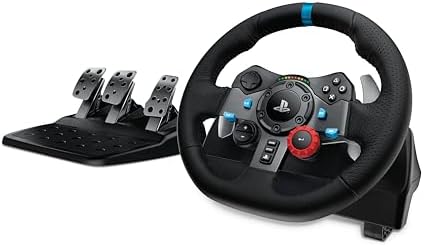
There is no "stock G29 shifter." The Logitech G29 Racing Wheel and Pedals bundle — $277 at publication, 4.6 stars across more than 43,000 reviews — ships a wheel and a three-pedal set. The shifter is a separate product: the Logitech G Driving Force Shifter, $59, compatible with the G29, G920 and G923. Logitech G's own Driving Force product page lists the shifter as an add-on rather than an included component. Some retailer bundles pair the two and some regional SKUs vary, which is where the confusion comes from.
That matters for your budget more than it sounds. If you already own the Driving Force Shifter, the TH8A is a $199 replacement for a working part, and the bar it has to clear is high. If you own only the wheel and pedals, the real question is $59 versus $199 for your first shifter — a very different decision, and one where the cheap answer is defensible far more often than sim-racing forums admit.
This piece scopes the shifter decision only. You are one upgrade deep on a G29, and there are three competing places to put the next $200: a standalone shifter, a load-cell pedal set, or a wheelbase upgrade. The shifter is the one people buy first because it is the most visible, and it is usually not the one that makes them faster. We will get to that.
Key takeaways
- The G29 does not include a shifter. Logitech's Driving Force Shifter is a separate $59 accessory. The comparison is $59 versus $199, not free versus $199.
- The TH8A's differentiators are the metal gate, Hall-effect sensing and a swappable sequential plate. Per Thrustmaster, its H.E.A.R.T magnetic sensors replace the contact points that wear out on cheaper units.
- Discipline decides, not the spec sheet. Rally, classic touring and truck sims justify a shifter. GT3 and formula cars do not.
- Sequential mode is the swing factor. It is a physical plate change, not a software toggle, and for drift and rally libraries it can justify the whole purchase on its own.
- Mounting is an unbudgeted second cost. A shifter takes lateral load a wheel does not. Plan $40–$200 for a rigid mount.
- Pedals usually beat shifters as the next upgrade. Braking is where consistency lives.
Step 0 — which discipline are you actually racing?
Buy for the cars you drive, not for the spec sheet. Sort your library.
H-pattern territory. Rally (classic and modern historic classes), pre-1990s touring cars, road cars with real gearsticks, and truck simulators. Per Wikipedia's overview of sim racing, these disciplines are a substantial share of the hobby, and in all of them the physical gate is part of the driving skill rather than an obstacle. If this is most of your hours, a good shifter changes how the games feel.
Paddle territory. Modern GT3, GTE, formula cars, and essentially every road car built after dual-clutch gearboxes became standard. These cars shipped with paddles. A manual gate here is not immersion; it is an anachronism that adds a failure point and costs you time.
Sequential territory. Modern rally, drift, and anything with a sequential race gearbox. Per Wikipedia's article on sequential manual transmissions, the mechanism swaps a lettered gate for a single push-forward/pull-back axis, and that is exactly what the hardware has to replicate. This is where the TH8A separates itself from the Logitech unit, which is H-pattern only.
Count your hours honestly before you spend. A reader who runs Le Mans Ultimate and iRacing GT3 four nights a week and touches Dirt Rally once a month should buy pedals.
Spec-delta table
| Shifter | Gate type | Mounting | Platform support | Price band | |
|---|---|---|---|---|---|
| Thrustmaster TH8A | H-pattern (7+R) and sequential, swappable plates | Desk clamp or bolt-through to rig | PS5, PS4, Xbox Series X\ | S, PC; works alongside any wheel | $190–210 |
| Logitech G Driving Force Shifter | H-pattern (6+R) only | Desk clamp or Logitech rig mount | PC, PS4/PS5, Xbox via compatible G-series wheel | $55–70 | |
| Paddle-only baseline (G29 as shipped) | None — paddles on the wheel | Included with wheel | Whatever the wheel supports | $0 additional |
How the two shifters differ mechanically
Materials and gate feel. Per Thrustmaster's product documentation, the TH8A is a 100% metal unit. The Logitech shifter uses a steel gear shaft in a largely plastic housing. In practice the difference shows up as gate definition — how clearly you feel the lever seat into a gate versus how much it floats between them — and as long-term consistency rather than as a dramatic day-one revelation.
Sensing. This is the substantive engineering difference. Thrustmaster's H.E.A.R.T system uses magnetic Hall-effect sensors with no physical contact in the sensing path. Contact-based potentiometers and switches wear, and wear on a shifter manifests as mis-detected gears — the single most demoralizing failure mode in a rally stage. Hall-effect sensing removes that wear path entirely. It is the same argument that made Hall-effect sticks standard on gamepads like the GameSir G7 SE, and it is just as valid here.
Adjustable resistance. The TH8A allows the shift resistance to be adjusted, which lets you tune between a light, quick gate for rally and a heavier, more deliberate one for trucks. The Logitech unit is fixed.
Sequential mode. The TH8A ships both gate plates. Swapping is a physical operation — you change the plate, not a setting. The Logitech shifter has no sequential mode at any price.
What actually changes in your driving. Throw length shortens slightly and gate definition sharpens, which together reduce mis-shift rate. If you are currently missing third under braking once a stage, that stops. If you are not missing gears, the TH8A will feel nicer and make you no faster.
When a standalone shifter is right — and when it isn't
Right when you run rally, classic touring cars or truck sims for hours a week, when mis-shifts are actively costing you stages or hauls, and when you already have somewhere rigid to bolt it. Under those conditions the TH8A is the correct buy and the $140 premium over the Logitech unit is straightforwardly worth it — you get the sequential plate, the Hall-effect sensing and the adjustable resistance for money you would otherwise spend replacing a worn plastic unit in two years.
Not worth it when your library is GT3, formula or arcade. Paddles are period-correct and faster in those cars. Buying a gate you will not use is the most common $200 mistake in this hobby.
Ambiguous when you own the Logitech shifter, it works, and you have $200 burning a hole. In that case, read the upgrade-order section below before you click buy.
Mounting is the real cost
This is the step almost every buyer skips, and it is the one that determines whether the purchase works.
A wheel takes rotational load through its clamp. A shifter takes lateral load — you are shoving a lever sideways into a gate, repeatedly, with force. Any flex in the mounting surface translates directly into gate wander, and gate wander produces exactly the mis-shifts you paid $199 to eliminate. A shifter on a flexing desk is worse than no shifter, because you have added an input you cannot trust.
Desk clamp works on a thick, solid desk with a real overhang. It fails on hollow-core, thin MDF, or anything with a lip that prevents the clamp seating flat. Test by grabbing the desk edge and pushing sideways — if it moves, the shifter will move.
Rig or side mount is the correct answer for anyone with a cockpit. Something like the Playseat Gearshift Holder at $39 is the low end of purpose-built mounting; full aluminium side mounts run considerably higher. Per Thrustmaster's documentation, the TH8A supports bolt-through mounting for exactly this reason.
Budget the mount at the same time as the shifter. A $199 shifter on a $0 mount is a $199 mistake; a $199 shifter on a $39 mount is a working upgrade.
Compatibility and connection notes for G29 owners
This is the detail that stops most G29 owners from buying, and it should not.
The TH8A is designed to attach to Thrustmaster wheelbases via their proprietary connector, and that is how it is marketed. It also operates as an independent USB device. Per Thrustmaster's own product materials, it is stated to be compatible with racing wheels across the market, not only its own — which for a G29 owner means the shifter connects over USB, appears to the PC as its own input device, and you bind its gears in-game while the Logitech wheel and pedals continue running on their own connection.
Three practical consequences:
- On PC this works cleanly. Two USB devices, two sets of bindings, one rig. Most modern sim titles handle multiple input devices without complaint.
- On console it is more constrained. Console titles are more restrictive about mixing input devices from different vendors than PC titles are. If you race primarily on PS5 or Xbox with a Logitech wheel, verify against your specific game before ordering.
- Check current cable and firmware requirements before you buy. Requirements have shifted across revisions. Thrustmaster's TH8A support page is the authoritative source, and it is worth two minutes.
By contrast, the Logitech Driving Force Shifter connects directly into the G29's own shifter port. It is a plug-and-play part of the same ecosystem with no binding work and no compatibility questions — which is a real, underrated advantage of the cheap option.
What else competes for the same money
A load-cell pedal set. The strongest competitor. See the upgrade-order section.
A second-seat or console-first wheel. The HORI Racing Wheel Overdrive at $119.99 is officially licensed for Xbox Series X|S with a 270-degree turn radius and clamp mounting. It is not a G29 replacement — 270 degrees is half a G29's rotation and there is no force feedback — but as a second seat for split-screen or a dedicated Xbox wheel it costs less than the TH8A and adds a whole racing position rather than one input.
Nothing at all, because a pad is fine. For arcade and semi-sim titles, a controller remains a legitimate way to race rather than a compromise. The PlayStation DualSense at $74 gives analog trigger modulation and adaptive-trigger support in titles that implement it; the wired GameSir G7 SE at $44.99 gives Hall-effect sticks and the lowest latency for $45. Steering assists in arcade racers are tuned around stick input. Move to a wheel when the assists — not your hands — are the limiting factor, and add a shifter only after that. Our best PC game controllers guide covers that tier in depth.
Common pitfalls
Buying the shifter before the mount. Covered above; it is the number-one cause of buyer's remorse on this specific product.
Assuming sequential is a menu setting. It is a physical plate swap. If you switch disciplines mid-session regularly, factor that in.
Expecting the TH8A to fix a flexing wheel clamp. If the wheel already moves under load, the shifter will not feel solid no matter how it is mounted. Fix the rig first.
Buying for a library you aspire to. Count the hours you actually logged last month, not the rally career you intend to start.
Overlooking the Logitech unit because it is cheap. At $59 with a 4.6 rating across more than 37,000 reviews, it is a genuinely good product for H-pattern-only use in the same ecosystem as your wheel.
Perf-per-dollar and the upgrade order that actually works
A G29 with pedals is $277. Adding the TH8A brings that rig to $476 — the shifter is 42% of the wheel's cost for one input that a large share of cars do not use. Adding the Logitech shifter instead brings it to $336, or 21%.
The upgrade order most sim racers benefit from, in sequence:
- A rigid mounting solution. Cheapest and highest-impact. Every other upgrade underperforms on a flexing surface.
- Pedals — specifically a load-cell brake. Braking is where lap time and consistency live. A load-cell brake responds to pressure rather than travel, which is how a real brake works, and it changes far more of your driving than a better gate does.
- A shifter, if and only if your disciplines use one. Slot it here, not first.
- A wheelbase upgrade. Direct drive is transformative and expensive; it belongs last for most people.
The shifter jumps to position two only when mis-shifts, rather than brake modulation, are demonstrably the limiting factor in your stages. That is a real situation for rally and truck-sim drivers and a rare one for everyone else.
Verdict matrix
Get the TH8A if… you run rally, classic touring cars, drift or truck sims for hours a week; you want a sequential gate as well as an H-pattern; you have a rigid mount or will buy one; and you race primarily on PC where multi-device binding is painless.
Keep or buy the Logitech Driving Force Shifter if… you only need H-pattern, you want the plug-and-play connection into the G29's own port, and you would rather put the $140 difference toward pedals. At $59 this is the right answer for most G29 owners.
Skip both and spend on pedals or a rig if… your library is GT3, formula or arcade; your wheel clamp flexes; or you have never once thought "I missed that shift" during a race. Fix the foundation, upgrade the brake, and revisit the shifter next year.
Bottom line
If you race rally, classic touring cars or trucks and you have somewhere rigid to bolt it, buy the Thrustmaster TH8A at $198.95 and budget another $39 or more for a mount — the sequential plate and Hall-effect sensing are worth the premium and will outlast the wheel. If you want an H-pattern for occasional use and would rather keep the money, buy the Logitech G Driving Force Shifter at $59 and put the difference into a load-cell brake. And if your library is modern GT and formula cars, buy neither: the paddles on your G29 are correct, faster, and already paid for.
Related guides
- Best Sim Racing Wheel and Controller for PC in 2026
- Logitech G29 vs HORI Racing Wheel Overdrive
- Best PC Game Controllers in 2026
- Logitech Extreme 3D Pro vs DualSense for Flight and Space Sims
- Do You Need a Shifter for Sim Racing?
- Is the Thrustmaster TH8A Worth It for a Logitech G29?
Citations and sources
- Thrustmaster — TH8A Shifter support and specifications (accessed 2026-08-26)
- Logitech G — Driving Force Racing Wheel product page (accessed 2026-08-26)
- Wikipedia — Sequential manual transmission (accessed 2026-08-26)
- Wikipedia — Sim racing (accessed 2026-08-26)
This piece is editorial synthesis based on publicly available information. No independent first-party benchmarking is reported.