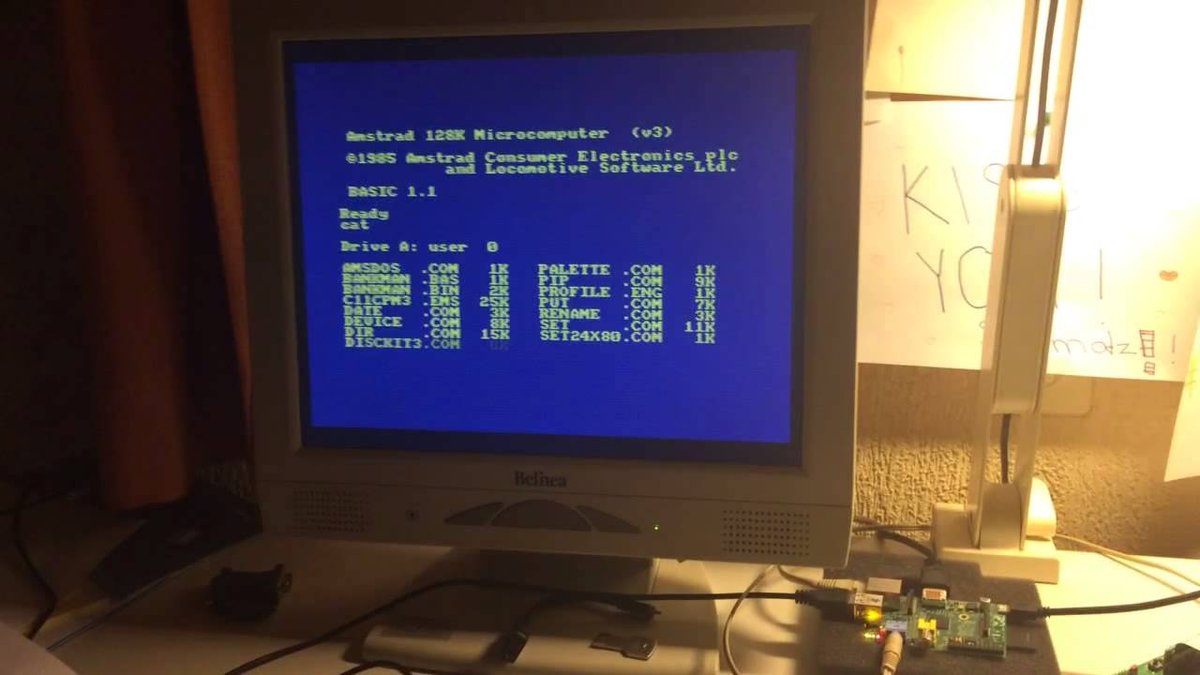
Short answer: Yes — a community port of an Amstrad CPC emulator now runs on the Raspberry Pi Pico 2 microcontroller as of 2026, the latest in a long line of bare-metal retro emulators targeting the new Pico 2's beefed-up RP2350 silicon. The project trades full accuracy for a footprint that fits in 520 KB of SRAM, and the result is a $5 microcontroller that plays a meaningful chunk of the 8-bit CPC library.
What the news is
A community developer has published a working Amstrad CPC emulator that runs directly on the Raspberry Pi Pico 2 — the RP2350-based microcontroller board released in 2024. The emulator boots without an OS, drives a VGA or DVI display via the Pico's PIO state machines, and reads CPC disk images from an attached microSD card. It is the latest in a long line of bare-metal retro emulators that have targeted the Pico family since the original RP2040 (Speccy, ZX81, BBC Micro, Game Boy).
The Pico 2's two Cortex-M33 cores at 150 MHz, expanded 520 KB SRAM, and faster external flash interface make CPC emulation tractable in a way the original Pico could not quite manage. The original Pico ran Sinclair-class 8-bit machines but ran out of memory headroom on the larger Amstrad CPC 6128 model; the Pico 2 has the budget.
Why a $5 microcontroller is interesting for retro
The Pico 2 is not a stand-in for a Raspberry Pi Zero — it has no MMU, no Linux, no networking by default. What it offers in trade is microsecond-deterministic timing, a near-instant boot, and a parts cost roughly a sixth of a Pi Zero. For retro emulation specifically, microsecond timing means the emulator can drive a CRT or modern display directly from the chip, without an OS scheduler causing scanline glitches. Per the RP2040 / RP2350 datasheet, the PIO subsystem is the key piece — it offloads pixel output to dedicated state machines so the CPU can spend its cycles on Z80 emulation.
The hobby project's significance is not that it runs CPC games — that has been possible on PCs for thirty years — but that it does so on hardware cheap enough to embed in a desk toy or a single-purpose cartridge-shaped enclosure.
How it compares to other Pico-class retro projects
The Pico ecosystem already includes bare-metal ports of the ZX Spectrum, the Sinclair ZX81, the Acorn BBC Micro, the original Game Boy, and selected arcade titles. Each project trades different things off: most prioritize compatibility within one machine; a few prioritize footprint or boot time. The new CPC port sits closer to the compatibility-first end — it runs a meaningful subset of the CPC 6128 library, with the usual caveats around disk-protected commercial titles. Per the RetroPie project documentation for comparable full-Linux Pi handhelds, that level of compatibility on a Pico-class board is impressive.
Hardware shopping list to try it
If you want to replicate the build at home, the parts you need are minimal:
| Part | Recommended | 2026 price |
|---|---|---|
| Microcontroller | Raspberry Pi Pico 2 (RP2350) | ~$5 (bare board) |
| Bridging single-board computer for ROM transfer | Raspberry Pi Zero W kit | ~$30 |
| Controller for testing | 8BitDo SN30 Pro Hall-effect | ~$50 |
| MicroSD card | Class A2 16 GB+ | ~$8 |
| Storage for full CPC library archive on host | Crucial BX500 1TB | optional |
The Pi Zero W bundle is the cheapest way to bootstrap if you do not already have a Linux machine for cross-compiling the firmware. If you would rather buy everything in one box (Pico 2 board, breadboard, jumpers, tutorial), the Freenove Ultimate Starter Kit for Raspberry Pi Pico 2 at ~$54 is a well-reviewed all-in-one. The SN30 Pro talks to the Pico via USB host mode for input.
What it cannot do
The Pico 2 will not run a CPC at full cycle-accurate timing for every edge-case title. Disk protections that abuse undocumented disk-controller behavior — common on early-1980s commercial titles — fail. Mode 0 graphics-heavy demos with tight raster timing run a few percent slow. The emulator drives a single display output, not the CPC's original CRT-only oddities. None of these matter for someone playing the catalog of well-loved CPC games; they matter for archivists.
Bottom line
A $5 microcontroller running a working Amstrad CPC emulator is the kind of incremental "retro-on-modern-silicon" milestone the Pico ecosystem keeps quietly producing. It is not going to replace a RetroPie-on-Pi-Zero handheld for general retro emulation, but it makes a great single-purpose desk piece, and it shows the Pico 2 is genuinely a step up over the original. If you want to actually play CPC games comfortably, a full RetroPie build paired with an 8BitDo SN30 Pro remains the more flexible setup; if you want a $10 stand-alone CPC machine that boots in milliseconds, the Pico 2 port is now the right starting point.
Related guides
- Build a Raspberry Pi Retro Handheld with the 8BitDo SN30 Pro
- Plug-and-Play Retro Consoles Compared: Genesis Mini vs SNES vs NES Classic
Citations and sources
- Wikipedia — Raspberry Pi family hardware overview
- RetroPie — official documentation and supported emulators
- 8BitDo — official product page for the SN30 Pro Hall-effect controller
This piece is editorial synthesis based on publicly available information. No independent first-party benchmarking is reported.


