
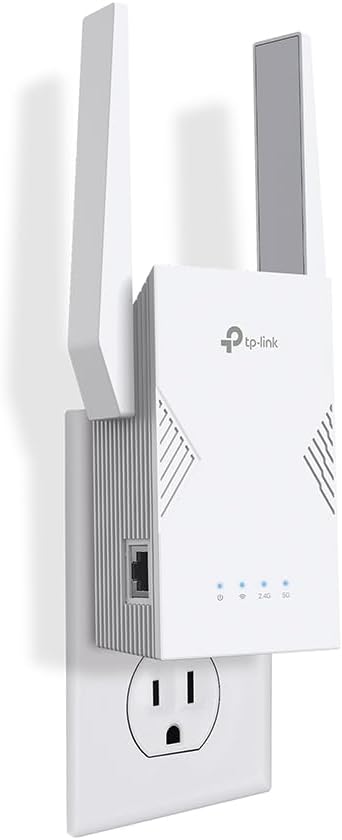
TP-Link BE3200 Wi-Fi 7 Range Extender RE223BE w/Ethernet Port
Bottom line: The TP-Link BE3200 Wi-Fi 7 Range Extender RE223BE w/Ethernet Port: Wi-Fi 7 MLO, Multi-RUs, 160 MHz and 4K-QAM when paired with a Wi-Fi 7 router; main trade-off: no 6 GHz band, so Wi-Fi 7's cleanest spectrum is unavailable.
As an Amazon Associate, SpecPicks earns from qualifying purchases. Full disclosure →
Pros & Cons
Pros
- ✓ Wi-Fi 7 MLO, Multi-RUs, 160 MHz and 4K-QAM when paired with a Wi-Fi 7 router
- ✓ Up to 2594 Mbps on 5 GHz plus 688 Mbps on 2.4 GHz, 3.2 Gbps combined
- ✓ Covers up to 2400 sq. ft. and handles up to 64 connected devices
- ✓ Ethernet port hardwires a console, TV, or desktop in the extended room
- ✓ EasyMesh support joins any EasyMesh router for one roaming network
Cons
- ✗ No 6 GHz band, so Wi-Fi 7's cleanest spectrum is unavailable
- ✗ Extends coverage rather than raising speed; throughput can drop on the extended link
- ✗ MLO and 4K-QAM gains require a Wi-Fi 7 router you may not own yet
- ✗ Single Ethernet port limits wired clients to one device without a switch
Manufacturer description
Extend your home network with the TP-Link RE223BE BE3200, a dual-band Wi-Fi 7 range extender built to erase dead zones without replacing your router. Pair it with a Wi-Fi 7 router and you unlock Multi-Link Operation, Multi-RUs, 160 MHz channels, and 4K-QAM, so latency-sensitive traffic like AR/VR gaming and 4K/8K streaming holds together at the far end of the house. The four-stream design delivers up to 2594 Mbps on 5 GHz and 688 Mbps on 2.4 GHz for 3.2 Gbps of combined bandwidth, and four positioned antennas with beamforming push that signal across as much as 2400 sq. ft. for up to 64…
SpecPicks Verdict
SpecPicks scored TP-Link BE3200 Wi-Fi 7 Range Extender RE223BE w/Ethernet Port using a rating × review-volume × price-fit model applied to published specs and reviews across the networking category. Compare with similarly-priced alternatives in the networking category before committing. Judge it on the specification table and the price rather than on sentiment: check the figures that decide your use case, then put it side-by-side with two or three close alternatives in the Compare tool before clicking through.
Common buyer scenarios for networking of this kind: matching it to an existing build, replacing a failing part, or upgrading from a previous-generation equivalent. Check the spec table below against your current setup — particularly socket / form-factor / power-rating fields — and confirm compatibility on the retailer's listing before purchase. Prices and stock are set by the retailer and may have moved since this page was last updated.
Frequently Asked Questions
Does the TP-Link RE223BE support the 6 GHz band?
No. The RE223BE is a dual-band Wi-Fi 7 extender that operates on 2.4 GHz and 5 GHz only. TP-Link states explicitly that it does not support the 6 GHz band.
How much area will this range extender cover?
TP-Link rates coverage at up to 2400 sq. ft. with support for up to 64 devices, using four positioned antennas with beamforming. Real-world range depends on wall construction and where you plug it in.
Will it make my internet faster?
No. TP-Link notes that all wireless extenders are designed to improve coverage, not raise speed, and that improving signal reliability can affect overall throughput. Expect better signal in dead zones rather than a higher speed test.
Do I need a Wi-Fi 7 router to use it?
No, it works with existing routers, but Wi-Fi 7 features like Multi-Link Operation, Multi-RUs, 160 MHz, and 4K-QAM only activate when paired with a Wi-Fi 7 router. It is also EasyMesh-compatible with any EasyMesh router.
How do I set up the RE223BE?
Setup runs through the TP-Link Tether app, which walks you through connecting the extender and uses an intelligent signal indicator to help you pick the best outlet location. For warranty and support terms, check the current product listing.
Key Features
- 𝐍𝐞𝐱𝐭-𝐆𝐞𝐧 𝐖𝐢-𝐅𝐢 𝟕 𝐏𝐞𝐫𝐟𝐨𝐫𝐦𝐚𝐧𝐜𝐞 - Pair with a Wifi 7 router and achieve the benefits of Multi-Link Operation (MLO), Multi-RUs, 160 MHz and 4K-QAM. Achieve optimized signal distribution throughout your entire home, and enjoy high performance on latest WiFi 7 devices.△
- 𝟒-𝐒𝐭𝐫𝐞𝐚𝐦, 𝐃𝐮𝐚𝐥-𝐁𝐚𝐧𝐝 𝐖𝐢𝐅𝐢 𝐰𝐢𝐭𝐡 𝟑.𝟐 𝐆𝐛𝐩𝐬 𝐓𝐨𝐭𝐚𝐥 𝐁𝐚𝐧𝐝𝐰𝐢𝐝𝐭𝐡 - Extend your router's performance with speeds up to 2594 Mbps (5 GHz band) and up to 688 Mbps (2.4 GHz band). Enjoy seamless 4K/8K streaming, AR/VR gaming, and fast downloads/uploads.⌂
- 𝐌𝐚𝐱𝐢𝐦𝐢𝐳𝐞𝐝 𝐂𝐨𝐯𝐞𝐫𝐚𝐠𝐞 𝐮𝐩 𝐭𝐨 𝟐𝟒𝟎𝟎 𝐒𝐪. 𝐅𝐭. - Four optimally positioned antennas with Beamforming technology boosts signal strength, reliability, and range, providing seamless whole-home Wi-Fi coverage and eliminating dead zones for up to 64 devices.
- 𝐎𝐮𝐫 𝐂𝐲𝐛𝐞𝐫𝐬𝐞𝐜𝐮𝐫𝐢𝐭𝐲 𝐂𝐨𝐦𝐦𝐢𝐭𝐦𝐞𝐧𝐭 - TP-Link is a signatory of the U.S. Cybersecurity and Infrastructure Security Agency’s (CISA) Secure-by-Design pledge. This device is designed, built, and maintained, with advanced security as a core requirement.
- 𝐄𝐚𝐬𝐲𝐌𝐞𝐬𝐡-𝐂𝐨𝐦𝐩𝐚𝐭𝐢𝐛𝐥𝐞 - Easily expand your network for seamless, whole-home coverage by connecting the RE223BE to any EasyMesh-compatible router. *
- 𝐃𝐨𝐞𝐬 𝐍𝐨𝐭 𝐒𝐮𝐩𝐩𝐨𝐫𝐭 𝟔 𝐆𝐇𝐳 𝐁𝐚𝐧𝐝– Please note This dual-band WiFi 7 range extender does not support the 6 GHz band. It operates on the 2.4 GHz and 5 GHz bands only.
Full Specifications
| Brand | TP-Link |
|---|---|
| Color | White |
| Range | 2400 square_feet |
| Frequency | 5 GHz |
| Unit Count | 1 Count |
| Connectivity | Wireless, WiFi, 2.4GHz |
| Built-In Media | 1 x Quick Installation Guide, 1 x RE223BE |
| Connector Type | RJ45 |
| Connection Type | Wireless |
| Special Feature | Access Point Mode, Guest Mode, LED Indicator, MU-MIMO |
| Special Features | Access Point Mode, Guest Mode, LED Indicator, MU-MIMO |
| Compatible Devices | Personal Computer, Smart Television, Smartphone, Tablet |
| Data Transfer Rate | 3200 megabits_per_second |
| Frequency Band Class | Dual-Band |
| Warranty Description | 2 Year Manufacturer |
| Wireless Compability | 802.11.be, 802.11a/b/g/n/ac, 802.11ax |
| Frequency Bands Supported | 2.4 GHz, 5 GHz |
| Wireless Communication Standard | 802.11.be, 802.11a/b/g/n/ac, 802.11ax |
| Full listing title | TP-Link BE3200 Wi-Fi 7 Range Extender RE223BE w/Ethernet Port | 3.2 Gbps Dual-Band Wireless Repeater | Internet Signal Booster for Home | Up to 2400 sq.ft, 64 Devices | MLO, EasyMesh | No 6 GHz Band |
Ready to buy?
TP-Link BE3200 Wi-Fi 7 Range Extender RE223BE w/Ethernet Port | 3.2 Gbps Dual-Band Wireless Repeater | Internet Signal Booster for Home | Up to 2400 sq.ft, 64 Devices | MLO, EasyMesh | No 6 GHz Band is listed on Amazon. Price, availability, shipping and returns are set by Amazon and its sellers — check the listing for current terms. SpecPicks earns a small commission on qualifying purchases — thank you for supporting independent review work.
Related Networking



More guides & deep dives from the SpecPicks archive
Browse all articles & guides →- Best Budget Gaming PC Build 2026 — ~$1,000 ($800 on Sale)
- The Complete Voodoo5 5500 AGP Driver Guide (2026 Edition)
- Emulation Hardware in 2026: FPGA, Software, and Cart-Reader Ecosystems
- RTX 4070 Super vs RX 7800 XT — Which to Buy in 2026
- How to Build a Windows 98 Retro PC in 2026
- Best 1440p Gaming GPUs in 2026
- Best Retro Handhelds in 2026 — From $35 to $500
More reviews from the SpecPicks archive
Browse all reviews →- Raspberry Pi 4 as a SimHub Dash for a Logitech G29 Rig
- Build a Silent Home NAS on a Raspberry Pi 4 8GB With a SATA SSD (2026)
- RTX 5060 vs RTX 3060 12GB for Local LLMs in 2026
- Best Gaming CPU for 1440p Builds in 2026
- Sound Blaster Audigy FX Install Guide for Win98 SE Period-Correct Builds
- RTX 5090 AI Models: Performance, VRAM, Power
- Voodoo 5 6000 Benchmarks: Quake III at Five Resolutions
- Ryzen AI Max Mini-ITX: Framework Desktop Specs Explained
- Blue Yeti vs HyperX QuadCast 2 S: Best USB Mic for New Streamers
- Inkling 975B: Thinking Machines' Open-Weight Speech Model, Explained
- Sound BlasterX G6 vs Audigy FX for Modern Retro WinXP Gaming
- Ryzen 5 5600G vs Ryzen 7 5700X for a 2026 Home Lab
- Raspberry Pi AI HAT+ 2025: TOPS, Price, Setup Guide
- Best Webcam for Streaming and Remote Work (2026)
- Putting a Modern SATA SSD in a Win98/XP Retro Build via an IDE Bridge
- GeForce FX 5900 Ultra vs Radeon 9800 Pro: The 2003 DirectX 9 Showdown Revisited
- Mistral Medium 3.5 Local Inference: VRAM, Quantization & Tokens/sec on Consumer GPUs
- OpenAI Says GPT-5.5-Cyber Beats Anthropic's Mythos on Security
- DualSense vs 8BitDo Pro 2 for PC Gaming in 2026
- Are We the Last Generation of PC Builders?
- When a Game Boy Clone Runs Too Fast: The Crystal-Swap Fix Behind a Viral Repair
- Best Budget SSD for a Gaming PC in 2026: Crucial BX500 vs SanDisk vs Samsung 970 EVO Plus
- 256GB Samsung microSD Drops to $32 — Storage Prices Slide
- Streamer PC Specs Decoded: The 2026 Parts That Match
Earliest SpecPicks reviews
Browse full archive →- Best GPU for Llama 3.1 8B (2026)
- Best GPU for Qwen 3 14B (2026)
- Best GPU for Qwen 3 32B (2026)
- Best GPU for Llama 3.1 70B (2026)
- Best GPU for DeepSeek-R1 32B (2026)
- Best GPU for Llama 3.1 405B (2026)
- How to run Llama 3.1 8B on NVIDIA GeForce RTX 5090
- How to run Qwen 3 14B on NVIDIA GeForce RTX 5090
- How to run Qwen 3 32B on NVIDIA GeForce RTX 5090
- How to run Llama 3.1 70B on NVIDIA GeForce RTX 5090
- How to run DeepSeek-R1 32B on NVIDIA GeForce RTX 5090
- How to run Llama 3.1 8B on NVIDIA GeForce RTX 4090