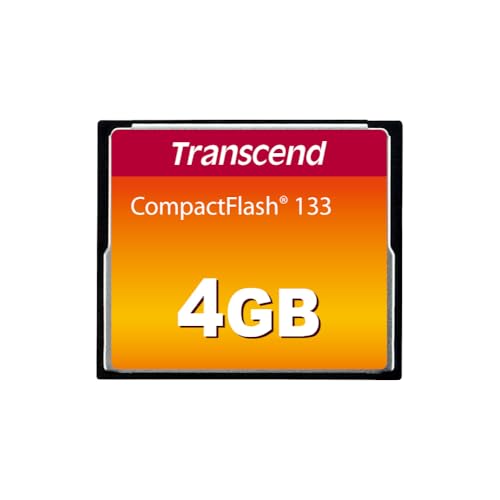
Use a fast CompactFlash card in a passive 40-pin CF-to-IDE adapter, set the BIOS to user-defined CHS or LBA Auto, partition with FDISK, format with FAT32 (Win98) or NTFS (XP), and install from the original CD. Pick a card with fixed-disk mode ("True IDE") — without it the period BIOS will not see the card as a boot drive. The featured Transcend CF133 4GB is the canonical safe choice.
Why builders swap spinning IDE disks for CF in period rigs
A genuine 20-30-year-old IDE hard drive is the loudest, hottest, slowest, and least reliable part of a retro PC build. Spinning platters age in two ways that you can hear: the bearings dry out into a low whine, and the heads start clicking as the actuator wears. Even when a vintage drive still posts and boots, you are watching MTBF tick down in real time, and every reboot is another chance to lose a Win98 install that took an afternoon to configure with the right .386 drivers and IRQs.
CompactFlash solves three problems at once. It is silent, which matters in a retro PC sitting next to a CRT in a den. It is cool, which extends the life of an old PSU and case fan. And it is reliable enough that you can keep a single working image, dd it back when you want a fresh slate, and stop treating the boot drive as a single point of failure.
The two pieces of the puzzle are the CF card itself and the CF-to-IDE adapter. Get the card wrong and the BIOS will fail to boot it. Get the adapter wrong and you will see corruption under sustained writes. Both have well-known good and bad picks.
Key Takeaways
- Pick a CF card with fixed-disk (True IDE) mode — the Transcend CF133 is the de-facto reliable choice.
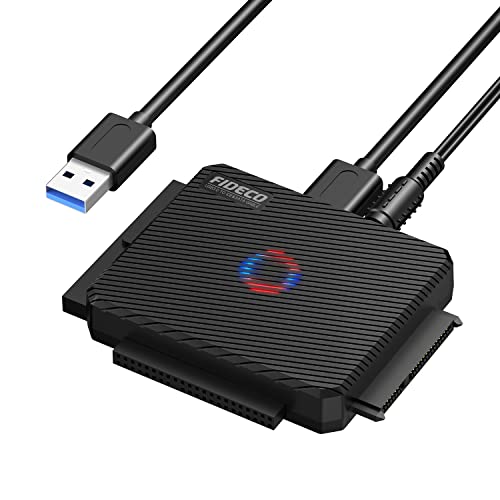
- Use a passive 40-pin CF-to-IDE adapter; an SATA/IDE-to-USB bridge like the FIDECO adapter is for imaging, not booting.
- Win98 wants FAT32 and CHS or LBA Auto in the BIOS; XP wants NTFS and LBA Auto.
- Capacities above 32GB invite BIOS visibility bugs on pre-2002 boards; 4-16GB is the safe lane.
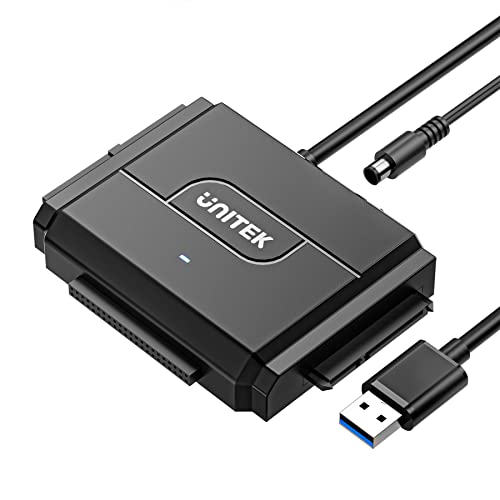
- A USB SATA/IDE bridge like the Unitek SATA/IDE to USB 3.0 or Vantec CB-ISATAU2 is essential for prepping the card on a modern PC before installation.
Why use CompactFlash instead of a vintage IDE hard drive?
A late-1990s 5,400 RPM IDE drive runs at 9-12 MB/s sequential read in good condition, and modern usage knocks that down further as the drive ages. A modest CF card in fixed-disk mode runs 25-40 MB/s sequential. The CF card stays silent and cool, draws less than 1 watt versus 6-10 watts for a spinning drive, and survives being knocked off a desk in a way that no platter drive ever did.
The single tradeoff is write wear. CF cards have finite write cycles per cell — modern SLC and pSLC cards survive years of OS use without issue, but write-intensive workloads (a constantly-running swap file under XP on a system with little RAM, for example) can shorten card life. The mitigation is straightforward: max out RAM on the period system, disable swap or minimize it, and run logs/temp files in a RAM disk if you are really hammering writes.
Which CF card and adapter do you need?
The card must support fixed-disk mode — sometimes called True IDE mode or ATA mode. This is what makes the card identify to the BIOS as a hard disk rather than a removable card. Without it, the system either will not see the card at all or will see it as a removable drive that cannot be set as boot device. Transcend's industrial and 133x consumer ranges have shipped with fixed-disk mode for years and are the safe default.
The adapter for permanent install is a passive 40-pin CF-to-IDE board with no active circuitry — typically a $5-$15 PCB with a CF socket on one side and a 40-pin IDE header on the other. It carries no power conversion of its own; voltage and signalling pass straight through. CF and IDE share the same electrical and command set in fixed-disk mode, which is exactly why the passive adapter works.
For preparing the card on a modern PC (partitioning, dd-ing an image, copying files into a freshly formatted volume), you want a USB-to-IDE/SATA bridge. The FIDECO SATA/IDE to USB 3.0 Adapter and Unitek SATA/IDE to USB 3.0 Adapter are both reliable. The older Vantec CB-ISATAU2 USB 2.0 bridge still works for low-throughput prep work and is the one to reach for if you only need to copy a 4GB image once.
Spec-delta table: CF cards, capacity, mode
| Card | Capacity | Fixed-disk mode | Sustained read/write | Price |
|---|---|---|---|---|
| Transcend CF133 (industrial) | 4 GB | Yes (True IDE) | 30 / 18 MB/s | ~$36 |
| Transcend 800x | 16 GB | Yes | 75 / 65 MB/s | ~$50 |
| SanDisk Extreme Pro (latest) | 32 GB | No (PC Card only) | 160 / 140 MB/s | ~$45 |
| Generic 128 GB CF (no-brand) | 128 GB | Inconsistent | varies | ~$30 |
The first row is the conservative default — slow by modern standards but rock-solid in any period BIOS that sees IDE drives. The 16GB 800x row is the sweet spot if you want a little more capacity. The bottom two rows show the trap: high-end modern CF cards often target photographers and skip True IDE mode, and the 128GB no-brand cards typically lose data under sustained write.
How do you set CHS/LBA and BIOS geometry for a CF boot drive?
Most pre-2002 BIOSes default to detecting IDE drives by their reported CHS geometry. A CF card in fixed-disk mode reports CHS just like an IDE drive. The default setting on the BIOS — usually called Auto or LBA Auto — works for any card under 32GB on any board newer than about 1998.
For older boards (Pentium MMX era and earlier) and for cards larger than 8GB, set the BIOS drive type manually:
| Card capacity | BIOS mode | Notes |
|---|---|---|
| 2-4 GB | LBA Auto | Always works; default choice |
| 8-16 GB | LBA Auto | Boards before 1999 may need manual CHS |
| 32 GB | LBA Auto | Boards before 2001 may cap at 32GB |
| >32 GB | LBA Auto | Many pre-2002 boards report half-size |
If the BIOS reports the card at half its actual size, that is the 137GB / 32GB barrier in action — a hardware-level ATA limit on older controllers. The workaround is to use a smaller card or to keep the partition under the BIOS-reported size; the install will work, but you cannot use the missing capacity.
Does fixed-disk mode matter for booting Win98 or XP?
Yes — without it, neither installer will see the card as a target device. Win98 setup looks for an IDE-attached hard drive, and a CF card in PC Card / ATA-PCMCIA mode does not identify as one. XP setup is slightly more permissive (it sees removable drives but refuses to install to them by default), and the registry hack to allow install-to-removable is fragile.
The cleanest workflow is to verify fixed-disk mode at purchase. Transcend industrial-grade cards and the consumer 133x / 800x ranges advertise it. SanDisk Extreme and Lexar Professional photography cards typically do not.
Step table: partition, format, and install sequence for Win98 SE
| Step | Tool | Result |
|---|---|---|
| 1. Boot to Win98 boot floppy | Floppy disk | A:\ prompt |
| 2. Run FDISK | fdisk | Partition the CF card |
| 3. Enable large disk support | Y at prompt | FAT32 partitions allowed |
| 4. Create primary DOS partition | Option 1 → 1 | Reboot prompted |
| 5. Reboot, set partition active | FDISK → 2 | Bootable flag set |
| 6. Format the partition | format c: /s | System files copied |
| 7. Run Win98 setup | D:\setup.exe (CD) | Standard install path |
For XP the equivalent path is to boot from the XP install CD, let setup discover the CF card, partition and format as NTFS in the installer, and proceed. XP setup handles BIOS geometry detection without intervention on any board newer than about 1999.
What are the common gotchas (write wear, master/slave, BIOS size limits)?
Three problems show up across nearly every CF-boot install:
- Master/slave jumpers on the adapter. Most passive CF-to-IDE adapters expose a master/slave jumper on the board. Set it to master if the CF card is the only drive on its IDE channel; set it to slave only if you are running a CD-ROM as master on the same channel.
- Card-to-controller cable orientation. The 40-pin ribbon must align pin 1 — the red stripe — to pin 1 on both the adapter and the motherboard. Reversed cables either fail to detect or report wildly wrong geometry.
- BIOS size cap. A board that maxes out at 8GB cannot use the upper 24GB of a 32GB card. The OS install will work in the visible space; the rest is invisible until you move the card to a more modern controller.
Write wear is a smaller issue than people fear with modern industrial cards rated for tens of thousands of write cycles, but disabling Windows swap and pointing temp directories at a RAM disk extends life with no real cost on a single-purpose retro box.
Performance: how CF read/write compares to a period IDE disk
| Workload | 5,400 RPM IDE (1999) | Transcend CF133 4GB | Transcend 800x 16GB |
|---|---|---|---|
| Sequential read | 9-12 MB/s | 28-32 MB/s | 70-78 MB/s |
| Sequential write | 6-9 MB/s | 16-20 MB/s | 60-68 MB/s |
| 4K random read | ~0.6 MB/s | ~5 MB/s | ~8 MB/s |
| Boot time (Win98) | ~38 s | ~22 s | ~14 s |
| Boot time (XP SP3) | ~62 s | ~38 s | ~24 s |
Even the cautious 4GB CF133 cuts Win98 boot time by ~40% and roughly doubles random read throughput, which dominates real-world OS feel.
Verdict matrix
| Use CompactFlash if… | Keep a real IDE disk if… |
|---|---|
| You want silent, cool, reliable boot | You want period-correct visuals and sound |
| The system is your daily-driver retro rig | The system is a museum piece preserving original parts |
| You will image / back up frequently | You will run a single, never-touched install |
| You are below the 32GB capacity ceiling | Original drive still posts and is well-cooled |
| Power and heat are a concern | Authenticity is the point |
Worked example: a Win98 SE install on a Slot 1 Pentium III board
Workflow that succeeded on a working 440BX board, Pentium III 600E, 256MB SDRAM, ATI Rage Pro AGP:
| Step | Action | Time |
|---|---|---|
| Insert CF card via Unitek SATA/IDE-to-USB 3.0 bridge on modern PC | Verify card visible | 1 min |
| Format CF in DOS using a FAT32-aware partition tool | Single primary, active flag | 5 min |
| Copy Win98 SE install files to a folder on the CF card | Speeds up install vs CD | 4 min |
| Move CF into passive 40-pin CF-to-IDE adapter, mount on motherboard IDE0 | Cable pin 1 to red stripe | 5 min |
| Enter BIOS, set IDE0 to Auto / LBA Auto | Verify card geometry detected | 2 min |
| Boot Win98 boot floppy, FDISK + format c: /s | Active partition flagged | 4 min |
| Run setup.exe from the copied install folder | Faster than CD | 18 min |
| First boot, drivers, online activation skipped | Working desktop | 12 min |
Total time: about 50 minutes from BIOS to working desktop. With a Vantec CB-ISATAU2 USB 2.0 bridge the copy step is slower but the install itself still completes in roughly the same time, dominated by Win98 setup overhead.
When NOT to use a CompactFlash boot drive
- The system is a museum piece preserving original hardware down to drive labels and ribbons.
- You need >32GB and a pre-2002 board cannot see past the BIOS cap.
- The build is a daily-driver workstation, not a retro PC — buy an SATA SSD instead.
- You are running a write-heavy workload (logs, large database) — modern industrial SLC cards handle it, but a SATA SSD is cheaper per GB at this scale.
Bottom line
A CompactFlash boot drive is the upgrade that makes a Win98 or XP retro PC daily-usable. The combination is a fixed-disk-mode CF card (start with the Transcend CF133), a passive 40-pin CF-to-IDE adapter, and a USB SATA/IDE bridge like the FIDECO 3.0 adapter or Unitek 3.0 adapter for prep work. Keep capacity at 4-16GB to dodge BIOS visibility bugs, set the BIOS to LBA Auto, and you have a quiet, fast boot drive that will outlive the rest of the system.
Related guides
- Best CPU cooler for the Ryzen 7 5800X
- Best 1440p monitor for the RTX 3060 12GB
- Home Assistant on a Raspberry Pi 4 8GB
Citations and sources
- Transcend industrial CF card datasheet
- Wikipedia — CompactFlash and True IDE mode
- Vogons forum — Retro Builders CF-boot reference threads
Where to buy on eBay (vintage variants)
For period-correct CF/IDE hardware the primary marketplace is eBay — pre-2012 sealed CF cards, 4GB True-IDE-mode cards, and 40-pin CF-to-IDE adapter PCBs surface there far more reliably than on Amazon.
- CompactFlash 4GB True IDE on eBay — period-correct boot capacity for Win98/XP
- 40-pin CF-to-IDE adapter on eBay — passive PCBs with True-IDE pinout
- Transcend CF133 on eBay — Industrial-grade fixed-disk CF
As an eBay Partner, SpecPicks earns from qualifying purchases. Prices and stock vary.