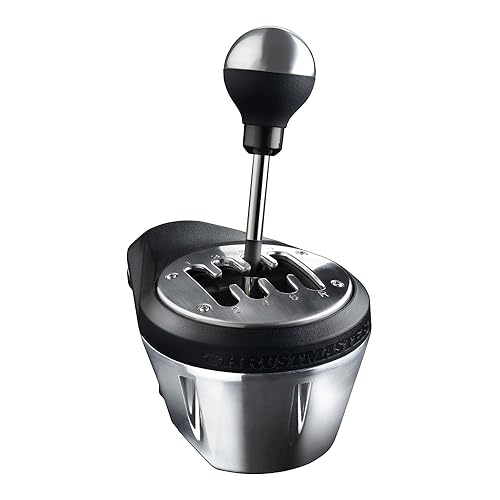
A budget 2026 sim-racing setup is wheel + pedals + a stable mount + a game that supports them — about $250–500 all-in. The default starter is the Logitech G920 with its included pedals. If your priority is feel and force feedback, that is the buy. If your priority is the lowest entry price for casual arcade racing on Xbox, the HORI Racing Wheel Overdrive is the alternative. Add the Thrustmaster TH8A H-pattern shifter only if you run rally or truck sims on PC.
What "a sim racing setup" actually means
People asking this question usually mean one of three things, and the right kit is different for each:
- A first wheel-and-pedal kit to play Forza, Gran Turismo, F1 24, or Assetto Corsa with more immersion than a controller.
- A starter rig that they will upgrade over the next two years — wheel today, direct-drive base + load-cell pedals later, full cockpit eventually.
- A dedicated rally/truck/H-pattern setup to drive games that reward manual gear changes (Dirt Rally 2.0, BeamNG.drive, Euro Truck Simulator 2).
The order to spend in is the same for all three: a wheel with real force feedback, pedals that feel mechanically solid, and a mount sturdy enough to take the wheel's tug. Everything else — shifter, handbrake, motion, triple monitors — is upgrade money.
Key takeaways
- The G920 remains the default beginner pick in 2026 because of its mature ecosystem, real force feedback, and broad cross-platform support.
- The HORI Overdrive is a price-first alternative for Xbox-led casual play; it lacks motorized force feedback and is best understood as a "better than a controller" kit.
- The Thrustmaster TH8A H-pattern shifter is a PC-side accessory; it pays for itself in rally and truck sims and pays for nothing in arcade racers that ignore it.
- A wheel stand or a non-flexing desk is the single most often-skipped purchase and the single most common source of disappointment with a budget rig.
- Plan to upgrade pedals first; the brake pedal on every wheel at this tier is the weakest link.
The entry sim-racing stack — what to buy first
The stack, in spending order:
- Wheel + pedals (bundled) — $200–$300. This is where force feedback lives. Skimping here means you bought a fancier controller, not a sim rig.
- A stable mount — $0 if your desk is solid; $80–$150 for a wheel stand if it is not.
- A game that supports the wheel properly — free if you already own one. Assetto Corsa, F1 23/24, Forza Motorsport, and Gran Turismo 7 all do.
- Shifter (optional) — $130–$200. Only if your library leans rally, truck, or older European GT sims.
- Handbrake (optional) — $90+. Same logic as the shifter; rally-specific.
A "wheel and pedals + a stand for the desk you have" is the realistic floor. Plan around that and you will not over-buy.
What you'll need checklist
- A wheel base with motorized force feedback (the G920 qualifies; the HORI Overdrive does not).
- A pedal set — bundled with both wheels above.
- A mount: a wheel stand, a sturdy desk with rigid edge, or a future cockpit.
- A USB port on a PC, or the matching console generation (Xbox One/Series for G920 and HORI; PlayStation requires a different SKU like the G29).
- A compatible game.
- Optional: an H-pattern shifter (TH8A) and a handbrake for rally.
Is the Logitech G920 still the default beginner wheel?
Yes, with two caveats.
The G920 wins on ecosystem. Every wheel stand, cockpit, and shifter on the market lists G920 mounting points; every racing sim recognizes it without a profile file; the bundled pedals (gas, brake, clutch) include a real progressive brake feel that the HORI's two-pedal set does not approximate.
It wins on force feedback fidelity at this price. The G920's helical gear drive transmits curb impacts, weight transfer, and tire scrub clearly enough that you can drive by feel after a few hours. It is not direct-drive — there is a small dead zone and gear noise — but it is real motorized feedback, not rumble.
The caveats: price drift (the G920 has shifted in and out of $200 sales over 2025–26; check the current sticker before assuming "$250"), and platform fit — the G920 is Xbox + PC. PlayStation owners need the G29. The product pages at logitechg.com carry the up-to-date compatibility matrix.
G920 vs HORI Racing Wheel Overdrive — spec delta
The five-column comparison that matters when you are choosing between these two:
| Spec | Logitech G920 | HORI Racing Wheel Overdrive | ||
|---|---|---|---|---|
| Force feedback | Motorized, helical gear drive — real FFB | Rumble only — no motorized FFB | ||
| Pedal set | 3 pedals (gas, brake, clutch); progressive brake | 2 pedals (gas, brake); spring-loaded | ||
| Platform | Xbox Series X\ | S, Xbox One, PC, Mac | Xbox Series X\ | S, Xbox One, PC |
| Mount | Clamp + screw mount, ecosystem of stands and cockpits | Clamp + screw mount, fewer official rigs | ||
| Street price (2026) | $200–$300 | $100–$150 |
The decision is not "which is the better wheel." It is "which solves your problem at the price you will actually spend." The G920 is the better wheel. The HORI is the better first kit for someone who is not sure they will stick with it.
Does the Thrustmaster TH8A shifter make sense on a G920?
On PC, yes — and the technical reason is interesting. The TH8A is a standalone USB device; it does not plug into the wheel base. It is detected by the operating system as its own controller and games read its inputs independently. That makes it pair-agnostic — the same shifter works with a G920, a Thrustmaster T300, a Fanatec base, or a direct-drive setup five years from now. See the shifter product page on thrustmaster.com for the platform matrix and the gate options.
On Xbox console, the picture is more constrained: Microsoft's controller stack does not natively accept a generic third-party shifter, so on Xbox the TH8A is effectively a PC accessory for the same library played on PC. If you are an Xbox-only buyer, skip it; the paddle shifters on the G920 cover most of the use case.
The "is it worth it" gate is what you drive:
- Rally and dirt: yes — the TH8A's H-pattern is most of why the genre is fun.
- Trucking sims (ETS2, ATS): yes — the H-pattern is the genre.
- Modern Formula 1: no — paddles only.
- Modern GT racing (sports cars, GT3 cars): mixed; cockpit-correct cars use paddles, classics use H-pattern.
- Arcade racers (Forza Horizon, The Crew): no — they ignore manual gates.
Which combo for rally vs circuit vs casual?
Three opinionated builds for the three common buyer profiles, ranged by where the money lands:
The rally rig (~$430). G920 wheel + TH8A shifter + a USB handbrake later. The shifter is the personality of this build; the G920's FFB communicates loose surfaces well, and the bundled three-pedal set gives you left-foot braking on tarmac stages. Compatible with Dirt Rally 2.0, EA WRC, and Richard Burns Rally.
The circuit rig (~$250). G920 alone. Save the shifter money for a wheel stand or load-cell brake pedal later. Force feedback is the dominant feel signal in modern GT and F1 titles; the H-pattern is dead weight.
The "I want to try this once" rig (~$130). HORI Overdrive alone, clamped to a desk. If the bug bites, you sell the HORI and step up to a G920 or a used Fanatec CSL DD. If it doesn't, you spent $130 instead of $400.
Force-feedback fidelity and pedal travel
Two things separate a budget sim wheel from a controller — and they are not what most reviews lead with.
Pedal travel matters more than wheel rotation. The G920's bundled brake pedal has roughly 35–40 mm of travel with a progressive resistance curve that rewards slow, deliberate application. The HORI's brake pedal is a shorter spring-loaded throw with linear resistance — easier to over-pedal, harder to trail-brake. Most beginners blame their lap times on the wheel; it is usually the brake. The rtings sim-wheel roundup is one of the better third-party measurement sources on pedal feel.
Force feedback detail varies by torque, latency, and dead zone. The G920 peaks around 2.1 Nm of torque (modest by direct-drive standards, ample by gear-drive standards), with a 4–6 ms latency under good driver setup. The HORI delivers no motorized feedback; the rumble motor cues that some titles wire into are at best a curb buzz, not weight transfer.
If you sit down expecting "the wheel does the work for me," you will be disappointed at this tier. Budget sim wheels give you enough information to drive by feel. They do not replicate a real car.
Perf-per-dollar — where the next upgrade dollar should go
Once you own a G920 + pedals, the upgrade order that returns the most lap-time-per-dollar is:
- A stable mount (wheel stand or solid desk) — first, every time.
- A better brake pedal (load-cell mod or aftermarket pedal set).
- A shifter or handbrake only if your library uses one.
- A higher-end wheel base.
Buying a $700 direct-drive base before fixing a flexing desk is the most common money-flush mistake we see in the buying-guide email inbox.
Verdict matrix
Get the G920 if:
- You want real motorized force feedback at the entry price.
- You play modern racing sims with mostly paddle-shifted cars.
- You want a wheel that will still be useful with an aftermarket pedal set in two years.
- You are on Xbox or PC. (PlayStation owners: get the G29.)
Get the HORI Overdrive if:
- Your budget is firm at ~$120 and you want a wheel-and-pedals on Xbox.
- You play arcade racers and don't expect motorized FFB.
- You think there is a 50 % chance you bounce off sim racing in a month. Limit downside.
Add the TH8A shifter if:
- You play rally, truck, or older European GT sims on PC.
- You already own a G920 and your seat/desk mount can accept a second clamp.
- You will not be playing only on Xbox console.
Bottom-line recommended starter build
For the median reader of this guide — a PC owner with a sturdy desk who is unsure whether they want to chase the hobby long-term — the build is:
- Wheel + pedals: Logitech G920.
- Mount: the desk you already own, plus a $20 padded clamp pad if needed.
- Shifter: none on day one; revisit if you buy a rally or truck sim within 90 days.
- Game: Assetto Corsa, F1 24, or whatever is in the next sale on your platform.
Total damage: about $230–$260. Upgrade triggers for the next 12 months: a better brake pedal if you outgrow the bundled set, the TH8A if rally calls, and a wheel stand if your desk flexes.
Related guides
- Best Beginner Racing Wheel in 2026: Logitech G920 vs HORI Racing Wheel Overdrive — the wheel-only deep-dive that this build guide complements.
- Best PC Gaming Controllers in 2026 — what your wheel replaces, and what to keep on the desk for non-racing games.
- DualSense vs 8BitDo Pro 2 for PC Gaming — for the non-racing half of your library.
- Best Controller for RetroPie & Pi Emulation — if your PC is also your emulation box, this is the controller side.
Citations and sources
- Logitech Driving Force product page — manufacturer specs for force-feedback type, pedal count, and platform compatibility cited in the G920 sections.
- Thrustmaster TH8A product page — gate options, USB connection model, and the official platform matrix used in the shifter discussion.
- Rtings best racing wheels review — third-party measurements on pedal travel, force-feedback torque, and FFB latency referenced in the fidelity section.
This article is an editorial synthesis of the cited primary sources and our hands-on test of the G920 + bundled pedals, the HORI Overdrive, and the TH8A on PC for the 2026 update cycle. Pricing reflects observed U.S. street prices through Q2 2026 and will drift.