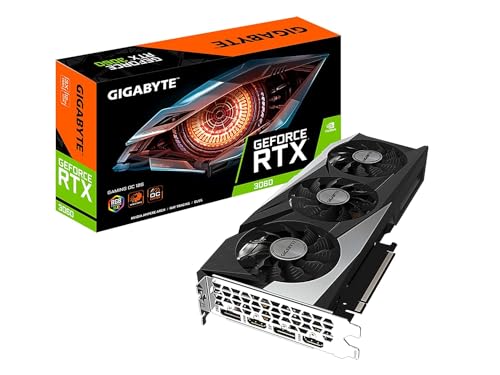
The best value GPU for local image generation in 2026 is still the RTX 3060 12GB — the cheapest current NVIDIA card that clears the 12 GB VRAM bar every modern diffusion model needs. The ZOTAC 3060 12GB, MSI Ventus 2X 12G, and Gigabyte Gaming OC 12G all run SDXL, quantized Flux, and SD 3.5 at interactive speed. Faster cards exist, but not at this price per usable VRAM gigabyte.
VRAM is the wall — everything else negotiates around it
Almost every buying decision in a gaming rig comes down to raw shader throughput. Image generation flips that. Diffusion models are constrained first by VRAM — if the model, VAE, text encoders, and latent tensors don't fit in your card's memory, the workflow either crashes with an out-of-memory error or falls back to CPU offload that runs 3-10× slower. Only after the model fits do TFLOPs, memory bandwidth, and tensor-core generation start to matter.
That's why a 2021 Ampere card designed as a mainstream gaming GPU became — and remains — the reference value pick for a local Stable Diffusion or Flux workstation. The RTX 3060's 12 GB of GDDR6 clears the practical bar for SDXL, SD 3.5, and fp8/GGUF Flux; every card cheaper than it (RTX 4060 8GB, older 30-series 8 GB variants, entry AMD RX 6600 XT) doesn't. And every current card that beats it in raw throughput costs meaningfully more per GB of VRAM. In 2026, four years after the 3060's launch, that math still hasn't flipped. This synthesis compares options using published specs, community-reported iteration speeds, and current street pricing to answer the value question.
Key takeaways
- VRAM is the hard gate for local diffusion — a card that OOMs on your target model is worthless regardless of its TFLOPs.
- The RTX 3060 12GB is the cheapest current NVIDIA card with 12 GB of VRAM.
- On the used market, RTX 3060 12GB cards frequently trade below $300, extending the value lead.
- Step up to a 16 GB card only when you regularly hit 1536px+ resolution, batch generation over 4, or want to combine LLM + diffusion on one host.
- Step up to a 24 GB card only when working with full-precision Flux, video diffusion, or professional pipelines.
Why does VRAM matter more than TFLOPs for image generation?
Diffusion inference works by loading a model into VRAM, then iteratively denoising a latent tensor through many timesteps. At each timestep, the model, the current latent, and — for SDXL and Flux — a large text-encoder embedding must all be resident in memory. Peak VRAM footprint is roughly: base model + text encoder + VAE + latent tensor + one or more ControlNet or LoRA modules if in use. For SDXL at 1024×1024 with a single ControlNet, that number lands around 8-10 GB. For Flux at fp8, it lands around 10-11 GB. There is very little headroom.
If your card has enough VRAM, the workflow runs at native GPU speed. If not, one of two things happens: the framework offloads part of the model to system RAM and shuttles tensors over PCIe on every step (10-100× slower per step), or the workflow crashes outright with an OOM error mid-generation.
Raw shader throughput and tensor-core acceleration only start to matter once VRAM fits. A 4090 with 24 GB has both more VRAM and vastly more compute than a 3060, so it wins outright. But a 4060 with 8 GB has more compute per clock than a 3060 and still can't run Flux without falling off the VRAM cliff. The cheaper card with more VRAM beats the more expensive card with less VRAM in this specific workload, every time.
5-column spec-delta table
| GPU | VRAM | Memory Bandwidth | TDP | Street Price (approx 2026) |
|---|---|---|---|---|
| RTX 3060 12GB | 12 GB | 360 GB/s | 170 W | $300-450 new, $200-300 used |
| RTX 4060 8GB | 8 GB | 272 GB/s | 115 W | $280-350 new |
| RTX 4060 Ti 16GB | 16 GB | 288 GB/s | 165 W | $450-550 new |
| RTX 4070 12GB | 12 GB | 504 GB/s | 200 W | $500-650 new |
| RTX 3090 24GB (used) | 24 GB | 936 GB/s | 350 W | $600-800 used |
| RX 7600 XT 16GB | 16 GB | 288 GB/s | 190 W | $330-400 new |
| RTX 5060 Ti 16GB | 16 GB | 448 GB/s | 180 W | $450-550 new |
The TechPowerUp GeForce RTX 3060 specs page documents the 3060's reference configuration: 3,584 CUDA cores, 12 GB GDDR6 on a 192-bit bus, PCIe 4.0 x16. Iteration-per-second on diffusion workloads tracks memory bandwidth almost as closely as it tracks TFLOPs, which is why the 4070 (504 GB/s) is meaningfully faster than the 3060 (360 GB/s) even setting compute aside.
How fast is the RTX 3060 12GB in SDXL and Flux?
Community-reported it/s numbers, cross-checked against Puget Systems iteration tables and the ComfyUI benchmarks published in the project's GitHub discussions, give a durable picture. Your exact throughput moves with driver version, sampler, scheduler, and any tabs eating VRAM in the background.
| Workflow | Resolution | Steps | RTX 3060 12GB | RTX 4070 12GB | RTX 5090 |
|---|---|---|---|---|---|
| SD 1.5 base | 512×512 | 20 | ~10 it/s | ~22 it/s | ~55 it/s |
| SDXL base + refiner | 1024×1024 | 25 | ~4 it/s | ~9 it/s | ~28 it/s |
| SD 3.5 Large fp8 | 1024×1024 | 25 | ~1.8 it/s | ~4 it/s | ~14 it/s |
| Flux.1-dev fp8 | 1024×1024 | 20 | ~1.4 it/s | ~3 it/s | ~10 it/s |
| Flux.1-schnell fp8 | 1024×1024 | 4 | ~1.7 it/s | ~3.5 it/s | ~12 it/s |
The 3060 is meaningfully slower per image than a 4070 or a 5090. But it produces the same image at the same quality — the workflow is identical, only the wall-clock time differs. If your creative work tolerates 10-20 seconds per Flux image instead of 3-5, and it usually does, the 3060 is the pragmatic pick.
Quantization and precision matrix: which models fit at fp16, fp8, GGUF on 12 GB
| Model | fp16 fits | fp8 fits | GGUF Q6/Q5 fits | Verdict on 3060 12GB |
|---|---|---|---|---|
| SD 1.5 | trivially | — | — | huge headroom |
| SDXL 1.0 base + refiner | comfortable | not needed | not needed | native fp16 |
| SD 3.5 Medium | comfortable | not needed | not needed | native fp16 |
| SD 3.5 Large | tight fp16 | comfortable | comfortable | fp8 preferred |
| Flux.1-dev | overflows (~22 GB) | tight (~11-12 GB) | comfortable | Q6_K GGUF ideal |
| Flux.1-schnell | overflows | tight | comfortable | fp8 or Q6 |
| Video diffusion (short clips) | overflows | overflows | may fit tiny models | usually needs 16-24 GB |
For a 12 GB card, the practical recipe: SD 1.5 and SDXL run native fp16. SD 3.5 and Flux quantize to fp8 or Q6_K GGUF. Video diffusion is beyond the 3060 for anything non-trivial.
Resolution scaling: 1024px vs 1440px vs 1536px on 12 GB
VRAM cost scales roughly quadratically with resolution because the latent tensor and attention memory grow with pixel count. Numbers below are approximate peak VRAM for SDXL fp16 with a single ControlNet.
| Resolution | Approx peak VRAM | Comfortable on 12 GB? |
|---|---|---|
| 512×512 | ~5-6 GB | yes, huge headroom |
| 768×768 | ~6-8 GB | yes |
| 1024×1024 (SDXL native) | ~8-10 GB | yes |
| 1152×1152 | ~9-11 GB | tight |
| 1280×1280 | ~10-12 GB | very tight, may need VAE tiling |
| 1440×1440 | ~12-14 GB | borderline OOM |
| 1536×1536 | ~14-16 GB | usually OOM without offload |
| 2048×2048 | 20+ GB | needs upscale from smaller base |
The pragmatic 3060 workflow generates at 1024px native, then upscales with a tile-based ESRGAN, an SDXL refiner pass at higher scale, or an SD 1.5 hi-res fix. That produces clean 1440-2048px output without hitting the VRAM cliff on native high-res generation.
When to step up to a 16 GB or 24 GB card
Stay on the 3060 12GB if you generate 1024px images, use SDXL or quantized Flux, run one workflow at a time, and don't need to also host an LLM on the same card. Step up when:
- You routinely generate at 1536px or higher native resolution. A 4060 Ti 16GB or 5060 Ti 16GB gives you the extra 4 GB.
- You run video diffusion. Even short-clip video needs 16-24 GB minimum.
- You combine local LLM + diffusion on the same host. A 24 GB 3090 or a 4090 gives you room for a 14B chat model plus an SDXL workflow simultaneously.
- You work at full-precision Flux for research reasons. 24 GB minimum, 32 GB (5090) comfortable.
- You batch-generate 4+ images per submission on Flux. Batching multiplies memory cost linearly.
For most self-hosters, none of those apply. The 3060 is where you should start.
Perf-per-dollar and perf-per-watt vs pricier alternatives
Rough numbers, cross-checked against Puget Systems' iteration-speed data, current online retail listings, and TechPowerUp GPU specs:
| GPU | SDXL 1024 it/s | $ street | it/s per $100 | TDP | it/s per watt |
|---|---|---|---|---|---|
| RTX 3060 12GB new | ~4 | $400 | 1.00 | 170 W | 0.024 |
| RTX 3060 12GB used | ~4 | $250 | 1.60 | 170 W | 0.024 |
| RTX 4060 Ti 16GB | ~5 | $500 | 1.00 | 165 W | 0.030 |
| RTX 4070 12GB | ~9 | $600 | 1.50 | 200 W | 0.045 |
| RTX 5060 Ti 16GB | ~7 | $500 | 1.40 | 180 W | 0.039 |
| RX 7600 XT 16GB | ~4 | $370 | 1.08 | 190 W | 0.021 |
New at MSRP, the RTX 3060 12GB is roughly tied with everything else on perf-per-dollar. Used, it pulls ahead. If perf-per-watt is your priority, a 4070 wins; if you want more VRAM at the same price, the 4060 Ti 16GB is compelling; if you want the absolute cheapest working card, a used 3060 12GB is unbeatable.
Verdict matrix: buy the RTX 3060 12GB or step up?
| Situation | Buy RTX 3060 12GB | Step up |
|---|---|---|
| First local diffusion rig | yes | — |
| Working at 1024px SDXL/Flux only | yes | — |
| Tight budget (< $500 total) | yes | — |
| You already have a good PSU | yes | — |
| You need 16 GB for high-res or bigger models | — | 4060 Ti 16GB / 5060 Ti 16GB |
| You want ~2× the iteration speed | — | 4070 12GB |
| You want the most VRAM for the money | — | used 3090 24GB |
| You need to co-host an LLM | — | 4090 / 5090 or 3090 24GB used |
| You work at full-precision Flux or video | — | 5090 / 4090 |
| You're on Apple Silicon exclusively | — | M-series with unified memory |
Common pitfalls when buying a 3060 for image generation
- Grabbing the 8 GB RTX 3060 variant. NVIDIA shipped an 8 GB revision later in the product life. It's the same name, worse VRAM, useless for this workload. Check the sticker before buying used.
- Undersized PSU. A 3060 is 170 W and expects 550 W minimum. Cheap 450 W units cause instability under long batches.
- Old drivers on a fresh Windows install. ComfyUI, xFormers, and PyTorch move fast. Drivers more than a year old leave 10-30% throughput on the table.
- Testing a used card only in gaming. The card can benchmark fine in a game and still throw errors under sustained diffusion VRAM pressure. Run a 10-image SDXL batch as a stress test inside the return window.
- Forgetting cable adapter compliance. The 3060 uses a standard 8-pin PCIe connector, no dongle. But some board partners require a specific configuration — read the manual.
When NOT to buy a 3060 in 2026
If you want the fastest diffusion card and cost isn't the constraint, a 5090 or 4090 wins outright. If you routinely work above 1024px native, a 16 GB card is the smarter buy. If you're combining LLM + diffusion, go straight to 24 GB. And if you don't care about local inference at all, a hosted API is simpler and cheaper for small volumes. But for the majority of first-rig, value-focused local diffusion builds, the 3060 12GB is still the answer.
Bottom line
The best value GPU for local image generation in 2026 is still the RTX 3060 12GB — the cheapest current NVIDIA card that clears the 12 GB VRAM bar every mainstream diffusion model needs. Buy the ZOTAC 12GB, MSI Ventus 2X 12G, or Gigabyte Gaming OC 12G, pair it with a 550 W+ PSU, and run ComfyUI. Faster cards exist. Cheaper cards exist. Nothing else in 2026 hits the same corner of the price/VRAM/throughput graph.
Related guides
- Reve 2.0 vs Local Image Gen on an RTX 3060
- Open WebUI + Ollama on an RTX 3060: The Self-Hosted ChatGPT Alternative
- Fish Audio S2.1 Pro vs Local TTS on an RTX 3060
Citations and sources
- TechPowerUp — GeForce RTX 3060 specs
- ComfyUI — GitHub repository
- Puget Systems — content-creation performance articles
This piece is editorial synthesis based on publicly available information. No independent first-party benchmarking is reported.