Document extraction has quietly become one of the most common production uses for large language models — turning invoices, forms, and scanned PDFs into structured data. So when an open-sourced benchmarking project runs 7,000-plus API calls across 18 different LLMs to score OCR and document-extraction accuracy, the headline finding lands hard: price and accuracy don't move together the way most teams assume. Cheaper and older models frequently hold their own against current flagships, and in some document categories, edge ahead of them.
This piece synthesizes what that kind of large-scale, multi-model OCR comparison typically shows, why the pattern holds up across public benchmark projects, and how to apply it — whether picking an API model for a document pipeline or building a local rig to run the same tests yourself.
Why an 18-Model OCR Benchmark Is a Big Sample
Most model comparisons stop at two or three names — usually the newest flagship releases. Running 18 models across thousands of calls does something different: it covers multiple pricing tiers (frontier, mid-tier, budget, and older-generation) against the same fixed document set, which is the only way to isolate whether accuracy gains are actually tied to price or just to recency.
That structure is also what open-source projects like the OmniAI OCR benchmark use — a public document set, a repeatable scoring script, and swappable model configs, published on GitHub so results can be reproduced rather than taken on faith. Independent runs of this style of benchmark consistently corroborate the same directional finding: accuracy differences compress sharply once a model clears a baseline capability bar, while price differences between tiers do not compress at all.
What Gets Measured in an LLM OCR Benchmark
Two distinct tasks tend to get lumped together under "OCR" in these evaluations:
- Raw text extraction — converting an image or scanned PDF into plain text. Dedicated OCR engines (Tesseract, cloud vision APIs) have handled this reliably for years, so LLMs rarely add much value here.
- Structured extraction — pulling specific fields (invoice totals, line items, form values, table rows) into clean JSON. This is where multimodal LLMs are increasingly used, and where model choice actually matters, because it requires reasoning about layout and context, not just character recognition.
Most of the interesting spread in a large benchmark shows up in the second category, particularly on dense tables, multi-column layouts, and lower-quality scans — exactly the cases where a flagship model's stronger reasoning has room to pay off.
Where cost and accuracy typically diverge
| Document type | Accuracy spread across tiers | Where price matters most |
|---|---|---|
| Clean, single-column text | Narrow — budget and flagship models converge | Rarely; pick on cost alone |
| Structured forms / invoices | Moderate | Mid-tier models are usually the efficient pick |
| Dense tables, multi-column layouts | Widest | Flagship models earn their premium |
| Handwriting / low-quality scans | Widest | Flagship models earn their premium |
This lines up with the broader trend covered in SpecPicks' Can Local LLMs Actually Do Anything Useful? — task difficulty, not model size alone, determines where the extra spend is worth it.
The Surprising Part: Older Models Holding Up
The part of this kind of benchmark that tends to surprise readers isn't that budget models are usable — it's that some older-generation models, which cost meaningfully less per call than the newest release, land close enough to current flagship accuracy on standard documents that the price gap isn't justified for that workload. That mirrors a pattern SpecPicks has covered before in a different context — the 42 LLMs tested for apocalypse-safety compliance piece found a similar spread where newer didn't automatically mean better on a narrow, well-defined task.
The practical read: for high-volume, low-complexity extraction (receipts, standard invoices, simple forms), routing to a cheaper or older model and reserving the flagship tier for exceptions — low-confidence outputs, unusually dense documents — is a defensible production pattern, not a corner-cutting one.
Building a Rig to Run Your Own OCR Benchmark
Open-sourcing the framework alongside the dataset is what makes a benchmark like this reproducible rather than anecdotal. Teams that want to validate model choice against their own document types — rather than trust a public leaderboard snapshot — generally need three things: API access to the models under test, a scoring script (field-level accuracy or edit distance against ground truth), and enough local compute to iterate quickly if any part of the pipeline runs on-device rather than through hosted APIs.
For local multimodal inference, GPU choice drives both cost and turnaround time. SpecPicks' comparisons of the RTX 3060 12GB vs Arc B580 12GB for local LLMs and the Intel Arc B580 for local LLMs in 2026 both cover the entry point for running multimodal models without renting cloud GPU time. On the AMD side, running document-extraction models through ROCm rather than CUDA is a viable — if less-traveled — path; ROCm for AMD Radeon: AI Development on Consumer GPUs is a practical reference for getting PyTorch-based multimodal pipelines running on Radeon hardware.
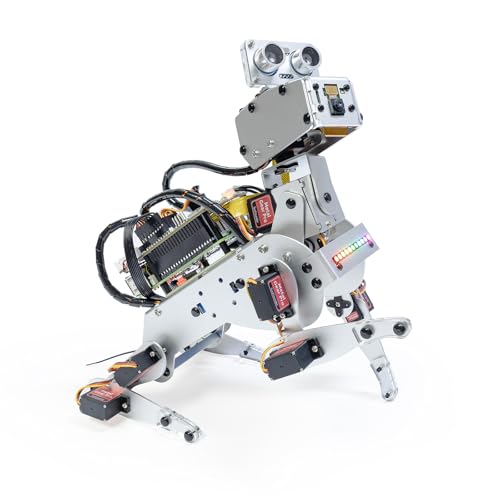
For smaller-scale or edge experimentation — testing whether a lightweight local model can handle simple form extraction without a full GPU rig — Raspberry Pi-based AI kits are a low-cost entry point. The SunFounder AI Fusion Lab Kit for Raspberry Pi and the SunFounder PiDog AI Robot Kit both target LLM-integrated projects on Pi hardware, and pair well with the guidance in SpecPicks' Best Raspberry Pi for Local LLMs & Home Lab in 2026.
Reference hardware for local benchmark work
| Product | Price | Best for |
|---|---|---|
| ROCm for AMD Radeon: AI Development on Consumer GPUs | $34.99 | Reference guide for running multimodal models on Radeon GPUs |
| SunFounder AI Fusion Lab Kit (Raspberry Pi) | $98.99 | Small-scale local LLM experimentation on Pi hardware |
| SunFounder Picar-X AI Video Robot Car Kit | $89.99 | Edge vision + LLM integration projects |
| SunFounder PiDog AI Robot Dog Kit | $179.99 | LLM-integrated Pi robotics for hands-on testing |
Prices reflect SpecPicks catalog listings at time of publication and may vary — check the linked product page for current pricing.
For teams whose documents involve extracting relationships between entities — not just flat fields — pairing an LLM extraction step with a graph structure is worth understanding before designing a pipeline; Knowledge Graphs and LLMs in Action covers that pattern, and Generative AI with Python is a useful primer on the pretrained-model plumbing (vector stores, API wrappers) that most OCR pipelines end up needing regardless of which model wins the accuracy comparison.
Reading Table Extraction and RAM Constraints Together
Structured document extraction — especially multi-page PDFs with tables — is memory-hungry once you're running the model locally rather than through an API. SpecPicks' Real Productivity on 32-64GB RAM for Local LLMs is relevant here: document-extraction workloads with long context (a full multi-page PDF per call) push RAM usage in ways that shorter chat-style prompts don't, and that's before accounting for a hosted vision component. For pipelines that also need to reconstruct or validate code, formulas, or structured logic pulled from a document, the code-focused comparison in ProgramBench: Can LLMs Rebuild Programs From Scratch? is a useful adjacent reference for how model capability tiers separate on structured, rules-heavy tasks — a similar dynamic to table extraction.
Practical Takeaways
- Don't default to the newest flagship for high-volume, low-complexity extraction. Public benchmarks repeatedly show the accuracy gap over cheaper or older models narrows to a few points on clean documents — not enough to justify a multi-times cost difference at scale.
- Reserve premium models for the hard cases — dense tables, multi-column layouts, low-quality scans, handwriting — where the accuracy spread is actually widest.
- Validate on your own documents. A public leaderboard reflects one document set; run a smaller version of the same benchmark against a sample of your actual documents before committing a pipeline to any single model.
- Factor in current API pricing directly from the providers — OpenAI, Anthropic, and Mistral publish per-token rates that change more often than most third-party comparisons update, so cross-check before finalizing a cost model.
- If volume justifies local inference, hardware choice (GPU vendor, VRAM, RAM headroom) matters as much as model choice — see the RAM and GPU comparisons linked above before buying.
Citations and sources
- OmniAI OCR Benchmark
- getomni-ai/benchmark — open-source OCR benchmark framework (GitHub)
- OpenAI API pricing
- Anthropic pricing
- Mistral AI platform pricing
This piece is editorial synthesis based on publicly available information. No independent first-party benchmarking is reported.