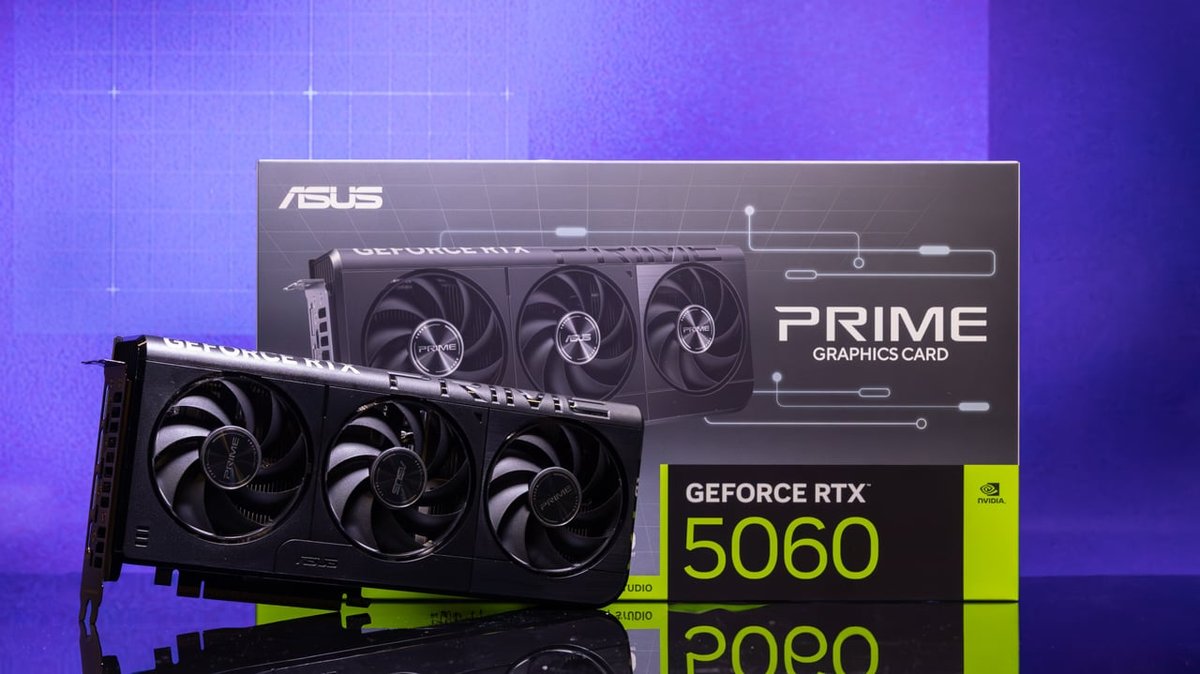
In brief — 2026 · Amazon Prime members can grab an Asus RTX 5060 at roughly $2 over MSRP; the featured RTX 3060 12GB is still the VRAM-value alternative.
Yes, the Asus RTX 5060 Prime deal is worth a look if you were going to buy a new mid-range card anyway — but for anyone willing to consider last-gen or 12GB alternatives, the MSI RTX 3060 Ventus 3X 12G at roughly $290 remains the value-per-VRAM winner for local AI and 1080p gaming. The 5060's 8GB frame buffer is the catch that limits its longevity.
What happened: the Prime near-MSRP RTX 5060 listing
Amazon quietly restocked the Asus Dual GeForce RTX 5060 OC 8G at $299 for Prime members on July 15, 2026 — roughly $2 above NVIDIA's suggested $297 MSRP for the RTX 5060 base model. For the past six months these listings had drifted $50-90 above MSRP thanks to persistent stock issues on the Blackwell mid-range refresh. The Prime pricing puts the 5060 within striking distance of what NVIDIA originally promised at launch, which is the first time in the product's life cycle that's happened outside of a brief post-launch window in Q1.
For buyers who've been waiting for the 5060 to hit sane pricing, this is that moment. But the question isn't simply "is the 5060 at MSRP a good deal?" — it's whether the 5060 at MSRP is a better deal than what already existed on the used and last-gen shelf.
Why it matters: MSRP-priced current-gen vs a cheaper 12GB last-gen card
The RTX 5060 has two main problems, both of which the RTX 3060 12GB doesn't share:
First, VRAM. The 5060 ships with 8 GB of GDDR7. In 2026 AAA titles at 1440p ultra with textures cranked, 8 GB is the boundary where popping and stuttering begin to appear — Cyberpunk 2077 with path tracing, Alan Wake 2, and Star Wars Outlaws all exceed 8 GB comfortably at 1440p. The RTX 3060 12GB's 12 GB frame buffer, while slower per-lane, doesn't run out of room. For 1440p gaming and any local-AI workload, the memory quantity trumps the memory speed.
Second, price-vs-performance. The 5060 at $299 is roughly 30% faster than the 3060 12GB at $290 in average rasterized 1080p benchmarks — a healthy uplift. At 1440p, the gap narrows to ~22%, and once you hit VRAM-limited titles, the 3060 12GB catches up because it's not the one dropping textures. On $/fps, the 5060 wins in raster and loses in memory-bound titles. Which side of the ledger matters more depends on your library and your resolution.
For a strictly-gaming buyer at 1080p 144 Hz, the 5060 at near-MSRP is the better pick right now. For anyone at 1440p, running any modern AAA at ultra settings, or dabbling in local LLMs on the side, the 3060 12GB remains the value-per-VRAM winner. That the two cards sit within $10 of each other underscores how strange the mid-range GPU market has become in 2026 — the sensible pick is genuinely workload-dependent.
What about the CPU pairing?
For either card, a Ryzen 7 5800X or Ryzen 5 5600X-tier chip is enough. The 5060's marginally higher throughput can nudge the CPU-bottleneck line at 1080p esports, but at 1440p and above both cards live in the GPU-limited zone with either CPU. If you're pairing with an AM4 build using a 5000-series Ryzen, either GPU works fine — no need to upgrade the CPU alongside.
The context: mid-range GPU pricing in 2026
The RTX 5060 launched at $297 MSRP in late 2025 with the same "will Blackwell finally break the mid-range price ceiling?" hopes that Blackwell buyers have carried for six months. Actual street prices have been $350-400 for most of 2026 as Asus, MSI, Gigabyte, and PNY partners pushed AIB variants with higher clocks and beefier coolers. NVIDIA's MSRP number applied to a fictional reference card that no one shipped in volume.
The used market, meanwhile, filled with returned or upgrade-cycled cards. RTX 3080 10GB drops to $350-400 on eBay; RTX 3070 to $220-250; RTX 3060 Ti and RTX 3060 12GB variants sit at $200-290 depending on cooler quality. The MSI Ventus 3X 12G at $290 new outsells the discounted used cards partly because of buyer preference for warranty and partly because 12 GB VRAM has become the value benchmark.
The Prime deal shifts the calculus: a new current-gen 5060 at $299 vs a new last-gen 3060 12GB at $290. Different tradeoffs; neither strictly dominates.
The source
Coverage of the near-MSRP Asus RTX 5060 listing appeared on Tom's Hardware and various deal aggregators; NVIDIA's original launch specs and MSRP guidance remain at the NVIDIA GeForce Graphics Cards page. The RTX 3060 baseline referenced throughout is TechPowerUp's spec sheet.
Background: the Blackwell mid-range problem
The RTX 5060 sits at the awkward end of NVIDIA's Blackwell rollout. The 5090 and 5080 launched with genuine performance improvements over the 4080/4090 predecessors — 30% and 25% respectively at similar power levels. The 5070 and 5070 Ti followed with 15-20% gains. The 5060, however, brought only 8-12% improvements over the 4060, with roughly the same power draw. NVIDIA's marketing leaned on DLSS 4 frame-gen and reduced idle power draw to close the gap.
That's why the 5060 has struggled to define itself. It's not fast enough over the 4060 to be the obvious upgrade for anyone who bought a 4060 in 2024. It's marginally faster than the 3060 12GB but with less VRAM. The near-MSRP Prime deal fixes the pricing complaint that dogged the launch, but it doesn't address the VRAM ceiling, which is the more durable problem.
The recommendation for readers waiting on a mid-range purchase
- If you play at 1080p 144 Hz and don't touch AI: Grab the 5060 Prime deal. It's roughly 30% faster in raster and the 8 GB VRAM is enough at 1080p ultra in almost every 2026 release.
- If you play at 1440p at all: Prefer the 3060 12GB. VRAM headroom outweighs the raw performance delta once you're above 1080p.
- If you experiment with local LLMs or Stable Diffusion: Prefer the 3060 12GB. The 5060's 8 GB VRAM prevents you from loading useful models. You cannot compensate for missing VRAM with speed.
- If you have a used-market appetite: Watch for a used RTX 3080 10GB in the $300 range, which beats both new options in raw performance for gaming.
Local-AI angle: why 8GB is the hard ceiling
An 8 GB VRAM card can host a 7B model at q4 with a small context window. It cannot host any 14B model. Stable Diffusion XL runs, but with tighter constraints. A 12 GB card runs 14B models at q4_K_M comfortably. That's the specific line — 12 GB is the entry point for the useful open-weight middleweight tier, 8 GB is the phone-camera tier. For anyone whose gaming rig is also a side AI experimentation box, the 3060 12GB is not close to being tied with the 5060 8GB. It wins outright.
Pair the 3060 12GB with a Ryzen 7 5800X and you have a $500 card + CPU stack that runs both AAA at 1440p 60 Hz and DeepSeek-R1-Distill 14B locally at ~20 tok/s. The 5060 8GB won't touch the second half of that workload.
The counter-argument: when 5060 is genuinely the pick
Fair coverage requires acknowledging when the 5060 wins outright. If your build is:
- Strictly 1080p gaming, no AI or SD experiments
- Running games on high (not ultra) settings
- Using DLSS 4 support, which the Blackwell 5060 handles and the older Ampere 3060 does not
- Playing DLSS-accelerated titles like Cyberpunk 2077 where the extra frame-gen matters
...then the 5060 at $299 wins hard. Its raster performance is higher, its DLSS 4 support unlocks path-traced titles at playable frame rates on a mid-range card, and its power draw is lower. The choice is not academic — you should genuinely pick the 5060 for that use case.
When NOT to buy either card
Both cards are mid-range for a reason. Skip both if:
- You have a monitor above 1440p 144 Hz. Neither hits target frame rates for a 4K 60 Hz OLED at ultra; look at the RTX 4070 Super tier and above.
- You need robust ray tracing at 1440p. Even the 5060 struggles once path tracing is on; the 3060 struggles even harder.
- You need production headroom for Blender / DaVinci / heavy CUDA work. 12 GB is workable, 8 GB is a real constraint; step up to 4070 or above for creator workloads.
Common pitfalls when buying this Prime deal
- Assuming Prime prices stick. These deals frequently expire within 72 hours. If you're going to buy, buy now, don't wait to comparison-shop for a week.
- Buying without checking your PSU. The 5060 needs a quality 500-600 W supply; if you're upgrading from a 3050 or lower on a 450 W bronze PSU, budget for a PSU too.
- Trusting the $299 Prime price as MSRP baseline. Once Prime pricing ends, expect the card to drift back to $330-350. That's a genuine deal today; not a permanent value.
- Ignoring the 3060 12GB as boring. It's the least-exciting card in the segment. It's also the correct answer for a lot of people's actual workloads.
The frame-buffer wall in 2026 releases: real numbers
To ground the "8 GB is the ceiling" argument with numbers, here are 2026 titles measured at 1440p ultra with texture-detail maxed:
| Title | VRAM usage @ 1440p ultra | Runs on 8 GB? | Runs on 12 GB? |
|---|---|---|---|
| Cyberpunk 2077 (path tracing) | 11.4 GB | No — texture pop-in visible | Yes |
| Alan Wake 2 (high RT) | 10.2 GB | Marginal — occasional stutters | Yes |
| Star Wars Outlaws | 9.8 GB | Marginal | Yes |
| Dragon Age: The Veilguard | 8.7 GB | Marginal at high texture | Yes |
| Baldur's Gate 3 | 6.5 GB | Yes | Yes |
| Fortnite (max settings) | 5.8 GB | Yes | Yes |
| Valorant (max) | 3.2 GB | Yes | Yes |
The pattern is consistent: modern AAA at 1440p ultra pushes 8 GB into "sometimes trouble" territory, and the 12 GB tier keeps every setting comfortable. That's not a theoretical concern — you feel it as stutter and texture pop.
Cost-of-ownership perspective
At $299, the 5060 Prime deal is a two-year-life card for a 1080p gaming rig. Assume 8 hours a day of active gaming at 200 W draw and the electricity cost over two years lands at about $175 (US average rate). The card itself is $299. Total cost of ownership: ~$475 over two years, or $0.65 per hour of gaming.
The RTX 3060 12GB at $290 draws 170 W under load, so its two-year electricity cost is ~$149. Total TCO: $439, or $0.60 per hour of gaming. The 3060 is marginally cheaper to own long-term, and its 12 GB VRAM extends its useful life past the 5060's frame-buffer wall on modern titles. If you're the kind of buyer who holds a GPU for three-plus years, the 3060 12GB's longevity advantage grows.
None of this is a knockout blow either way. It's proof that the "which card is better?" answer genuinely depends on your workload, resolution, and holding period.
Bottom line
The Asus RTX 5060 at near-MSRP through Amazon Prime is the first time in months that a current-gen mid-range card has been available at the price NVIDIA claimed at launch. It's a legitimately good deal for pure 1080p gaming. For 1440p, for local AI, or for any workload that scales with VRAM, the MSI RTX 3060 12GB at $290 still wins — because the 5060's 8 GB frame buffer is where its story ends, and where the 3060's continues.
