See our review methodology. Catalog prices below were observed on 2026-08-30 and change frequently — check the live listing before you buy.
They look fine, and the reason is arithmetic. Per Nintendo's support documentation, the Super NES Classic Edition outputs 720p or 480p over HDMI, and 1280×720 scales to 3840×2160 by exactly 3× in both axes. A 4K panel is the best possible target for a 720p source. Softness comes from how the monitor interpolates, not from the ratio.
Who this is for
You have a mini console — a Genesis Mini, an SNES Classic, or both — and either you have just bought a 27-inch 4K gaming monitor or you are about to. You plugged the console in, and the picture looks softer and mushier than it did on the old TV in the other room. You want to know whether that is the monitor's fault, the console's fault, or just what 720p looks like when you sit two feet away from it.
The short version is that it is mostly the monitor's scaler, partly your viewing distance, and not at all the resolution mismatch that people usually blame. The 720p-to-2160p relationship is the cleanest integer relationship in consumer display scaling. If your panel took the naive path — copy each source pixel into a 3×3 block of output pixels — the result would be a pixel-perfect, razor-edged image with no interpolation blur at all. Almost no desktop monitor takes that path.
That changes what you should shop for. The specs that dominate 4K gaming monitor reviews — refresh rate, HDR peak brightness, response time, adaptive sync — are all irrelevant to a console that outputs a fixed 720p signal at a fixed refresh. What matters instead is a much shorter list: what scaling and aspect-ratio controls the on-screen menu exposes, how much latency the processing path adds, and whether the panel has a mode that runs a leaner pipeline.
This guide covers three 27-inch 4K panels currently in the SpecPicks catalog and the two mini consoles most likely to be plugged into them, and it is honest about the case where the answer is "your current monitor is fine, sit further back."
Key takeaways
- Both mini consoles output a fixed 720p HDMI mode. Neither offers 1440p or 2160p, and neither exposes scaling options in its menu.
- 720p → 2160p is an exact 3× integer scale. 720p → 1080p is 1.5× — a worse ratio. A 4K panel is theoretically the better target.
- Softness comes from bilinear or bicubic interpolation in the monitor's scaler, not from the resolution ratio.
- On a dual-mode panel, the FHD high-refresh mode sometimes runs a leaner processing path than native UHD. It costs nothing to try both.
- Viewing distance matters more than any spec on this page. The same upscale that looked fine on a TV across a room is brutal at 27 inches and two feet.
Step 0 — what resolution does each console actually output?
The Super NES Classic Edition outputs 720p or 480p over HDMI, per Nintendo's support page. There is no 1080p mode, no 1440p mode and no 2160p mode. The Sega Genesis Mini is in the same class — its published specifications describe a 720p HDMI output, and per its product listing it ships with an HDMI cable and a USB power adapter in the box.
Underneath that HDMI output, the actual game content is far lower resolution still. The original SNES rendered at 256×224 for most titles; the Genesis rendered at 320×224. The mini consoles run an internal emulator that scales that native framebuffer up to the 720p HDMI signal before it ever leaves the box. So there are two scaling steps in the chain, and you only control the second one:
- Inside the console: 256×224 or 320×224 → 1280×720. Fixed, not user-configurable, already done by the time the signal reaches the cable.
- Inside the monitor: 1280×720 → 3840×2160. This is the step the panel controls, and the only one you can influence.
That framing is what makes the rest of this article tractable. You cannot change what the console sends. You can only change what the monitor does with it — and, more effectively, how far away you sit.
Why does 720p look soft on a 4K panel?
This is where the common explanation goes wrong. The usual claim is that 720p on 4K is a "non-integer scale" and that this is the source of the blur. The arithmetic does not support it:
| Source | Target | Vertical ratio | Horizontal ratio | Integer? |
|---|---|---|---|---|
| 1280×720 | 3840×2160 (4K) | 2160 ÷ 720 = 3.0 | 3840 ÷ 1280 = 3.0 | Yes — exact 3× |
| 1280×720 | 1920×1080 (FHD) | 1080 ÷ 720 = 1.5 | 1920 ÷ 1280 = 1.5 | No — fractional |
| 1920×1080 | 3840×2160 (4K) | 2160 ÷ 1080 = 2.0 | 3840 ÷ 1920 = 2.0 | Yes — exact 2× |
720p into 4K is a perfect 3× integer relationship. 720p into 1080p is not. If integer ratios were the whole story, a 4K panel would render these consoles more sharply than a 1080p one, not less.
What actually produces the softness is the interpolation algorithm. An integer ratio only helps if the scaler performs integer scaling — nearest-neighbour replication, where each source pixel becomes a solid 3×3 block of identical output pixels, preserving hard pixel edges. Desktop monitor scalers almost universally use bilinear or bicubic interpolation instead, which computes each output pixel as a weighted blend of neighbouring source pixels. That algorithm is the right default for arbitrary fractional ratios, and it produces a deliberately smooth result. Applied to pixel art with hard edges, "smooth" reads as "blurry."
Integer scaling, where it exists at all, is a GPU-side feature on PC or a function of a dedicated external scaler. It is not something a mini console can request over HDMI, and it is rarely exposed in a desktop monitor's OSD. That is the gap, and no monitor purchase on this page closes it completely.
The second factor is angular pixel size. A 720p image blown to 55 inches and viewed from eight feet subtends a small angle per source pixel; the same image on a 27-inch panel at two feet subtends a much larger one. Every interpolation artefact is magnified accordingly. This is why the console "looked better on the TV" — the TV's scaler was probably not better, you were just five feet further away from it.
Spec-delta table
| Monitor | Panel and native res | Refresh modes | Scaling and aspect controls | Notes for sub-1080p sources |
|---|---|---|---|---|
| KOORUI 27" 4K (G2741L) | 27" Fast IPS, 3840×2160 | UHD 160 Hz or FHD 320 Hz dual mode | OSD aspect and image-size presets; HDMI 2.1 / DP 1.4 | Dual-mode FHD path is worth trying with a 720p source |
| SANSUI 27" 4K | 27" Fast IPS, 3840×2160 | UHD 160 Hz or FHD 320 Hz dual mode | OSD aspect presets, PIP/PBP; 2× HDMI 2.1, 2× DP 1.4 | Two HDMI 2.1 inputs means console and PC stay connected |
| Samsung 27" Odyssey 4K | 27" Fast IPS, 3840×2160 | 144 Hz, 1 ms | Samsung OSD image-size and screen-adjustment menu | Most mature OSD of the three for aspect control |
| Sega Genesis Mini | Source device | Fixed 720p HDMI output | None — no scaling options in console menu | Ships with HDMI cable and USB power adapter |
| Nintendo SNES Classic | Source device | 720p or 480p HDMI output | Three built-in display filters, no scale control | 480p mode exists but is not an improvement here |
Prices may vary. Check the live listing before purchase.
How much input lag does monitor-side upscaling add?
Any signal that arrives at a resolution other than the panel's native one has to pass through the scaler, and scaling is a processing step with a cost measured in milliseconds. That cost is separate from — and additive to — the panel's own response time. A "1 ms" response-time figure describes how fast a pixel changes state, not how long the display took to decide what state to change to.
RTINGS' methodology for measuring monitor input lag is the reference for how this is quantified properly: the measurement is taken from signal input to photons leaving the panel, and it is reported per resolution and per refresh mode precisely because those paths differ inside the same monitor. That last part is the actionable insight — a single display can have materially different latency depending on which mode it is running.
For a 16-bit platformer, none of this is likely to be perceptible. For a Genesis-era shoot-'em-up or a precision platformer where frame-tight inputs are the whole game, a scaler that adds double-digit milliseconds on top of the console's own emulation latency is worth eliminating.
Two practical steps. First, disable every optional processing feature in the OSD — dynamic contrast, motion interpolation, noise reduction, local dimming, "AI" enhancement modes. Each is another pass over the frame. Second, if the monitor has a game or low-latency mode, use it; that mode's entire job is to bypass processing stages.
The dual-mode panels add a third option. When a monitor switches to its FHD high-refresh mode, it is running a different internal pipeline than in native UHD. Sometimes that pipeline is leaner. Whether it is on any given unit is not something a spec sheet tells you, but flipping between modes with the console connected costs nothing and takes ten seconds.
Does the KOORUI 27" 4K dual-mode panel handle it?
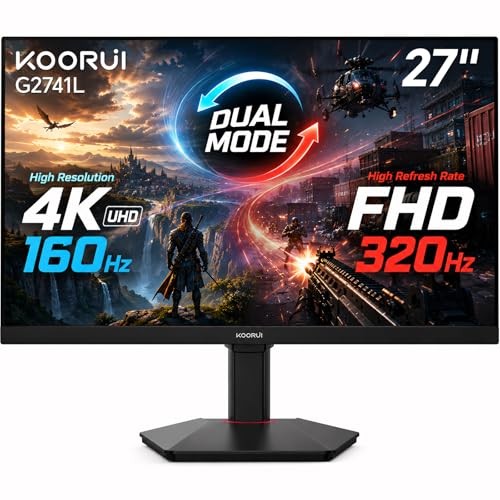
The KOORUI 27" 4K G2741L lists at $349.99 in the SpecPicks catalog as of 2026-08-30. Per its product listing it is a Fast IPS panel running UHD at 160 Hz or FHD at 320 Hz, with HDMI 2.1 and DP 1.4 inputs, HDR400, FreeSync Premium and G-SYNC compatibility, and a height/pivot/tilt stand.
For a 720p console, the interesting spec is the dual-mode switch, not any of the gaming credentials. Its native UHD mode gives you the clean 3× ratio; its FHD mode gives you a 1.5× ratio but potentially a shorter processing path. Neither is obviously better in advance, which is exactly why a panel that offers both is a reasonable hedge.
The HDMI 2.1 input is irrelevant to bandwidth here — a 720p60 signal needs a small fraction of what any modern certified cable and port carry — but it does mean the console will negotiate without trouble. The pivot function is a genuine bonus for anyone who also emulates vertical-orientation arcade titles.
Best fit: the reader who wants one panel that is a serious PC gaming monitor first and a competent retro display second, and who wants the dual-mode option without paying the Samsung premium.
Does the SANSUI 27" 4K dual-mode panel handle it?
The SANSUI 27" 4K lists at $329.99 as of 2026-08-30 and is the closest direct comparison to the KOORUI. Per its product listing it is also a Fast IPS dual-mode panel — UHD at 160 Hz or FHD at 320 Hz — with HDR400, FreeSync Premium, built-in speakers and PIP/PBP.
Two things make it the better pick for a retro setup specifically. First, it exposes two HDMI 2.1 inputs and two DP 1.4 inputs, so a mini console and a PC can both stay permanently connected without an HDMI switch in the chain. Removing the switch removes a handshake failure point, and HDMI handshake problems on mini consoles are far more often caused by switches and receivers than by anything else in the signal path.
Second, the built-in speakers matter more than they normally would. A mini console has no analog audio output — audio comes over HDMI or not at all. Without panel speakers you need a monitor with a 3.5 mm audio-out to break the HDMI audio back out, which is an extra spec to check and an extra cable to run.
Best fit: the reader assembling a mixed console-and-PC desk who wants the fewest boxes in the chain.
Does the Samsung Odyssey 27" 4K handle it?
The Samsung 27" Odyssey 4K lists at $489.99 as of 2026-08-30 — a $140 premium over the SANSUI. Per its product listing it is a Fast IPS panel at 144 Hz with a 1 ms response time, G-Sync compatibility, FreeSync Premium, HDR400 and Black Equalizer.
On the raw spec sheet it is the worse buy for this use case: 144 Hz against 160 Hz, and no dual-mode 320 Hz option at all. Neither of those numbers means anything to a console outputting a fixed low refresh, but they are what you are paying the premium for, and the console is not using them.
What you actually get for the money is Samsung's OSD. Its image-size and screen-adjustment menus are the most mature of the three, which is the single most relevant software feature for a sub-1080p source — these are the controls that let you choose how the incoming signal maps onto the panel rather than accepting one default. If a monitor is going to give you meaningful control over a 720p input, this is the one most likely to do it. Black Equalizer also has an incidental use here: it lifts shadow detail in the dark 16-bit titles that were mastered for CRT gamma and look crushed on a modern IPS panel.
Best fit: the reader who wants the most OSD control and is buying primarily for PC use, with the retro consoles as a secondary input.
What about the consoles themselves?
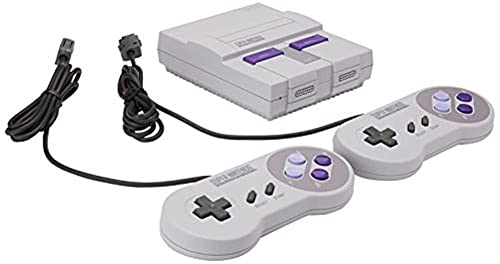
The Sega Genesis Mini lists at $216.77 as of 2026-08-30 — well above its launch price, which is what happens to discontinued hardware. Per its product listing it includes 42 games, two wired controllers, an HDMI cable and a USB power adapter. The bundled HDMI cable is electrically sufficient; a 720p60 signal is nowhere near the bandwidth limit of any certified cable, so replacing it fixes nothing.
The Nintendo Super NES Classic Edition lists at $212.30 and ships with 21 games per its product listing, including the first release of Star Fox 2. Its firmware includes three display modes — a 4:3 mode, a pixel-perfect mode and a CRT filter that simulates scanlines. The CRT filter is worth trying on a 4K panel for a specific reason: scanline simulation reintroduces the horizontal structure that made the original art read correctly, and it partly masks the interpolation smoothing the monitor applies afterwards. It is a taste call, but it is the one image control either console actually gives you.
On handshake: both consoles are HDMI 1.x-era devices. If the monitor reports no signal, connect the console directly to the display first, bypassing every switch, splitter, receiver and capture device. Those intermediate boxes are the overwhelmingly common cause of handshake failures with older HDMI sources, and diagnosing the chain by elimination takes two minutes.
Both consoles are eBay-channel purchases in the SpecPicks catalog. Both are discontinued, and current Amazon listings for discontinued console hardware are frequently stale third-party inventory — the eBay buy button on the strip above is the one more likely to reach a real seller.
Is an external scaler worth it before you buy a different monitor?
An external scaler box sits between console and monitor and takes the scaling decision away from the panel. Its advantage is control: a dedicated retro scaler can perform true nearest-neighbour integer scaling, apply proper scanline emulation and hand the monitor a signal at its native resolution so the monitor's own scaler is bypassed entirely. That is the only way to get a genuinely pixel-sharp 3× image out of these consoles on a desktop panel.
The counter-case is straightforward. Good retro scalers cost a meaningful fraction of a monitor, they add a box and two more cables to the setup, and they require configuration you will do once and then forget. For a casual player who wants to play Sonic 2 on a Saturday, the honest answer is that the interpolated image is fine, the CRT filter helps, and sitting a foot further back helps more than either.
Buy the scaler if you have several retro systems feeding one display, if pixel-art fidelity is the point of the hobby for you, or if you already own a good monitor and do not want to replace it. Skip it if a mini console is your only retro hardware.
Perf-per-dollar: what a clean picture actually costs
| Tier | Spend | What it buys |
|---|---|---|
| Free | $0 | Enable the console's CRT/pixel-perfect filter, disable all monitor post-processing, sit 12–18 inches further back |
| $330 | SANSUI 27" 4K, $329.99 | Dual-mode panel, two HDMI inputs, speakers — no switch needed in the chain |
| $350 | KOORUI 27" 4K, $349.99 | Same dual-mode flexibility, pivot stand, HDMI 2.1 / DP 1.4 |
| $490 | Samsung Odyssey 27" 4K, $489.99 | Most OSD control over image size and aspect, Black Equalizer for CRT-gamma titles |
| $490+ | Any of the above plus an external scaler | True integer scaling and proper scanline emulation — the only path to a pixel-sharp result |
The free tier is not a joke entry. Turning off dynamic contrast and motion interpolation, enabling the console's own filter and adjusting your seating position costs nothing and addresses the majority of what people are reacting to when they say the picture looks wrong.
Verdict matrix
Get the KOORUI if… you want a legitimate 4K gaming monitor first and a retro display second, you value the pivot stand, and $349.99 is inside budget.
Get the SANSUI if… the retro setup is the point. Two HDMI 2.1 inputs and built-in speakers remove the two most common extra boxes — an HDMI switch and an audio breakout — from the chain, and it is the cheapest of the three at $329.99.
Get the Samsung Odyssey if… you want the deepest OSD control over image size and aspect ratio, you will use the panel primarily for PC gaming, and the $140 premium over the SANSUI buys you software maturity you will actually use.
Keep your current panel if… it already displays the console without a handshake problem. No monitor in this price class performs true integer scaling on a 720p input, so the upgrade buys you better PC gaming, not a meaningfully sharper mini console. Spend the money on a scaler instead if retro fidelity is the actual goal.
Recommended pick
For a desk that has both a mini console and a PC on it, the SANSUI 27" 4K at $329.99 is the recommendation. It matches the KOORUI's dual-mode panel spec at $20 less, and its two HDMI 2.1 inputs plus built-in speakers eliminate the HDMI switch and the audio breakout — two boxes that are more likely to cause a handshake failure with a 720p HDMI 1.x source than the monitor itself ever will. The Samsung Odyssey is the better monitor in the abstract; it is not $140 better at displaying a 720p signal.
Bottom line
Retro mini consoles look acceptable on a 4K gaming monitor, and the resolution math is on your side rather than against you: 1280×720 into 3840×2160 is an exact 3× scale, the cleanest ratio available in consumer displays. What costs you sharpness is that desktop scalers interpolate rather than replicate, and that a 27-inch panel at desk distance magnifies every artefact your old TV hid behind eight feet of living room.
So buy the monitor you want for everything else you do, verify it exposes usable aspect and image-size controls, turn off every processing feature in the OSD, and switch on the console's own CRT filter. If pixel-perfect 16-bit output is genuinely the priority, the money belongs in an external scaler, not in a more expensive panel — none of these three will do integer scaling no matter what you pay.
Related guides
- KOORUI 27" 4K vs Samsung Odyssey 27" 4K: Best 4K Monitor for Console & PC
- Best 4K Monitor for an RTX 3060 12GB: KOORUI vs Samsung Odyssey
- Sega Genesis Mini vs SNES Classic: The Definitive 2026 Showdown
- Genesis Mini vs SNES Classic vs Raspberry Pi 4: Which Retro Setup Wins
- Can an RTX 3060 12GB Drive a 27-Inch 4K Monitor in 2026?
Citations and sources
- Nintendo Support — Super NES Classic Edition video output (accessed 2026-08-30)
- Sega Genesis Mini — published specifications (accessed 2026-08-30)
- RTINGS — Monitor input lag test methodology (accessed 2026-08-30)
- Tom's Hardware — Best 4K Gaming Monitors (accessed 2026-08-30)
This piece is editorial synthesis based on publicly available information. No independent first-party benchmarking is reported. Scaling ratios are arithmetic on published output resolutions, and prices are SpecPicks catalog street prices observed on 2026-08-30.
— Mike Perry