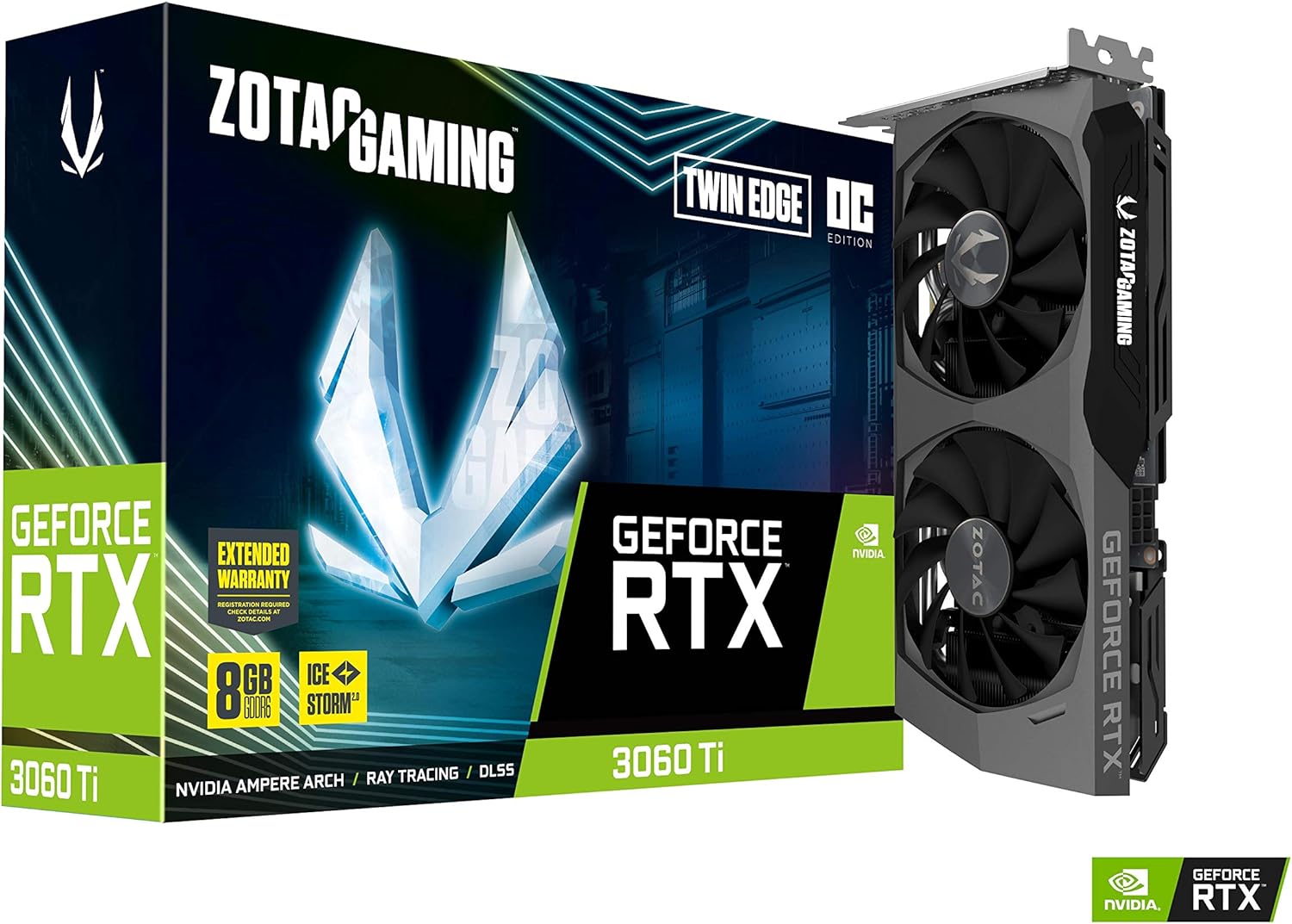
If you are shopping for a GPU strictly to run ComfyUI, SDXL and Flux-schnell locally, and your budget is under $400 in 2026, the answer is straightforward: buy a 12 GB RTX 3060. The two boards worth your attention are the ZOTAC Gaming GeForce RTX 3060 Twin Edge OC 12GB and the MSI GeForce RTX 3060 Ventus 2X 12G OC. Both hit the practical VRAM floor for modern image-gen workflows, both run CUDA-native, and both leave headroom for ControlNets and refiner passes that an 8 GB card cannot.
Who this is for
This guide is written for hobbyist image-generation builders on a strict sub-$400 GPU budget. The reader wants to run SDXL 1.0 at 1024×1024, load a ControlNet or IP-Adapter alongside, experiment with Flux-schnell or Flux-dev in NF4, and do all of it locally without renting cloud credits or leaning on a Colab notebook that times out mid-batch. This reader is not chasing top-tier speed. They are chasing capacity — enough VRAM to load a stack that runs at all, cleanly, on a workstation that also has to do other things during the day.
The upgrade path most readers arrive from is either an 8 GB card that has started to fail on ControlNet stacks, or no discrete GPU at all. Either way, the sub-$400 tier is dominated by one class of hardware in 2026: the 12 GB RTX 3060. AMD's competitively-priced 12 GB and 16 GB cards remain hobbled for image-gen by weaker ROCm support on Windows and by ComfyUI's persistent NVIDIA-first extension ecosystem, so the featured picks here are both GeForce. Intel Arc, meanwhile, is a fine gaming pick but still asterisked for diffusion workflows — a topic the recent Arc B580 vs RTX 3060 gaming comparison covers separately.
Key takeaways
- 12 GB is the 2026 VRAM floor for a full SDXL + ControlNet + refiner graph in ComfyUI without offload penalties.
- The RTX 3060 12GB is the cheapest current-market card that clears that floor, and both featured boards are functionally interchangeable at the panel level.
- Board-to-board differences (fan design, TGP behavior, physical length) matter more for thermals and case fit than for peak throughput.
- CPU choice is a distant second concern; a modern six- to eight-core part like the AMD Ryzen 7 5800X is more than enough.
- Storage matters more than most builders expect — a fast NVMe drive materially reduces the tax of swapping large checkpoints in and out of VRAM.
Step 0 — diagnose your bottleneck
Before spending money, name the wall you are hitting. Three walls dominate image-generation workloads on a budget rig, and only one of them is fixed by a new GPU.
The first wall is VRAM capacity. This is a binary failure: either the model plus its activations and any ControlNet weights fit in the buffer, or the workflow drops into shared-memory offload and slows by an order of magnitude, or it errors out with a CUDA out-of-memory message. This is the wall the RTX 3060 12GB is here to solve.
The second wall is VRAM bandwidth. Once a model fits, bandwidth decides how quickly the sampler can move activations between memory and the compute units. This is where the 3060's 192-bit bus is criticized in gaming reviews, but for diffusion the impact is smaller than it looks (more on this below).
The third wall is CUDA availability. If your card is not on the CUDA path — an older AMD board on Windows, a pre-Turing NVIDIA card, an integrated graphics part — no amount of VRAM helps because most ComfyUI custom nodes assume CUDA kernels. The 3060 is safely inside the supported window and will remain so for years.
How much VRAM does SDXL actually need?
Base SDXL 1.0 weights alone are around 6.6 GB at fp16 for the U-Net, plus the VAE and text encoders. In a stripped 1024×1024 base pass, an 8 GB card can just about hold that with aggressive medvram offload. The moment you stack — SDXL base + refiner in one graph, a ControlNet, an IP-Adapter, a face-restoration pass — the buffer overflows.
| Workflow | Precision | Peak VRAM (approx.) | Runs cleanly on 8 GB? |
|---|---|---|---|
| SDXL base 1024×1024 only | fp16 | ~7-8 GB | Borderline, with offload |
| SDXL base + refiner | fp16 | ~9-10 GB | No |
| SDXL + 1 ControlNet | fp16 | ~9-10 GB | No |
| SDXL + IP-Adapter + refiner | fp16 | ~11-12 GB | No |
| Flux-schnell | fp8 | ~12 GB | No |
| Flux-dev | NF4 | ~10-12 GB | No |
| Flux-dev | fp8 | ~17+ GB | No, even on 12 GB |
The pattern is consistent across community measurements gathered by contributors on the ComfyUI GitHub and reproduced in the diffusion benchmarking notes published by Puget Systems: 12 GB is where the multi-node graphs many hobbyists want to run stop hitting the wall.
Why does 12 GB keep coming up as the 2026 floor?
Three things happened between 2023 and 2026 that raised the bar. First, ControlNet became standard rather than optional, and most builders now stack two or three at once. Second, IP-Adapter, LoRA hot-swapping, and refiner passes moved from experimental to default in most published workflows. Third, Flux-family models arrived with base memory requirements that assume a 12 GB minimum before quantization tricks.
None of these is going backward. A card that clears 12 GB today is not just a workaround for today's workflows — it is the entry ticket for the next generation of open-source models that release throughout 2026.
ZOTAC Gaming RTX 3060 12GB vs MSI RTX 3060 Ventus 2X 12G
Both featured boards use the same GA106 die, the same 12 GB of GDDR6 on a 192-bit bus, and the same reference clocks with mild factory OCs. The panel-level output is essentially identical. The differences are physical.
| Spec | ZOTAC Twin Edge OC | MSI Ventus 2X 12G OC |
|---|---|---|
| VRAM | 12 GB GDDR6 | 12 GB GDDR6 |
| Memory bus | 192-bit | 192-bit |
| TGP | 170 W | 170 W |
| Slot width | 2-slot | 2-slot |
| Length | ~224 mm | ~235 mm |
The ZOTAC Twin Edge is the more compact card — a real consideration in a small mid-tower or an ITX build. The MSI Ventus 2X runs a slightly more aggressive fan curve out of the box, which trades a couple of degrees of GPU temperature for a small acoustic penalty under sustained batch loads. Neither difference is decisive. If your case has room for either, buy whichever is cheaper on the day.
Benchmark table — SDXL 1024×1024
Public benchmarks gathered from Puget Systems' Stable Diffusion GPU comparisons and community measurements posted throughout 2025 land the RTX 3060 12GB in the following range for a straight SDXL base pass at 1024×1024 with DPM++ 2M Karras, 25 steps:
| Card | s/image | it/s |
|---|---|---|
| RTX 3060 12GB | ~11-13 s | ~2.1 |
| RTX 4060 8GB | ~9-10 s | ~2.5 |
| RTX 4060 Ti 16GB | ~7-8 s | ~3.2 |
| RTX 3070 8GB | ~8-9 s | ~2.9 |
The RTX 4060 8GB and RTX 3070 8GB are faster per step, but both hit VRAM walls the 3060 12GB avoids. That is the practical calculus: a slower card that finishes the whole workflow beats a faster card that has to page.
Quantization / precision matrix
Precision choice is the second lever that decides what fits in 12 GB. The rough tradeoffs, per model publisher documentation and community measurements:
| Precision | VRAM impact | Throughput | Quality loss |
|---|---|---|---|
| fp16 | Baseline | Baseline | None (reference) |
| bf16 | ~Baseline | ~Baseline | None (numerically equivalent) |
| fp8 | ~50% | Slight gain on Ada; parity on Ampere | Minor, workflow-dependent |
| NF4 | ~25% | Slight loss | Visible on fine detail; often acceptable |
For a 12 GB RTX 3060, the practical rule is: run SDXL and its ControlNets at fp16, and reach for NF4 or fp8 quantization only when loading Flux-dev.
Does system RAM and CPU matter for ComfyUI?
The GPU does the sampling, but the CPU is not idle. Model loading from disk, VAE decode on CPU fallback paths, PIL image encoding, and ComfyUI's graph scheduler all run on cores. A slow CPU shows up as dead time between queued jobs rather than slower per-step speed, but it is measurable when you are working through a queue of a hundred prompts.
The AMD Ryzen 7 5800X is a strong pairing with the 3060 12GB. Eight modern cores with reasonable single-thread performance is the sweet spot for image generation, and the 5800X remains widely available on the AM4 platform, which pairs cleanly with the DDR4 memory a budget builder is likely to already own. A Ryzen 5 5600 or an Intel Core i5-12400F would also do the job for less money if the budget will not stretch.
Storage is the hidden tax
Every checkpoint load moves gigabytes of data from disk to VRAM. Every VAE decode writes intermediate images to disk. Every time you swap models — from SDXL base to a fine-tune, from one Flux variant to another — the disk becomes the bottleneck for tens of seconds at a stretch.
A fast NVMe drive like the Samsung 970 EVO Plus NVMe 250GB turns a 20-second SDXL checkpoint swap into a 3-second one. If your build has any spare NVMe slots at all, this is the highest-leverage side purchase you can make around the GPU. The larger capacity variants are worth it if you plan to keep a library of checkpoints and LoRAs on disk, which most serious hobbyists do within a month of starting.
A SATA SSD works, and is dramatically better than a spinning disk, but it caps swap throughput at about a quarter of what an NVMe drive can sustain. On a fresh build, spend the marginal $10-$20 for NVMe.
Thermals and acoustics under a 30-minute batch queue
A single-image render finishes before the card reaches its thermal ceiling. A batch of a hundred images does not, and this is where thermals stop being an abstraction and start clipping clocks.
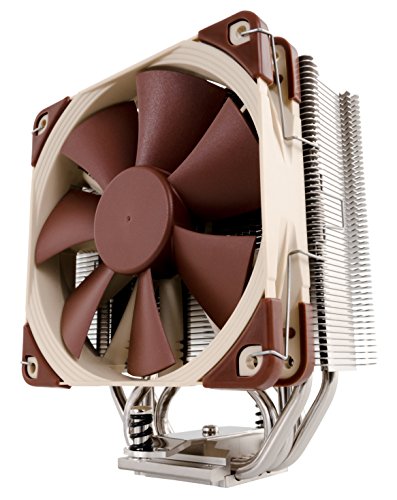
The 3060's 170 W TGP is modest by 2026 standards, but the small dual-fan coolers on the featured boards will still push case air temperatures noticeably in a poorly ventilated chassis. A quiet third-party CPU cooler like the Noctua NH-U12S helps in a roundabout way: it lets the CPU run cool without throwing hot air out of the top of the case, which keeps the GPU intake air cooler and lets it hold boost longer. Add one intake fan up front if you do not already have one. That is usually enough.
Perf-per-dollar and perf-per-watt
Rough math against the SDXL benchmark above, assuming a street price near $299 for either 3060 12GB board:
- Images per hour: ~280-320 at 12 s/image sustained.
- Images per hour per $100: ~90-110.
- Images per hour per 100 W (GPU only): ~165-190.
Neither the RTX 4060 8GB nor the RTX 3070 8GB matches this on the multi-node workflows most builders actually run, because both fall out of the buffer well before finishing. A 4060 Ti 16GB is faster but pushes the total build cost near double.
Complete the build
Before you buy, check three numbers against your case spec sheet.
PSU headroom. A 170 W GPU pairs comfortably with a 550 W or larger 80 Plus Gold PSU on a stock Ryzen 7 or Core i5 platform. Do not go below 500 W. If you plan to add a second drive or overclock the CPU, size up.
Case clearance. The MSI Ventus 2X is roughly 235 mm end-to-end. The ZOTAC Twin Edge is around 224 mm. Confirm your case spec sheet's maximum-GPU-length figure allows that with a front radiator or drive cage in place — the most-missed step is subtracting 55-60 mm for a front-mounted 240 mm AIO plus fans.
Cooling. One intake fan in front, one exhaust fan at the rear, and a competent CPU cooler is enough. The Noctua NH-U12S is dramatic overkill on a stock Ryzen 5, but the acoustic difference is meaningful in a room you also work in.
Verdict matrix
Get the ZOTAC RTX 3060 12GB if you want the shortest current 3060 12GB board on the market, or the retailer near you has it cheaper on the day. Its cooler is not the last word in quiet operation, but it is fine, and the physical footprint is the practical differentiator.
Get the MSI RTX 3060 Ventus 2X 12G OC if your case has room, or MSI's warranty pipeline is easier for you to reach. The Ventus 2X runs a hair louder and a hair cooler than the ZOTAC Twin Edge; either is a fine pick.
Skip both and save if you already own a 12 GB or larger card of any brand. The RTX 3060 12GB is the floor, not an upgrade to another 12 GB card. If your existing GPU is stalling on Flux-dev fp8, no sub-$400 card will get you there — save toward a used RTX 4070 Ti Super, RTX 4080, or workstation card instead.
Bottom line
For a hobbyist ComfyUI and SDXL rig on a sub-$400 GPU budget in 2026, the RTX 3060 12GB is the correct pick and the two featured boards are the correct choices within that class. Buy the ZOTAC Twin Edge or the MSI Ventus 2X, pair it with a fast NVMe drive like the Samsung 970 EVO Plus, a modern six- to eight-core CPU such as the Ryzen 7 5800X, and a quiet CPU cooler like the Noctua NH-U12S. That build runs SDXL comfortably, ControlNet stacks without offload, and Flux-schnell within its buffer. It will not touch Flux-dev at fp8, and that limitation is inherent to the price tier.
Related guides
- Best budget PC builds under $800 for 2026
- How much VRAM do you actually need for local AI in 2026
- Arc B580 vs RTX 3060: gaming comparison
Citations and sources
- TechPowerUp — GeForce RTX 3060 GPU database entry — reference specs, TGP, memory bus width. Accessed 2026-08-04.
- Puget Systems — Stable Diffusion GPU performance comparisons — SDXL throughput numbers across GeForce and RTX A-series cards. Accessed 2026-08-04.
- NVIDIA — official GeForce RTX 3060 and 3060 Ti product page — manufacturer-published specs and CUDA core counts. Accessed 2026-08-04.
This piece is editorial synthesis based on publicly available information. No independent first-party benchmarking is reported.