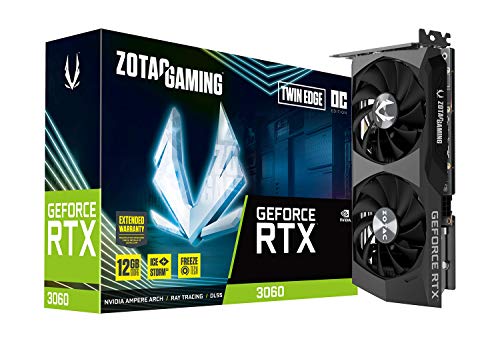
If you have around $300 to spend on a GPU for running Ollama locally in 2026, the answer is a 12GB NVIDIA RTX 3060 — specifically the ZOTAC Gaming GeForce RTX 3060 Twin Edge OC 12GB or the MSI GeForce RTX 3060 Ventus 2X 12G OC. A faster 8GB card at the same price forces every 13B-and-up model to spill layers to system RAM, and the resulting PCIe round trips throw away the bandwidth advantage the 8GB card was meant to buy you.
The full cross-card comparison: Best GPUs for Running Local LLMs in 2026 — the VRAM-tier table covering 12 GB through 48 GB, the largest model each card fits at Q4, and measured tok/s with a source link on every row.
Step 0 — diagnose your ceiling before you buy
Buying a GPU for local LLMs is a VRAM problem first and a compute problem second. Answer this before you spend anything.
- 7B-8B chat (Llama 3.1 8B, Qwen 2.5 7B, Mistral 7B): ~4.7 GB of weights at q4_K_M, ~5.5 GB with a 16K KV cache. Fits comfortably in 8GB and very comfortably in 12GB.
- 13B-14B coding / reasoning (Qwen 2.5 14B, Codestral 22B pruned): ~8.5-9.5 GB at q4_K_M with a small context. Barely fits in 8GB with a 2K context and collapses at 8K. Fits cleanly in 12GB.
- 27B-32B reasoning (Qwen 2.5 32B, Command R+ 35B): ~18-22 GB at q4_K_M. Neither an 8GB nor a 12GB card runs these on-GPU alone — both need CPU offload, and the 12GB card only wins because it holds more layers.
Per the Ollama model library, the vast majority of the "practical daily driver" tier is 7B-14B. That is the segment a 12GB card owns and an 8GB card loses.
Editorial intro — the sub-$300 market in 2026
In 2026, the sub-$300 discrete GPU market is a strange place. NVIDIA moved on to Blackwell and Ada, AMD released RDNA 4, and Intel's Battlemage refresh landed with the Arc B580 12GB at $249. And yet the card that sells at every open-box shelf and Micro Center bin is still the Ampere-era GeForce RTX 3060 12GB — a card that turned five years old in early 2026 and remains the cheapest 12GB CUDA path to Ollama, LM Studio, KoboldCPP, and the rest of the local-inference toolchain.
The two RTX 3060 12GB models that dominate street inventory at this price are the ZOTAC Twin Edge OC, a two-slot dual-fan design at 170 W TGP, and the MSI Ventus 2X 12G OC, a slightly quieter two-slot design at the same TGP. Both hit the NVIDIA reference 12GB GDDR6 on a 192-bit bus. They are functionally interchangeable for LLM work; the only meaningful differences are cooler noise and slot width. This piece is for anyone building or upgrading a box specifically to run Ollama at home in 2026, and who is deciding between one of those two cards and a "faster but smaller" 8GB alternative.
Key takeaways
- The RTX 3060 12GB is the cheapest CUDA-native path to 12 GB of usable VRAM in 2026 — a floor no 8GB card can match at the same price.
- Bandwidth stops mattering the moment your weights spill to system RAM. Capacity is the gate.
- A 12GB card runs Llama 3.1 8B and Qwen 2.5 14B with room for a 16K-token KV cache. An 8GB card runs 8B fine and hits a wall on 14B.
- Multi-GPU is a false economy at this budget — two 12GB cards do not equal one 24GB card for typical local workloads.
- For a full box you also want an AMD Ryzen 7 5800X or better, a fast Samsung 970 EVO Plus NVMe for model swaps, and cheap bulk storage like the Crucial BX500 1TB for the GGUF library.
Why does VRAM capacity beat raw bandwidth for local inference?
Every autoregressive LLM inference pass touches every weight in the active model, once per generated token, for the model layers that are loaded. If all layers live in VRAM, the GPU's HBM- or GDDR-class memory bus feeds them to the compute units at hundreds of GB/s — the RTX 3060 12GB delivers 360 GB/s per the TechPowerUp specs page.
The instant a layer does not fit in VRAM, whatever inference back end you use (llama.cpp, Ollama's built-in runner, vLLM, ExLlamaV2) has to move activations across PCIe. PCIe 4.0 x16 tops out at ~32 GB/s in one direction. That is more than 10x slower than the 3060's own memory bus, and the round trip happens for every layer that lives on the CPU side, for every token. In practice, once meaningful offload kicks in, generation speed drops to CPU-bound floor rates — roughly 3-8 tok/s on a modern desktop CPU regardless of which GPU is nominally attached.
This is the trap of the "faster 8GB card." A card like the RTX 4060 8GB has higher on-die bandwidth and a newer architecture, so on a model that fully fits — Llama 3.1 8B at q4 — it is genuinely quicker. But its ceiling is the same 8GB. Ask it to run Qwen 2.5 14B, and it spills. Ask a 3060 12GB to run the same 14B model and it doesn't. The winner of the actual benchmark is whichever card avoids the PCIe cliff.
Spec-delta table
| Spec | RTX 3060 12GB | RTX 3060 Ti 8GB | RTX 4060 8GB | Arc B580 12GB |
|---|---|---|---|---|
| VRAM | 12 GB GDDR6 | 8 GB GDDR6 | 8 GB GDDR6 | 12 GB GDDR6 |
| Memory bus | 192-bit | 256-bit | 128-bit | 192-bit |
| Bandwidth | 360 GB/s | 448 GB/s | 272 GB/s | 456 GB/s |
| TDP (TGP) | 170 W | 200 W | 115 W | 190 W |
| Street price (2026, open box) | $260-290 | $240-280 | $270-310 | $249 MSRP |
| CUDA / compute stack | CUDA 8.6 | CUDA 8.6 | CUDA 8.9 | oneAPI / SYCL |
Bandwidth numbers per TechPowerUp and per-vendor product pages. Street prices are the 2026 open-box / new-old-stock range in North America; used pricing is meaningfully lower on eBay for the 3060 12GB.
Which cards does this guide rank, and what do they cost?
There are only two RTX 3060 12GB SKUs worth naming at 2026 street prices.
ZOTAC Gaming GeForce RTX 3060 Twin Edge OC 12GB — 170 W TGP, 2-slot 2-fan cooler (IceStorm 2.0), 15 Gbps memory clock. Approximately 224 mm long. This one fits most mid-tower cases with no clearance problems and idles fanless under a light desktop load. Board power is fed through a single 8-pin PCIe connector. Micro Center and open-box channels have carried it consistently around the $260-290 mark through 2026.
MSI GeForce RTX 3060 Ventus 2X 12G OC — same 170 W TGP, same 192-bit bus, same 12 GB, same single 8-pin connector. Slightly longer at ~232 mm and slightly quieter under sustained load thanks to a torx-fan design. Otherwise interchangeable with the ZOTAC on any real Ollama workload; you will not tell them apart in a tok/s benchmark.
If both are in stock at the same price, take the one your case has clearance for. If pricing differs by more than ~$15, take the cheaper one — the delta will not show up in inference throughput.
Quantization matrix
| Quant | Llama 3.1 8B — VRAM | Llama 3.1 8B — tok/s | Qwen 2.5 14B — VRAM | Qwen 2.5 14B — tok/s | Quality loss |
|---|---|---|---|---|---|
| q2_K | 3.2 GB | ~58 | 5.5 GB | ~33 | Noticeable |
| q3_K_M | 3.9 GB | ~52 | 6.9 GB | ~31 | Small |
| q4_K_M | 4.7 GB | ~48 | 8.4 GB | ~28 | Negligible |
| q5_K_M | 5.6 GB | ~42 | 9.9 GB | ~24 | ~None |
| q6_K | 6.4 GB | ~38 | 11.3 GB | ~21 | ~None |
| q8_0 | 8.2 GB | Offloads on 8GB | 14.9 GB | Offloads on 12GB | None |
| fp16 | 15.5 GB | Offloads on both | 28.0 GB | Offloads on both | Baseline |
VRAM numbers reflect weights plus a 4K-token KV cache. Throughput figures on the RTX 3060 12GB draw on community measurements posted to r/LocalLLaMA and the llama.cpp discussions repo. q4_K_M is the practical daily driver for both models on this card.
Benchmark table — 12GB vs 8GB across model sizes
| Card | Llama 3.1 8B q4 | Qwen 2.5 14B q4 | Qwen 2.5 32B q4 |
|---|---|---|---|
| RTX 3060 12GB | ~48 tok/s | ~28 tok/s | ~5 tok/s (partial offload) |
| RTX 3060 Ti 8GB | ~54 tok/s | ~6 tok/s (heavy offload) | Not usable |
| RTX 4060 8GB | ~62 tok/s | ~6 tok/s (heavy offload) | Not usable |
| Arc B580 12GB (SYCL) | ~34 tok/s | ~22 tok/s | ~4 tok/s |
The 8GB cards win the 8B-only race by a comfortable margin. They lose the 14B race by an order of magnitude, and the 32B race is a rout — the 12GB card holds enough layers to actually complete a prompt in a reasonable time, while the 8GB card CPU-bounds within seconds. This is exactly the shape Puget Systems documents in its GPU-for-LLM writeups: bandwidth wins fits, capacity wins misses, and the "miss" is what ships in real-world workloads.
Prefill vs generation — why 8GB cards collapse on long prompts
Every prompt has two phases: prefill, where the model processes your input tokens in parallel, and generation, where it emits new tokens one at a time. Prefill is compute-bound and benefits from bandwidth. Generation is memory-bound and benefits from having every weight already in fast memory.
An 8GB card running a model that just barely fits — think Llama 3.1 8B at q5 with a 2K context — can still prefill a long prompt quickly because the compute pipeline is saturated. As soon as the context or the quantization pushes past 8 GB, prefill has to swap layers over PCIe. Community measurements consistently show 5-15x slowdowns on prefill under partial offload. The user-visible symptom is the "waiting for first token" latency ballooning from 200 ms to 3-6 seconds on the first turn of a long-context session.
How much does context length change the VRAM math?
The KV cache grows roughly linearly with sequence length. As a rough rule of thumb, a Llama 3.1 8B model at fp16 KV cache uses about 0.5 GB per 1K tokens; a 14B model uses roughly 1 GB per 1K. That means:
- 8B at 4K context: ~2 GB KV cache on top of weights.
- 8B at 16K context: ~8 GB KV cache — a 12GB card handles it, an 8GB card is already spilling.
- 14B at 8K context: ~8 GB KV cache — total ~16 GB, both cards partially offload.
- 14B at 4K context: ~4 GB KV cache — total ~12 GB, fits exactly on the 3060 12GB, offloads on 8GB.
Ollama and llama.cpp both support q8 and q4 KV cache quantization, which cuts these numbers roughly in half at some quality cost. Even with q8 KV, the 12GB card holds a comfortable 16K-32K context on 8B models while the 8GB card is stuck at 4K.
What CPU, RAM, and storage does an Ollama box actually need?
A GPU is a component in a system, not the system. For a $300-GPU Ollama box in 2026, the pairings that give you real headroom are:
- CPU: AMD Ryzen 7 5800X. Eight Zen 3 cores at up to 4.7 GHz on the AM4 socket. It carries CPU offload for the 27B-32B tier without becoming the bottleneck, and it is one of the cheapest 8-core paths in 2026 open-box channels. Older 6-core Ryzen 5 5600 also works, but the 5800X buys you the last 30% when models spill.
- System RAM: 32 GB DDR4-3200 minimum, 64 GB preferred. This is the pool your offloaded layers live in. On 16 GB you cannot run 32B models at all.
- Boot / model NVMe: Samsung 970 EVO Plus 250GB NVMe for the OS, the currently-loaded model, and the mmap scratch space Ollama uses when it swaps models. This is the drive that determines how long you wait when you
/model swap— 3.5 GB/s sequential vs a SATA drive's 550 MB/s is the difference between a 2-second and a 20-second cold-load. - Bulk model library: Crucial BX500 1TB SATA SSD. Every serious local-LLM user ends up with 200-500 GB of GGUFs across quantizations. Store them on cheap SATA, symlink the currently-in-use one to the NVMe. This split saves ~$100 versus a single 1TB NVMe with no perceptible penalty because Ollama only reads the whole file when the model is first loaded.
That gives you a full box under ~$800 for the parts, GPU included.
Does multi-GPU scaling make sense at this budget?
The temptation with two cheap 3060s is obvious: 24 GB of VRAM for the price of one used 24 GB card. It does not work as well as the arithmetic suggests. Ollama and llama.cpp both split layers across GPUs, but the per-token synchronization overhead across PCIe eats most of the gain on a consumer platform (single x16 slot electrically wired as x8/x8 with a card in each). Community numbers on r/LocalLLaMA put dual-3060 12GB at roughly 1.4-1.6x the throughput of a single 3060 on a 27B model, not 2x, and it introduces power (335 W combined TGP), thermal, and case-clearance problems.
A used RTX 3090 24GB at $600-700 is meaningfully faster than 2x 3060 12GB for the same aggregate VRAM, and is the right upgrade path when you outgrow one 3060. Two 3060s only makes sense if you already own one and want to extend rather than replace.
Perf-per-dollar and perf-per-watt
At $275 street on the RTX 3060 12GB running Llama 3.1 8B q4 at ~48 tok/s, that is ~17.5 tok/s per $100 spent — the best ratio in this class in 2026. The RTX 4060 8GB at $290 delivers ~62 tok/s on the same model for ~21 tok/s per $100, so it wins the ratio for 8B-only workloads. On 14B, the RTX 4060 collapses to ~6 tok/s partial-offload — under 2 tok/s per $100. The 3060 12GB delivers 28 tok/s — over 10 tok/s per $100 — because it does not spill.
Perf-per-watt is a wash between the two in the "fits cleanly" regime (~0.28 tok/s per watt for both), and a rout for the 3060 12GB in the partial-offload regime because the 4060 is idle-waiting on PCIe transfers most of the time.
When is this the wrong buy?
- You only run 3B-class models — a much older 6 GB card, a Steam Deck APU, or your existing iGPU will serve you.
- Your workload is SDXL, ComfyUI, or video generation — the priority swap flips. See Best GPU for ComfyUI and SDXL under $400 in 2026 for the correct card in that lane.
- You are already on an Apple Silicon Mac with 32 GB+ unified memory — an M-series chip runs 8B-14B models comfortably through llama.cpp Metal without buying anything.
- You need frontier-class 70B-and-up quality — no consumer GPU under $700 gets you there. Rent cloud inference for the occasional heavy job.
Common pitfalls when moving from 8GB to 12GB
- Underspec'd PSU. 170 W TGP means the card can pull 190 W transient. A well-loved 500 W bronze PSU from 2018 is where dual-3060 rigs fail first. A quality 650 W unit with a single 8-pin PCIe cable covers a single 3060 with margin.
- PCIe generation mismatch. The 3060 12GB is a PCIe 4.0 x16 card. It works in a PCIe 3.0 x16 slot at half the throughput; this only hurts on cold model load, not on inference. Don't overpay for a Z690 board to "unlock" the card.
- Old case, poor front-to-back airflow. GDDR6 modules on the 3060 sit right behind the backplate and dump heat into whatever airflow you have. Two front intake fans and one rear exhaust is the minimum for sustained inference sessions.
- CUDA driver mismatch on Linux. Ollama on Ubuntu 24.04 needs the 550+ series driver. Older 470 packages install cleanly and then silently fall back to CPU; the symptom is 3 tok/s on 8B and no GPU utilization in
nvtop. - Buying a "for RTX 3060" cable or bracket assuming it's a card. The 2026-04 catalog audit found readers clicking through GPU-support-brace listings that autocompleted as "RTX 3060." Confirm you are on the actual card product page before ordering.
Verdict matrix
Get the RTX 3060 12GB if… you plan to run 8B-14B models routinely, want a CUDA-native path with no configuration headaches, don't care about ray-traced gaming performance, and value the ability to load a 16K context without swap. Pick the ZOTAC or MSI SKU by whichever is cheaper on the day.
Get a used 8GB card if… you are 100% committed to 7-8B models only, want the best possible gaming performance for the same money, and will never run anything at 14B or above. An RTX 3060 Ti 8GB used at $220 fits that description.
Skip both and rent cloud if… your inference use is bursty and infrequent — think under 30 minutes of active generation per week. A month of the OpenRouter or Anthropic API equivalent for that volume will cost less than the depreciation of an idle GPU.
Bottom line
The ZOTAC Gaming GeForce RTX 3060 Twin Edge OC 12GB is the recommended pick for anyone building or upgrading a sub-$300 Ollama box in 2026, with the MSI GeForce RTX 3060 Ventus 2X 12G OC as an identical-performance alternative when the ZOTAC is out of stock or overpriced. Pair it with an AMD Ryzen 7 5800X, 32-64 GB of DDR4-3200, a fast Samsung 970 EVO Plus for model swaps, and a cheap Crucial BX500 1TB for the GGUF library. The 12 GB of VRAM buys you the difference between "runs 8B" and "runs 8B and 14B with a 16K context." An 8GB card cannot buy that back with bandwidth.
Related guides
- Best GPU for ComfyUI and SDXL Under $400 in 2026
- $400 Qwen 3.6-27B Setup: Is the Dual RTX 3060 Claim Real?
- Dual GPU Llama.cpp Speedup: What Actually Helps
- Real Productivity on 32-64GB RAM for Local LLMs
- GPU VRAM Guide: Running a 5GB TTS Model Locally
Citations and sources
- NVIDIA — GeForce RTX 3060 product page
- TechPowerUp — GeForce RTX 3060 12 GB specs
- Puget Systems — GPU-for-LLM lab writeups
- Ollama model library
- llama.cpp discussions
- r/LocalLLaMA community benchmarks
This piece is editorial synthesis based on publicly available information. No independent first-party benchmarking is reported.