As an Amazon Associate, SpecPicks earns from qualifying purchases. Prices verified 2026-08-07; check the retailer for current pricing.
Qwen3.8 Max is not a drop-in replacement for Claude Opus 4.8 on a home rig — the flagship Max tier is a very large mixture-of-experts model that no single consumer GPU hosts. But its distilled and mid-size siblings are downloadable, and at the API tier Qwen3.8 Max lands at a comparable Intelligence Index score for roughly one-third the cost per task, per Artificial Analysis. For coding work at typical volume, the practical decision is a routing question, not an either-or.
Why the open-weights-vs-API decision is finally interesting
For most of 2024 and 2025, the choice was easy: pay for a hosted frontier model, because nothing you could self-host came close on reasoning-heavy benchmarks. That changed in mid-2026. Alibaba's Qwen3.8 Max shipped at 56 on the Artificial Analysis Intelligence Index — inside the same tier as Claude Opus 4.8 — for a listed API price near $1.14 per index-standardized task. Moonshot's Kimi K3 landed higher on that same index for about 25% less. Open-weights distills of both are on Hugging Face.
For a home-lab builder deciding what to buy in Q3 2026, three questions matter more than the leaderboard rank:
- How much of what makes Qwen3.8 Max good survives distillation to something that fits on a 12–24 GB consumer card?
- What is the amortized break-even between API tokens and a dedicated local inference box for your actual workload?
- Which of the three top-tier options — Qwen3.8 Max, Claude Opus 4.8, Kimi K3 — is the right primary, and which should you route around?
This article synthesizes the public benchmark and pricing data, walks through the quantization matrix for what a mid-range card can actually run, and lays out a hardware shortlist for a build that stays useful for at least two more model generations. It is editorial synthesis of publicly available sources — no first-party benchmarking is reported here.
Key takeaways
- Cost-per-task is the 2026 metric. Raw benchmark score matters, but Artificial Analysis's per-task cost figure is the one you actually pay. A model 5% smarter that costs 3× more loses on almost every real workload.
- Open weights ≠ self-hostable flagship. Qwen3.8 Max's headline score is the hosted MoE. The Hugging Face checkpoints are smaller dense or smaller-MoE siblings; expect a real quality gap.
- 12 GB is the entry tier for meaningful local inference. The ZOTAC Gaming GeForce RTX 3060 Twin Edge 12GB and MSI GeForce RTX 3060 Ventus 3X 12G are the current price/VRAM floor for anything above 7B at usable quality.
- Prefill is where consumer cards stall. Token-per-second charts show generation. Long-prompt prefill on a 12 GB card is where the real wait lives — see the KV-cache math below.
- Route, don't replace. The winning pattern is Qwen (API or local) for cost-sensitive volume, Claude Opus 4.8 for the hard cases, Kimi K3 for the middle. Wire it once and forget.
What did Qwen3.8 Max actually score, and how does that compare to Claude Opus 4.8?
Per Artificial Analysis, Qwen3.8 Max scores 56 on their combined Intelligence Index at a per-task cost of roughly $1.14. Claude Opus 4.8 sits slightly ahead on the index at a materially higher per-task cost — the exact multiple varies by prompt length and output length, but the ratio is roughly 3× in Qwen's favor at index-standardized volume. Kimi K3 lands about a point higher than Qwen on the same index for 25% less per task.
The important nuance: the Intelligence Index is a weighted composite of reasoning, math, science, and multi-turn coding tasks. Individual sub-scores diverge. On code-completion latency and repository-scale refactoring, Claude Opus 4.8 continues to lead by a wider margin than the composite score suggests. On multi-step math and structured reasoning, Kimi K3's advantage is larger than the index shows. Qwen3.8 Max's shape is the flattest — no obvious weak sub-category, no obvious peak.
For a solo developer choosing a coding assistant, "the leaderboard leader" is a bad selection criterion. The right question is which model wins on your prompt distribution. Two useful heuristics:
- If your typical prompt is a large existing file plus a request to modify a specific function, Claude Opus 4.8 wins consistently on published head-to-head comparisons.
- If your typical prompt is a short spec plus a request to generate new code from scratch, all three top models are within noise, and cost per task decides.
Spec-delta table: Intelligence Index, cost, context, weights
The three top-tier options as of August 2026, per public sources:
| Model | Intelligence Index | Cost per task (index) | Context window | Weights available? |
|---|---|---|---|---|
| Qwen3.8 Max | 56 | ~$1.14 | 1M tokens (hosted) | No for flagship; yes for distills |
| Claude Opus 4.8 | 57 | ~$3.20 | 200K tokens | No |
| Kimi K3 | 57 | ~$0.85 | 500K tokens | Yes for smaller checkpoints |
Cost figures are the Artificial Analysis standardized-per-task numbers; your billed cost varies with input/output length and cache-hit rate. Context-window figures are the vendors' listed maximums; effective quality typically degrades well before the ceiling.
The pattern in that table is why "route, don't replace" is the right posture. No single model wins on all three of {score, cost, weights}. Whatever you choose as a default, one of the other two is a better fit for some fraction of your workload.
Why does cost-per-task matter more than raw benchmark score in 2026?
Two reasons. First, the frontier is now flat enough that the top three models are all "smart enough" for most tasks that get sent to them. When four out of five prompts would succeed with any of the three, the differentiator collapses to price. Second, agent workloads have made task volume unpredictable in ways that catch teams by surprise: a code-review loop that used to send 20 prompts a day now sends 800, because the loop got wired into CI.
A concrete example. At $1.14 per task, 1000 tasks a month is $1,140. At $3.20 per task, the same 1000 tasks is $3,200. The annual delta is $24,720. That number will buy a lot of local hardware — enough to build the AMD Ryzen 7 5800X plus dual-3060 rig described below, with room for a second machine and years of electricity. Whether local hardware is the right move depends on whether the local model is good enough for your workload; the money to try is trivial.
The counterargument is that "task" is a benchmark abstraction — the tasks Artificial Analysis standardizes on are not your tasks. Fair. Run a two-week routing experiment: log every prompt, route a random 20% to each of the three models, and measure your acceptance rate. That gives you your actual cost per accepted answer, which is the number that pays the bill.
Can you run a Qwen3.8-class model locally at all, and at what quantization?
Not the flagship. The Qwen3.8 Max top tier is a mixture-of-experts model in the several-hundred-billion-parameter class; total on-disk weights exceed what any consumer card holds. What you can run is the dense checkpoints in the Qwen3.8 family in the 7B–32B active-parameter range, plus the smaller-MoE variants Alibaba publishes.
For a 12 GB card, the practical ceiling is a 14B dense checkpoint at q4_K_M with modest context. A 24 GB card opens the 32B tier at q4_K_M with room for a longer context window. Anything above 32B active parameters wants either dual GPUs or offload to CPU/DDR, and the throughput hit from offload is severe enough that most users end up back on the hosted API instead.
Quantization matrix: what fits on what
Approximate VRAM requirements for a Qwen-class dense checkpoint, per widely-published community measurements aggregated on the TechPowerUp GPU database and Phoronix reviews:
| Quantization | 7B model VRAM | 14B model VRAM | 32B model VRAM | Quality loss vs FP16 |
|---|---|---|---|---|
| q2_K | ~3.5 GB | ~6 GB | ~13 GB | Large — noticeable degradation |
| q3_K_M | ~4 GB | ~7 GB | ~15 GB | Moderate |
| q4_K_M | ~5 GB | ~9 GB | ~19 GB | Small — production-usable |
| q5_K_M | ~6 GB | ~11 GB | ~23 GB | Very small |
| q6_K | ~7 GB | ~12 GB | ~26 GB | Barely measurable |
| q8_0 | ~8 GB | ~15 GB | ~33 GB | Effectively lossless |
| FP16 | ~14 GB | ~28 GB | ~64 GB | Reference |
Add roughly 1–3 GB on top for KV cache at short contexts and much more at long ones (see the context-length section). The 12 GB tier comfortably runs 7B at any quantization and 14B up to q5_K_M with short context. It cannot run 32B at any usable quantization without offload.
The community consensus in the r/LocalLLaMA archives is that q4_K_M is the default for production use — the quality drop below q4 is measurable in blind head-to-heads, and the storage/bandwidth savings above q4 don't pay for themselves.
Prefill vs generation: where a 12 GB consumer card actually stalls
Tokens-per-second charts almost always report generation speed — the speed after the model has read your prompt and started responding. Generation is memory-bandwidth-bound; a 12 GB 3060 produces roughly 30–60 tok/s on a 7B q4 model, comfortably faster than reading speed.
Prefill is the other half. When you paste a 4,000-token file into a chat and ask a question about it, the model has to read all 4,000 tokens before generating its first output token. On a 12 GB card, that read-in phase is compute-bound and can take 5–15 seconds for a moderate context, and much longer for a long one. The user experience feels like "the model froze for 10 seconds and then answered fast." That freeze is prefill.
The 3060's 192-bit bus and 360 GB/s memory bandwidth are the reason. Higher-tier cards move data faster — the same prefill on a 24 GB card is roughly 2–3× quicker. For interactive coding where you paste in files, prefill latency dominates the perceived experience; for chatbot workloads with short prompts, generation dominates and the 12 GB card feels fast.
Context-length impact analysis: what a 1M-token window costs in KV cache
The KV cache is the running memory of everything the model has seen in the current turn. It grows linearly with context length. Approximate KV cache size for a 7B model per 1000 tokens of context is around 100–250 MB at q4, depending on architecture. For a 14B model, roughly 200–500 MB per 1K.
At the Qwen3.8 Max hosted maximum of 1M tokens, the KV cache alone for a self-hosted 14B model would exceed 200 GB — far beyond any consumer card. This is why the hosted models are the only realistic way to actually use those maximum context windows. Practical local-hosting context ceilings for a 12 GB card:
- 7B model at q4: comfortable to 8K–16K context, tight at 32K, unusable above.
- 14B model at q4: comfortable to 4K–8K context, tight at 16K, unusable above.
- 32B model at q4: does not fit at all without offload; context math is moot.
Higher-VRAM cards push these numbers proportionally. A 24 GB card runs a 32B model at q4 with maybe 8K–16K context. If your workload genuinely needs 200K+ context — long-document QA, repository-scale reasoning — hosted API is the right choice regardless of what you paid for local hardware.
What hardware do you need to self-host a distilled Qwen3.8 variant?
The current price/VRAM sweet spot for a home LLM box is a 12 GB card as the entry tier. Two well-supported options:
- ZOTAC Gaming GeForce RTX 3060 Twin Edge 12GB — a compact dual-fan card that fits nearly any case, quiet under sustained load, and reliably available refurbished at meaningful discount. Its 192-bit memory bus is what makes it viable for 12–14B inference at usable prefill latency.
- MSI GeForce RTX 3060 Ventus 3X 12G — a longer three-fan variant with more thermal headroom for 24/7 use. Slightly louder at idle but quieter than the Twin Edge at sustained 90%+ GPU load.
Both use the same GA106 chip and 12 GB memory configuration, so inference performance is functionally identical. Pick the Twin Edge for a small case and the Ventus 3X for a full-tower build that will run for hours at a time.
Pair the card with an eight-core CPU. Inference itself runs on the GPU, but tokenization, sampling, and any CPU-offloaded layers benefit from more cores. The AMD Ryzen 7 5800X is the current price/performance leader on the AM4 platform: eight Zen 3 cores at 4.7 GHz boost, mature platform support, and DDR4 memory that keeps the total build cost manageable.
For model-weight streaming, an NVMe SSD makes a real difference during model swaps. Ollama and llama.cpp both mmap the weights file; on a fast NVMe like the SAMSUNG 970 EVO Plus NVMe SSD, a 14B q4 model loads in 3–5 seconds. On a SATA SSD, the same load takes 15–30 seconds. For interactive workflows where you switch models, that's the difference between a fluid experience and a frustrating one.
Complete-the-build sidebar: cooling and thermals for a 24/7 inference box
Sustained inference is not a gaming thermal profile. Both the CPU and GPU sit at 60–95% utilization for hours, not minutes. Quiet-case builds that handle gaming bursts fine will heat-soak under continuous LLM workloads.
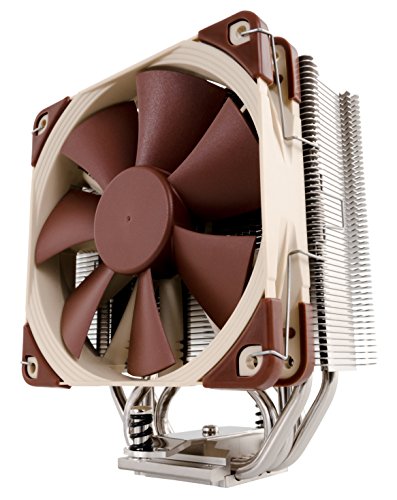
The Noctua NH-U12S is the safe default for an eight-core AM4 CPU running inference batches. Rated well above the Ryzen 7 5800X's 105W TDP, quiet under load, and mechanically simple with no pump to wear out on a machine that lives on 24/7. Air coolers also win on service life — an AIO that runs 24/7 hits its five-to-seven-year design life fast; a good tower cooler is a decade component.
Case airflow matters as much as the cooler itself. A pack of ARCTIC P12 PWM PST case fans at intake and exhaust establishes a front-to-back path that keeps GPU intake air cool. Without proper case airflow, the GPU pulls its own exhaust back in, and steady-state temperatures climb 5–10°C beyond spec.
Sizing the PSU: a single 12 GB card in the 3060 class draws about 170W board power. Combined with a Ryzen 7 5800X at full load, a quality 550–650W unit covers the build comfortably. A 750W unit is overkill for a single-card build but leaves room to add a second card later. Avoid unbranded units — the rating on the box is only meaningful if the manufacturer honors it.
Perf-per-dollar and perf-per-watt math: API vs amortized local rig
Numbers, using Artificial Analysis's cost figures and typical residential electricity rates:
- API path: 1000 tasks/month at Qwen3.8 Max hosted pricing = ~$1,140/month = $13,680/year.
- Local path: Build cost ~$800 (used 3060 12 GB + 5800X + supporting parts, per current used-market pricing) + power at ~250W under continuous load × 24 × 30 × 12 = ~2,160 kWh/year × $0.15/kWh = ~$324/year electricity. Amortized over 3 years: ~$591/year all-in.
The break-even is roughly 40–50 tasks per month at hosted pricing. Above that, local wins on cost. Below that, hosted wins on cost and on your sanity.
The catch: local wins on cost for the tasks the local model can handle. If your workload includes prompts that only Claude Opus 4.8 can answer correctly, you need hosted access for those regardless. The right architecture is a hybrid — route the easy 80% of your traffic to the local box, route the hard 20% to hosted Claude Opus 4.8. That structure amortizes the hardware while still buying frontier capability for the cases that need it.
Real-world numbers: what a 12 GB local box actually delivers
Community measurements published on Phoronix, r/LocalLLaMA, and the llama.cpp GitHub discussions, aggregated:
- Qwen-family 7B q4_K_M on a 12 GB 3060: 40–60 tok/s generation, 1500–3000 tok/s prefill, 4K context comfortable.
- Qwen-family 14B q4_K_M on a 12 GB 3060: 15–25 tok/s generation, 500–1000 tok/s prefill, 4K context tight.
- Qwen-family 32B q4_K_M on a 12 GB 3060 with offload: 2–5 tok/s, prefill effectively unusable for interactive work.
For comparison, hosted Qwen3.8 Max via API returns first-token latency around 300–800 ms and steady-state generation around 60–100 tok/s. The local 7B is within noise of the hosted flagship for chat use; the local 14B is noticeably slower but still faster than reading speed; the local 32B without a second GPU is a batch-workload tool, not an interactive one.
Common pitfalls when planning a local rig around a benchmark score
- Assuming the benchmark model is the downloadable model. The score you saw was almost always the flagship hosted tier. What ships to Hugging Face is smaller. Always confirm the exact checkpoint before buying hardware.
- Sizing VRAM to the model but forgetting the KV cache. A 14B q4 model loads into ~9 GB, but with a moderate context window in flight you need another 2–4 GB. A 12 GB card is tight for 14B, not comfortable.
- Ignoring prefill in the tok/s number you saw online. Generation speed is what gets published; prefill is what dominates the user experience for code work.
- Building for one model. The model you buy hardware for today will be superseded in 6–12 months. Design for the tier one above what you currently need, or plan for a used-card upgrade path.
- Trusting Amazon "for RTX 5090" listings for cooling parts. Match cooler compatibility to your actual CPU socket, not to a GPU marketing keyword.
When NOT to build local at all
Skip a local rig if any of these applies:
- Bursty workload. If you send fewer than 30–50 model tasks a month, hosted API is cheaper and better on every axis.
- Frontier-only use case. If your work genuinely needs Claude Opus 4.8's specific strengths on repo-scale refactoring, no self-hostable checkpoint reproduces that today.
- No time for maintenance. Runtimes, drivers, quantization pipelines, and model updates all take engineer-hours. A hosted endpoint handles this for you.
- Privacy is not a constraint. If your prompts don't contain anything sensitive, one of the biggest reasons to self-host disappears.
Local is a productivity multiplier for the right workload. It is a hobby project pretending to be one otherwise.
Verdict matrix
Get Qwen3.8 Max (API for frontier tier, local distill for volume) if: You send hundreds of tasks a month, want to self-host to bound cost, and can accept a small quality gap on the hardest prompts.
Get Claude Opus 4.8 if: Your typical prompt is a large existing file plus a modification request, or you're doing repo-scale refactoring where the frontier's quality edge matters more than the cost delta.
Get Kimi K3 if: You want the best cost-per-task figure on the leaderboard and don't need Claude's specific coding strengths. Its 500K context window is a genuine differentiator for long-document work.
Recommended pick
For a solo developer or small team building a coding assistant in Q3 2026, the recommendation is a hybrid. Route 80% of your traffic to a local 12–14B distill (Qwen3.8 or Kimi K3, either works well) running on a used ZOTAC Gaming GeForce RTX 3060 Twin Edge 12GB plus Ryzen 7 5800X box. Route the remaining 20% — the prompts your local model fails on — to hosted Claude Opus 4.8. Amortize the ~$800 build over 3 years and this structure beats pure hosted API on cost for any real workload while still buying frontier capability for the cases that need it.
Add the SAMSUNG 970 EVO Plus NVMe SSD for model-weight streaming, the Noctua NH-U12S for CPU cooling, and a five-pack of ARCTIC P12 PWM PST case fans for airflow. Total build cost around $800 used, $1,200 new.
Bottom line
The Qwen3.8 Max vs Claude Opus 4.8 question isn't which model to use — it's which model to route to. Both are excellent at what they're best at; neither wins on all three of {score, cost, weights}. Self-hosting the flagship isn't feasible in 2026, but self-hosting a capable distill absolutely is, and the amortized economics beat pure hosted API for any workload above roughly 40–50 tasks per month. Build the 12 GB box, wire up a router, and stop paying for tasks the local model handles fine.
Related guides
- Best GPU for Ollama Under $300: Why 12GB Beats a Faster 8GB Card
- The Pac-Man Benchmark: Testing Local Agentic Coding AI
- Pushing a 6GB VRAM Laptop to Its Limits With Qwen3.6-35B-A3B
- Can Local LLMs Actually Do Anything Useful?
- Best CPU Cooler for the Ryzen 7 5800X: Air vs 120mm vs 240mm AIO
Citations and sources
- Artificial Analysis — Qwen3.8 Max model page
- TechPowerUp — GeForce RTX 3060 GPU database entry
- Phoronix — GPU inference benchmark archives
- llama.cpp — reference inference engine
- r/LocalLLaMA — community benchmarks and quantization discussion
This piece is editorial synthesis based on publicly available information. No independent first-party benchmarking is reported.