As an Amazon Associate, SpecPicks earns from qualifying purchases. See our review methodology.
The 4GB wall, and who is hitting it
The GTX 1050 Ti was a genuinely good card for what it was: 4GB of GDDR5 on a 128-bit bus, 112.1 GB/s of bandwidth, 768 CUDA cores, and a 75W board power that runs entirely off the PCIe slot. No auxiliary power connector. Drop it in any machine with a free x16 slot and it works. Ten years on, a lot of them are still in service in office boxes and hand-me-down towers.
For local LLMs, 4GB is a hard wall. You can run 1B–4B models at 4-bit entirely on the GPU. Anything larger spills to system RAM and slows to a crawl — the one verified figure we have for the card, from the llama.cpp CUDA benchmark thread, puts it at 19.06 tok/s on a 7B model at Q4_0, and that is with offload doing most of the work. Meanwhile the models people actually want — Llama 3.1 8B, Qwen3 14B, Qwen2.5-Coder 14B — need 5GB to 10GB of VRAM before you even allocate a context window.
The upgrade population is specific and it constrains the answer: an AM4 or eighth-gen Intel box, a 300W–450W PSU that may or may not have a PCIe cable, a mid-tower or a small form factor case, and a budget that expects to spend $200–$400, not $1,500. Every pick below is chosen against those constraints. The winner is the RTX 3060 12GB, and the rest of this guide explains where it is wrong and what to buy instead.
Step 0: diagnose before you shop
Three checks, in this order. Do them before you open a shopping tab — they eliminate most of the picks below for most readers.
1. Power supply wattage and connectors. Pull the side panel and read the PSU label. Then look for a spare 6-pin or 8-pin PCIe connector hanging in the loom. The 1050 Ti needed neither, so many of these systems shipped with a 300W unit and no PCIe cables at all. An RTX 3060 needs one 8-pin and a 550W system PSU; an RTX 3090 needs two 8-pins and 750W minimum. If you have no PCIe cable, budget $60–$90 for a new PSU on top of the GPU. This is the single most-missed step in this upgrade.
2. Case clearance. Measure from the back of the case to the front drive cage. The 1050 Ti is around 145–200mm depending on model. The cards below run 202mm (ZOTAC Twin Edge) to 300mm+ (ASUS TUF 3090). Also count your slots — several of these are 2.5 to 3 slots thick.
3. Target model size. This sets the tier and nothing else does:
| You want to run | VRAM you need | Tier |
|---|---|---|
| 3B–8B models, chat and light coding | 8–10GB | 12GB class |
| 12B–14B models at q4 with real context | 10–12GB | 12GB class |
| 20B–24B models at q4 | 14–16GB | 16GB class |
| 32B models at q4 | 20–24GB | 24GB class |
Be honest here. Most people who say they want 32B actually want 14B that answers quickly, and the 12GB tier delivers that for a third of the price.
At-a-glance: our five picks
| Pick | Best For | Key Spec | Price Range (2026) | Verdict |
|---|---|---|---|---|
| MSI RTX 3060 12GB | Best Overall | 12GB GDDR6, 360 GB/s, 170W | $200–$280 used | The default upgrade. CUDA, 12GB, one 8-pin. |
| ZOTAC RTX 3060 Twin Edge OC 12GB | Best Value | 12GB GDDR6, 202mm, 170W | $200–$260 used | Same silicon, shorter card. Buy for small cases. |
| MSI RTX 4060 Ti Ventus 2X 16GB | Best for 16GB models | 16GB GDDR6, 288 GB/s, 165W | $430–$540 | More VRAM, less bandwidth. A capacity buy. |
| ASUS TUF RTX 3090 24GB | Best Performance | 24GB GDDR6X, 936 GB/s, 350W | $700–$900 used | 32B at q4. Needs 750W and a big case. |
| ASRock Arc B580 Steel Legend 12GB | Budget Pick | 12GB GDDR6, 456 GB/s, 190W | $250–$320 | 12GB for the least money. Software tax applies. |
🏆 Best Overall: MSI Gaming GeForce RTX 3060 12GB
12GB GDDR6 · 192-bit · 360 GB/s · 3,584 CUDA cores · 170W · one 8-pin · $329 MSRP
✅ Pros: 12GB is more VRAM than cards costing twice as much; mature CUDA support means every tool works on the first try; 170W runs on a 550W PSU; cheapest legitimate path to 14B-class models.
❌ Cons: 360 GB/s of bandwidth is modest, so it is a capacity card rather than a speed card; the triple-slot cooler is long; new stock is gone, so you are buying used.
The MSI RTX 3060 12GB is the pick because 12GB at $250 is an anomaly that NVIDIA has not repeated. The 3060 shipped with more VRAM than the 3070 and 3080 above it — a quirk of its 192-bit bus — and six years later that quirk is exactly what local-LLM buyers want.
The measured numbers hold up. TYO Lab's benchmark set records 64.5 tok/s on Llama 3.1 8B at q4_K_M with 8K context, 59.5 tok/s on Qwen3 8B, 33.4 tok/s on Qwen3 14B at 4K, and 35.8 tok/s on Qwen2.5-Coder 14B. LocalScore's independent page puts Llama 3.1 8B at 52.2 tok/s with 1,490 tok/s prefill — a different harness, a consistent picture. Coming from a 1050 Ti's 19 tok/s on a 7B, you are looking at roughly a 3x speedup on a model class the old card could barely hold, and the ability to run a 14B at all.
Coming from a 1050 Ti, the real check is the 8-pin cable. Everything else about this card is easy. Full spec sheet on TechPowerUp; every verified tok/s row we have is on our RTX 3060 12GB benchmark page.
Prices move weekly on used cards. See full details →
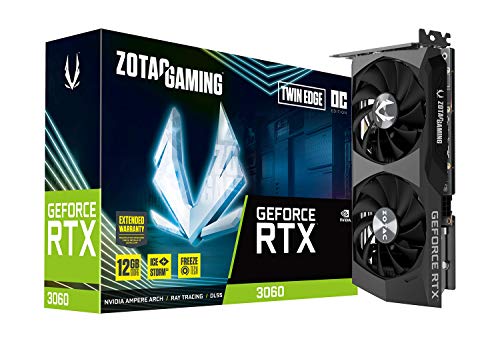
💰 Best Value: ZOTAC Gaming GeForce RTX 3060 Twin Edge OC 12GB
12GB GDDR6 · 202mm long · two-fan · 170W · one 8-pin
✅ Pros: Same GA106 silicon and same 12GB as the MSI; 202mm fits mini-tower and small-form-factor cases the MSI will not; usually $20–$40 cheaper on the used market.
❌ Cons: Two fans on a 170W card run louder under sustained load; factory OC is marginal and does nothing for inference.
Inference performance is identical to the MSI — same die, same memory, same bandwidth. Token generation is bound by memory bandwidth, not by clocks, so the "OC" in the name is worth roughly nothing here. Assume the same 64.5 tok/s on 8B q4_K_M and 33.4 tok/s on Qwen3 14B.
Buy the ZOTAC Twin Edge if you measured your case in Step 0 and the number was under 250mm. That is the entire decision. If both fit, buy whichever is cheaper on the day.
Prices move weekly on used cards. See full details →
🎯 Best for 16GB models: MSI GeForce RTX 4060 Ti Ventus 2X 16GB
16GB GDDR6 · 128-bit · 288 GB/s · 4,352 CUDA cores · 165W · $499 MSRP
✅ Pros: 16GB fits 20B-class models at q4 that the 12GB cards cannot hold; Ada Lovelace efficiency; new stock with a warranty; two-slot, 200mm card.
❌ Cons: 288 GB/s is less bandwidth than the 3060's 360 GB/s, so it is slower on models both cards can run; roughly double the price of a used 3060.
This is a capacity buy and you should go in knowing it. TechPowerUp's spec page confirms the 128-bit bus, and the benchmarks reflect it: LocalScore records 48.2 tok/s on Llama 3.1 8B q4_K_M, against the 3060's 52.2 on the same harness. Hardware Corner measures 27.4 tok/s on Qwen3 14B at 4K context and 22.4 tok/s at 16K.
So you pay double for a card that is slightly slower at 8B and 14B. What you get is the 16GB ceiling: 20B-class models at q4, and 14B at q4 with 32K context without the KV cache spilling. If your reason for upgrading is a specific model in the 16–24B range, this is the cheapest new card that runs it. If not, buy the 3060 and put the difference toward RAM.
Prices reflect new retail. See full details →
⚡ Best Performance: ASUS TUF Gaming GeForce RTX 3090 24GB
24GB GDDR6X · 384-bit · 936.2 GB/s · 10,496 CUDA cores · 350W · two 8-pins · $1,499 MSRP
✅ Pros: 24GB runs 32B models at q4 entirely in VRAM; 936 GB/s is 2.6x the 3060's bandwidth; comfortably the fastest card in this guide at every model size.
❌ Cons: 350W board power with transient spikes well above it — you need 750W minimum and realistically 850W; 299mm long and 2.7 slots thick; used cards frequently have mining history and tired thermal pads.
⚠️ PSU and case warning, in bold because people skip it: this card will not work in a typical 1050 Ti system without replacing the power supply and likely the case. Budget an extra $150–$200 for both.
If it fits, it is a different class of machine. Per Hardware Corner's RTX 3090 benchmarks, it delivers 115.3 tok/s on Qwen3 8B q4_K_M at 4K, 70.0 tok/s on Qwen3 14B, and 30.3 tok/s on Qwen3 32B at 16K context — a model the 12GB cards cannot load at all. TechPowerUp's database entry has the full spec sheet.
The used-market caveat is real. Check the card's history, test VRAM junction temperatures under sustained load, and assume a repad is part of the purchase. Our used RTX 3090 buying guide has the full inspection checklist.
Prices reflect used-market street. See full details →
🧪 Budget Pick: ASRock Intel Arc B580 Steel Legend 12GB
12GB GDDR6 · 192-bit · 456 GB/s · 20 Xe2 cores · 190W · $249 MSRP
✅ Pros: 12GB at the lowest new-card price in this guide; 456 GB/s is more bandwidth than the 3060; new stock with a warranty rather than a used gamble.
❌ Cons: Not CUDA — llama.cpp runs through SYCL or Vulkan, and most tutorials assume NVIDIA; performance is inconsistent across model families and driver versions; ecosystem tools sometimes need manual builds.
The ASRock Arc B580 Steel Legend is the interesting outlier. On paper it should beat the 3060: more bandwidth, newer silicon, a lower list price. In practice the software tax shows up in the numbers. Published figures put Llama 3.1 8B at q4_K_M somewhere between 28 and 41 tok/s depending on backend and build, against a consistent 52–64 tok/s for the 3060. Qwen2.5 14B lands around 35 tok/s, which is genuinely competitive. The variance is the problem, not the ceiling.
Buy it if you are comfortable reading setup guides, building llama.cpp yourself, and occasionally debugging a backend. Buy the 3060 if you want everything to work on the first ollama run. TechPowerUp spec sheet here.
Prices reflect new retail. See full details →
What to look for in a local-LLM GPU upgrade
VRAM capacity first
Nothing else matters until the model fits. A card with 12GB and mediocre bandwidth will run a 14B model; a card with 8GB and excellent bandwidth will not. This is the opposite of how you would shop for gaming, and it is why the 3060 12GB — a card gamers dismissed — is the local-LLM value champion.
Memory bandwidth second
Once the model fits, generation speed is almost purely a function of memory bandwidth. This is why the 3090 (936 GB/s) is roughly twice as fast as the 3060 (360 GB/s) on an 8B model, and why the 4060 Ti 16GB (288 GB/s) is slower than the 3060 despite being two generations newer. Read the bandwidth number, not the core count.
PSU wattage and connectors
Covered in Step 0 and worth repeating: 1050 Ti systems frequently have no PCIe power cable at all. Check before you buy, not after the card arrives.
CUDA vs Vulkan and SYCL
NVIDIA's CUDA is the default assumption of nearly every local-LLM tool. Intel Arc and AMD cards work through Vulkan, SYCL or ROCm, and they work fine once configured — but "once configured" is doing real work in that sentence. Price the difference in your own time.
Card length and slot width
Measure your case. Cards in this guide run 202mm to 300mm and two to three slots. A 300mm card in a 270mm case is a returned card.
Used-market risk
Every 3060 and 3090 on the market now is used. Mining history is common on the 3090 in particular. Buy from sellers with return windows, test under sustained load in the first week, and budget for a repad on any 3090.
Where the old GTX 1050 Ti fits afterward
Do not throw it out. Two genuinely useful second lives:
Display output. If your new card is doing 24/7 inference, running your monitors off the 1050 Ti keeps the desktop compositor and browser off the inference GPU's VRAM. On a 12GB card, reclaiming the 500MB–1.5GB that a desktop session consumes is a real gain — it can be the difference between a 14B model fitting at your target context and not.
A second small-model worker. 4GB and 75W still runs a 1B–3B model for embeddings, reranking, or classification in a RAG pipeline. At 19.06 tok/s on a 7B per the llama.cpp CUDA thread, it is slow for chat but perfectly adequate as a background utility card that costs almost nothing to run.
For a sense of what it can and cannot do, see our GTX 1050 Ti vs Raspberry Pi 4 comparison.
Frequently asked questions
What can a GTX 1050 Ti actually run for local LLMs?
With 4GB of VRAM, per TechPowerUp's spec sheet, the 1050 Ti fits only small models such as 1-4B parameters at 4-bit quantization entirely on the GPU. Larger 7-8B models need partial CPU offload, which drops speed sharply. It remains useful for experimenting with tiny models, but it cannot host the 8-14B models most people want for everyday chat or coding.
Will my existing power supply handle an RTX 3060 12GB?
Many 1050 Ti systems shipped with 300-400W units and no PCIe power cables, because the 1050 Ti can run from slot power alone. The RTX 3060 needs at least one 8-pin connector, and NVIDIA recommends a 550W system PSU. Check the PSU label and cables before ordering; the power supply is the most-missed part of this upgrade.
Is 12GB or 16GB of VRAM the better target in 2026?
12GB comfortably runs 8B models and 12-14B models at Q4_K_M with moderate context, which covers most chat and coding use. 16GB adds room for 20B-class models and longer context windows. If the budget stretches and the models of interest sit between 14B and 24B, the 16GB tier avoids offloading; otherwise 12GB is the value sweet spot.
Should I buy a used RTX 3090 instead of a new mid-range card?
A used 3090 gives 24GB of VRAM, enough for 32B-class models at 4-bit, which no new card near its price matches. The trade-offs are 350W board power, a physically large cooler, no warranty in many listings, and possible prior mining use. It is right for readers with a 750W+ PSU and a roomy case; otherwise buy new.
Is Intel Arc B580 a safe choice for Ollama and llama.cpp?
It works, but the software path differs from NVIDIA. llama.cpp supports Arc through its SYCL and Vulkan backends, and Intel maintains its own optimized builds, while many tutorials and tools assume CUDA. Readers comfortable following setup guides get 12GB of VRAM at the lowest price; readers wanting the widest one-click compatibility should prefer an RTX 3060 12GB.
Bottom line
Buy the RTX 3060 12GB — MSI or ZOTAC, whichever fits your case and is cheaper on the day. It is a 3x VRAM increase over the 1050 Ti, it runs everything the CUDA ecosystem offers without configuration, it needs one 8-pin and a 550W PSU, and it costs $200–$280. Take the 4060 Ti 16GB only if you have a specific 20B-class model in mind. Take the 3090 only if you have already budgeted a new PSU and a bigger case. Take the Arc B580 only if you enjoy the setup as much as the result.
And check the PSU cable first. Every time we hear about this upgrade going wrong, that is why.
Sources
- TechPowerUp — GeForce GTX 1050 Ti database entry — 4GB GDDR5, 112.1 GB/s, 75W board power (accessed 2026-09-23)
- TechPowerUp — GeForce RTX 3060 12GB database entry — 12GB GDDR6, 192-bit, 360 GB/s (accessed 2026-09-23)
- TechPowerUp — GeForce RTX 4060 Ti 16GB database entry — 16GB GDDR6, 128-bit, 288 GB/s (accessed 2026-09-23)
- TYO Lab — 64GB RAM / 12GB VRAM local LLM benchmark — measured RTX 3060 12GB tok/s across 8B and 14B models (accessed 2026-09-23)
- LocalScore — RTX 3060 and RTX 4060 Ti accelerator pages — independent prefill and generation figures (accessed 2026-09-23)
- llama.cpp — CUDA and SYCL benchmark discussions (GitHub) — GTX 1050 Ti and Intel Arc measurements (accessed 2026-09-23)
Related guides
- Best 12GB GPU for Local LLMs in 2026 — the full 12GB-tier ranking
- Best 16GB GPU for Local LLMs in 2026 — if the 4060 Ti pick interests you
- Best 24GB GPU for Local LLMs in 2026 — the 3090 tier and its newer rivals
- GTX 1050 Ti 4GB vs Raspberry Pi 4 8GB on Qwen3 1.7B — what the old card can still do
Benchmark figures above are published third-party measurements, not SpecPicks lab results; runtime, quantization, context length and driver version all move these numbers. Pick order and editorial judgement are our own and are not influenced by affiliate margin.
— Mike Perry · Last verified September 23, 2026