Introduction
You have an old card in a drawer. Before you spend anything, the honest question is not "which GPU is fastest" — it is "does the card I already own clear the bar for the model I actually want to run, and if not, what is the cheapest card that does?"
Gemma 3 4B is a reasonable bar to measure against. Google's model card documents a 128K-token context window for the 4B size and describes a model that takes "text and image input and generat[es] text output" — a genuinely capable small model rather than a toy. Quantized to Q4_K_M, 4 billion parameters at roughly 4.85 bits each works out to about 2.4 GB of weights.
That number is the whole article. A 4 GB card has 2.4 GB of weights plus a KV cache plus whatever the desktop compositor already took, and that arithmetic decides everything. Public measurements then decide how pleasant the result is: TechPowerUp lists the GTX 1050 Ti at 4 GB of GDDR5 on a 128-bit bus for about 112 GB/s of bandwidth and a 75 W board power, against the RTX 3060 12GB at 12 GB and roughly 360 GB/s — 3.2× the bandwidth and 3× the memory.
Key takeaways
- Gemma 3 4B at Q4_K_M is ≈2.4 GB, derived from 4B parameters at ~4.85 bits each. It fits 4 GB only with a short context and a clean desktop.
- The 1050 Ti generates at 19.06 tok/s on the llama.cpp CUDA thread's 7B Q4_0 reference; scaled to a 2.4 GB model that implies roughly 28 tok/s.
- A 3060 12GB runs 3B-class models at 122.85 tok/s per geerlingguy's ai-benchmarks and 8B models at 55.20 tok/s at 4K context per Hardware Corner.
- The 6GB middle tier is real. A GTX 1660-class card measures 41.35 tok/s on the same 7B Q4_0 run, and DatabaseMart's GTX 1660 benchmarks log 38.36 tok/s on a 3B model using 2.0 GB of VRAM.
- Pascal's limit is architectural, not just capacity. Compute capability 6.1 predates the low-precision tensor paths modern kernels exploit.
- 12GB is the tier that changes what you can run, not how fast you run it: 12B and 14B models at Q4_K_M need 7-9.5 GB resident.
Step 0: work out your VRAM budget before you shop
Three things share the card: weights, the KV cache, and everything else already using the GPU.
Weights are arithmetic. Parameters × bits-per-weight ÷ 8. Gemma 3 4B at Q4_K_M ≈ 2.4 GB; at Q5_K_M ≈ 2.9 GB; at Q8_0 ≈ 4.3 GB.
The KV cache scales with context. A naive fp16 cache on a 34-layer 4B-class model runs on the order of 0.14 MB per token, so 4K of context is roughly 0.6 GB and 8K is 1.1 GB. Gemma 3's interleaved local/global attention keeps the long-context cost well below the naive figure — which is how the model card can offer 128K tokens on a 4B model at all — but plan against the naive number when you are within a few hundred megabytes of the ceiling.
Everything else is the part people forget. A desktop compositor, a browser with hardware acceleration and a video call can hold several hundred megabytes of VRAM before the model loads.
The threshold: if weights + KV + desktop exceeds physical VRAM, the runtime either fails to allocate or silently spills layers to system RAM at PCIe and DDR4 speeds — which on a 4 GB Pascal card is the difference between usable and unusable.
Spec delta across three VRAM tiers
| Spec | EVGA GTX 1050 Ti FTW 4GB | MSI GTX 1660 Super 6GB | MSI RTX 3060 12GB |
|---|---|---|---|
| VRAM | 4 GB GDDR5 | 6 GB GDDR6 | 12 GB GDDR6 |
| Memory bandwidth | ~112 GB/s | ~336 GB/s | ~360 GB/s |
| CUDA compute capability | 6.1 (Pascal) | 7.5 (Turing) | 8.6 (Ampere) |
| Board power | 75 W | 125 W | 170 W |
| Street price | Used market only; varies | Used/limited new; varies | Live catalog price, varies |
Specifications are from TechPowerUp's database entries for the GTX 1050 Ti and the RTX 3060 12 GB. Current pricing lives on the EVGA GTX 1050 Ti, MSI GTX 1660 Super and MSI RTX 3060 12GB pages and changes frequently.
The bandwidth row is the one that predicts throughput. Generation speed on a fully-resident model is close to bandwidth ÷ weight size, so a 3.2× bandwidth advantage is roughly a 3.2× token-rate advantage on the same model.
Benchmark table: throughput by card and quantization
| Card | Model / quant | Fits fully in VRAM? | Generation tok/s | Source |
|---|---|---|---|---|
| GTX 1050 Ti 4GB | Llama 2 7B Q4_0 | Marginally, short context | 19.06 | llama.cpp CUDA thread |
| GTX 1050 Ti 4GB | Gemma 3 4B Q4_K_M | Yes, short context only | ~28 (derived) | Scaled from the 7B figure above |
| GTX 1660-class 6GB | Llama 2 7B Q4_0 | Yes | 41.35 | llama.cpp CUDA thread |
| GTX 1660 Super 6GB | Llama 3.2 3B Q4_K_M | Yes (2.0 GB used) | 38.36 | DatabaseMart |
| GTX 1660 Super 6GB | Llama 3.1 8B Q4_K_M | Yes (4.9 GB used) | 16.67 | DatabaseMart |
| RTX 3060 12GB | Llama 3.2 3B Q4_K_M | Yes | 122.85 | geerlingguy/ai-benchmarks |
| RTX 3060 12GB | Qwen3 8B Q4_K_XL, 4K ctx | Yes (6.0 GB used) | 55.20 | Hardware Corner |
| RTX 3060 12GB | Qwen3 8B Q4_K_XL, 16K ctx | Yes (7.5 GB used) | 42.00 | Hardware Corner |
| RTX 3060 12GB | 12B-class Q4_K_M | Yes (8.1 GB used) | 29.00 | llmrun.dev |
Two notes on reading this honestly. The cited 1050 Ti and 1660 rows come from different llama.cpp builds in the same thread, so treat the prompt-processing figures there as non-comparable; the generation numbers are the meaningful ones. And the 4B row is derived, not measured — it scales the measured 7B result by the ratio of weight sizes, which is the right first-order model for a bandwidth-bound workload.
Quantization matrix for a 4B model
| Quant | Bits/weight | Weights (GB) | Runs on 4 GB? | Runs on 6 GB? | Quality cost |
|---|---|---|---|---|---|
| q2_K | ~3.35 | 1.7 | Yes, with context room | Yes | Severe; avoid on a 4B model |
| q3_K_M | ~3.90 | 2.0 | Yes | Yes | Noticeable |
| q4_K_M | ~4.85 | 2.4 | Yes, short context | Yes, comfortably | The standard baseline |
| q5_K_M | ~5.70 | 2.9 | Tight; 2K context at best | Yes | Marginal gain |
| q6_K | ~6.60 | 3.3 | No practical headroom | Yes | Near-lossless |
| q8_0 | ~8.50 | 4.3 | No | Tight | Pointless at this size |
| fp16 | 16.0 | 8.0 | No | No | Not a consumer configuration |
A 4 GB card's usable range is the top four rows, and only the first three leave room for a context window worth having. A 6 GB card clears the whole practical table.
Why the 1050 Ti's Pascal architecture costs you more than VRAM
VRAM decides whether a model loads. Architecture decides how slowly it answers once it has.
The 1050 Ti reports compute capability 6.1 in the llama.cpp CUDA thread's own device banner. Pascal at that level has no tensor cores and no efficient low-precision matrix path, so the quantized kernels that make modern inference fast have to fall back to slower routes. You can see it in the numbers: the 1660-class Turing card is 2.2× the 1050 Ti's generation rate on the identical model and quant, which is more than the bandwidth ratio alone explains.
Support is the other half. Pascal is old enough that CUDA build targets for it are gradually being dropped from prebuilt binaries, which means more building from source over time. The card still works today; it is on a clock.
Prefill vs generation on small cards
Prompt processing is compute-bound and hits a 4 GB card twice: once because Pascal's matrix throughput is low, and once because a long prompt needs a KV cache the card cannot spare. That is why 4 GB owners report a model that "feels fine" in short chat and falls apart the moment they paste a document or attach a system prompt of any length.
Generation is bandwidth-bound and degrades more gracefully. If your usage is short prompts and conversational replies, the 1050 Ti's ~28 tok/s derived rate on a 4B model is genuinely usable — faster than most people read. If your usage is RAG, long system prompts, or agent loops that re-send context every turn, the card is the wrong tool regardless of quantization.
Context-length impact
| Context | Naive fp16 KV (4B-class) | Weights + KV at q4_K_M | Fits 4 GB? | Fits 6 GB? |
|---|---|---|---|---|
| 2K | ~0.28 GB | ~2.7 GB | Yes | Yes |
| 4K | ~0.56 GB | ~3.0 GB | Tight | Yes |
| 8K | ~1.12 GB | ~3.5 GB | No headroom for desktop | Yes |
| 32K | ~4.5 GB | ~6.9 GB | No | No, at fp16 KV |
Gemma 3's sliding-window layers make the real 32K figure substantially smaller than the naive projection — that architecture is why a 4B model can advertise 128K at all — but the shape of the table holds: on 4 GB, context is the constraint that bites before quality does.
What the 6GB middle tier buys you
The MSI GTX 1660 Super is the honest middle option. Six gigabytes clears a 4B model at any practical quant with an 8K context to spare, and Turing's kernels are supported everywhere without special builds. DatabaseMart's measurements put a 3B model at 38.36 tok/s using 2.0 GB, and an 8B model at 16.67 tok/s using 4.9 GB — so it even reaches one tier up, slowly.
It is a false economy under one condition: if you expect to want a 12B or 14B model within a year. Those need 7-9.5 GB resident per llmrun.dev's database, which is a 12 GB card's job, and buying 6 GB first means buying twice.
What 12GB unlocks that 4GB never will
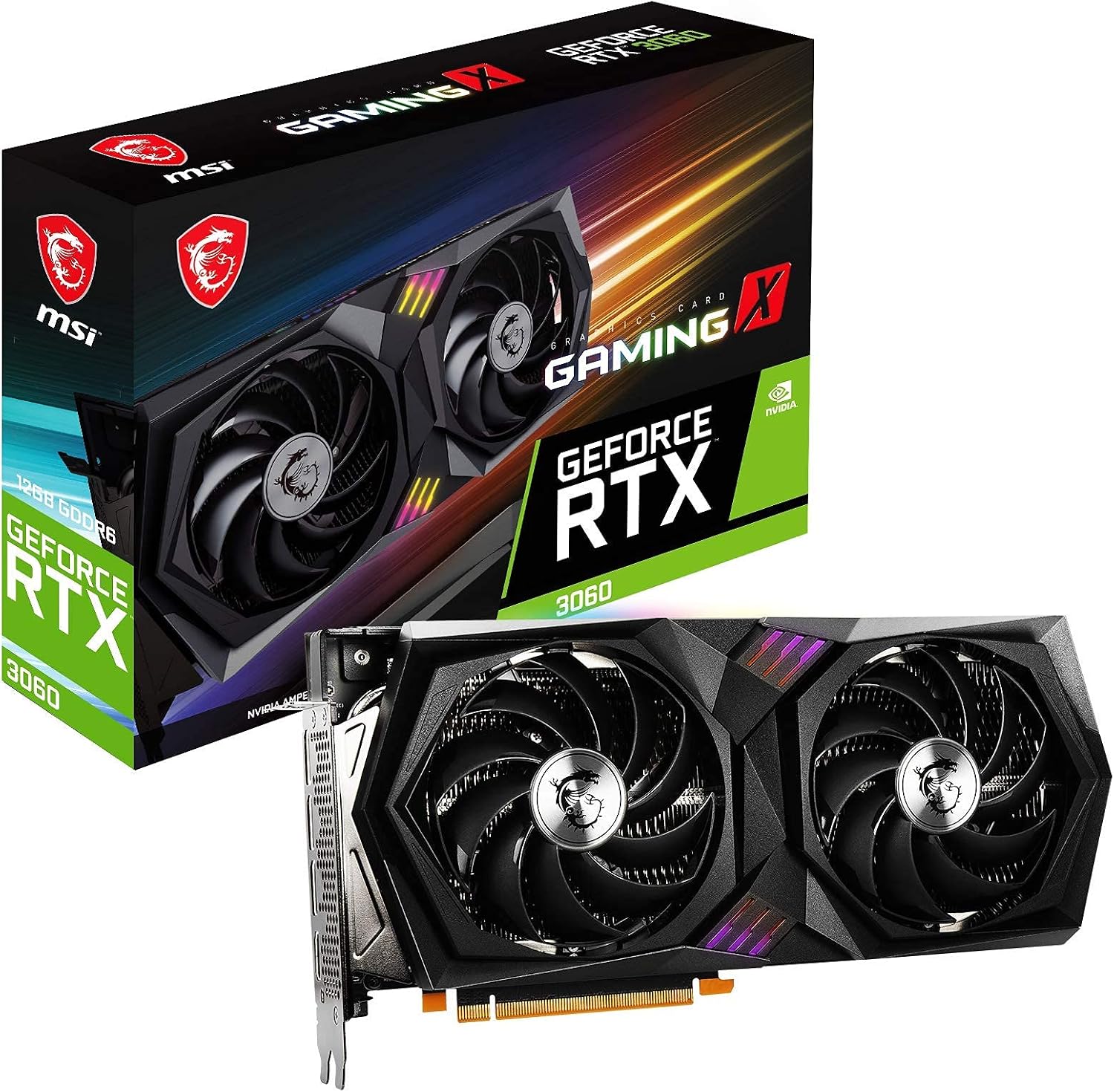
This is a capability step, not a speed step. On the MSI RTX 3060 12GB or the ZOTAC Twin Edge OC 12GB, llmrun.dev logs 12B-class models at 29.00 tok/s using 8.1 GB, 13B at 27.20 tok/s using 8.6 GB, and 14B at 24.60 tok/s using 9.5 GB. None of those load on 4 GB or 6 GB at any useful quantization.
One caution worth repeating: the RTX 3060 was also sold in an 8 GB variant with a 128-bit bus. It shares the name and not the capability. Check the listing title for "12G" or "12GB" before buying — the RTX 3060 12GB benchmark page tracks the 192-bit part specifically.
Performance per dollar and per watt
| Metric | GTX 1050 Ti 4GB | GTX 1660 Super 6GB | RTX 3060 12GB |
|---|---|---|---|
| Generation, 3B-4B class | ~28 tok/s (derived) | 38.36 tok/s | 122.85 tok/s |
| Board power | 75 W | 125 W | 170 W |
| Tokens/sec per 100 W | ~37 | ~31 | ~72 |
| Largest practical model | 4B | 8B (slowly) | 14B |
Per watt, the Ampere card wins outright — roughly double the 1050 Ti's efficiency and more than double the 1660 Super's — which is the opposite of what the 75 W sticker suggests. Efficiency here is a function of finishing the work quickly, not of drawing less while doing it.
Common pitfalls
- Counting only weights. A 2.4 GB model on a 4 GB card is not a 1.6 GB surplus once the desktop and KV cache are counted.
- Running the display off the same 4 GB card. A browser with hardware acceleration can cost hundreds of megabytes you needed.
- Assuming "it loaded" means "it fits." Runtimes silently offload layers; check reported VRAM rather than trusting a clean start.
- Buying a used 3060 8GB by accident. Different bus, different capability, same name.
- Pairing an old card with a new one to pool VRAM. Layer splitting works, but throughput drifts toward the slower card's bandwidth.
When NOT to upgrade
If a 4B model at a short context is genuinely your workload — quick rewrites, classification, a local autocomplete — the 1050 Ti clears the bar and the upgrade buys you speed you will not notice. Spend the money on system RAM or a second monitor instead. The card that is wrong is the one that cannot run your model at all, and for 4B-class work this one can.
Verdict matrix
- Keep the GTX 1050 Ti if… your ceiling is 4B-class models at Q4_K_M with 2-4K of context and short prompts. ~28 tok/s derived is faster than reading speed.
- Step up to the GTX 1660 Super if… you want 4B models with real context headroom and occasional 8B experiments, and your budget stops well short of a 12 GB card. Expect 38.36 tok/s at 3B and 16.67 tok/s at 8B.
- Buy the RTX 3060 12GB if… you expect to want a 12B or 14B model, a long context, or both. It is the cheapest card that makes those load at all, at 24.60-29.00 tok/s.
Bottom line
For a first local-LLM box in 2026, the RTX 3060 12GB is the pick — not because 122.85 tok/s on a 3B model is exciting, but because 12 GB is the smallest capacity that still says yes a year from now. Keep the 1050 Ti if 4B is genuinely enough; it clears that bar and owes you nothing.
Related guides
- RTX 3060 12GB Local LLM Guide: Which Models Actually Fit (2026)
- GTX 1050 Ti in 2026: Performance, Use Cases, and Modern Comparisons
- Budget Ollama Build Under $500: What Actually Runs in 2026
- Gemma 3 12B vs Qwen2.5 14B on a 12 GB RTX 3060: Which Fits, Which Is Faster
- RTX 3060 12GB vs RTX 4060 Ti 16GB for Gemma 3 12B (2026)
Live price comparison
Both cards are past their production window, so pricing is the volatile part of this decision: check the EVGA GTX 1050 Ti FTW 4GB and the MSI Gaming GeForce RTX 3060 12GB listings side by side, plus the MSI GTX 1660 Super if the middle tier tempts you. Prices shown may vary at checkout.
Citations and sources
- llama.cpp — Performance on NVIDIA CUDA, discussion #15013 (accessed 2026-09-17)
- Google — Gemma 3 model card (accessed 2026-09-17)
- TechPowerUp — GeForce GTX 1050 Ti specifications (accessed 2026-09-17)
- TechPowerUp — GeForce RTX 3060 12 GB specifications (accessed 2026-09-17)
- DatabaseMart — Ollama GPU benchmark, GTX 1660 (accessed 2026-09-17)
- geerlingguy/ai-benchmarks (accessed 2026-09-17)
- Hardware Corner — RTX 3060 12GB LLM benchmarks (accessed 2026-09-17)
- llmrun.dev — RTX 3060 12GB model database (accessed 2026-09-17)
This piece is editorial synthesis based on publicly available information. No independent first-party benchmarking is reported.


