As an Amazon Associate, SpecPicks earns from qualifying purchases. See our review methodology.
Quick answer: For most people it's a 12 GB card, and the MSI GeForce RTX 3060 12GB is the best overall pick. Qwen3 8B at Q4_K_M is a 5.03 GB file and Q8_0 is 8.71 GB (Qwen3-8B-GGUF on Hugging Face). An 8 GB card runs Q4. A 12 GB card runs near-lossless Q8 with room for context. Hardware Corner measures 55.2 tok/s on the 3060 at 4K context.
Who this guide is for and why VRAM tier decides it
This guide is for anyone who wants Qwen3 8B running on their own GPU: a coding assistant in VS Code, a private chat box, a document-summary pipeline, or an agent that calls tools all day. Qwen3 8B is the size most people start with. It's smart enough for real work, and it supports both thinking and non-thinking modes (Qwen3 announcement). It's also small enough that the buying decision comes down to one spec: how much VRAM you have, and how much context you want to feed the model.
Before you look at any card, run this Step 0 diagnostic:
- Will you run Q4 or Q8? Q4_K_M (5.03 GB) is the default in Ollama and in most llama.cpp guides. It's fine for chat and drafting. Q8_0 (8.71 GB) is close to lossless. Use it if you do structured extraction, tool calling or code where one wrong token breaks the output.
- How long are your prompts? A chat session rarely passes 4K tokens. A RAG pipeline that stuffs in five documents, or a coding agent that reads whole files, easily hits 16K–32K. Qwen3 8B handles 32,768 tokens natively and up to 131,072 with YaRN scaling, per the model card.
- Does the model have to fit entirely on the GPU? It should. Once layers or KV cache spill into system RAM, generation speed collapses, because dual-channel DDR4 or DDR5 has a fraction of a graphics card's memory bandwidth.
Those three answers map directly onto VRAM tiers. Q4 at short context fits 8 GB. Q8 at moderate context needs 12 GB. Q8 at 32K context needs 16 GB. Everything below follows from that, and as you'll see, a 12 GB card covers the most real-world use cases for the least money.
Qwen3 8B GPU picks at a glance
| Pick | Best For | Key Spec | Price Range | Verdict |
|---|---|---|---|---|
| MSI GeForce RTX 3060 12GB | Best Overall | 12 GB GDDR6, 360 GB/s, 170 W | $329 launch; ~$480 on Amazon today | Runs Q8_0 fully on-GPU; 55.2 tok/s at Q4 |
| Gigabyte RTX 5060 WINDFORCE OC 8G | Best Value | 8 GB GDDR7, 448 GB/s, 145 W | $299 launch; ~$460 on Amazon today | Fast Q4, but no Q8 |
| MSI RTX 4060 Ti Ventus 2X 16G | Best for Long Context | 16 GB GDDR6, 288 GB/s, 165 W | $499 launch; ~$540 on Amazon today | Q8_0 plus a 32K KV cache |
| Gigabyte RTX 4070 WINDFORCE OC 12G | Best Performance | 12 GB GDDR6X, 504 GB/s, 200 W | $599 launch; ~$820 on Amazon today | 71.2 tok/s at Q4, fastest here |
| ZOTAC RTX 3060 Twin Edge OC 12GB | Budget Pick | 12 GB GDDR6, 360 GB/s, 170 W | $329 launch; ~$500 on Amazon today | Compact 12 GB card for always-on boxes |
Bandwidth and board-power figures are from the TechPowerUp GPU Database. Amazon listing prices are as of September 24, 2026 and move daily. The launch MSRPs are the better guide to what a card is worth, and street prices on older cards like the RTX 3060 often dip well below the listing shown.
🏆 Best Overall: MSI GeForce RTX 3060 12GB
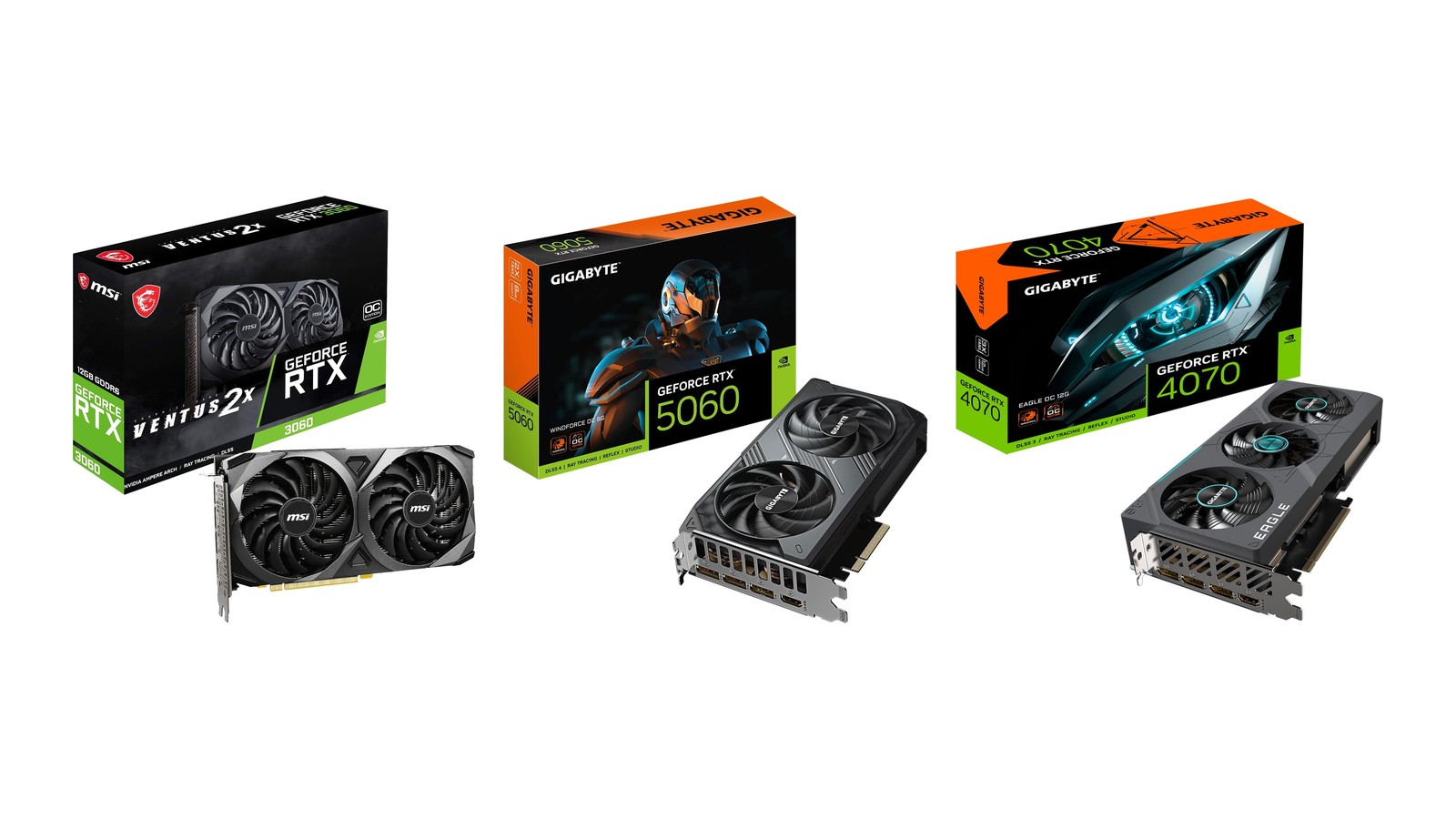
The MSI GeForce RTX 3060 12GB is the card we'd put in most Qwen3 8B builds.
- VRAM: 12 GB GDDR6, 192-bit bus
- Bandwidth: 360 GB/s
- Board power: 170 W (550 W PSU is plenty)
- Architecture: Ampere, full CUDA support in every runtime
✅ Pros
- Fits Q8_0 (8.71 GB) plus an 8K context fully in VRAM
- 55.2 tok/s generation at Q4 / 4K context, 42.0 tok/s at 16K
- Mature drivers; works with Ollama, llama.cpp, vLLM and ExLlamaV2 without fuss
❌ Cons
- Slowest prompt processing of the four GPU tiers here (1,696.8 tok/s at 4K)
- Q8 at a full 32K context does not fit
The reason this card wins is simple: it's the cheapest route to running Qwen3 8B at near-lossless quality with no offload. According to Hardware Corner's RTX 3060 12GB benchmarks, the 3060 generates 55.2 tok/s on Qwen3 8B Q4_K at 4K context, 42.0 tok/s at 16K and 31.9 tok/s at 32K. All three are faster than you read. Its 192-bit bus gives it more bandwidth than the newer 16 GB RTX 4060 Ti, and on a GPU generation speed follows bandwidth.
Right when: you want Q8 quality, you run agents or RAG at 8K–16K context, or you want one card that also handles 14B models at Q4. Not worth it when: you only ever chat at Q4, and a newer 8 GB card is cheaper where you shop.
See full details and current price → Prices change often; check the listing before you buy.
💰 Best Value: Gigabyte GeForce RTX 5060 WINDFORCE OC 8G
The Gigabyte RTX 5060 WINDFORCE OC 8G is the fastest way to run Qwen3 8B at Q4 on a new, low-power card.
- VRAM: 8 GB GDDR7, 128-bit bus
- Bandwidth: 448 GB/s
- Board power: 145 W
- Architecture: Blackwell, with DLSS 4 for gaming
✅ Pros
- 61.7 tok/s on Qwen3 8B Q4 in Ollama (DatabaseMart RTX 5060 benchmark)
- Lowest power draw in the lineup
- The best gaming card in this guide per watt
❌ Cons
- Q8_0 (8.71 GB) is larger than the card's entire 8 GB
- Q4 with a 16K fp16 KV cache lands right at the 8 GB limit
Q4_K_M fits. Q8_0 does not. That's the whole trade-off. At Q4 with 8K context you need about 6.9 GB (5.03 GB of weights, about 1.2 GB of KV cache, plus runtime buffers), which leaves a comfortable margin. Push to 16K and the estimate rises to about 8.1 GB. At that point you either quantize the KV cache to q8_0 (llama.cpp's --cache-type-k q8_0 --cache-type-v q8_0) or accept a partial spill.
Right when: you run Q4 chat or coding completions at ≤8K context, you also game, and you care about idle and load power. Not worth it when: you want Q8 quality or long RAG prompts. For those, a 12 GB card is the better buy even though it's slower on paper.
See full details and current price → Prices change often; check the listing before you buy.
🎯 Best for Long Context: MSI GeForce RTX 4060 Ti Ventus 2X 16G
The MSI RTX 4060 Ti 16GB is the pick when your prompts are long and your quality bar is high.
- VRAM: 16 GB GDDR6, 128-bit bus
- Bandwidth: 288 GB/s
- Board power: 165 W
- Architecture: Ada Lovelace
✅ Pros
- Q8_0 plus a full 32K fp16 KV cache fits (about 14.2 GB total)
- Strong prompt processing: 2,675.2 tok/s at 4K context
- Room to step up to Qwen3 14B at Q6_K (12.12 GB)
❌ Cons
- The narrowest memory bus here; generation is slower than the 3060's (45.8 vs 55.2 tok/s at 4K)
- Priced close to the much faster RTX 4070
Hardware Corner's RTX 4060 Ti 16GB page shows the pattern clearly: 45.8 tok/s at 4K, 34.3 tok/s at 16K and 25.5 tok/s at 32K on Qwen3 8B Q4_K. It's also the only card in this guide the site tested at 64K (13.0 tok/s), because it's the only one with the memory to get there. You're buying capacity, not speed.
Right when: you feed whole codebases or long PDFs into the model, or you need Q8 at 32K. Not worth it when: your prompts stay under 16K. A 3060 12GB is faster there and cheaper.
See full details and current price → Prices change often; check the listing before you buy.
⚡ Best Performance: Gigabyte GeForce RTX 4070 WINDFORCE OC 12G
The Gigabyte RTX 4070 WINDFORCE OC 12G is the fastest card in this lineup by a wide margin.
- VRAM: 12 GB GDDR6X, 192-bit bus
- Bandwidth: 504 GB/s
- Board power: 200 W (650 W PSU recommended)
- Architecture: Ada Lovelace
✅ Pros
- 71.2 tok/s generation at Q4 / 4K context, 52.1 at 16K, 38.1 at 32K
- 3,564.1 tok/s prompt processing at 4K, more than twice the 3060
- Handles Qwen3 14B Q4 at 42.5 tok/s, so it has headroom to grow
❌ Cons
- Most expensive card here by a lot
- Same 12 GB ceiling as the 3060, so Q8 at 32K still doesn't fit
Every figure above comes from Hardware Corner's RTX 4070 benchmarks. Prefill is the number to watch. If you run an agent that re-reads a 10K-token file on every step, the 4070 finishes that pass in about 3 seconds where the 3060 takes about 6. Across a working day, that difference adds up.
Right when: you use Qwen3 8B interactively for hours a day, run coding agents with big prompts, or plan to move up to 14B. Not worth it when: Qwen3 8B chat is the whole job. At 55 tok/s the 3060 is already faster than you can read.
See full details and current price → Prices change often; check the listing before you buy.
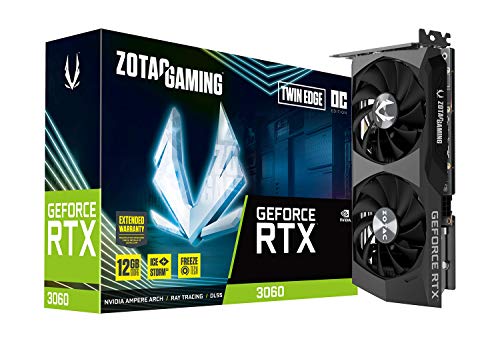
🧪 Budget Pick: ZOTAC Gaming GeForce RTX 3060 Twin Edge OC 12GB
The ZOTAC RTX 3060 Twin Edge OC 12GB is the same GA106 GPU and the same 12 GB / 360 GB/s memory as our best-overall pick, in a shorter two-fan card.
- VRAM: 12 GB GDDR6, 192-bit bus
- Bandwidth: 360 GB/s
- Board power: 170 W
- Form factor: compact dual-slot, two fans
✅ Pros
- Identical Qwen3 8B performance to any other RTX 3060 12GB
- Short enough for most small-form-factor and mini-tower cases
- Often the cheapest 12 GB listing when it's in stock
❌ Cons
- Smaller cooler runs louder under hours-long inference load
- ZOTAC's warranty terms need registration; check them before you buy
For an always-on box, a Proxmox VM, a home-lab server, or an Ollama endpoint for the whole house, a compact 12 GB card is the sensible choice. Tokens per second match the MSI card, because on this GPU generation speed is set by the memory bus, not the cooler. Buy whichever 3060 12GB is cheaper on the day.
Right when: you're building a small 24/7 inference box. Not worth it when: the card will sit next to your desk and fan noise bothers you. Then the MSI's larger cooler is worth a few dollars.
See full details and current price → Prices change often; check the listing before you buy.
How much VRAM does Qwen3 8B need at each quantization?
File sizes are the official GGUF builds on Hugging Face; BF16 is 8.2B parameters × 2 bytes. The VRAM column adds an fp16 KV cache at 8K context. Qwen3 8B has 36 layers and 8 KV heads of dimension 128, which works out to about 144 KB per token, or 1.21 GB at 8K. We also add about 0.7 GB of runtime buffers.
| Quantization | File size | VRAM at 8K context | Which pick fits it |
|---|---|---|---|
| Q4_K_M | 5.03 GB | ~6.9 GB | All five |
| Q5_K_M | 5.85 GB | ~7.8 GB | RTX 5060 only barely; every 12 GB and 16 GB pick comfortably |
| Q6_K | 6.73 GB | ~8.6 GB | RTX 3060 12GB, RTX 4070, RTX 4060 Ti 16GB |
| Q8_0 | 8.71 GB | ~10.6 GB | RTX 3060 12GB, RTX 4070, RTX 4060 Ti 16GB |
| BF16 | ~16.4 GB | ~18.3 GB | None; needs a 24 GB card |
And here is how context length moves the requirement at Q4_K_M and Q8_0:
| Context | KV cache (fp16) | Q4_K_M total | Q8_0 total |
|---|---|---|---|
| 4K | 0.60 GB | ~6.3 GB | ~10.0 GB |
| 16K | 2.42 GB | ~8.2 GB | ~11.8 GB |
| 32K | 4.83 GB | ~10.6 GB | ~14.2 GB |
Treat these as planning numbers. Ollama and llama.cpp allocate slightly differently, and quantizing the KV cache to q8_0 halves the cache column.
Real-world numbers: Qwen3 8B tokens per second
| Card | Gen @ 4K | Gen @ 16K | Gen @ 32K | Prefill @ 4K | Source |
|---|---|---|---|---|---|
| RTX 4070 12GB | 71.2 | 52.1 | 38.1 | 3,564.1 | Hardware Corner |
| RTX 5060 8GB | 61.7 (default ctx) | varies by workload | does not fit fp16 KV | not reported | DatabaseMart (Ollama) |
| RTX 3060 12GB | 55.2 | 42.0 | 31.9 | 1,696.8 | Hardware Corner |
| RTX 4060 Ti 16GB | 45.8 | 34.3 | 25.5 | 2,675.2 | Hardware Corner |
All rows are Q4-class quants in tokens per second. Hardware Corner's figures come from llama.cpp and cover context scaling, so they're the fairest comparison. The 5060 number comes from a different harness (Ollama at its default context), so don't compare it to the others to the decimal point.
What to look for in a GPU for Qwen3 8B
VRAM capacity
This matters more than anything else. Buy for the largest quantization and context you'll actually use, plus about 10% headroom. For Qwen3 8B that means 8 GB for Q4 chat, 12 GB for Q8 or 16K-context agents, and 16 GB for Q8 at 32K.
Memory bandwidth
Generation speed on a GPU scales with memory bandwidth, because each new token reads the full set of weights. That's why the 360 GB/s RTX 3060 beats the 288 GB/s RTX 4060 Ti despite being a generation older. Look at GB/s, not CUDA core counts.
CUDA vs ROCm vs Vulkan support
NVIDIA's CUDA path is still the most compatible across llama.cpp, Ollama, vLLM and ExLlamaV2, which is why every pick here is NVIDIA. AMD works through ROCm or Vulkan, and Intel Arc through SYCL or Vulkan. Both are workable if you're comfortable troubleshooting.
Power and PSU sizing
Inference keeps the GPU loaded for long stretches. Size the PSU for sustained load: 550 W for the 5060 or 3060, 650 W for the 4070.
Card length and case fit
Two-fan cards like the ZOTAC Twin Edge and the MSI Ventus 2X fit most mid-towers and many SFF cases. Check the manufacturer's length spec against your case before ordering.
Used-market risk
A used RTX 3060 12GB is a good buy if the seller shows a stress test and GPU-Z confirms 12 GB. Some RTX 3060 variants have 8 GB, and listings don't always say so.
Qwen3 8B GPU FAQ
Can I run Qwen3 8B on a 6 GB card? Yes, at Q4_K_M with a short context. The 5.03 GB model leaves little room for the KV cache, so once a conversation passes a few thousand tokens something spills to system RAM and generation slows sharply. It's fine for trying the model. If you're buying new, start at 8 GB, and if you want Q8 or long prompts, start at 12 GB.
Is Q4 good enough, or should I run Q8? For chat, summaries and first-draft code, Q4_K_M is the community default and the quality loss is small. For tool calling, JSON extraction and anything where one wrong token breaks a parser, Q8_0 is worth it. If your card fits Q8 at the context you need, run Q8. If not, Q6_K (6.73 GB) is a good middle step.
Why is the RTX 4060 Ti 16GB slower than the RTX 3060 at generation? Bandwidth. The 4060 Ti's 128-bit bus delivers 288 GB/s against the 3060's 360 GB/s, and token generation is bandwidth-bound. The 4060 Ti still wins on prompt processing (2,675 vs 1,697 tok/s at 4K), because prefill is compute-bound. It also wins on capacity, and that's why you'd buy it.
Does thinking mode change the hardware I need? Not the VRAM, but it does change how much speed matters. Thinking mode emits hundreds or thousands of reasoning tokens before the answer, so a 55 tok/s card can take 20–40 seconds to reply on hard prompts. If you use thinking mode heavily, the RTX 4070's 71 tok/s is worth more than it is for plain chat.
Should I buy for Qwen3 8B, or leave room for bigger models? If you think you'll try 14B models within a year, buy 12 GB now. Qwen3 14B at Q4_K_M is 9.00 GB, which fits on the 3060 and 4070 but not the 5060. We compare those two directly in RTX 5060 8GB vs RTX 4070 12GB for Qwen3 14B.
Common pitfalls
- Ollama silently offloading. If
ollama psshows anything less than "100% GPU", part of the model or cache is in system RAM. Lowernum_ctxor pick a smaller quant. - Buying the 8 GB RTX 3060 by mistake. Check that the listing says 12GB and the memory bus says 192-bit.
- Leaving context at 32K "just in case." Ollama and llama.cpp reserve the full KV cache up front. On an 8 GB card, a 32K context setting alone costs 4.83 GB.
- Old runtimes on Blackwell. The RTX 5060 needs a recent driver and a CUDA build that supports Blackwell. Update old Docker images before you judge the card's speed.
Sources
- Qwen Team, Qwen3: Think Deeper, Act Faster — model family, thinking modes, context lengths. Accessed September 24, 2026.
- Qwen/Qwen3-8B-GGUF on Hugging Face — official quantization file sizes. Accessed September 24, 2026.
- NVIDIA, GeForce RTX 3060 Family — official RTX 3060 specifications. Accessed September 24, 2026.
- Hardware Corner, RTX 3060 12GB, RTX 4060 Ti 16GB and RTX 4070 local LLM benchmarks — Qwen3 8B generation and prefill at 4K–32K. Accessed September 24, 2026.
- DatabaseMart, RTX 5060 Ollama Benchmarks — Qwen3 8B eval rate on the RTX 5060. Accessed September 24, 2026.
This guide is an editorial synthesis of the published benchmarks and manufacturer specifications cited above; VRAM totals are SpecPicks calculations from the models' published architectures.
Related guides
- Best 12GB GPU for Local LLMs in 2026
- Best 8GB GPU for Local LLMs in 2026
- Best 16GB GPU for Local LLMs in 2026
- RTX 5060 8GB vs RTX 4070 12GB for Qwen3 14B
- Qwen3 8B: Raspberry Pi 4 8GB vs RTX 3060 12GB
— Mike Perry