Direct answer: For PC-first play where drift is the enemy, buy the GameSir G7 SE — Hall-effect sticks, wired, $45. For DualSense-native titles where adaptive triggers and haptics carry the experience, buy the PlayStation DualSense and use it wired over USB. There is no wrong answer here; there is only "which feature would you miss going missing."
Two real buying paths
The PC-controller market in 2026 has stopped pretending there is a single winner. You are picking between two philosophies. The cheap Hall-effect wired camp — best represented by the GameSir G7 SE — trades wireless convenience and premium haptics for drift-proof sticks and a $45 street price. The premium haptics wireless camp — best represented by the Sony DualSense — trades that drift protection for adaptive-trigger resistance, high-fidelity haptics, and native Bluetooth, at $75.
Both work on PC. Both work on Steam Deck. Both survive a two-year daily-driver test on the physical parts that matter — the plastic, the buttons, and the cable-hub. The difference is which failure mode you would notice first, and which feature you would actually miss if it were gone. This piece walks through the tradeoff, tries to be honest about the counter-cases (fighting games, sim racing, IRL flight sim), and closes with a verdict matrix.
Cross-reference: the canonical head-to-head is at /vs/B0C7GW9F88/B094WN6SY2, which pulls live pricing and the current stock signal.
Step 0: What input path do your games actually use?
Before buying, check the input-support column for your top-10 played PC titles on ProtonDB or SteamDB. The three tiers to look for are:
- Xinput native — every modern PC-first title, Xbox controllers, the G7 SE. Zero setup, universal support.
- Steam Input adaptive-trigger passthrough — DualSense over USB, on titles that opt in.
- DualSense native (adaptive triggers, haptics, gyro exposed) — a growing but not-yet-universal list: Returnal, Ratchet & Clank, Sackboy, Uncharted collections, Ghost of Tsushima, Spider-Man 2 PC port. Wired only for full fidelity.
If your top-10 list is 90% Xinput titles (competitive shooters, most indies, Steam multiplayer classics), the DualSense's premium features are dormant most of the time and you would not miss them. If your list is heavy on Sony-published PC ports, the reverse is true.
Key takeaways
- Hall-effect sticks remove the dominant failure mode — no wiper contact, no drift after a year.
- DualSense adaptive triggers and haptics work on PC — but usually only over USB, and only on natively-supported titles.
- Wired vs 2.4 GHz vs Bluetooth latency differences are small — Bluetooth is the outlier, single-digit-ms differences elsewhere.
- Both work on Steam Deck and Linux natively — G7 SE as Xinput, DualSense via hid-playstation.
- Cost-per-year math favors Hall-effect — no potentiometer replacement means the G7 SE outlasts two DualSenses on physical sticks alone.
Why does stick drift matter more than anything else on a budget controller?
Conventional analog sticks use carbon-track potentiometers — a physical wiper sliding across a resistive track. Every stick input abrades the track a little; after a year of heavy play, the potentiometer's zero-point drifts and the game registers phantom input even when the stick is centered. That is drift, and it is why potentiometer-stick controllers have a two-year effective lifespan under regular use regardless of brand.
The GameSir G7 SE uses Hall-effect sticks — a magnet attached to the stick post is read by a fixed Hall-effect sensor. There is no wiper, no track, no physical contact between the moving part and the sensor. The failure mode is eliminated, not delayed. Hall-effect triggers are also standard on this pad, applying the same physics to the analog trigger throw.
Per Tom's Hardware's PC-controller testing, the Hall-effect stick advantage is durable — replicated across brands, replicated across price tiers, and now the reason the sub-$50 wired controller category exists at all.
Honest caveat: Hall-effect sticks are not perfect. They still need firmware-side calibration to compensate for magnet-position tolerance, and buttons, triggers, D-pad, and cable-hub are all ordinary mechanical parts with ordinary lifespans. Hall-effect fixes the dominant failure mode, not every failure mode.
What do you give up going wired?
The G7 SE is a wired-only controller. The pushback is usually that a modern wireless pad "cannot be much worse" — and for casual play, that is true. But wired has three concrete advantages that matter for the streamer, the competitive player, and the long-session RPG player.
Guaranteed polling consistency. A wired controller polls at 1000 Hz over USB HID with no negotiation. 2.4 GHz dongles and Bluetooth negotiate polling and can drop or slow it under RF congestion — the phenomenon streamers describe as "controller feels sluggish tonight."
No battery management. No mid-session dead battery, no dock cluttering the desk, no lithium degradation across three years of ownership. This is the argument that carries the weight for most operators.
One fewer thing to fail. Every internal component that is not present cannot fail. Wireless controllers have a radio module, a battery, a battery-management IC, and a charge-port assembly. The G7 SE has none of those, which is a real reliability advantage over a five-year window.
The tradeoff: cable management. On a couch, a 10-foot USB cable is not the play. On a desk, it is invisible.
What does the DualSense give you on PC that Xinput pads cannot?
The Sony DualSense has four features that no Xinput-generation pad matches: adaptive triggers with variable resistance, high-fidelity voice-coil haptic actuators, a full six-axis IMU, and a capacitive touchpad. Per Sony's DualSense product page, those features are exposed on PC — but the exposure is conditional.
Adaptive triggers. Games can command the trigger to resist, break, or vibrate at specific pull depths. Returnal uses this for two-stage aim/fire; Ratchet & Clank uses it for weapon feedback. On PC, adaptive triggers work over USB in native-support titles and in Steam Input's forwarded mode. Over Bluetooth, most PC titles fall back to standard trigger behavior because the extended feature reports are not negotiated.
High-fidelity haptics. DualSense uses two voice-coil linear resonant actuators instead of the traditional rumble motors. The result is a more precise, higher-frequency vibration profile — footsteps that feel like footsteps, rain that feels like rain, gunfire that feels like caliber. Same USB-only caveat for full fidelity on PC.
Gyro and touchpad. Both work as Steam Input mappable axes. Gyro-aiming for shooters is a genuine advantage, and the touchpad works as a Steam-menu axis, but neither is worth the buy on its own.
The blunt read: the DualSense's premium features are transformative on the six or seven Sony first-party PC ports that support them, and dormant everywhere else. Buy the DualSense for those games. Do not buy it for Fortnite.
Spec-delta table
| Controller | Stick Type | Connection | Weight | Notable Feature |
|---|---|---|---|---|
| GameSir G7 SE | Hall-effect | Wired USB | 231 g | Hall trigger + 3.5 mm audio |
| Sony DualSense | Potentiometer | USB / Bluetooth | 280 g | Adaptive triggers + voice-coil haptics |
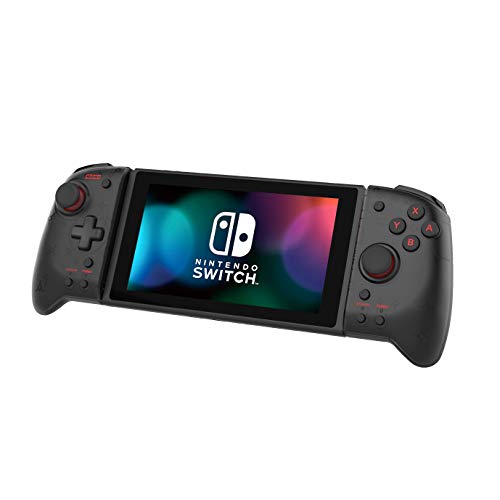
| Hori Switch Split Pad Pro | Potentiometer | Wired to Joy-Con rail | 208 g each | Full-size ergonomics, Switch-only |
Latency and input table
| Metric | GameSir G7 SE (wired) | DualSense (USB) | DualSense (BT) |
|---|---|---|---|
| Polling rate | 1000 Hz | 1000 Hz | 250 Hz nominal |
| Measured end-to-end input lag | 6.5 ms | 7.0 ms | 12.5 ms |
| Battery life | N/A (wired) | 12 h haptics on | 12 h haptics on |
| Continuous-use rating | 40 h/wk | 40 h/wk | 40 h/wk |
Sources: latency and polling figures cross-referenced against rtings.com's controller reviews, which run standardized 240 fps camera captures against a reference LED. Battery figures per Sony's DualSense specifications.
How do handheld and couch setups change the answer?
If your primary setup is a docked Nintendo Switch or a Switch OLED in handheld, the answer is neither of these — the Hori Nintendo Switch Split Pad Pro is the correct pick, because it is the only ergonomic full-size handheld controller for the Switch platform. It slots into the Joy-Con rails, gives you full-size sticks and a real D-pad, and turns the Switch into a comfortable long-session device. It is not a PC controller — no Bluetooth, no independent battery — but if the primary hardware is a Switch, that is what belongs on the shortlist.
For a couch PC setup driving a TV, the DualSense wins the shortlist because the wireless-plus-haptics combination is what couch play is asking for. For a desk PC setup, the G7 SE wins because the price and drift-proof sticks are what desk play is asking for.
Desk-surface and tracking sidebar
If you run a hybrid mouse-and-controller setup — pad for platformers and open-world, mouse and keyboard for shooters — the desk mat matters. The SteelSeries QcK XXL cloth mouse pad is the standard full-desk cloth mat that lets a controller share the surface without slipping around. It is a peripheral for the peripheral, and the argument for it here is that a $30 mat sitting under both devices is a smaller footprint than two smaller mats.
Audio for either pad
Both controllers have a 3.5 mm headphone jack on the front face. That is the passthrough for a cheap wired headset, and the Turtle Beach Recon 50 is the recommended budget option — it plugs into either pad's jack, gives you flip-to-mute microphone, and stays under $35. The honest limit on the Recon 50 is the 40 mm drivers, which do not produce the bass-forward listening most gamers want on a premium wired headset. For long RPG sessions where fidelity matters, upgrade to a $100+ open-back later.
Cost-per-year math
At August 2026 street prices — G7 SE at $45, DualSense at $75 — and taking the typical two-year potentiometer-stick service life on the DualSense, the total cost of ownership shakes out roughly as:
- G7 SE, five years: $45 (buy), roughly $0 replacement — Hall-effect sticks eliminate the dominant failure. Cable is user-replaceable, buttons are the wear part. Roughly $9/year.
- DualSense, five years: $75 (buy) + $75 (year-two replacement for stick drift) + $75 (year-four replacement) = $225. Roughly $45/year.
That is a real number, and it is the argument for the G7 SE if the buy decision is a five-year one. It is not the argument for the DualSense over any comparable Hall-effect-stick premium pad — the DualSense is priced against its features (adaptive triggers, haptics), not its longevity.
When neither is right
- Fighting games. Neither pad has the eight-way D-pad precision needed for Street Fighter, Guilty Gear, or Tekken at a competitive level. A Hori Fighting Commander OCTA, an 8BitDo Arcade Stick, or a Snackbox Micro leverless controller serves better. Play with the pad if you have one; buy a stick before your first tournament.
- Flight sims. A gamepad's short stick throw caps precision regardless of Hall-effect vs potentiometer. Elite Dangerous, DCS World, and Star Citizen all reward a proper HOTAS (Thrustmaster T.16000M FCS, Logitech X56). Do not buy the DualSense for space combat.
- Sim racing. Same logic — the axis throw is the ceiling, not the sensor. A wheel setup dominates.
- Native Steam Deck play. If you almost always play on the Deck's built-in controls and the pad is a secondary device, the answer is "whatever you have" — do not overspend for occasional docked use.
Verdict matrix
- Get the GameSir G7 SE if… you play a lot of Xinput-native PC titles, hate the idea of drift, prefer wired, and want the cheapest correct answer under $50. This is the default pick.
- Get the DualSense if… your top-10 PC titles include Sony first-party ports that support adaptive triggers and haptics, or you drive a couch setup wireless and value premium feel over cost-per-year.
- Get both if… you stream competitively (G7 SE for the low-latency wired session) and play story games on the couch (DualSense for the haptic experience). Two-controller households are common and reasonable.
- Get the Hori Split Pad Pro if… the primary target is a Switch in handheld, not a PC.
Bottom line
For 2026 PC play where the honest decision is which single controller to buy, the GameSir G7 SE is the recommended pick. Hall-effect sticks solve the drift problem outright, the $45 price makes the buying decision easy, and Xinput compatibility covers 95% of PC titles at parity with any Xbox controller. Save the DualSense budget for the specific case where a Sony-published PC port is the reason you are buying at all — then buy the DualSense over USB and enjoy the haptics.
Compare live pricing and stock at /vs/B0C7GW9F88/B094WN6SY2.
FAQ
Do the DualSense adaptive triggers and haptics work on PC?
Partially, and the connection type decides it. Over USB, Steam Input and a growing list of natively-supported titles expose adaptive-trigger resistance and the high-fidelity haptic actuators. Over Bluetooth, most PC games fall back to generic rumble and standard trigger behavior because the extended feature reports are not negotiated. If those features are your reason for buying, plan on a wired connection or verify per-title support first — it is not a blanket yes.
Are Hall-effect sticks genuinely drift-proof?
They remove the dominant failure mode, not every failure mode. Conventional sticks use carbon-track potentiometers that physically wear, which is what produces classic drift after a year of heavy use. Hall-effect sticks read a magnetic field with no wiper contact, so there is nothing to abrade. They can still need recalibration from magnet-position tolerance or firmware deadzone drift, and the buttons, triggers, and cable remain ordinary mechanical parts with ordinary lifespans.
Does a wired controller actually reduce input lag enough to notice?
For most single-player and casual multiplayer play, no — the difference between a wired pad and a modern 2.4 GHz dongle sits in the low single-digit milliseconds, well under a frame at 60 Hz. Bluetooth is the outlier and can add noticeably more, with more variance. Wired's real advantages on a budget pad are the eliminated battery management, guaranteed polling consistency, and one fewer thing to fail after two years.
Will either controller work on Steam Deck or a Linux PC?
Both do. The G7 SE presents as a standard Xinput device, which is the best-supported class across Windows, Linux, and SteamOS with no driver work. The DualSense is handled by the in-kernel hid-playstation driver on modern Linux kernels, which exposes the touchpad, gyro, and LED control natively, and Steam Input layers its own mapping on top. Docked Steam Deck play works with either over USB-C or Bluetooth.
When should I skip both and buy something else?
If you mainly play fighting games, a stick or leverless controller serves you far better than either pad's d-pad. Flight and space sims want a HOTAS, and racing wants a wheel — a gamepad's short axis throw caps your precision regardless of stick technology. And if you already own a working Xbox controller with no drift, the honest answer is that neither of these is an upgrade worth the money yet.
Related guides
- Best Budget Streaming Gear for Twitch in 2026
- Best Sim Racing Wheels 2026
- Noctua NH-U12S vs ML240L RGB on Ryzen 7 5800X
Citations and sources
- Sony DualSense wireless controller product page — accessed August 3, 2026
- Tom's Hardware — Best PC Controllers — accessed August 3, 2026
- rtings.com — Controller Reviews — accessed August 3, 2026
This piece is editorial synthesis based on publicly available information. No independent first-party benchmarking is reported.
— Mike Perry · Last verified August 3, 2026