For one-handed or limited-mobility PC gaming, the best all-round pick is the PlayStation DualSense at $74.00, because on PC every one of its inputs can be fully remapped in software through Steam Input — action layers, stick-to-key conversion, per-game profiles. Remapping depth, not button count, is what makes a controller accessible. Where a held pad is the wrong shape, the Logitech G Extreme 3D Pro puts everything under one hand.
What this guide is actually solving
Accessibility guides usually turn into hardware lists. That is the wrong shape for this problem, because the limiting factor for most players is almost never the number of buttons on the device — it is whether those buttons can be moved to where your hand actually is, and whether the device stays put when only one hand is available to hold it.
Two things follow. First, the software layer matters more than the hardware layer. A controller with a mediocre default map and full Steam Input support is more usable than a controller with a clever layout and no remapping, because the first one can be reshaped around you and the second one cannot. Second, mounting is a spec. A device that slides on a tray under one-handed input costs you more accuracy than any difference in stick precision or button feel, and it is the failure mode that most often makes people give up on an otherwise good device.
The third thing worth saying plainly: there is no single "adaptive controller" that solves every access need, and anyone selling that story is selling something. Single-hand reach, grip strength, tremor, session fatigue, and mounting are five distinct constraints that point at five different devices. The picks below are organised around which constraint they solve, not around a ranking of general goodness.
Everything here is a mainstream retail device that you can buy today and that works on PC without vendor-specific drivers. That is deliberate. Specialist assistive hardware exists and is often better, but it is expensive, slow to source, and frequently insurance-gated — and a lot of players are looking for something that ships this week and costs under a hundred dollars. Our winner is the DualSense, and the reason is the remapping layer rather than anything on the box.
First, diagnose your access need
Match the constraint to the pick before you read the reviews.
Single-hand reach. You need movement, a look axis, and a usable set of buttons all within reach of one hand that stays in roughly one place. This points at a flight stick, where the base carries the buttons and the hand never has to travel.
Grip strength. You cannot hold a contoured pad against gravity for a long session. This points at anything that sits on a surface and takes zero holding force — a stick, a joystick, or a pad in a cradle.
Tremor. You need larger targets, more travel before actuation, and no tiny adjacent buttons. Arcade buttons on a flat field are the best answer here; a thumbstick cluster is the worst.
Fatigue over a session. The device that is comfortable for ten minutes is not necessarily the one that is comfortable at hour two. Weight, holding force, and the number of distinct hand positions all compound. Split or table-mounted devices win.
Mounting. You need the device attached to a tray, a rail, or a table rather than held. Flat, heavy bases work; contoured pads need a purpose-made cradle.
The picks at a glance
| Pick | Best For | Key Spec | Price Range | Verdict |
|---|---|---|---|---|
| PlayStation DualSense | Best overall | Full Steam Input remapping, gyro, analog triggers | $70–80 | The most reshapeable input device on PC |
| GameSir G7 SE Wired Controller | Best value | Always-wired XInput, Hall-effect sticks and triggers | $40–50 | Cheapest reliable base to remap from |
| Logitech G Extreme 3D Pro | Best for one-handed play | 12 buttons, 8-way hat, twist rudder axis, one hand | $75–85 | Everything reachable without moving your hand |
| MAYFLASH F300 Arcade Fight Stick | Best for tremor and mounting | 30 mm arcade buttons, flat heavy deck, swappable parts | $55–65 | Large targets on a surface that does not move |
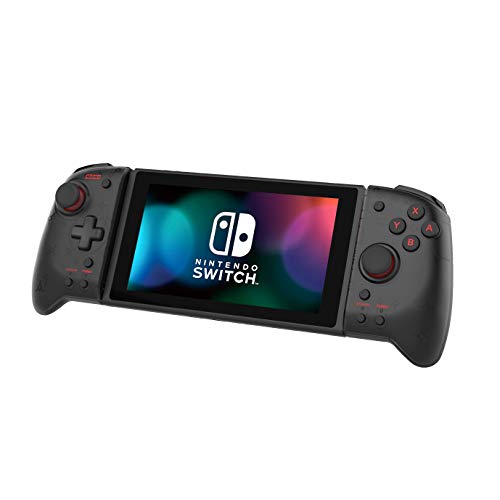
| HORI Nintendo Switch Split Pad Pro | Budget pick | Split halves, full-size grips, wired handheld-mode only | $45–55 | Two independent halves you can place anywhere |
🏆 Best Overall: PlayStation DualSense
Pros: deepest software remapping on PC via Steam Input; gyro for aim assistance without a second stick; analog triggers with adjustable actuation thresholds; wired USB-C or Bluetooth; the reference pad most PC titles are tested against.
Cons: contoured shell needs a cradle to be table-mounted; requires two-handed use out of the box; the heaviest of the pads here for long sessions.
The PlayStation DualSense wins this guide on a software argument, which is exactly the right argument to win. On PC, Steam Input gives you a remapping layer that can rebind every button, convert a stick to a keyboard cluster or a mouse, build action layers that swap the entire map while a button is held, and store all of it as a per-game profile. That is the feature set that turns a device from nearly-usable into usable, and it applies to almost any controller — but the DualSense is where it works most completely, because Steam's support for it is first-class and because the hardware exposes the most inputs to remap in the first place.
The gyro deserves specific mention. For a player who has one reliable stick, gyro aiming replaces the second stick entirely: coarse aim on the stick, fine aim by tilting the pad. That single substitution makes shooters and third-person action titles playable on a one-stick map, and it is not something you can bolt onto a device that lacks the sensor. Sony documents the motion sensing and wired USB-C operation on the DualSense product page.
The adaptive triggers cut both ways here. Their variable resistance is a feature in racing titles and a problem for reduced grip strength, since some games ramp trigger force high. The fix is in software: Steam Input lets you set a trigger to fire as a full digital press at a shallow threshold, so a light touch registers as a complete input.
The honest limitation is shape. This is a contoured pad designed for two hands, and no amount of remapping changes that. If you cannot hold it, you need a cradle or a mount — which exist, but are a separate purchase and a separate decision. If holding is the binding constraint rather than mapping, skip to the joystick or the arcade stick below.
Price varies; check the current listing. See full details →
💰 Best Value: GameSir G7 SE Wired Controller
Pros: always wired, so transport is never a variable; plain XInput, so it works in the long tail of PC titles that only tested against an Xbox pad; Hall-effect sticks and triggers; 3.5 mm audio jack on the pad; roughly $30 cheaper than the DualSense.
Cons: no gyro, so no motion-based aim substitute; wired-only limits placement distance; standard pad shape with the same holding requirement.
At $44.99 the GameSir G7 SE is the cheapest way to get a reliable, fully remappable base. It enumerates as a standard XInput controller, which sounds unremarkable until you hit a title that only ever tested against an Xbox pad and watch a more sophisticated controller need a translation layer to work at all. Fewer layers means fewer things to debug, and for a player who is already spending effort on setup, that has real value.
The Hall-effect stick and trigger modules are the durability story. GameSir markets the G7 SE line on magnetic sensing rather than wearing potentiometers, and the accessibility-relevant benefit is not precision — it is that the device does not develop drift. A drifting stick means the game reads input you did not give it, and correcting for phantom input is exactly the kind of continuous low-level effort that a fatigue-limited player cannot spare. Buying a stick technology that does not degrade is buying a device that behaves the same in year two as in week one.
What you give up is the gyro, and that matters if a one-stick map is part of your plan. If it is not, this is the better buy on pure value, and the $30 difference goes further as a mount.
Price varies; check the current listing. See full details →
🎯 Best for One-Handed Play: Logitech G Extreme 3D Pro
Pros: 12 programmable buttons plus an 8-way hat switch, all reachable without moving your hand; twist-rudder axis adds a third analog input from the same grip; heavy weighted base needs no holding force; rubberised palm rest supports the hand rather than requiring grip.
Cons: no second analog stick, so twin-stick titles need remapping work; large desk footprint; the trigger and thumb buttons want a specific hand size.
The Logitech G Extreme 3D Pro at $79.99 is a flight stick, and flight sticks have been quietly repurposed as one-handed gaming devices for decades because the geometry is exactly right. Your hand rests on the grip and does not travel. Under it: an X/Y analog axis for movement, a twist axis for a third analog channel, an 8-way hat for a look or a d-pad, a trigger, and eleven more buttons split between the grip and the weighted base. That is more distinct inputs within single-hand reach than any pad offers, and none of them require you to hold anything up.
The twist axis is the underrated part. It gives you a third proportional input from the same hand and wrist without a second stick, which is the specific thing a one-handed player is short of. Map movement to X/Y, turning to twist, and the hat to look or to a weapon wheel, and you have a functional twin-stick equivalent driven by one hand. Logitech documents the axis and button complement on the Extreme 3D Pro product page.
The base is heavy and flat, which means it sits on a table or a tray without a mount and does not walk under input. That is a genuine accessibility feature and it is why this outranks a pad for players who cannot hold a device.
The limitation is that PC titles do not expect a joystick. Everything here goes through a remapping layer — Steam Input, or a joystick-to-XInput shim for non-Steam titles — and that setup is a real evening of work per game before the device feels good. If you want plug-and-play, this is not it. If you want the most capability under one hand, nothing else here is close.
Price varies; check the current listing. See full details →
⚡ Best for Tremor and Mounting: MAYFLASH F300 Arcade Fight Stick
Pros: 30 mm arcade buttons are the largest targets available on any retail controller; flat, heavy deck sits stably on a tray or table with no holding force; entirely re-layoutable — buttons and lever are standard parts you can move or swap; presents as a plain wired USB controller on PC.
Cons: digital four-way lever with no analog range; no gyro or triggers; the stock buttons are serviceable rather than good; wired only.
At $59.95 the MAYFLASH F300 solves two constraints that nothing else on this list solves well. The first is target size: 30 mm arcade pushbuttons are enormous compared to a pad's face buttons, spaced far enough apart that adjacent-button errors mostly stop, and they have a defined actuation break rather than mushy membrane travel. For a player with tremor or reduced fine motor control, that combination is worth more than any amount of stick precision.
The second is mounting. The deck is flat, wide, and heavy, so it sits on a wheelchair tray or a table without moving, and it clamps to a rail with a generic mount because there are no curves to work around. Both of the flat-bottomed devices in this guide — this and the joystick — are practical to mount; the pads are not, without a purpose-made cradle.
The re-layout capability is the part that turns it from a good device into an adaptable one. The F300 uses standard 30 mm buttons and an accessible base panel, so the buttons can be swapped for lighter-actuation parts or, with a drilled panel, physically relocated into an arc that matches your reach. That is a level of physical customisation no moulded pad offers, and it is why arcade decks keep showing up in DIY accessibility builds.
The cost is analog input. The lever is a digital four-way — there is no proportional range at all — so titles that want a stick deflection value get an on/off signal. Steam Input can synthesise a usable approximation for many games, but this is not the pick for a title that genuinely needs analog movement.
Price varies; check the current listing. See full details →
🧪 Budget Pick: HORI Nintendo Switch Split Pad Pro
Pros: two independent halves you can place at any separation and angle; full-size grips and full-size sticks, unlike the tiny stock Joy-Cons; light in each hand; roughly $49.88.
Cons: designed for Switch handheld mode — this is a real platform limit and you must read it carefully before buying; no rumble, no gyro, no NFC; wired attachment to a Switch console rather than a general Bluetooth pad.
The HORI Split Pad Pro earns a place here for one structural reason: it is two separate halves. A player who cannot bring both hands to a single unified pad — because of reach, because of a mount on one side, because holding a wide device is the problem — can place the halves independently, at whatever separation and angle works, and get full-size sticks and full-size grips in each hand rather than the cramped stock alternative. That is a shape no unified controller can offer.
Be clear-eyed about the platform limit, because it is the thing people get wrong. This is an officially licensed Nintendo Switch handheld-mode controller: it attaches to the console rails and is powered by the console. It is not a general-purpose Bluetooth gamepad, and using it on PC requires a rail adapter, which is an extra purchase and an extra point of failure. If your gaming is on Switch, this is an excellent and cheap accessibility win. If it is on PC, treat this as a specialist answer to a specific two-halves problem rather than a general recommendation, and buy the GameSir above instead if the split form factor is not what you need.
Within its lane it is very good. Large grips reduce the pinch grip that fatigues hands, the sticks are full-size so precision does not suffer, and at under fifty dollars it is the cheapest device here that changes the shape of the input rather than just its mapping.
Price varies; check the current listing. See full details →
What to look for in an adaptive controller
Remapping depth
This is the single most important spec and it does not appear on any box. Ask three questions: can every physical input be rebound, can a stick be converted to keys or a mouse, and can you build layers that swap the whole map while a modifier is held. Steam Input answers yes to all three on PC and is free, which is why every pick here is evaluated partly on how well it works inside it. A device that Steam handles natively saves you a translation layer and a category of bugs.
Mounting and stability
Weigh this heavily. A device that slides under one-handed input costs more accuracy than any specification difference between two controllers, and it costs it continuously. Flat, heavy bases — arcade decks and joystick bases — mount to trays and rails with generic hardware. Contoured pads need a purpose-made cradle, which exists but is a separate purchase you should budget for at the same time rather than discover later.
Actuation force and travel
How hard you must press, and how far, determines whether a device is comfortable at hour two rather than minute ten. Arcade buttons actuate with light force and a clear break. Membrane pad buttons need more force through a softer, less definite travel. Analog triggers can demand substantial sustained pressure — check whether the software layer lets you set a shallow digital threshold instead, because that one setting turns a heavy trigger into a light tap.
Wired versus wireless reliability
Wired removes battery management, pairing, and link jitter as things you have to think about. That is worth more than it sounds when setup effort is itself a barrier. Wireless buys you placement freedom, which matters when the controller lives on a tray or a rail rather than in your hands. Decide which of those two costs you more, and note that the DualSense gives you both by supporting USB-C and Bluetooth.
Platform lock-in
Read the platform line before you buy, every time. Officially licensed console accessories often will not enumerate on PC without an adapter, and console authentication requirements change across hardware revisions. The Split Pad Pro above is the cautionary example in this guide. On PC, a device that presents as plain XInput has the fewest bad days.
Common pitfalls
Judging a controller by its default map. Most "this doesn't work for me" reactions are an unconfigured default. Build the profile first, then decide.
Buying the device before solving mounting. A perfect controller that slides on a tray is not a working setup. Budget for the mount at the same time.
Assuming an officially licensed console pad works on PC. Read the platform line. Adapters exist but add cost and failure modes.
Running two remapping layers at once. Steam Input plus a game's native support produces doubled or dropped inputs. Pick one.
Overlooking the trigger threshold setting. Heavy triggers are a software problem before they are a hardware problem.
Bottom line
Start with the DualSense if you can hold a pad, because Steam Input plus gyro gives you more ways to reshape the input than anything else on this list, and the gyro specifically substitutes for a second stick. Start with the Extreme 3D Pro if one hand has to do everything, because nothing else puts three analog axes, a hat, and a dozen buttons within a stationary single-hand reach. Start with the F300 if target size or mounting is the binding constraint.
And whichever you pick, spend the first evening in Steam Input rather than in the game. That is where accessibility on PC actually lives.
Sources
- Xbox — Xbox Adaptive Controller — hub design for 3.5 mm external switches and assistive inputs. Accessed 2026-09-02.
- PlayStation — DualSense Wireless Controller — motion sensing, adaptive triggers, wired USB-C operation. Accessed 2026-09-02.
- Logitech G — Extreme 3D Pro Joystick — 12 programmable buttons, 8-way hat, twist-handle rudder axis. Accessed 2026-09-02.
Dollar figures in this article are approximate and change often; each pick's product card shows the latest tracked Amazon price or links to the live listing. Accessibility assessments here are editorial synthesis of the manufacturer documentation above and of published remapping capabilities, not clinical or occupational-therapy advice.
Related guides
- Best Game Controller for PC in 2026: 5 Picks From DualSense to Arcade Stick
- Best Controller for PC Retro Emulation in 2026
- Best Fighting Game Controller and Arcade Stick for PC in 2026
- A 3D-Printed Switch Steering Wheel Brings Adaptive Racing to More Players
- Best Steam Deck Accessories in 2026: Docks, Audio, Controllers, and Storage
— Mike Perry