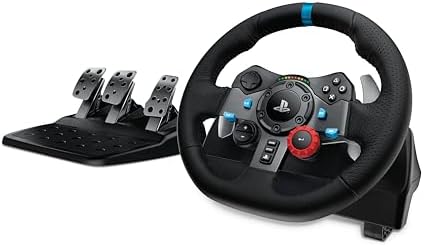
Buy a 900-degree force-feedback wheel for American Truck Simulator — the Logitech G29 at around $277 is the default. Skip the H-pattern shifter until you have logged 50 hours. For Farming Simulator 25, do not buy a wheel at all: a wired gamepad like the GameSir G7 SE handles loader and implement work far better.
Why truck and farm sims are a different buying problem
Almost every wheel recommendation on the internet is written by and for circuit racers. That audience optimises for lap time: fast steering ratios, high-torque feedback, load-cell brakes, and a driving position that mimics a formula car. None of those priorities survive contact with a 53-foot trailer at a loading dock.
Truck and farm simulation invert the requirements in three specific ways. First, session length. A long-haul run in Euro Truck Simulator 2 or American Truck Simulator is 45 to 90 minutes of continuous low-intensity input, not a 12-minute sprint. Fatigue, not precision, is the limiting factor, and a wheel that feels wonderfully heavy for ten laps is exhausting over an hour of highway.
Second, steering range. A race car uses roughly 540 degrees lock to lock and rarely more than a quarter turn at speed. A tractor unit uses several full turns, and the sims model that ratio faithfully. Reversing a trailer into a dock requires hand-over-hand steering that a 270-degree wheel physically cannot express — you run out of travel mid-manoeuvre and the correction becomes binary.
Third, and most underestimated, binding load. Racing needs steering, throttle, brake, clutch, shift up, shift down, and maybe a pit-limiter button. American Truck Simulator and Farming Simulator 25 each need 25 to 40 bound functions in normal play: indicators, high beams, engine brake and retarder levels, air horn, wipers on three speeds, trailer hitch and unhitch, parking brake, cruise control set and resume, camera changes, and in FS25 an entire second layer of implement controls. A device with 12 buttons does not cover that, and the resulting keyboard reach is what actually determines whether a setup is comfortable.
So the useful question is not "which wheel is best." It is "which device covers your specific mix of steering precision, session length and binding count," and that answer differs sharply between hauling and farming.
Key takeaways
- 900 degrees of rotation is the single most important specification for truck sims, and it is the main line separating the G29 from the HORI Racing Wheel Overdrive.
- 25–40 bindings are needed for normal ATS or FS25 play — plan your button budget before you plan your wheel budget.
- Roughly $120 to $280 covers the entire realistic wheel range here; the Thrustmaster TH8A shifter adds about $199 on top and is optional.
- Session length is 45–90 minutes, so comfort and low-fatigue feedback matter more than peak force.
- Farming Simulator is a gamepad game, not a wheel game, for the large majority of players.
Step 0: which driver are you?
Highway hauler. You run long routes, mostly straight, enjoying scenery and radio. Steering precision matters least for you; comfort and cruise-control bindings matter most. A wheel is a luxury upgrade rather than a fix — the HORI Overdrive or even a gamepad is defensible.
City-delivery driver. You take short contracts into tight urban yards and spend a meaningful fraction of each run reversing. You are the buyer for whom 900-degree rotation is not negotiable. Buy the G29.
Field-work farmer. You spend your hours in FS25 running a loader, hitching implements, and managing a harvester's unloading pipe. Steering is a small part of your input load. Buy a gamepad, and consider a joystick as a second device for proportional loader control.
Spec delta
| Device | Rotation | Feedback type | Buttons / axes | Platform | Price band |
|---|---|---|---|---|---|
| Logitech G29 | 900° | Dual-motor force feedback | 25 buttons, 3 pedal axes | PC, PS4, PS5 | ~$277 |
| HORI Racing Wheel Overdrive | 270° | Spring return | 15 buttons, 2 pedal axes | PC, Xbox | ~$120 |
| GameSir G7 SE | n/a | Hall-effect sticks/triggers | 15 buttons, 6 axes | PC, Xbox | ~$45 |
| PlayStation DualSense | n/a | Haptic, adaptive triggers | 14 buttons, 6 axes | PC, PS5 | ~$74 |
| Logitech Extreme 3D Pro | n/a | None | 12 buttons, 4 axes | PC | ~$80 |
Why 900-degree rotation matters more in a truck than a race car
Take the specific case that decides this purchase: backing a 53-foot trailer into a dock at a 90-degree angle.
The manoeuvre requires you to steer away from the direction you want the trailer to go, hold a shallow correction, then unwind quickly as the trailer swings. On a real tractor unit that is roughly two to three full turns of wheel movement, and both ATS and ETS2 model the steering ratio accordingly. Logitech's G29 specification lists 900 degrees of rotation — two and a half turns — which maps the sim's full lock range onto the physical wheel one-to-one.
The HORI Racing Wheel Overdrive gives you 270 degrees. The sim compensates by applying a much steeper steering ratio: a quarter turn of your wheel becomes a full lock in-game. On the highway this is fine and arguably more responsive. At the dock it is not, because the sensitive range collapses. A correction that wants 15 degrees of in-game steering angle needs about 4 degrees of physical wheel movement, which is inside the range of unintentional hand movement. You end up oscillating.
There is a partial software fix — most sims let you cap the in-game steering range to match your hardware, and lowering sensitivity plus adding a linearity curve makes a 270-degree wheel much more usable. It does not close the gap, but it narrows it enough that a HORI owner should absolutely spend twenty minutes in the settings before concluding the wheel is the problem.
The counter-case for 270 degrees is genuine, though: it is faster to correct with at speed, it needs less desk clearance, and hand-over-hand steering is physically tiring across a 90-minute haul. Highway haulers can reasonably prefer it.
Force feedback versus spring return
Spring return does one thing: it pushes the wheel back to centre with force proportional to how far you have turned it. That is the single most important tactile cue in driving and it is why any wheel beats a thumbstick — you always know your steering angle without looking.
Force feedback adds information. In ATS and ETS2 at highway speed, the G29's dual-motor system communicates road camber, crosswind push against a high trailer, tyre scrub on a tight turn, and the distinct lurch of a trailer beginning to sway. Those are cues you would otherwise read visually or not at all, and trailer sway in particular is much easier to catch early when you can feel it building.
The fatigue argument cuts the other way. Force feedback resists you continuously, and over a 90-minute session that adds up. Most long-haul players end up running feedback strength somewhere between 40% and 70% rather than maxed, which is a settings decision worth making deliberately on day one rather than discovering in hour three.
The honest ordering: any wheel is a large upgrade over a gamepad, force feedback is a meaningful but secondary refinement, and the gap between the G29 and the HORI Overdrive is mostly rotation range rather than feedback quality.
Do you need an H-pattern shifter?
Short answer: not first, and possibly not ever.
The case for it is real. American Truck Simulator models multi-range gearboxes including 18-speed configurations with splitter and range selectors, and a dedicated shifter maps those to physical positions the way the real transmission works. Thrustmaster's TH8A supports both H-pattern and sequential modes and is the standard choice for this. For players whose enjoyment comes from operating machinery rather than arriving at destinations, it is the single most transformative add-on available.
The case against is arithmetic. The TH8A costs roughly $199, which is about 72% of the G29's price — you are nearly doubling your spend to change one input. It needs its own clamp space on a desk that is already hosting a wheel. It does nothing at all in Farming Simulator 25, where implements matter more than gears. And most importantly, a large fraction of ATS players who start with manual shifting migrate to automatic or sequential within a few dozen hours, because a 45-minute highway leg with 200 gear changes stops being immersive and starts being admin.
Buy the wheel. Drive for 50 hours. If you are still shifting manually at hour 50, buy the shifter — you have proven you want it.
The button-count problem nobody warns you about
Here is the binding budget for a normally-equipped ATS setup, before you add any convenience macros: steer, throttle, brake, clutch, shift up, shift down, park brake, engine brake off/1/2/3, retarder, left indicator, right indicator, hazards, headlights, high beam, beacon, air horn, city horn, wipers off/1/2/3, cruise set, cruise resume, cruise off, hitch/unhitch, trailer cable, six camera views, map, route advisor, and horn-adjacent courtesy functions. That is comfortably past 35.
| Device | Native buttons | Realistic bindings with shift-modifier | Keyboard needed? |
|---|---|---|---|
| Logitech G29 | 25 | ~40 with one modifier | Rarely |
| HORI Overdrive | 15 | ~26 with one modifier | Occasionally |
| GameSir G7 SE | 15 | ~26 with one modifier | Occasionally |
| DualSense | 14 | ~24 with one modifier | Frequently |
| Extreme 3D Pro | 12 | ~22 with one modifier | Frequently |
The G29's 25-button count — including a full D-pad and the rotary selector — is the quiet reason it dominates truck-sim recommendations, more than its feedback quality. It is the only device here that covers a complete ATS binding set without a keyboard within reach.
Every device benefits enormously from a shift-modifier binding: hold one button and every other button gains a second function. Both franchises support it natively. Set it up before you complain about button count.
Farming Simulator 25 is a different animal
Field work is not a steering problem. A tractor pulling a cultivator across a field is driving in near-straight lines at 12 km/h, often with GPS guidance assistance. What consumes your attention is the implement: raising and lowering, folding and unfolding, running the PTO, controlling a front loader's boom and bucket independently, aiming a harvester's unloading pipe into a moving trailer.
Those are button-and-axis problems, and a wheel is actively worse at them because your hands are committed to a device that only does steering. The GameSir G7 SE is the practical pick: wired, so there is no latency or battery question; Hall-effect sticks and triggers, which resolves the drift problem that kills cheap pads; and 15 buttons with two analog sticks for simultaneous loader-arm and bucket control.
The enthusiast option is a joystick. Proportional front-loader control — boom on pitch, bucket on roll, and a third function on the twist axis — is genuinely closer to how the real machine is operated, and a Logitech Extreme 3D Pro does it for about $80. It is a specialist second device, not a first purchase, and it is poor at driving. Players who do a lot of loader work often end up running both: pad for driving, stick for loading.
The couch and desk split
Where you sit changes the right answer more than most buyers expect.
Living-room setup. A DualSense over Bluetooth is the correct choice and the latency objection does not apply here in the way it does in competitive games. You are driving at 30 to 90 km/h with a slow steering ratio; a 15–25ms wireless delay is well below the threshold where it affects a correction. Adaptive triggers giving throttle and brake a progressive resistance curve is a real ergonomic win for long sessions.
Desk setup. Wired is simply better — the GameSir G7 SE costs less, never needs charging mid-haul, and removes an entire failure mode. On a desk you also have the option of the wheel, which is where the money should go if you are primarily a trucker rather than a farmer.
Where wireless latency does matter: nowhere in these two franchises. This is worth stating plainly because the "wired is mandatory" advice imported from shooter communities causes people to overweight it. Buy wired because it is cheaper and more reliable, not because of latency.
Cost per hour
| Device | Price | Hours/year (typical) | Cost per hour, year one | Notes |
|---|---|---|---|---|
| Logitech G29 | ~$277 | 150 | $1.85 | Strong used market; resale holds well |
| HORI Overdrive | ~$120 | 150 | $0.80 | Cheapest route to proportional steering |
| GameSir G7 SE | ~$45 | 200 | $0.23 | Also serves every other game you own |
| DualSense | ~$74 | 200 | $0.37 | Likely already owned |
| Thrustmaster TH8A | ~$199 | 150 | $1.33 | Add-on cost on top of a wheel |
Year one flatters cheap devices and hides the fact that a G29 routinely lasts five to eight years, at which point it is under $0.40 per hour. The used market is worth watching for both the G29 and the TH8A specifically — both are long-lived, widely produced, and frequently sold on by racers upgrading to direct-drive bases, which means the supply of lightly-used units is steady and prices are soft.
Verdict matrix
Get the Logitech G29 if you drive ATS or ETS2 as your primary sim, you do city delivery or dock work, and you want a device that covers a full binding set. Counter-case: your desk cannot take a clamped wheel, or you play under a few hours a month.
Get the HORI Racing Wheel Overdrive if you want proportional steering at the lowest price and you are a highway hauler who rarely reverses. Counter-case: 270 degrees will frustrate you at the dock.
Get the GameSir G7 SE if Farming Simulator 25 is your main game, or you want one device that covers both franchises adequately at $45. Counter-case: it will never feel like driving a truck.
Get the DualSense if you already own one or you play from a couch. Counter-case: on a desk, the wired pad is cheaper and more reliable.
Add the Thrustmaster TH8A only if you have already logged 50+ hours still shifting manually and you specifically enjoy operating the gearbox. Counter-case: nearly everything else on this list is a better use of $199.
Recommended pick
For a reader whose main game is American Truck Simulator or Euro Truck Simulator 2, buy the Logitech G29. The 900-degree rotation is the specification that decides the manoeuvres these sims are actually built around, the 25-button count is the only one here that covers a complete binding set, and the pedal set is included rather than an upsell. It is the most expensive non-shifter option on the list and it is still the right one.
If Farming Simulator 25 is the reason you are reading this, buy the GameSir G7 SE instead and spend nothing else. Giants Software's Farming Simulator site is a reasonable place to check current platform and controller support before committing. Field work rewards button density and Hall-effect precision, not steering range, and $45 covers it completely.
Bottom line
Decide whether you are hauling or farming first — that single question splits this buying decision cleanly in two, and getting it wrong is how people end up with a $277 wheel they use for twenty minutes a week. Truckers buy rotation range and button count. Farmers buy a wired gamepad. The shifter is a reward for hours already logged, not an entry ticket.
Citations and sources
- Logitech G — G29 Driving Force Racing Wheel — manufacturer specification for the 900-degree rotation range, dual-motor force feedback and button count (accessed August 2026).
- Thrustmaster — TH8A Shifter — manufacturer specification confirming H-pattern and sequential modes used in the shifter discussion (accessed August 2026).
- Farming Simulator official site — current platform and controller-support reference for the Farming Simulator 25 section (accessed August 2026).
Binding counts, cost-per-hour figures and session-length estimates above are editorial synthesis based on the published device specifications and typical play patterns, not laboratory measurements. Prices reflect catalog data at the time of writing and change frequently.
Related guides
- Best Sim Racing Wheel and Controller for PC in 2026
- Logitech G29 vs HORI Racing Wheel Overdrive
- Thrustmaster TH8A vs the G29 Stock Shifter
- Best Game Controller for PC in 2026
— Mike Perry