Introduction: the sub-$120 local-LLM decision
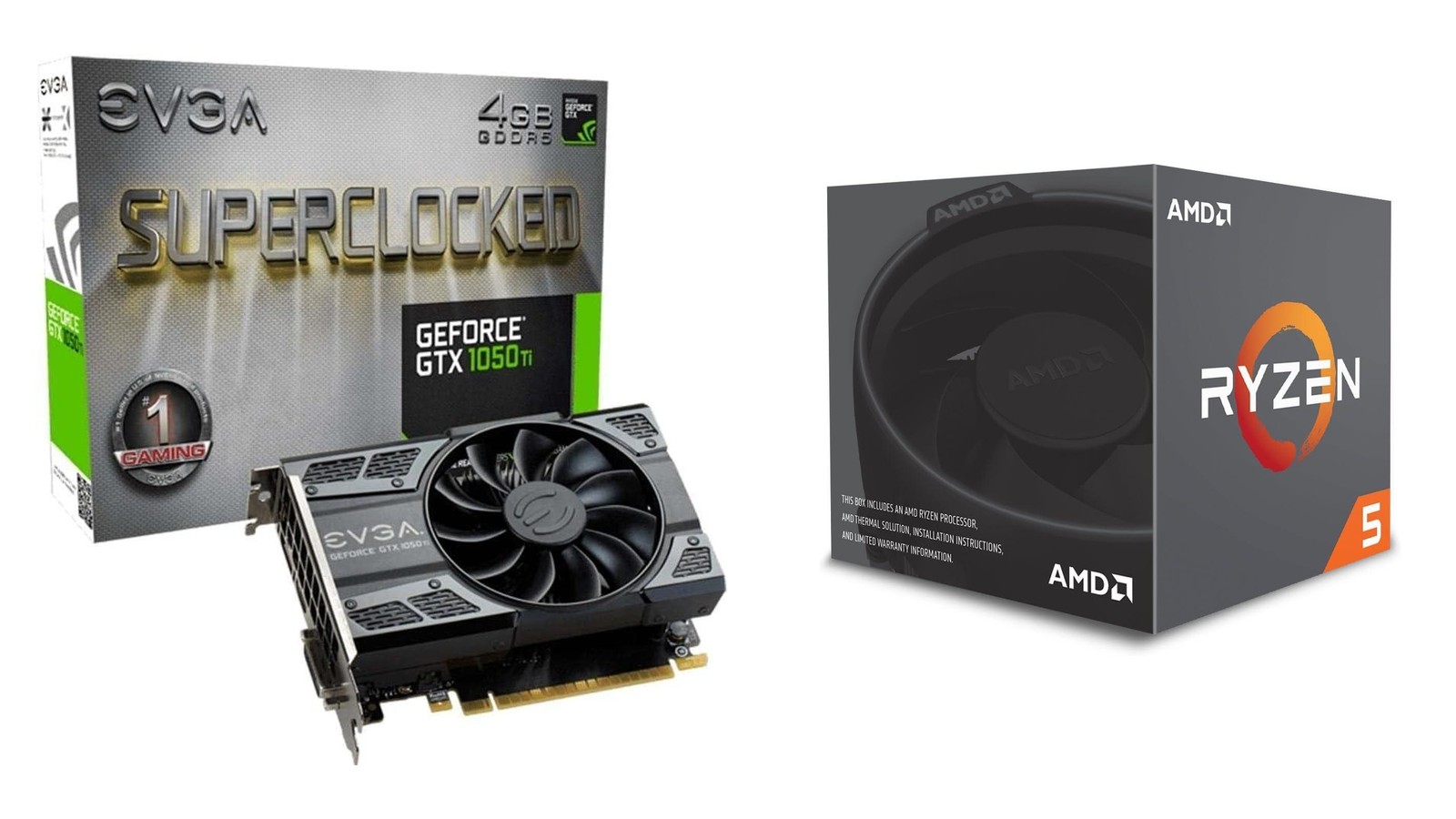
This piece is for readers who already own one of these two parts. A GTX 1050 Ti 4GB and a Ryzen 5 2600 are the leftovers of a typical 2018 AM4 gaming build. The question is whether the card is worth keeping for local AI, or whether the six-core CPU can do the job alone. The reverse question matters too: a 2600 owner may be offered a used 1050 Ti for spare change and wonder if it helps.
1B-class models are the right yardstick for this hardware. Google's Gemma 3 1B and Meta's Llama 3.2 1B Instruct are two widely used small instruction models. Both quantize to about 0.8 GB at Q4_K_M, per the bartowski and Unsloth GGUF repositories. They're small enough to run acceptably on either part. They handle routing, classification, short summaries, autocomplete and simple tool calls, but not open-ended reasoning.
The two parts take opposite routes. The 1050 Ti has 4 GB of dedicated GDDR5 on a 128-bit bus at 112 GB/s, per Wikipedia's GeForce 10 series table. The Ryzen 5 2600 has six Zen+ cores reading ordinary dual-channel DDR4. AMD rates it for up to 2933 MT/s, which works out to 46.9 GB/s. The card has 2.4× the bandwidth and far more parallel compute. The CPU has as much memory as the motherboard holds.
Unusually for this hardware class, measured numbers exist for both. LocalScore, a Mozilla Builders benchmark built on llamafile, has community runs of Llama 3.2 1B Q4_K_M on a GTX 1050 Ti, on two separate Ryzen 5 2600 systems, and on the RTX 3060 12GB and Ryzen 5 5600G discussed below. No public Gemma 3 1B measurement exists on any of the four parts, so the Gemma figures in this synthesis are estimates, labelled as such.
Key Takeaways
- Generation is close. LocalScore's averages are 45.23 tok/s on the 1050 Ti against 38.45 and 34.27 tok/s on two Ryzen 5 2600 systems. That's a 1.2-1.3× gap.
- Prefill isn't close. Prompt processing is 1,013.6 tok/s on the card against 109.1 tok/s on the 2600, about 9.3×. Average time to first token is 1.30 s against 13.23 s.
- On a 4,096-token prompt, generation speed is a tie. In the pp4096+tg256 test the card generated 30.13 tok/s (result #1009) and the 2600 generated 30.29 tok/s (result #3667). The difference was the wait for the first token: 4.56 s against 44.90 s.
- 4 GB isn't the constraint at 1B. Every quant of both models fits the card, up to F16 at 2.48 GB. Gemma 3 1B's full 32K context costs about 0.14 GB of KV cache.
- Pascal is off NVIDIA's newest toolkit. CUDA 13.0 removed offline compilation and library support for Maxwell, Pascal and Volta. Use a CUDA 12.x or Vulkan build of llama.cpp.
- An RTX 3060 12GB is 4.1× faster at generation. It averages 184.98 tok/s on the same suite (LocalScore).
Step 0: which bottleneck are you actually hitting?
Work out which limit applies to you before buying anything. There are three questions.
- What model size? At 1B, both parts are in their comfort zone. At 3B the 1050 Ti still holds the weights (Llama 3.2 3B Q4_K_M is a 2.02 GB file), but its context room shrinks fast. At 7B-8B, 4 GB is gone and the comparison is over.
- How long are your prompts? This is the question that decides it. A 50-token classification prompt produces its first token almost instantly on either part. A 2,000-token pasted document takes about 2 seconds on the card and 18-20 seconds on the 2600, at the measured prefill rates. If your workload is RAG, summarization or any agent loop that re-sends context, prompt length is your bottleneck.
- Always-on or interactive? An always-on box that answers a few requests an hour cares about idle power, not speed. The 2600 can't run without a graphics card at all: its AMD spec page says "Discrete Graphics Card Required". So on a 2600 box the question isn't really card vs no card. It's whether that card does the inference too.
If you answered "1B, short prompts, overnight batch," the 2600 alone is fine. If you answered "long prompts, a person waiting," the card's 9× prefill lead is the part you'll notice.
Spec delta: GTX 1050 Ti 4GB vs Ryzen 5 2600
| Spec | EVGA GTX 1050 Ti FTW 4GB | AMD Ryzen 5 2600 | Why it matters at 1B |
|---|---|---|---|
| Memory pool | 4 GB GDDR5, dedicated (Wikipedia) | System DDR4, 2 channels, up to 2933 MT/s (AMD) | 0.8 GB models fit either one |
| Memory bandwidth | 112 GB/s, 128-bit (Wikipedia) | 46.9 GB/s theoretical (2 × 8 B × 2933 MT/s) | Sets the generation ceiling |
| Power | 75 W reference; EVGA FTW lists 6-pin input, 120 W total draw, 300 W PSU minimum (Newegg) | 65 W TDP (AMD) | The card adds to a host that's already drawing power |
| Compute | 768 CUDA cores, 1,981 GFLOPS FP32, FP16 at 1/64 rate (Wikipedia) | 6 Zen+ cores, 12 threads, 3.4/3.9 GHz (Wikipedia) | Sets the prefill rate |
| Launch price | US $139, Oct 2016 (Wikipedia) | US $199, April 2018 (Wikipedia) | Both are now used-market parts |
Two notes on the table. First, the EVGA FTW is not a slot-powered card, unlike many 1050 Ti models. Newegg's listing for the EVGA GeForce GTX 1050 Ti FTW Gaming 4GB requires a 6-pin connector. Second, the 1050 Ti's FP16 throughput is only 31 GFLOPS. F16 and BF16 model files will load, but the card has no fast half-precision path, so quantized files are the right choice on it.
Benchmark table: Gemma 3 1B and Llama 3.2 1B, measured and estimated
All measured rows use LocalScore's suite unless marked otherwise. LocalScore averages nine prompt/generation mixes, from 1,024 prompt + 16 generated tokens up to 4,096 + 256 and 1,280 + 3,072 (methodology). Its numbers compare cleanly with each other, but not with llama-bench's pp512/tg128 figures.
| Configuration | Model / quant | Prefill (tok/s) | Generation (tok/s) | Avg TTFT | Source |
|---|---|---|---|---|---|
| GTX 1050 Ti, suite average | Llama 3.2 1B Q4_K_M | 1,013.6 | 45.23 | 1.30 s | LocalScore #1009 |
| GTX 1050 Ti, 4,096-token prompt | Llama 3.2 1B Q4_K_M | 905.5 | 30.13 | 4.56 s | Result #1009 |
| GTX 1050 Ti, 64-token prompt | Llama 3.2 1B Q4_K_M | 1,028.2 | 56.35 | 0.08 s | Result #1009 |
| Ryzen 5 2600 (system A), suite average | Llama 3.2 1B Q4_K_M | 109.1 | 38.45 | 13.23 s | LocalScore #3667 |
| Ryzen 5 2600 (system A), 4,096-token prompt | Llama 3.2 1B Q4_K_M | 91.3 | 30.29 | 44.90 s | Result #3667 |
| Ryzen 5 2600 (system A), 64-token prompt | Llama 3.2 1B Q4_K_M | 122.8 | 43.72 | 0.54 s | Result #3667 |
| Ryzen 5 2600 (system B), suite average | Llama 3.2 1B Q4_K_M | 109.4 | 34.27 | 13.36 s | LocalScore #3872 |
| Quadro P1000 (same GP107 chip, 640 cores), Ollama | Llama 3.2 1B Q8_0 | n/a | 28.90 | n/a | DatabaseMart |
| GTX 1050 Ti (estimate) | Gemma 3 1B Q4_K_M | ~1,000-1,200 | ~40-50 | ~1.2 s | Estimate: same 0.806 GB file size |
| Ryzen 5 2600 (estimate) | Gemma 3 1B Q4_K_M | ~110-130 | ~34-40 | ~12 s | Estimate: same basis |
The Gemma rows are estimates. Gemma 3 1B's Q4_K_M file is 0.806 GB against Llama's 0.808 GB, and generation on both parts is bound by bytes read per token. So generation should land within about 10% of the Llama figures. Gemma has fewer parameters (999.9M against 1,235.8M, per the Unsloth and bartowski repos), which should help prefill. Its 262,144-token vocabulary makes the output layer costlier, which works the other way. Measure your own build before relying on the Gemma rows.
Two caveats on the 1050 Ti row. The LocalScore run used a 2009-era Intel Core i7-870 as the host (result #1009). A slow host adds per-token overhead that matters more on a 1B model than on a 7B. The card's llama-bench-style ceiling is also higher than its LocalScore average. In the llama.cpp CUDA thread, the 1050 Ti moved 72.9 GB/s on a 3.56 GiB 7B Q4_0 model (19.06 tok/s tg128), about 65% of its peak bandwidth. Applying a small-model efficiency discount to that rate gives an estimated 75-80 tok/s tg128 on Llama 3.2 1B Q4_K_M in a clean llama-bench run. Treat 45 tok/s as a realistic mixed-workload figure and 75-80 as the upper bound.
Quantization matrix: Q4 to F16 at 1B
| Quant | Llama 3.2 1B file | Gemma 3 1B file | Fits 1050 Ti? | Est. gen, 1050 Ti (Llama) | Est. gen, 2600 (Llama) |
|---|---|---|---|---|---|
| Q4_K_M | 0.808 GB | 0.806 GB | Yes | 45.2 (measured) | 38.5 (measured) |
| Q5_K_M | 0.912 GB | 0.851 GB | Yes | ~40 | ~34 |
| Q6_K | 1.022 GB | 1.012 GB | Yes | ~36 | ~30 |
| Q8_0 | 1.321 GB | 1.069 GB | Yes | ~28 | ~24 |
| F16 / BF16 | 2.480 GB | 2.007 GB | Yes, but slow FP16 | ~15 | ~13 |
File sizes come from the bartowski Llama 3.2 1B and Unsloth Gemma 3 1B GGUF repositories. The speed columns scale the measured Q4_K_M rows by file size, which is the right first-order model for a bandwidth-bound workload. The Q8_0 estimate for the card lines up with the one direct data point: the P1000, a cut-down version of the same chip, measured 28.90 tok/s on Ollama's Q8_0 Llama 3.2 1B.
Gemma's files grow more slowly with quant level because a large share of the model is its 262,144 × 1,152 embedding table, per the model config. Gemma 3 1B at Q8_0 is only 1.069 GB, so it runs about 20% faster than Llama at Q8_0 on either part.
Quality loss is harder to pin down. No public GGUF perplexity table exists for either 1B model. The nearest data is Meta's own: plain 4-bit post-training quantization dropped Llama 3.2 1B's MMLU from 49.3 to 43.3 and BFCL tool-use from 25.7 to 14.3, per the Llama 3.2 1B model card. Meta's scheme differs from llama.cpp's K-quants, but the lesson carries: small models lose proportionally more to quantization than 3B+ models do. Under the same scheme, Meta reports the 3B's MMLU moving only from 63.4 to 60.5. With 4 GB of VRAM and a 1B model, Q6_K or Q8_0 costs you nothing in fit. Take Q8_0 for tool calling and structured output, and Q4_K_M when raw speed matters more.
Prefill vs generation: why the 1050 Ti wins prompt processing and the Ryzen 5 2600 closes the gap on short generations
The two phases hit different limits, which is why the headline ratio depends on which one you measure.
Generation is bandwidth-bound. Each new token reads the full weight file once. On paper the 1050 Ti's 112 GB/s is 2.4× the 2600's 46.9 GB/s, so the card should generate 2.4× faster. It doesn't, for two reasons. At 0.8 GB per token, fixed per-token overhead (kernel launches, sampling, host round-trips) takes a large share of each token's time. That overhead lands on the GPU path, and the i7-870 host makes it worse. The 2600, meanwhile, extracts a decent share of its bandwidth: 0.808 GB × 38.45 tok/s is 31.1 GB/s, roughly two-thirds of DDR4-2933's theoretical peak (the run didn't report its RAM speed). The measured result is 1.2-1.3×, not 2.4×.
Prefill is compute-bound. Processing a prompt is batched matrix multiplication, where 768 CUDA cores beat six Zen+ cores by an order of magnitude. Zen+ also splits 256-bit AVX2 into two 128-bit halves, which Zen 2 fixed. The measured gap is 9.3× (1,013.6 against 109.1 tok/s).
This is also why the card's lead looks biggest in the per-test data at the two extremes. With a 64-token prompt and 1,024 generated tokens, both parts start instantly (0.08 s and 0.54 s) and the card generates 56.35 tok/s against 43.72, a 1.3× gap. With a 4,096-token prompt, generation speed is identical (30.13 and 30.29 tok/s). The card answers in 4.56 seconds while the 2600 takes 44.90.
Worked example: a 1,500-token email thread summarized into 150 tokens. On the card that's about 1.5 s of prefill plus about 3.5 s of generation, roughly 5 seconds. On the 2600 it's about 14 s plus about 4 s, roughly 18 seconds. The generated text arrives at nearly the same speed. The difference is the silent wait before it starts.
Context-length impact: 2k, 8k and 32k on both parts
KV-cache size per token comes straight from each model's config. Llama 3.2 1B has 16 layers and 8 KV heads of dimension 64, which works out to 2 × 16 × 8 × 64 × 2 bytes = 32 KiB per token at fp16 (config). Gemma 3 1B has 26 layers with a single KV head of dimension 256. Only 4 of those layers keep global attention; the other 22 use a 512-token sliding window (config). llama.cpp stores only the window for those layers by default. Its --swa-full flag, documented in the server README, restores the full-size cache.
| Context | Llama 3.2 1B KV (fp16) | Gemma 3 1B KV (fp16, SWA) | 1050 Ti with Q4_K_M | Ryzen 5 2600 |
|---|---|---|---|---|
| 2k | 64 MiB | ~19 MiB | Fits easily | Fits easily |
| 8k | 256 MiB | ~43 MiB | Fits easily | Fits easily |
| 32k | 1 GiB | ~139 MiB (Gemma's maximum) | Fits | Fits |
| 128k (Llama only) | 4 GiB | n/a | Only with q8_0 KV cache | Fits in 16 GB RAM |
The 4 GB card's cliff barely applies at 1B. The llama.cpp banner reports 4,031 MiB available on a 1050 Ti (discussion #15013). Subtract about 770 MiB for Llama Q4_K_M and an assumed 400 MiB for runtime buffers, and about 2,860 MiB is left. That's roughly 89K tokens of fp16 KV cache, or Llama's full 128K with the cache quantized to q8_0 (-ctk q8_0 -ctv q8_0). Gemma 3 1B tops out at 32K, which costs it about 0.14 GB.
What does bite at long context is speed. Every generated token also reads the whole KV cache, and every prompt token has to be prefilled. At 32K, a full prompt takes at least 36 seconds on the card and at least 6 minutes on the 2600. Those figures extrapolate the measured 4K prefill rates (905.5 and 91.3 tok/s), and prefill slows further at depth, so real waits run longer. Interactive long-context work on a 2600 alone isn't practical.
The real cliff arrives one size up. Llama 3.2 3B has 28 layers, so its KV cache costs 112 KiB per token (config). Its 2.02 GB Q4_K_M file leaves room for only about 15K tokens of fp16 context on a 4 GB card. Past that, llama.cpp keeps layers in system RAM and the card's advantage drains away.
Where the 4GB ceiling ends the conversation: the RTX 3060 12GB
If your use case grows past 1B-3B, neither part here is the answer. The step up is 12 GB of dedicated memory, and the cheapest common card with it is the RTX 3060 12GB: 360 GB/s on a 192-bit bus at 170 W, US $329 at launch, per Wikipedia's RTX 30 series table.
On the same LocalScore suite the MSI Gaming GeForce RTX 3060 12GB class of card averages 184.98 tok/s generation, 6,042.3 tok/s prefill and 0.23 s to first token (LocalScore). That's 4.1× the 1050 Ti's generation rate. The ratio matches llama.cpp's 7B results almost exactly: 75.57 against 19.06 tok/s is 3.96× (discussion #15013).
What the 3060 unlocks matters more than its 1B speed:
- 3B at full speed. Llama 3.2 3B Q4_K_M runs at 122.85 tok/s tg128 on a 3060 (Geerling, issue #40), with room for long context.
- 4B with long context. Qwen3 4B plus a 32K cache fits comfortably.
- 8B-class assistants. A 7B Q4_K_M model runs at 61.53 tok/s on the same machine (Geerling, issue #40). A 4 GB card can't hold that model at all.
Buy the 12 GB version specifically. The 8 GB RTX 3060 has a 128-bit bus and 224 GB/s (Wikipedia). It shares the name but not the capability, so check for "12GB" in the listing title.
The iGPU alternative: Ryzen 5 5600G
The third route skips the discrete card entirely. The AMD Ryzen 5 5600G drops into the same AM4 socket as the 2600 (check your board's BIOS for Zen 3 support first). It brings six Zen 3 cores, DDR4-3200 support and seven Radeon graphics cores at 1,900 MHz, per AMD's spec page.
The CPU cores alone nearly erase the 1050 Ti's generation lead. LocalScore's Linux 5600G run averages 43.92 tok/s generation and 279.0 tok/s prefill on Llama 3.2 1B Q4_K_M (LocalScore #1278). That's within 3% of the 1050 Ti on generation, and 2.6× the 2600 on prefill. A second run, on Windows, came in at 32.77 and 181.2 tok/s (LocalScore #3576), a reminder that OS and build matter as much as the silicon.
The iGPU has no measured 1B-class row. The nearest data point is llama.cpp's Vulkan scoreboard, where an unnamed "AMD Ryzen 5000 Series" iGPU runs Llama 2 7B Q4_0 at 90.55 tok/s prefill and 10.98 tok/s generation. Scaled to a 0.8 GB model by file size, that suggests roughly 50 tok/s generation. Treat that as an estimate: the iGPU shares the same 51.2 GB/s DDR4 bus as the CPU cores, so it can't beat that ceiling.
The 5600G's real advantage is that it needs no graphics card. On an always-on box, that removes a 1050 Ti's idle draw from the power bill.
Perf-per-dollar and perf-per-watt math
| Part | Gen (tok/s) | Prefill (tok/s) | Rated power | Gen tok/s per W | Launch price | Gen tok/s per $100 |
|---|---|---|---|---|---|---|
| GTX 1050 Ti 4GB | 45.23 | 1,013.6 | 75 W | 0.60 | $139 | 32.5 |
| Ryzen 5 2600 | 38.45 | 109.1 | 65 W TDP | 0.59 | $199 | 19.3 |
| Ryzen 5 5600G (CPU) | 43.92 | 279.0 | 65 W TDP | 0.68 | $259 | 17.0 |
| RTX 3060 12GB | 184.98 | 6,042.3 | 170 W | 1.09 | $329 | 56.2 |
Throughput comes from LocalScore's Llama 3.2 1B Q4_K_M averages (1050 Ti, 2600, 5600G, 3060). Power ratings and launch prices come from Wikipedia's GeForce 10, RTX 30 and Ryzen tables.
Three caveats apply. First, the GPU rows need a host CPU drawing power too, so their per-watt figures flatter them. Second, launch prices are only reference points. All four now sell mostly used, and current new-stock listings for the two older parts sit far above their used-market prices, so check the price at checkout. Third, per-dollar math only applies to parts you'd buy. If you already own both, the marginal cost of trying each is zero.
The RTX 3060 wins on both efficiency columns despite its 170 W rating, because efficiency is about finishing the work, not about drawing less power along the way. Between the two parts this article is about, generation per watt is a dead heat (0.60 against 0.59). Prefill per watt favors the card by about 8×.
Common pitfalls
- Pulling the wrong quant in Ollama.
ollama run llama3.2:1bdownloads Q8_0 at 1.3 GB, not Q4_K_M (Ollama library).gemma3:1bdownloads Q4_K_M at 815 MB (Ollama library). Compare like with like. - Downloading a CUDA 13 build for the 1050 Ti. NVIDIA's CUDA 13.0 release notes say offline compilation and library support for Pascal "have been removed in CUDA Toolkit 13.0". Toolkits "through the 12.x series" can still build for it. llama.cpp's release page ships CUDA 12.4, CUDA 12.8 and Vulkan binaries next to the CUDA 13 ones, so pick one of those.
- Expecting new drivers. Per Phoronix, NVIDIA confirmed the 580 driver branch is the last for Maxwell, Pascal and Volta.
- Single-channel RAM on the 2600. One DDR4 stick halves the 46.9 GB/s figure, and CPU generation halves with it. Install memory in matched pairs.
- Treating Vulkan and CUDA as interchangeable on Pascal. On a 7B model, the 1050 Ti's Vulkan build generated slightly faster (20.96 tok/s, per the Vulkan scoreboard) but prefilled at about half the CUDA rate (136.42 against 266.70 tok/s). For long prompts, use a CUDA 12.x build.
When NOT to use either
Skip both parts if you need an 8B-class model, if you run agent loops that resend thousands of tokens per turn and need fast replies, or if you need reliable tool calling. The 1B models' BFCL tool-use score is 25.7 at full precision, per Meta's card. Neither part fixes a model-capability problem, and a faster 1B model is still a 1B model.
Verdict matrix
- Get (keep) the GTX 1050 Ti if: you already own it, your prompts run past a few hundred tokens, or a person is waiting on each answer. Expect about 45 tok/s generation and about 1 second to first token on a 1B model.
- Get (keep) the Ryzen 5 2600 alone if: your prompts are short (intents, tags, one-line questions), or the box runs overnight batch jobs. Expect about 34-38 tok/s generation and put spare money into a matched DDR4-3000/3200 kit, not a GPU.
- Skip both and get the RTX 3060 12GB if: you want 3B-8B models, long context at interactive speed, or anything you'd call an assistant. It averages 184.98 tok/s on the same 1B suite and runs a 7B model at 61.53 tok/s.
Bottom line
For 1B-class models, keep the GTX 1050 Ti in the slot. It doesn't generate much faster than a Ryzen 5 2600 (45 against 38 tok/s), but it reads prompts about nine times faster, and that's the delay you actually feel. Don't buy either part new for local AI in 2026. If you're spending money, spend it on 12 GB of VRAM.
Live price comparison
A GPU and a CPU don't share a head-to-head page, so here are the individual listings: the EVGA GTX 1050 Ti FTW 4GB, the AMD Ryzen 5 2600 with Wraith Stealth and, for the upgrade path, the MSI RTX 3060 12GB and the AMD Ryzen 5 5600G. Collected public benchmarks for each chip are on the Ryzen 5 2600, Ryzen 5 5600G and RTX 3060 12GB pages. Prices were current at the last refresh and may vary, so confirm at checkout.
Related guides
- RTX 3060 12GB vs GTX 1050 Ti 4GB for Gemma 3 4B
- GTX 1050 Ti 4GB vs Ryzen 5 5600G iGPU for Qwen3 4B
- Ryzen 5 2600 vs Ryzen 5 5600G, CPU-only Llama 3.2 3B
- Best budget GPU for local LLMs: the RTX 3060 12GB
- Which LLMs fit an RTX 3060 12GB
Citations and sources
- LocalScore: GTX 1050 Ti, Llama 3.2 1B Q4_K_M (accelerator #1009) (accessed 2026-09-19)
- LocalScore: test #1009 per-test results (accessed 2026-09-19)
- LocalScore: Ryzen 5 2600, system A (accelerator #3667) (accessed 2026-09-19)
- LocalScore: test #3667 per-test results (accessed 2026-09-19)
- LocalScore: Ryzen 5 2600, system B (accelerator #3872) (accessed 2026-09-19)
- LocalScore: Ryzen 5 5600G, Linux (accelerator #1278) (accessed 2026-09-19)
- LocalScore: Ryzen 5 5600G, Windows (accelerator #3576) (accessed 2026-09-19)
- LocalScore: RTX 3060 (accelerator #43) (accessed 2026-09-19)
- LocalScore: methodology (accessed 2026-09-19)
- llama.cpp: Performance on NVIDIA CUDA, discussion #15013 (accessed 2026-09-19)
- llama.cpp: Performance with Vulkan, discussion #10879 (accessed 2026-09-19)
- llama.cpp: server README (<code>--swa-full</code>) (accessed 2026-09-19)
- llama.cpp: releases (accessed 2026-09-19)
- Jeff Geerling: ai-benchmarks issue #40 (RTX 3060) (accessed 2026-09-19)
- DatabaseMart: Ollama benchmark on the Quadro P1000 (accessed 2026-09-19)
- Google: Gemma 3 model card (accessed 2026-09-19)
- Meta: Llama 3.2 1B Instruct model card (accessed 2026-09-19)
- bartowski: Llama 3.2 1B Instruct GGUF (accessed 2026-09-19)
- bartowski: Llama 3.2 3B Instruct GGUF (accessed 2026-09-19)
- Unsloth: Gemma 3 1B IT GGUF (accessed 2026-09-19)
- Gemma 3 1B config.json (Unsloth mirror) (accessed 2026-09-19)
- Llama 3.2 1B config.json (Unsloth mirror) (accessed 2026-09-19)
- Llama 3.2 3B config.json (Unsloth mirror) (accessed 2026-09-19)
- Ollama: llama3.2:1b (accessed 2026-09-19)
- Ollama: gemma3:1b (accessed 2026-09-19)
- Wikipedia: GeForce 10 series (accessed 2026-09-19)
- Wikipedia: GeForce RTX 30 series (accessed 2026-09-19)
- Wikipedia: List of AMD Ryzen processors (accessed 2026-09-19)
- Wikipedia: Zen 2 (accessed 2026-09-19)
- AMD: Ryzen 5 2600 specifications (accessed 2026-09-19)
- AMD: Ryzen 5 5600G specifications (accessed 2026-09-19)
- Newegg: EVGA GTX 1050 Ti FTW 04G-P4-6258-KR (accessed 2026-09-19)
- NVIDIA: CUDA Toolkit 13.0 release notes (accessed 2026-09-19)
- Phoronix: NVIDIA 580 driver is the last for Maxwell, Pascal and Volta (accessed 2026-09-19)
This piece is editorial synthesis based on publicly available information. No independent first-party benchmarking is reported.