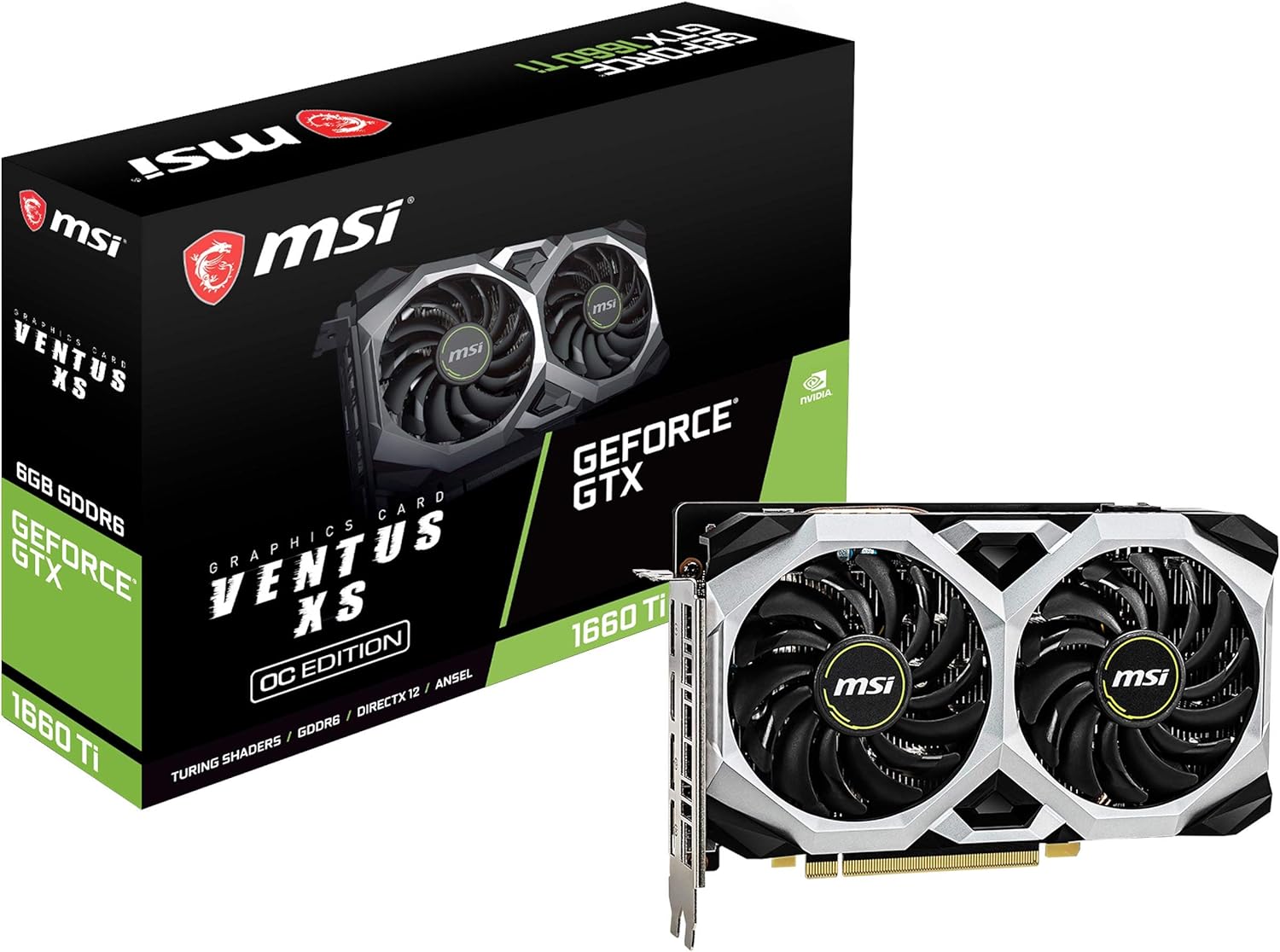
If you've seen a listing advertising a "GTX 1660 8GB" and wondered whether you missed a product launch, the short answer is no — it doesn't exist. NVIDIA's entire GTX 1660 family, across every trim level and every add-in-board partner, tops out at 6GB of VRAM. Anything advertised otherwise is a labeling error, a stale listing, or confusion with a different card entirely.
Does the GTX 1660 Actually Have 8GB of VRAM?
No. NVIDIA's own product pages for the GTX 1660, GTX 1660 Ti, and GTX 1660 Super all list 6GB as the memory capacity. Wikipedia's GeForce 16-series entry, which aggregates the reference specs across the whole family, confirms the same ceiling for every SKU NVIDIA shipped under the 1660 name.
| Card | VRAM | Memory type | Bus width | Launch |
|---|---|---|---|---|
| GTX 1660 | 6GB | GDDR5 | 192-bit | March 2019 |
| GTX 1660 Ti | 6GB | GDDR6 | 192-bit | February 2019 |
| GTX 1660 Super | 6GB | GDDR6 | 192-bit | October 2019 |
There's no hidden 8GB revision, no region-exclusive SKU, and no later refresh that bumped capacity. If a retailer or marketplace listing says otherwise, treat it as a red flag rather than a spec sheet.
Why the "GTX 1660 8GB" Claim Keeps Circulating
A few distinct sources of confusion feed this myth, and it's worth knowing them so the same pattern doesn't trip you up on other cards later:
- Memory speed vs. memory capacity. GDDR6 on the 1660 Ti and Super runs at an effective 8 Gbps per pin. That "8" gets misread as "8GB" in secondhand summaries and auto-generated spec aggregators, even though it describes bandwidth, not capacity.
- Naming proximity to real 8GB cards. Cards like the RTX 3050 8GB or RX 6600 8GB sit in a similar price bracket and get compared to the 1660 constantly; some comparison content blends the two spec sheets together carelessly.
- Stale or templated listings. Marketplace listings for used cards are frequently copy-pasted from a template, and an 8GB figure meant for an unrelated card can end up attached to a 1660 listing without anyone checking it.
- Relabeled or miscategorized cards. In rare cases a listing's box art or silkscreen text doesn't match the actual chip installed. A label reading "8GB" is not proof of anything — the only reliable check is software-level VRAM reporting, covered further down.
None of these describe an actual 8GB GTX 1660 — they explain why the claim keeps resurfacing in search results and listings.
GTX 1660 Family at a Glance
| Spec | GTX 1660 | GTX 1660 Ti | GTX 1660 Super |
|---|---|---|---|
| VRAM | 6GB GDDR5 | 6GB GDDR6 | 6GB GDDR6 |
| CUDA cores | 1408 | 1536 | 1408 |
| Bus width | 192-bit | 192-bit | 192-bit |
| Launch price | $219 | $279 | $229 |
Even the Ti and Super revisions, which upgraded memory type and clock speeds, kept the same 6GB ceiling as the original. NVIDIA's next capacity jump in this segment came with the RTX 30-series, not a later 1660 revision.
If You Need 8GB Today: Real Alternatives
If your workload genuinely needs more than 6GB — modern titles at 1440p, texture-heavy modding, or local AI inference — there are legitimate 8GB cards in roughly the same price tier as a used 1660:
- AMD RX 6600 (8GB GDDR6). AMD's own product page lists a genuine 8GB frame buffer, and it's a common step-up target for 1660 owners upgrading within a similar budget.
- RTX 3050 8GB. NVIDIA sells this chip in both 6GB and 8GB configurations, so confirm the exact listing before buying — don't assume the higher figure by default.
- RTX 3060 12GB. A bigger jump in both price and VRAM, worth considering if you're also doing local AI work, where extra headroom pays off directly. Our breakdown of how running out of VRAM affects your FPS covers why capacity matters more than raw core count once you cross a game's texture budget.
If you're shopping used, the same verification habit that exposes a fake "8GB GTX 1660" applies broadly: confirm VRAM in software before finalizing any purchase, never from box text or a listing description alone.
When the GTX 1660's Real 6GB Is (and Isn't) Enough
Good fits for 6GB:
- 1080p60 in esports titles and most last-generation AAA games
- Legacy libraries without ray tracing requirements, including many of the games covered in our list of retro games with 1:1 remakes
- Budget builds where a used 1660 remains a common recommendation for general desktop use and older game libraries
Where 6GB starts to limit you:
- Modern AAA titles at 1440p or with high-resolution texture packs, where VRAM pressure — not just GPU compute — starts capping frame rates
- Local AI workloads. Community projects have pushed useful results out of small VRAM budgets — see our guides on training a generative kick-drum model on 6GB of VRAM and running a 5GB text-to-speech model across 21 different GPUs — but headroom above 6GB gives noticeably more flexibility for larger models
- If a workload doesn't fit in VRAM at all, the CPU-only route is worth knowing about: our guide to running a 26B-parameter LLM locally with no GPU and Chrome's built-in Gemini Nano running without a dedicated GPU both cover that path directly
Older NVIDIA cards, including 1660-generation hardware, also show up in hobbyist and legacy hardware projects unrelated to gaming performance — our build log for a DIY NVIDIA 3D Vision emitter using an RP2040 is one example of that kind of second-life use.
How to Verify Your Own GPU's VRAM
Don't trust box text, marketplace listings, or Windows' Task Manager "GPU memory" summary alone — check it directly:
| Method | Platform | What it shows |
|---|---|---|
| nvidia-smi | Windows/Linux | Authoritative total VRAM reported directly by the NVIDIA driver |
| GPU-Z | Windows | Full card identification, VRAM size, memory type, and bus width |
| Task Manager, Performance tab | Windows | Dedicated GPU memory, but can be misleading on shared/hybrid configurations |
| dxdiag | Windows | Basic display adapter memory summary |
nvidia-smi is the most reliable source since it comes straight from NVIDIA's driver stack rather than an OS-level abstraction layer, and GPU-Z is the go-to third-party tool whenever a listed spec doesn't match what a card should have.
Frequently Asked Questions
Does the GTX 1660 Ti have 8GB of VRAM? No — 6GB of GDDR6, per NVIDIA's own product page.
Does the GTX 1660 Super have 8GB of VRAM? No — also 6GB, using GDDR6 instead of the base model's GDDR5.
Did any AIB partner ever release an 8GB GTX 1660? No. Partner cards change cooling, clocks, and PCB design, but VRAM capacity is fixed by NVIDIA's reference spec for a given chip.
What should I buy instead if I need 8GB on a budget? The RX 6600 8GB or RTX 3050 8GB (confirm the VRAM variant before buying) are the closest legitimate options at a similar price point.
How do I check exactly how much VRAM my GPU has? Use nvidia-smi or GPU-Z rather than a listing description or Task Manager's summary view.
Is 6GB of VRAM enough in 2026? For 1080p esports and older AAA libraries, yes. For modern titles at 1440p+ or local AI inference, more headroom is worth paying for.
Citations and sources
- https://www.nvidia.com/en-us/geforce/graphics-cards/16-series/gtx-1660/
- https://www.nvidia.com/en-us/geforce/graphics-cards/16-series/gtx-1660-ti/
- https://www.nvidia.com/en-us/geforce/graphics-cards/16-series/gtx-1660-super/
- https://en.wikipedia.org/wiki/GeForce_16_series
- https://www.techpowerup.com/gpuz/
- https://developer.nvidia.com/nvidia-system-management-interface
- https://www.amd.com/en/products/graphics/amd-radeon-rx-6600.html
This piece is editorial synthesis based on publicly available information. No independent first-party benchmarking is reported.
