Yes — the moment any layers spill from a 12 GB card into system RAM, the host CPU stops being a spectator and starts setting your tokens per second. The Ryzen 7 5800X's 16 threads and larger cache give it a clear edge over the 8-thread i7-9700K in that partial-offload window, though memory bandwidth, not core count, is the real ceiling for both.
Key takeaways
- With the whole model resident in VRAM, the CPU barely matters. With layers on the CPU, it matters a great deal — and the switch flips abruptly.
- Per AMD's product page, the 5800X is an 8-core, 16-thread Zen 3 part; the i7-9700K is 8 cores with no hyperthreading, per TechPowerUp's review.
- The offloaded portion of token generation is memory-bandwidth bound, so both chips converge toward the same DDR4 ceiling.
- SMT helps prompt prefill more than it helps token generation, which is why the 5800X's lead widens on long prompts.
- If the model fits in VRAM with room to spare, or does not fit at all, upgrading the CPU changes nothing. Buy VRAM.
The configuration nobody writes about
There is plenty of coverage comparing these two chips for 1440p gaming, and plenty covering CPU-only inference on a 5800X. What is missing is the case that most people running local models on a budget card actually live in: partial offload.
Here is the situation concretely. You have a 12 GB card — an RTX 3060 12GB is the archetype — and you want to run a 27B-to-32B-class model. At a 4-bit quantization, the weights for a model that size do not fit in 12 GB alongside a KV cache of any useful length. So llama.cpp, Ollama, or whatever wraps them puts as many layers on the GPU as will fit and leaves the rest on the CPU, with system RAM holding those weights.
At that moment the machine stops being a GPU inference box and becomes a hybrid one. Every token requires a pass through the GPU-resident layers and a pass through the CPU-resident layers, sequentially. The GPU finishes its share quickly and then waits. Your tokens per second is set by the slower half, and the slower half is the CPU.
This is not an exotic edge case. It is the default outcome for anyone who bought a 12 GB card and then discovered that the interesting models are larger than 12 GB. It is also the only configuration where a CPU upgrade on this kind of machine has a defensible return, which is why it deserves its own comparison rather than being folded into a gaming benchmark.
The two chips in question are the last relevant part on their respective sockets for a lot of people: the Intel Core i7-9700K sitting at the top of a dead LGA1151 platform, and the AMD Ryzen 7 5800X as the mid-range option on AM4, a socket that still has parts worth buying.
Step 0: find out how many layers are actually on the CPU
Do not buy anything until you have read your own offload split. Both major runtimes print it.
llama.cpp reports the layer assignment at load time — how many of the model's layers were offloaded to the GPU and how many remain on the host, along with the buffer sizes allocated in VRAM and in system RAM. Ollama surfaces the same information in its server log when it loads a model, and ollama ps will tell you the CPU/GPU split for a currently-loaded model as a percentage.
Read those numbers and put yourself in one of three buckets:
100% GPU. Every layer is on the card. The CPU is doing tokenization, sampling and orchestration, and essentially nothing else during generation. A CPU upgrade will change your throughput by an amount you will struggle to measure. Stop reading and spend the money elsewhere.
A handful of layers on CPU. This is the band where the article applies. A minority of layers on the host, most on the card. Here the CPU is on the critical path for every token, and the difference between 8 threads and 16 threads is real.
Most layers on CPU. You are effectively doing CPU inference with GPU assistance. A better CPU helps, but the honest recommendation is more VRAM — this configuration is slow on any consumer CPU, and no AM4 or LGA1151 part rescues it.
The diagnostic takes two minutes and it will save some readers the entire cost of an upgrade.
Why 8 threads versus 16 changes generation but not prefill the way you expect
The two phases of inference stress the machine differently, and conflating them is where most CPU-upgrade advice goes wrong.
Prompt prefill processes your entire input at once. Every token in the prompt can be worked on in parallel, which makes prefill a compute-dense, highly parallel matrix operation. This is the phase that scales with cores and with SMT: more threads means more arithmetic in flight, and the memory system can keep up because the same weights get reused across many tokens.
Token generation produces one token at a time, and each token requires reading the model's weights. For the CPU-resident layers, that means streaming those weights out of system RAM, per token. There is essentially no reuse to exploit. The operation is bandwidth-bound rather than compute-bound, and once you have enough threads to saturate the memory controller, additional threads contend for the same DDR4 channels and buy you nothing — sometimes slightly less than nothing, as cache pressure increases.
That is the shape of the answer to the SMT question. Sixteen threads pull ahead clearly on prefill. On generation, both chips run into the same dual-channel DDR4 wall, and the gap narrows to whatever their cache hierarchies and memory controllers can extract.
Which is why the 5800X's advantage is most visible in workflows with long prompts — document summarization, long-context chat, retrieval-augmented pipelines stuffing thousands of tokens of context in — and least visible in short back-and-forth chat.
Spec delta
| Spec | Intel Core i7-9700K | AMD Ryzen 7 5800X |
|---|---|---|
| Cores / threads | 8 / 8 (no SMT) | 8 / 16 (SMT) |
| Memory | Dual-channel DDR4 | Dual-channel DDR4 |
| L3 cache | Smaller, per Intel's specifications | 32 MB, per AMD's specifications |
| TDP | 95 W class | 105 W |
| Platform upgrade path | LGA1151 — end of line | AM4 — 5000-series parts still available |
Core, thread and cache figures are as published by the manufacturers and by TechPowerUp's reviews of each part, cited at the end of this piece. Both are dual-channel DDR4 platforms, which is the single most important shared constraint here.
Memory bandwidth, not core count, decides offload throughput
If you take one thing from this comparison, take this: both of these chips are dual-channel DDR4 parts, and for the offloaded layers that is the ceiling.
The generation phase streams the CPU-resident weights from RAM for every token produced. The rate at which that can happen is a function of memory bandwidth — channels times frequency times bus width — and no amount of core count changes it. Two eight-core chips on the same dual-channel DDR4 platform, running the same quantization of the same model, will converge on similar generation throughput once threads are sufficient to saturate the controller.
This has three practical consequences.
Populate both channels. A single DIMM halves your effective bandwidth and will cost you more than any CPU choice on this page. If you are running one stick, fix that before anything else.
Memory frequency is a real lever. Moving from a slower DDR4 kit to a faster one with tight timings raises the ceiling directly, in a way that adding cores does not. On AM4 in particular there is a well-known relationship between memory clock and the internal fabric clock that makes this worth attending to. Confirm your kit is on the board's QVL and that XMP or DOCP actually applied — a kit running at its JEDEC default instead of its rated speed is a common and entirely silent problem.
Quantization is a bandwidth decision. Dropping from a higher-precision quantization to a lower one reduces bytes read per token proportionally. That is why q4 variants feel so much faster than q8 on CPU layers: it is not that the arithmetic got cheaper, it is that there is less to read.
Throughput shape by model size
The table below describes the shape of the problem rather than claiming specific figures. Published throughput numbers for these configurations vary enormously with quantization, context length, runtime version, thread count and memory speed, and quoting a single tokens-per-second figure for "a 32B on a 3060" would be misleading precision. What is stable across every public report is which component is the limiter in each regime.
| Model size (4-bit class) | Where it lives on a 12 GB card | Limiting component | CPU upgrade impact |
|---|---|---|---|
| 7-8B | Fully resident in VRAM | GPU compute and VRAM bandwidth | Negligible |
| 13-14B | Fully resident, tight | GPU, with small host overhead | Very small |
| 27-32B | Partially offloaded, some layers on host | System RAM bandwidth via CPU layers | Meaningful — this is the band |
| 70B | Heavily offloaded, most layers on host | System RAM bandwidth, dominant | Helps, but the answer is more VRAM |
The upgrade case lives entirely in the third row. Above and below it, the CPU is not what you are waiting on.
Prefill versus generation: why offload punishes long prompts twice
The offloaded configuration penalizes long context in two separate ways, and they compound.
First, prefill has to run through the CPU-resident layers as well as the GPU-resident ones. Prefill on CPU is slow relative to a GPU, so a long prompt has a long time-to-first-token even before any output appears. This is the phase where the 5800X's 16 threads matter most, because prefill genuinely scales with thread count.
Second — and this is the one people miss — a long context grows the KV cache, the KV cache lives in VRAM for the GPU-resident layers, and a growing KV cache eats the VRAM that was holding your model layers. As the conversation lengthens, the runtime may end up with less room than it started with, which in some configurations means fewer layers can stay on the GPU. You start a session with a comfortable split and end it with a worse one, and the throughput degradation across a long conversation is not imaginary.
The mitigations are ordinary: cap the context length to what you actually need rather than the model's maximum, use a quantized KV cache if your runtime supports it, and reuse cached prefixes for system prompts that do not change between turns.
Context length and the 12 GB cliff
On a 12 GB card the KV cache is a first-class budget item, not a rounding error. Its size scales with context length, with the number of layers you have on the GPU, and with the precision you store it at.
The practical pattern to internalize: every additional thousand tokens of context you allow is VRAM that is not holding model weights. On a card with headroom this is invisible. On a card that was already spilling layers, it directly increases how much work lands on the CPU — which means your effective tokens per second is a function of your context setting, not just your hardware.
If you are choosing between a 32K context window and an 8K one for a chat workload where you never exceed 4K, take the 8K. It is free throughput.
What else the host has to do: gaming between jobs
For a machine that infers on weekdays and games on weekends, the gaming question is a tiebreaker rather than the deciding factor.
At 1440p with an RTX 3060 12GB, the GPU is the limiter in nearly every title and both CPUs deliver essentially the same experience. At 1080p in CPU-heavy simulation and competitive titles, the newer Zen 3 architecture pulls ahead on minimum framerates — which is the metric you feel as stutter, rather than the average that appears in headlines. The dedicated SpecPicks head-to-head on that question is at i7-9700K vs Ryzen 7 5800X at 1440p; TechPowerUp's 5800X review is the standard reference for the gaming delta between Zen 3 and the Coffee Lake refresh parts.
If gaming is genuinely half the machine's job, the 5800X is the better all-rounder. If gaming is occasional, it should not move your decision at all.
Platform math: DDR4, PSU, and the cooler
The reason this comparison is even close is that both platforms use DDR4. Moving from a 9700K to a 5800X means a new motherboard and CPU but not new memory, which is what keeps the upgrade affordable. Moving to a current-generation platform would mean DDR5 as well, and that changes the arithmetic entirely.
The PSU almost certainly carries over — the 5800X's 105 W class TDP is a modest step up from the 9700K's 95 W class, and neither is a demanding part by modern standards.
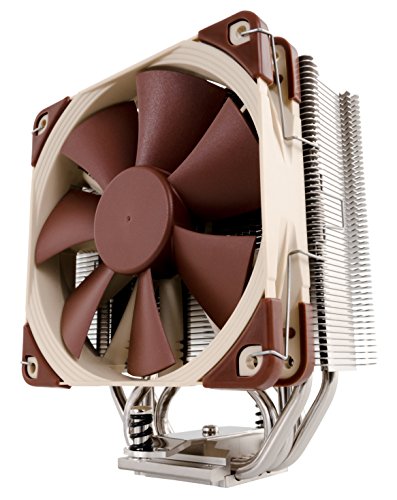
The cooler is worth a paragraph because this is a workload that runs hot for hours, which is different from gaming. A Noctua NH-U12S at around $80 is not there to enable overclocking headroom; it is there so that an 8-core part under sustained all-core load does not spend its life bouncing off a thermal limit with the fan at maximum. On a 24/7 inference host the payoff is twofold: consistent clocks instead of thermally-modulated ones, and a machine quiet enough to keep in a room you occupy. The 5800X in particular is known for running warm under all-core load, and a competent tower cooler is not optional equipment for it. See Best CPU Cooler for the Ryzen 7 5800X for the wider field.
Storage: where a SATA SSD is fine and where it is not
Model weights are large files, and how fast they load off disk is a real quality-of-life factor — but only at load time.
A Kingston A400 960GB SATA SSD will load a multi-gigabyte GGUF noticeably slower than an NVMe drive on the first load. Once the file is in the OS page cache and the weights are in VRAM and RAM, storage is out of the loop entirely and contributes nothing to your tokens per second.
So it matters if you swap between models frequently — a research workflow trying five models in an afternoon feels the difference on every switch. It does not matter if you load one model in the morning and use it all day. Where a SATA drive of this class is the right buy is bulk capacity for a model library, because a collection of quantized models runs to hundreds of gigabytes and cost per gigabyte matters more than sequential read for cold storage. The sensible arrangement is a small NVMe drive for the models you use daily and a larger SATA drive for the library.
Perf per dollar and per watt
At publication, the 5800X sits around $171 to $254 depending on seller and condition, and the i7-9700K around $259. Prices were accurate at publication and may vary — both are used- and surplus-market parts now, and their pricing is unstable.
That pricing is the crux of the recommendation. If you already own a 9700K, the upgrade cost is a 5800X plus an AM4 board, against a throughput gain confined to the partial-offload band and to prefill in particular. That is a defensible purchase for someone doing long-context work daily and a poor one for someone running short chats.
If you are buying a host from scratch, the comparison is not close: the 5800X costs less than the 9700K on the current market, brings twice the threads, and sits on a socket that still offers an upgrade step. Paying more for the dead platform is difficult to justify.
On power, both idle low enough that an always-on host is dominated by the rest of the system — the GPU's idle draw and the display, if one is attached. Neither chip's TDP should decide this.
Verdict matrix
Get the 5800X if… you run 27-32B-class models with layers on the host, your prompts are long, or you are building the machine from scratch. Sixteen threads on prefill is the concrete win, AM4 gives you somewhere to go next, and on the current market it costs less than the Intel part.
Keep the 9700K if… your models fit in VRAM, your prompts are short and conversational, and the machine is a secondary box for occasional jobs. The CPU is not what you are waiting on, and a board-plus-CPU spend buys you very little.
Skip both and buy VRAM instead if… most of your layers are landing on the CPU. Moving to a 16 GB or larger card removes the offload penalty rather than softening it, and that is a categorically different improvement from making the slow path slightly less slow. See RTX 3060 12GB and the 70B offload reality check for what that band actually looks like.
The recommended pick
The Ryzen 7 5800X is the better CPU-offload host, and the reason is narrower than the general "newer is better" argument. Per AMD's specifications it brings SMT and a 32 MB L3 cache to a workload whose two phases stress exactly those things: prefill scales with threads, and a larger last-level cache softens the bandwidth wall that generation runs into. The i7-9700K's eight threads without SMT, per TechPowerUp's review of the part, leave prefill throughput on the table in precisely the long-context case that partial offload already punishes.
The caveat stands: neither chip escapes dual-channel DDR4, so the gain is real but bounded. Buy the 5800X for a new host. Upgrade an existing 9700K only if you have read your offload split and confirmed you are in the band where it matters.
Bottom line
The CPU matters when — and only when — layers spill. Read your offload split first, populate both memory channels, run your memory at its rated speed, and cap your context to what you use. Do those four things and you will have captured most of the available throughput on either chip. After that, the 5800X's extra threads are worth having, mainly on long prompts, and mainly if you are buying rather than upgrading.
Related guides
- CPU Offload for Local LLMs: Ryzen 7 5800X with 12GB of VRAM
- i7-9700K vs Ryzen 7 5800X at 1440p Gaming
- RTX 3060 12GB, 70B Models, and the Offload Quantization Reality
- Ollama vs vLLM vs llama.cpp on a 12GB GPU
- Best CPU Cooler for the Ryzen 7 5800X
Citations and sources
- AMD — Ryzen 7 5800X product page (accessed 2026-08-27)
- TechPowerUp — AMD Ryzen 7 5800X review (accessed 2026-08-27)
- TechPowerUp — Intel Core i7-9700K review (accessed 2026-08-27)
This piece is editorial synthesis based on publicly available information. No independent first-party benchmarking is reported.
— Mike Perry