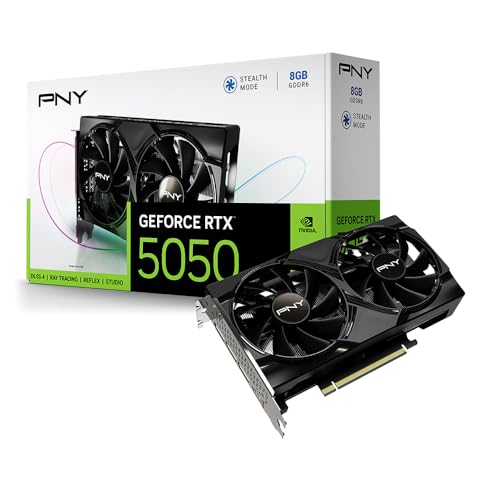
The short answer: no, not uniformly — but the criticism aimed at the RTX 5050 is mostly earned, and it's worth understanding why before writing the card off or buying it on faith. The core complaint isn't that the RTX 5050 is slow in an absolute sense. It's that Nvidia's cheapest Blackwell desktop GPU ships with a smaller core count than the card it replaces, and leans on frame-generation software to make the generational case instead of raw silicon.
What the RTX 5050 actually is
The RTX 5050 uses Nvidia's GB207 die, built on the same Blackwell architecture as the rest of the RTX 50-series. Per specs listed on Nvidia's official RTX 5050 product page and cross-referenced on Wikipedia's GeForce RTX 50-series entry, the card pairs 8GB of GDDR6 memory on a 128-bit bus with DLSS 4, including Multi Frame Generation support carried down from the higher-end 50-series cards.
| Spec | RTX 5050 |
|---|---|
| Architecture | Blackwell (GB207 die) |
| CUDA cores | 2,560 |
| Memory | 8GB GDDR6, 128-bit bus |
| DLSS | DLSS 4 with Multi Frame Generation |
| Segment | Entry-level 1080p |
Street pricing for cards in this tier fluctuates with retailer promotions and regional availability, so treat any specific dollar figure as a snapshot rather than a constant — always check current listings before assuming a price point is accurate today.
Why the RTX 5050 draws so much criticism
The core of the backlash is a generational-regression pattern, not a defect. According to spec pages for the GeForce RTX 40-series, the RTX 4060 it effectively replaces used Nvidia's AD107 die with 3,072 CUDA cores — meaningfully more shader hardware than the RTX 5050's 2,560. That's the same shape of criticism the RTX 4060 itself absorbed at launch, when it arrived with fewer cores than the RTX 3060 it replaced. It's become a recurring pattern at the bottom of Nvidia's stack: each generation's cheapest card tends to trim raw hardware and ask software — namely DLSS frame generation — to do more of the work of making the upgrade feel meaningful.
That's not automatically a bad trade. DLSS 4's Multi Frame Generation genuinely improves perceived smoothness in supported titles. But it's a different kind of improvement than a straight shader-count increase: it doesn't reduce input latency in the same way real frames do, and it only helps in games that implement it. A buyer comparing spec sheets — cores, bus width, memory — will reasonably conclude the RTX 5050 looks like a step sideways or even backward versus its predecessor, and that read isn't wrong on the numbers alone.
For more on how Nvidia's marketing claims interact with real-world driver and BIOS behavior, see the related coverage of Resize BAR support disagreements between motherboard BIOS and Nvidia's own tooling — a good example of the gap between a spec sheet promise and what actually ships to a given board.
RTX 5050 vs. RX 7600: how the spec sheets compare
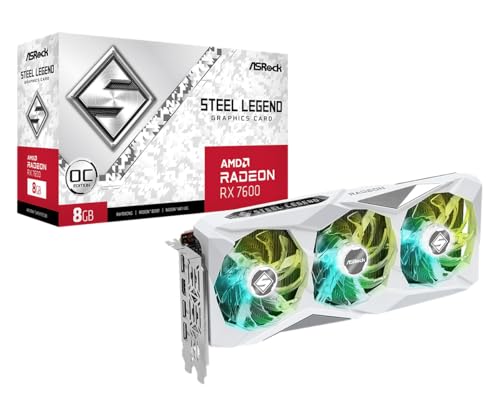
AMD's Radeon RX 7600, per its RX 7000-series specifications, competes directly in this segment: 8GB of GDDR6 on a 128-bit bus, similar to the RTX 5050, built around 2,048 stream processors across 32 compute units.
| Spec | RTX 5050 | RX 7600 |
|---|---|---|
| Cores | 2,560 CUDA cores | 2,048 stream processors |
| Memory | 8GB GDDR6, 128-bit | 8GB GDDR6, 128-bit |
| Upscaling | DLSS 4 + Multi Frame Generation | FSR |
| Segment | Entry 1080p | Entry-to-mid 1080p |
Specific frame-rate deltas between the two cards vary by game, settings, and driver version, and change as both vendors ship driver updates — that's a moving target best checked against current independent benchmark roundups from outlets that publish repeatable, per-title methodology rather than taken from any single source at a point in time. What's stable is the positioning: both cards target 1080p gaming at similar memory capacity, and the real differentiator for most buyers comes down to software ecosystem (DLSS 4 versus FSR, Nvidia's encoder/driver stack versus AMD's) and whatever street price is active at the time of purchase, more than a fixed performance gap.
Where the RTX 5050 genuinely makes sense
The backlash narrative obscures a real use case: anyone upgrading from a GPU several generations old. A build coming from a GTX 10-series or early RTX 20-series card gains a real step up in ray tracing capability, upscaling quality, and encoder features, regardless of how the RTX 5050 compares to its immediate predecessor or AMD's closest competitor. That's the same logic that applies to budget prebuilt math worth scrutinizing — see the breakdown of what an $850 prebuilt's parts are actually worth for how component-level value gets misrepresented in bundled pricing.
It's also a reasonable choice for HTPC and living-room builds where 1080p output and low power draw matter more than benchmark charts — a similar low-footprint philosophy to home-server builds like self-hosting Jellyfin on a Raspberry Pi 4 8GB, even though the hardware classes don't overlap directly.
Where it doesn't make sense
8GB of VRAM is the recurring limiter across this entire price tier, not unique to Nvidia. It's workable for 1080p at medium-to-high settings in most current titles, but it becomes a bottleneck at 1440p, in ray-tracing-heavy titles, or in modern AAA games with aggressive texture streaming. Buyers who want genuine generational headroom — not just parity with last generation plus frame-generation software — are better served either paying up for a higher tier or accepting that the RTX 5050 is a stopgap, not a multi-year investment.
It's also not a serious option for local AI or LLM workloads, where addressable memory matters more than gaming-tuned shader throughput. For that use case, platforms built around larger unified or dedicated memory pools are a better starting point — see the coverage of the Ryzen AI Max+ 395, Strix Halo's integrated graphics gaming benchmarks, and Coral TPU for LLM inference, all of which target the memory-capacity problem the RTX 5050 explicitly doesn't solve. Buyers considering alternative low-power graphics platforms more broadly may also want the breakdown of what the LattePanda Sigma's integrated graphics actually offer for context on where entry-level graphics silicon tops out across form factors.
The verdict
The RTX 5050 isn't a broken product — it's a card whose spec sheet tells a less flattering story than its marketing does. Fewer CUDA cores than its direct predecessor, a memory configuration shared with AMD's cheaper competitor, and a value proposition that leans on DLSS 4 Multi Frame Generation rather than raw hardware gains are all real, checkable facts, not internet pile-on. Whether that adds up to "bad" depends entirely on what a buyer is upgrading from and what they expect a generational refresh to deliver. As a step up from old hardware, it's fine. As a generational leap over the RTX 4060, the spec sheet alone makes clear why so many reviewers pushed back.
Citations and sources
- Nvidia — GeForce RTX 5050 product page
- Wikipedia — GeForce RTX 50 series
- Wikipedia — GeForce RTX 40 series
- Wikipedia — Radeon RX 7000 series
- TechPowerUp — GPU Specs Database
This piece is editorial synthesis based on publicly available information. No independent first-party benchmarking is reported.