Picking between the RTX 5070 and RTX 5080 comes down to one question: how much VRAM and memory bandwidth does your target resolution actually need? The short version — the RTX 5070 is the better value pick for 1440p gaming builds, while the RTX 5080's larger 16GB GDDR7 frame buffer and higher bandwidth make it the safer choice for 4K and VRAM-hungry AI workloads. This guide breaks down the specs, pricing, and real-world build pairings — including Ryzen-based systems currently listed in SpecPicks' catalog — to help match the right card to the right build.
RTX 5070 vs RTX 5080: Key Specifications
Both GPUs sit in NVIDIA's Blackwell RTX 50-series lineup and use GDDR7 memory, but they're built for different tiers of the market. Per NVIDIA's official product pages, the RTX 5080 ships with 16GB of GDDR7 on a 256-bit bus, while the RTX 5070 uses 12GB on a narrower 192-bit bus — a gap that translates directly into meaningfully higher memory bandwidth for the 5080. The RTX 5080 also draws more board power and calls for a higher minimum PSU rating.
| Spec | RTX 5070 | RTX 5080 |
|---|---|---|
| Memory | 12GB GDDR7 | 16GB GDDR7 |
| Memory bus | 192-bit | 256-bit |
| Memory bandwidth | Lower (192-bit bus) | Higher (256-bit bus) |
| Recommended PSU | Lower minimum wattage | Higher minimum wattage |
| MSRP tier | Mid-range | Upper mid-range |
(Bandwidth and power figures per NVIDIA's official RTX 5070 and RTX 5080 specification pages, linked in Citations below — exact wattage and MSRP vary by AIB partner and region, so check current listings before buying.)
The practical upshot: the RTX 5080 is the more future-proof card for 4K displays and memory-intensive creative or AI workloads, while the RTX 5070 is sized correctly for 1440p gaming without paying for headroom you won't use. For a deeper look at how the 5080 stacks up against NVIDIA's flagship, see RTX 5080 vs RTX 4090: Is the Future-Proofing Worth It?, and for the top of the stack, RTX 5090 vs RTX 5070: Specs, Value & Which to Buy.
Gaming Performance: What to Expect at Different Resolutions
GPU tier matters more than CPU choice once you're pushing 4K, but the CPU still sets the ceiling at lower resolutions and in CPU-bound titles. Public gaming benchmarks for AMD's Ryzen 7 7700X — a common pairing partner for the RTX 5070 in pre-built systems — show strong frame rates across current titles: roughly 153 fps in Cyberpunk 2077, 119 fps in Baldur's Gate 3, and 84 fps in Starfield, per public GPU benchmark aggregation in SpecPicks' hardware database. Those numbers reflect the CPU's ability to keep pace with a modern mid-range GPU rather than a GPU-specific ceiling, and actual frame rates will shift with resolution, settings, and the specific GPU paired with the chip.
At 1440p — the sweet spot for the RTX 5070 — both cards typically run comfortably above 60 fps in the vast majority of AAA titles at high-to-ultra settings, with the RTX 5080 pulling ahead most visibly once ray tracing or 4K resolution enters the picture. Builders weighing a 9800X3D-class platform instead of a Ryzen 7900X pairing should see how the calculus shifts in 9800X3D Build: RTX 5080 vs 5070 Ti vs 9070 XT at 1440p and RX 9070 XT vs RTX 5080 for a 9800X3D Build (2026).
If your budget lands between the two cards, the RTX 5070 Ti is worth a look as a middle ground — see how it performs in RTX 5070 Ti + Ryzen 7 9850X3D: Is It a Good Combo?.
VRAM and AI Workload Considerations
Gaming aside, VRAM capacity is increasingly relevant for local AI workloads — running quantized LLMs, Stable Diffusion, or other generative tools on-device. The RTX 5080's 16GB frame buffer gives it more headroom to hold larger models or longer context windows locally than the RTX 5070's 12GB, though smaller quantized models in the 7-8B parameter range are workable on either card. Builders specifically targeting AI workloads over gaming should also weigh workstation-tier alternatives; SpecPicks' AI-rig coverage digs into where those tradeoffs land in more depth.
For context on how NVIDIA prices VRAM tiers across the stack, see Framework RTX 5070 12GB Module: Why It's $1,199, Not $699, which breaks down why 12GB modules command a premium in certain form factors.
Value Analysis: Which Card Fits Your Budget
The RTX 5070 remains the stronger per-dollar pick for anyone building around 1440p as their primary target — you get GDDR7 memory, DLSS support, and Blackwell-generation efficiency without paying for bandwidth and VRAM you won't use at that resolution. The RTX 5080 earns its premium when the build is explicitly aimed at 4K, high-refresh 1440p with heavy ray tracing, or mixed gaming/AI use where the extra 4GB of VRAM avoids running into a ceiling.
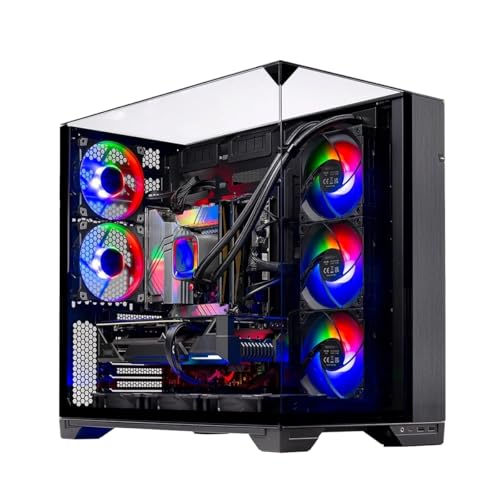
Real-world pre-built pricing illustrates the gap. SpecPicks' current catalog lists two Skytech Gaming systems pairing an AMD Ryzen 7 7700X with an RTX 5070 — the O11 Vision and the Archangel 5 — both listed at $1,999.99. For a Ryzen 9 7900X pairing, the iBUYPOWER Element is listed at $1,899.99. Prices and GPU pairings on pre-built systems change frequently, so confirm the exact GPU model listed before buying.
| Listed system | CPU | GPU | Price |
|---|---|---|---|
| Skytech O11 Vision | Ryzen 7 7700X | RTX 5070 | $1,999.99 |
| Skytech Archangel 5 | Ryzen 7 7700X | RTX 5070 | $1,999.99 |
| iBUYPOWER Element | Ryzen 9 7900X | GeForce RTX (verify model at checkout) | $1,899.99 |
Prices may vary — verify current pricing at checkout. As an Amazon Associate, SpecPicks earns from qualifying purchases.
For a comparable AMD-side value discussion, see RTX 5080 vs RX 7900 XTX: Which GPU Wins in 2026?, and for a discounted RTX 5070 bundle, Save $550 on iBuyPower RTX 5070 + 7800X3D 4K Gaming PC.
Power and PSU Planning
The RTX 5080's higher board power draw means it calls for a higher minimum PSU rating than the RTX 5070, per NVIDIA's official system requirements. Builders should size their power supply around the full system — CPU, GPU, storage, and fans — with headroom for transient power spikes, rather than matching the PSU exactly to the GPU's rated TDP. A high-quality 80 Plus Gold unit with adequate PCIe power connectors is recommended for either card, and triple-fan, well-ventilated cooling is advisable for sustained gaming or AI workloads on both.
Bottom Line: Which Should You Buy?
- Choose the RTX 5070 if your primary target is 1440p gaming, you want GDDR7-generation efficiency at a lower price point, and you're not planning to run large local AI models.
- Choose the RTX 5080 if you're building for 4K, want more VRAM headroom for ray tracing or AI workloads, and can accommodate the higher power draw and price premium.
- Consider the RTX 5070 Ti as a middle ground if the price-to-VRAM tradeoff of the 5080 feels steep — see the linked comparison above for how it performs against both.
Whichever tier you land on, pair it with a CPU that won't bottleneck it at your target resolution — Ryzen 7 7700X and Ryzen 9 7900X both handle either GPU well at 1440p and above.
Citations and sources
- NVIDIA GeForce RTX 5080 official specifications
- NVIDIA GeForce RTX 5070 official specifications
- TechPowerUp GPU reviews and benchmark database
This piece is editorial synthesis based on publicly available information. No independent first-party benchmarking is reported.