The latest generation of NVIDIA AI server racks uses glycol-based cooling fluid — the same class of compound found in hot tubs, food processing equipment, and residential hydronic heating systems — to handle thermal loads that would overwhelm conventional data center cooling architecture. More significantly, the approach eliminates the evaporator coils and refrigeration condensers that have defined enterprise liquid cooling for decades.
This is a meaningful infrastructure shift for anyone working at the intersection of high-density compute and data center design, from hyperscale operators to homelab builders trying to understand what AI hardware actually demands.
What "Hot Tub Coolant" Actually Means
The shorthand is accurate, if reductive. Hot tubs typically circulate water mixed with propylene glycol or ethylene glycol to prevent freezing, control pH, and inhibit biological growth. Data center engineers have used glycol-water mixtures in cooling distribution units (CDUs) for years — but NVIDIA's current approach, particularly as deployed in high-density racks like the GB200 NVL72, brings glycol-based coolant into direct contact with server infrastructure at a scale and thermal density that changes the calculus for cooling plant design.
Traditional enterprise liquid cooling works like a home air conditioner in reverse: hot water from the servers flows into a chiller, a refrigerant loop extracts heat, and the refrigerant discharges that heat through an evaporator or condenser coil. This requires compressors, refrigerant handling, and certified HVAC technicians for maintenance — all significant operational overhead.
Glycol-based direct liquid cooling (DLC) works differently. The glycol-water mixture flows through cold plates mounted directly on GPU dies and other high-TDP components. Because modern AI accelerators can tolerate coolant inlet temperatures well above what refrigerant-cooled systems deliver, the warm glycol can be rejected through dry coolers or fluid coolers without active refrigeration. No compressors. No evaporator coils. No refrigerant certifications required for the maintenance team.
Per NVIDIA's infrastructure documentation for GB200-class deployments, the racks are designed for facility-side liquid supply, with glycol-water as the recommended coolant medium for most installations. Third-party data center operators documenting their deployments in public engineering forums confirm that the architecture bypasses the chiller plant entirely when ambient conditions allow — a regime known as "free cooling" that becomes far more achievable when coolant rejection temperatures are elevated.
Why Evaporators Are Being Left Behind
An evaporator's role in conventional liquid cooling is to drop coolant temperature below ambient — necessary when servers require supply water in a range that outdoor air cannot achieve without active refrigeration. When servers can accept significantly warmer supply water, that same heat rejection can happen through a simple heat exchanger exposed to outdoor air, even in moderate climates for substantial portions of the year.
NVIDIA's GB200 NVL72 rack — housing 72 Blackwell GPUs across 36 nodes — produces thermal loads that make traditional air cooling physically impossible at reasonable rack density. The engineering response is not just liquid cooling: it is liquid cooling optimized for high supply-water temperatures, which is precisely where glycol-water mixtures become the fluid of choice for their corrosion inhibition, biocide properties, and freeze protection.
The elimination of evaporators carries several practical consequences that data center engineers and industry analysts have highlighted in public commentary:
- Reduced mechanical complexity: Removing refrigerant loops eliminates compressors, expansion valves, and refrigerant charge as maintenance concerns, reducing the number of active mechanical failure points.
- Different maintenance profile: Glycol-water systems are maintained with chemistry checks and fluid top-offs — a task familiar to anyone servicing hydronic heating, pool equipment, or automotive cooling — rather than requiring refrigerant-certified HVAC technicians.
- Expanded deployment options: Facilities without existing chiller plants can potentially support high-density AI racks using only fluid coolers, widening where dense AI compute can be cost-effectively located.
- Free cooling hours: By accepting higher coolant supply temperatures, the system can reject heat without active refrigeration for more hours per year and across more geographies, reducing total cooling system energy consumption.
No vendor-specific efficiency figures from NVIDIA's published materials or third-party audits are reproduced here — facility-specific results vary significantly by climate, building design, and workload — but the thermodynamic logic is well-established in data center engineering literature, including the Uptime Institute's annual global data center survey and the Green Grid's PUE framework.
The Chemistry Parallel: What Hot Tubs and AI Servers Share
Propylene glycol (PG) is non-toxic, approved for food and pharmaceutical contact, and widely used in hot tubs because it is safe for incidental human exposure and effective at preventing biological growth and corrosion. Ethylene glycol (EG) is more common in automotive and industrial cooling but is toxic. Data center CDU manufacturers have long offered PG solutions for installations where toxicity or regulatory concerns arise.
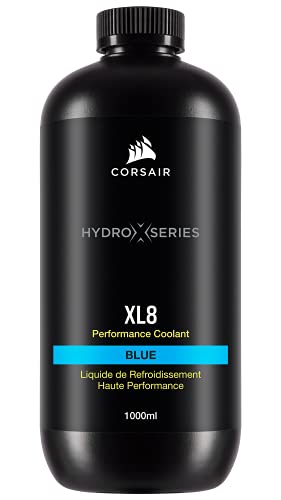
For homelab and maker builders exploring liquid cooling at smaller scale, this same chemistry is accessible and well-understood. The CORSAIR Hydro X Series XL8 Performance Coolant in Translucent Purple ($19.99/L) uses a glycol-based formulation with corrosion inhibitors and biocides comparable in function to what industrial CDUs circulate. The difference is one of scale: a high-density AI rack requires hundreds of liters of glycol solution; a custom PC loop uses one or two.
Other XL8 variants — Translucent Red ($24.99), Translucent Blue ($24.99), and Clear ($16.99) — use the same underlying chemistry. This parallel is more than cosmetic. The engineering principles at work — coolant temperature management, corrosion inhibition, flow rate optimization, and heat rejection without active refrigeration — translate directly from small-form-factor custom loops to data center infrastructure. Understanding how a glycol-based PC loop manages heat exchange provides the conceptual foundation for understanding what NVIDIA has scaled to rack level.
Comparing Cooling Architectures
| Factor | Glycol DLC (NVIDIA approach) | Chilled Water / Evaporative |
|---|---|---|
| Supply water temperature | Higher inlet temps acceptable | Lower temps typically required |
| Evaporator / chiller | Not required when free cooling viable | Required for most deployments |
| Coolant type | Glycol-water, PG options available | Chilled water or refrigerant |
| Maintenance trades | Fluid chemistry; no refrigerant cert | Refrigerant-certified HVAC |
| Rack density support | Designed for multi-kW/U AI loads | Constrained by air handling capacity |
| Infrastructure complexity | Lower (fewer active components) | Higher (chiller plant, controls, refrigerant) |
| Free cooling eligibility | Broader (higher rejection temps) | Narrower (low supply temps required) |
The table reflects general engineering characteristics of the two approaches, not vendor-published performance claims for specific deployments.
Implications for AI Data Center Design
The shift matters beyond the immediate NVIDIA product line. It signals a broader recalibration of what data center cooling infrastructure must support.
Facility Requirements Are Changing
Hyperscale operators building for next-generation AI clusters are working through specifications that assume high-temperature liquid cooling infrastructure, not chilled water plants. Per the ASHRAE TC 9.9 thermal guidelines, which define thermal envelopes for IT equipment, the trend toward higher-class server operating temperatures has been building for years. AI accelerators are accelerating it.
For new builds, this changes civil and mechanical engineering scopes: smaller mechanical rooms, different pipe sizing, and potentially significantly reduced structural load from chiller equipment — which can weigh tens of thousands of kilograms in large installations.
Co-location Market Dynamics
Co-location providers with existing chilled water infrastructure face a counterintuitive challenge: their cooling plant may over-cool for what NVIDIA's AI gear actually requires. Some operators are evaluating whether to raise supply water temperatures when serving AI tenants — reducing chiller energy consumption — while adding fluid coolers to handle heat rejection when free cooling conditions are met.
What This Means for Energy Efficiency
Free cooling (rejecting heat without active refrigeration) dramatically reduces the energy consumed by cooling systems relative to total IT load. The Green Grid's PUE metric captures this relationship: a data center running entirely on free cooling approaches a PUE of 1.0 for the cooling component. Eliminating or reducing chiller runtime — which glycol-based high-temperature cooling enables — addresses one of the largest remaining PUE drivers in modern facilities. Industry analysis consistently identifies chiller plants as among the highest-energy systems in conventional data center design.
What Makers and Homelab Builders Can Take From This
The trajectory of AI server cooling is a preview of where high-performance computing goes when thermal density outpaces air. For the maker community, the relevant takeaways are durable:
Glycol chemistry is accessible and well-understood. The same corrosion-inhibiting, biocide-treated glycol solutions that data center CDUs circulate are available at consumer scale. For custom liquid-cooled builds pushing high-TDP components, the CORSAIR Hydro X XL8 Green coolant and its siblings provide comparable chemistry to industrial formulations.
Higher coolant temperatures can be more efficient. The instinct in consumer liquid cooling is to maximize flow and minimize coolant temperature. Data center engineering demonstrates that running warmer coolant — and sizing radiators accordingly — can be more energy-efficient than chasing low temperatures with active refrigeration. Radiator surface area is cheaper than compressor energy at scale.
Eliminating active refrigeration is achievable. In appropriate climates, a well-designed glycol loop can reject heat through a simple radiator without a compressor. Homelab operators in cooler climates have been experimenting with passively-rejected loops for years. NVIDIA's approach validates this direction at data center scale.
For a broader look at how on-device AI hardware demands are evolving at the consumer tier, the Microsoft + NVIDIA Agent PC local hardware guide covers what's needed to run AI inference workloads locally — a useful complement to understanding what cloud-side infrastructure supports at scale.
More detail on NVIDIA's liquid cooling announcement is in the SpecPicks overview of the hot tub coolant rollout. For makers approaching compute from the opposite end of the power envelope, the Raspberry Pi 4 8GB homelab deep dive for 2026 covers thermal management and performance at low-wattage SBC scale — a useful contrast to the multi-hundred-kilowatt AI rack context.
Frequently Asked Questions
Is NVIDIA actually using hot tub chemicals in AI servers?
Functionally, yes. Propylene glycol — the compound used in hot tubs for freeze protection, corrosion control, and biological management — is one of the glycol types specified for data center direct liquid cooling systems compatible with NVIDIA's high-density rack infrastructure. The chemistry is the same class of compound; the scale and engineering context are vastly different.
Why does eliminating evaporators matter for AI data centers?
Evaporators and chillers are the most mechanically complex and energy-intensive components of conventional liquid cooling plants. High-temperature glycol-based cooling allows heat to be rejected through simpler dry coolers or fluid coolers without active refrigeration, reducing infrastructure complexity, maintenance requirements, and the energy consumed by cooling systems — one of the largest remaining efficiency levers in data center design.
Can homelab builders replicate NVIDIA's cooling approach at small scale?
At consumer scale, yes in principle. Custom PC liquid cooling loops using glycol-based coolants and quality radiators follow the same thermodynamic logic. True free cooling is harder in a standard room but achievable with large radiators and adequate ambient airflow in cooler climates.
How does glycol DLC compare to immersion cooling?
Both eliminate air as the primary cooling medium. Immersion cooling submerges hardware in dielectric fluid; glycol DLC circulates coolant through cold plates mounted on components. Cold-plate DLC is generally preferred for standard server form factors because it requires less hardware modification and is compatible with conventional chassis designs without full liquid submersion.
What maintenance does a glycol-based cooling system require?
Glycol systems require periodic chemistry testing (pH, concentration, inhibitor levels) and scheduled fluid replacement — simpler than refrigerant-based systems, which require licensed HVAC technicians for refrigerant handling. Consumer coolants like CORSAIR's Hydro X XL8 specify replacement intervals of 12–24 months depending on operating conditions.
Does this approach work in all climates?
Free cooling is most viable in cooler climates or cooler seasons. Data centers in warm climates still need some active cooling during peak ambient periods. NVIDIA's approach expands the hours and geographies where free cooling is viable by raising the acceptable coolant supply temperature, but it does not eliminate all active cooling plant requirements everywhere.
Citations and sources
- NVIDIA GB200 NVL72 Product Page — rack architecture and liquid cooling specifications
- The Green Grid — PUE framework and data center cooling efficiency metrics
- Uptime Institute Global Data Center Survey — industry data center cooling trend analysis
- ASHRAE TC 9.9 Thermal Guidelines for Data Communications Equipment — IT equipment thermal envelope standards for liquid cooling
This piece is editorial synthesis based on publicly available information. No independent first-party benchmarking is reported.