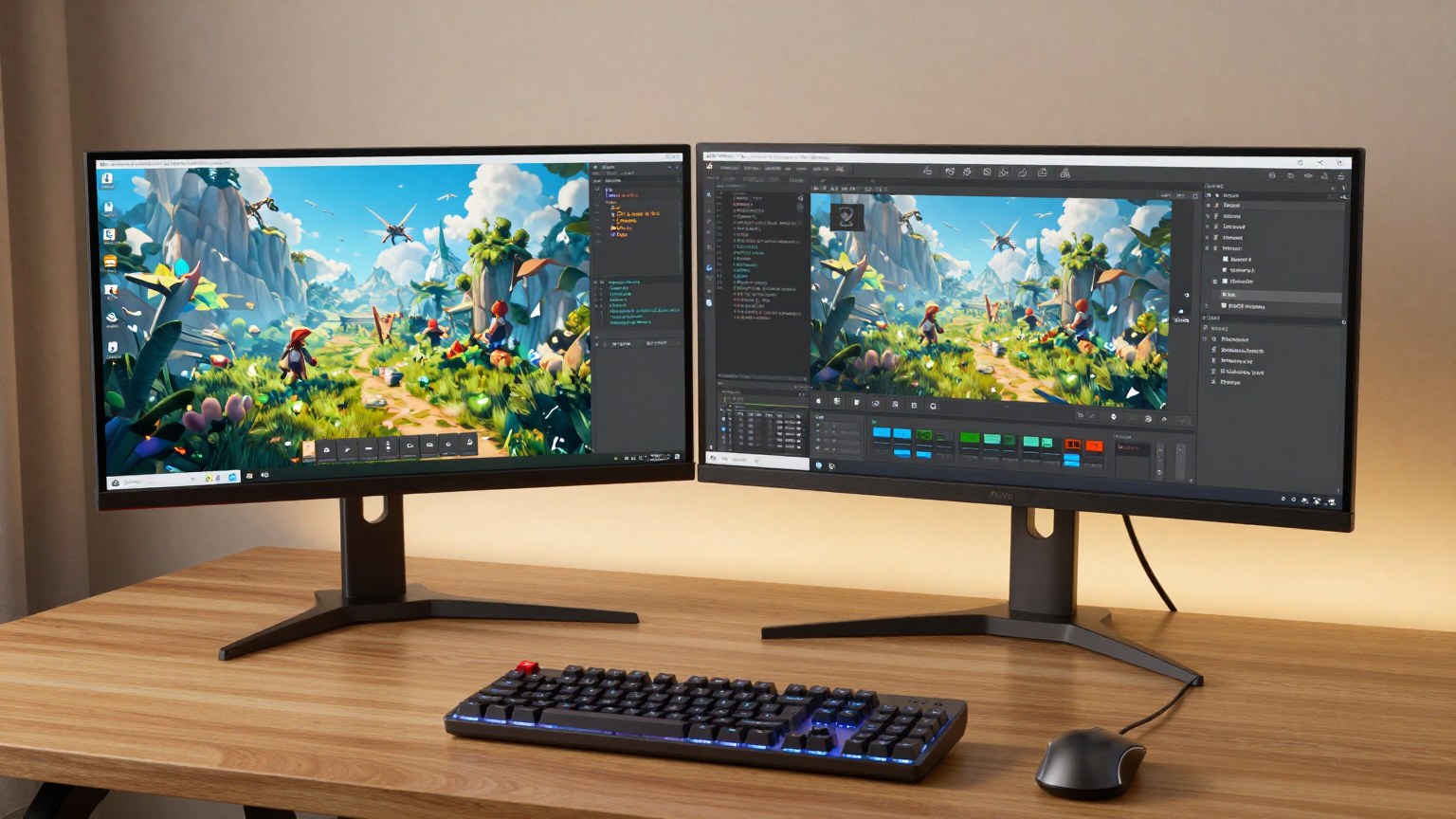
For most desks, the Prime Big Deal Days monitor to buy is the Samsung 27" Odyssey 4K UHD. Its Amazon listing specifies 3840x2160 at 144Hz on a Fast IPS panel. Amazon lists the event as October 6–7, 2026. Prices will change during those two days, so check the live price on the listing before you buy.
As an Amazon Associate, SpecPicks earns from qualifying purchases. See our review methodology.
Introduction
Prime Big Deal Days 2026 runs October 6–7, 2026, starting at 12:01 a.m. PT on the 6th, per About Amazon's announcement. It's the second big Amazon sale of the year and the last one before Black Friday, which falls on November 27, 2026.
Monitors are one of the easier things to shop during a sale, because the specs that matter are fixed and published. Resolution, refresh rate, panel type and ports don't change between listings, and you can check them against a manufacturer page before you click buy. What changes is the price, and that is where most buyers get caught out.
This guide is for two groups. The first is gamers moving up to 1440p or 4K. They need a panel their GPU can drive, and a common mistake is buying a 4K 144Hz screen for a card that can't come close to 144 fps at 4K. The second is people who spend the day in a terminal, an editor and a browser, including anyone running local LLMs or coding assistants. For that work, screen area matters more than refresh rate, and a 21:9 ultrawide often beats two small screens.
The guide is also clear about who should wait. If you want an OLED panel or a 4K 240Hz monitor, or you find the live price sits at or above the launch price, waiting for Black Friday is reasonable. There's a section on that below.
These five picks come from the SpecPicks monitor catalog. Each one was chosen on its published specs, what reviewers and owners report, and how well it fits a particular desk. No first-party testing is reported here. Every spec links to where it came from.
In short: the Samsung Odyssey 4K is the Best Overall pick for a mixed gaming-and-work desk. The KOORUI 27" 4K Dual Mode is the Best Value, because it covers both 4K detail and 320Hz esports in one panel. The LG 34WN80C is the pick for AI and coding desks. The ASUS TUF VG32VQ1B is the 1440p gaming pick, and the KOORUI G2721P is the cheapest way to get 1440p at high refresh.
Step 0 — Which tier do you actually need?
Work out what your GPU can drive and what you'll do at the desk before you look at prices. A monitor that outruns your graphics card doesn't hurt anything, but you pay for refresh rate you won't see.
| Your setup | Match it with | Why |
|---|---|---|
| RTX 3060 12GB / RTX 4060 / RX 7600-class GPU, mostly gaming | 1440p at 165–200Hz | This class of card suits 1440p better than 4K in modern games. High refresh at 1440p is reachable in esports titles |
| RTX 4070-class and up, mixed gaming and work | 4K at 144Hz+ | 4K needs roughly 2.25x the pixels of 1440p. A faster GPU is what makes a 4K high-refresh panel worth it |
| Competitive shooters above all else | Dual-mode 4K/1080p or a 1080p 240Hz+ panel | You get the highest frame rate at the lowest resolution |
| Coding, local-LLM dashboards, spreadsheets | 34" 21:9 at 3440x1440 | You can fit three windows side by side without a bezel down the middle |
| Laptop-first desk | Any panel with USB-C DisplayPort Alt Mode and power delivery | One cable carries video, data and charging |
The 2.25x figure is just arithmetic: 3840×2160 is 8.29 million pixels and 2560×1440 is 3.69 million. If your card is more than two years old, a 1440p panel is usually the better choice. Browse the whole shortlist in Gaming Monitors. If the GPU is also due for an upgrade, see the GPU category or the companion Prime Big Deal Days GPU guide.
The five picks at a glance
| Pick | Best For | Key Spec (panel, resolution, refresh) | Price tier | Verdict |
|---|---|---|---|---|
| Samsung 27" Odyssey 4K UHD | Mixed gaming and work desks | Fast IPS, 3840x2160, 144Hz | Mid-to-upper | Best Overall |
| KOORUI 27" 4K Dual Mode G2741L | Single-player 4K plus esports | Fast IPS, 3840x2160 at 160Hz or 1920x1080 at 320Hz | Mid | Best Value |
| LG 34WN80C-B 34" UltraWide | AI workstation and coding desks | Curved IPS, 3440x1440 21:9, 60Hz | Mid-to-upper | Best for Work |
| ASUS TUF Gaming VG32VQ1B | 1440p gaming on a 32" curve | Curved VA, 2560x1440, 165Hz | Mid | Best 1440p Performance |
| KOORUI 27" G2721P | Cheapest 1440p high refresh | Fast IPS, 2560x1440, 200Hz | Budget (under $200 class) | Budget Pick |
Specs come from each monitor's manufacturer page or Amazon listing: KOORUI's G2741L launch announcement, LG's 34WN80C-B product page, ASUS's TUF Gaming VG32VQ1B page and KOORUI's G2721P product page. This table shows price tiers, not deal prices. The live price box on each product page is the number to trust during the event.
How to tell a real deal from a fake one
Most "deals" during a big sale event are real in a narrow sense: the price shown is lower than some other number on the page. What matters is which number.
The strikethrough list price trap. The trap buyers miss most is list-price inflation. An Amazon listing can show a crossed-out "List Price" or "Typical Price" that is well above what the monitor has actually sold for over the past few months. A "35% off" badge measured against an inflated list price might be a normal Tuesday price. Don't anchor on the strikethrough.
Use two anchors instead.
- Launch MSRP. This is the price the manufacturer set at launch, and it doesn't move. For example, KOORUI announced the G2741L on September 18, 2025, at a $499 launch price. An event price well under that is a real discount. An event price near it isn't.
- Recent price history. Look at what the listing has charged for most of the last 60–90 days. If the Prime price only matches the low point from a few weeks ago, the deal is ordinary.
Why SpecPicks doesn't quote deal prices. Monitor prices change several times a day during the event, and Amazon releases Lightning Deals in waves. A price written into this article on September 30 would be wrong by the morning of October 6. Each pick links to a product page with a live price and a last-checked time. Use that number, and compare it against the two anchors above.
Other traps to watch for:
- Model-number swaps. Monitor makers reuse names. Samsung alone sells several "Odyssey" 27-inch models in QHD and 4K and in IPS and OLED. Check the resolution and refresh rate on the listing you're actually buying, not the model you think it is.
- Third-party sellers. A deal price from a marketplace seller with thin history is not the same as one sold and shipped by Amazon. Return windows and warranty handling differ.
- Refurbished or renewed listings sometimes sit next to new ones in deal feeds. The condition is in the listing title. Read it.
🏆 Best Overall: Samsung 27" Odyssey 4K UHD
Spec chips: 27" · Fast IPS · 3840x2160 · 144Hz · 1ms · HDR400 · G-Sync Compatible · FreeSync Premium · adjustable stand
Pros
- 4K on a 27-inch panel works out to about 163 pixels per inch, which makes text sharp for coding and documents
- 144Hz with G-Sync Compatible and FreeSync Premium covers both NVIDIA and AMD GPUs
- Fast IPS gives wider viewing angles than VA, and color stays consistent across the screen
- The adjustable stand saves you buying a monitor arm on day one
Cons
- HDR400 is entry-level HDR. With edge-lit dimming it won't match OLED or mini-LED HDR
- Driving 4K at 144 fps in modern games takes an RTX 4070-class GPU or faster
- Samsung sells several similarly named Odyssey 27" models, so confirm the listing says 4K UHD and 144Hz
This is the pick for a desk that does a bit of everything. The Amazon listing specifies 3840x2160 at 144Hz with a 1ms Fast IPS panel, HDR400, and support for both G-Sync Compatible and FreeSync Premium. That combination covers most buyers. The pixel density is high enough that 4K reads clearly at 150% Windows scaling, and 144Hz is fast enough that games and scrolling feel smooth on any modern GPU.
The trade-off is the GPU. At 4K, a mid-range card runs demanding games well below 144 fps. VRR helps here: G-Sync Compatible and FreeSync Premium hide tearing as frame rates move around. For many people 4K at 60–90 fps with VRR looks better than 1440p at 144 fps in single-player games. If you mostly play competitive shooters, though, the higher refresh rates further down this list are worth more.
Right when: you have an RTX 4070-class card or better, or you split time between gaming and text-heavy work, and you want one 27-inch screen that does both well.
Not worth it when: your GPU is RTX 3060-class and gaming is the main use. In that case, get the ASUS or KOORUI 1440p pick and put the savings toward a GPU.
View Current Price on Amazon · See Full Details →
💰 Best Value: KOORUI 27" 4K Dual Mode (G2741L)
Spec chips: 27" · Fast IPS · 4K UHD @ 160Hz or FHD @ 320Hz · 1ms · DisplayHDR 400 · HDMI 2.1 · DP 1.4 · height/pivot/tilt stand
Pros
- Dual mode lets one panel act as a 4K 160Hz screen or a 1080p 320Hz esports screen
- HDMI 2.1 supports 4K at 120Hz from a PS5 or Xbox Series X
- Launched at a $499 MSRP, a clear anchor for judging event pricing
- The stand includes height, tilt and 90° pivot
Cons
- KOORUI's support and warranty network is smaller than Samsung's, LG's or ASUS's
- 1080p on a 27-inch panel looks soft for desktop work. Treat 320Hz mode as a game-only setting
- HDR400 is entry-level HDR, the same limit as the Samsung
Dual mode is the reason to buy this monitor. According to KOORUI's launch announcement, the G2741L switches between 4K UHD at 160Hz and 1080p Full HD at 320Hz. It also uses a Fast IPS panel with 90% DCI-P3 coverage and VESA DisplayHDR 400, and has HDMI 2.1 and DisplayPort 1.4 ports. It launched on September 18, 2025, at $499.
In practice, you run 4K at 160Hz for single-player games, work and video. When you open a competitive shooter, you switch to 1080p at 320Hz, where even a mid-range GPU can push very high frame rates. This is a real help for RTX 3060- and 4060-class owners. The 4K mode gives them a sharp desktop, and the 1080p mode gives them a refresh rate their card can reach.
Brand support is the honest drawback. KOORUI is a value brand. Owners dealing with warranty claims won't find the same service footprint as the big three display makers. Buy it from a seller with a clean return policy, and check for dead pixels or backlight bleed within the return window.
Right when: you want 4K sharpness and esports-level refresh in one screen, or you share the monitor between a PC and a current-generation console.
Not worth it when: you want the strongest after-sales support, or the event price sits near the $499 launch MSRP.
View Current Price on Amazon · See Full Details →
🎯 Best for AI Workstation and Coding Desks: LG 34WN80C-B 34" UltraWide
Spec chips: 34" curved · IPS · 3440x1440 (21:9) · sRGB 99% · USB-C with 60W power delivery · HDR10 · height/tilt stand
Pros
- 3440x1440 gives you about 34% more pixels than a 2560x1440 panel, all on one continuous surface
- One USB-C cable carries video to a laptop and charges it at up to 60W, per LG
- Covers up to 99% of sRGB, which suits photo and document work
- Height and tilt adjust on the included stand
Cons
- 60Hz and no FreeSync, per DisplayNinja's review. This is not a gaming panel
- LG now lists the model as discontinued, so stock during the event may be limited or from third parties
- 60W power delivery won't keep a high-power gaming laptop charged under load
The case for a 21:9 ultrawide on a work desk is about layout. At 3440x1440, you can put a terminal, a code editor and a browser or model dashboard side by side, each one as wide as a typical laptop screen. There's no bezel down the middle like there is with two monitors, and one cable does it all. LG's product page lists 3440x1440 IPS, up to 99% sRGB, HDR10 and USB-C with 60W power delivery. DisplayNinja adds DisplayPort 1.4, two HDMI 2.0 ports, two USB 3.0 downstream ports and about 300 nits of brightness.
For local-LLM work in particular, the extra width helps with a common setup: an inference server log or nvtop in one pane, a chat UI or notebook in the middle, and documentation on the right. You can see GPU memory use, token output and your code at the same time without switching windows.
The downside is refresh rate. DisplayNinja notes a 60Hz ceiling with no FreeSync support. Games will play, but motion won't look like it does on the 144Hz+ panels above. LG also lists this model as discontinued. If the event listing comes from a third-party seller, check the condition and return terms carefully.
Right when: the desk is mostly for work, you plug in a laptop every day, and you want one wide screen instead of two.
Not worth it when: gaming is a main use. For that, a 1440p 165Hz+ panel or a high-refresh ultrawide is the better buy.
View Current Price on Amazon · See Full Details →
⚡ Best Performance for 1440p Gaming: ASUS TUF Gaming VG32VQ1B
Spec chips: 31.5" · 1500R curve · 2560x1440 · 165Hz · 1ms MPRT (ELMB) · FreeSync Premium · HDR10 · DP 1.2 · HDMI 2.0
Pros
- 1440p at 165Hz suits RTX 3060- and 4060-class GPUs
- The 31.5-inch 1500R curve feels immersive at a normal desk distance
- ASUS's Extreme Low Motion Blur (ELMB) targets 1ms MPRT for motion clarity
- VA panels usually have higher contrast than IPS, which helps dark scenes
Cons
- Owners report dark-scene smearing, a common VA trait, in the Overclock.net owner thread
- DisplayPort 1.2 and HDMI 2.0 are older ports. There's no HDMI 2.1 for 4K 120Hz console output
- 1440p stretched across 31.5 inches is less sharp than 1440p on 27 inches
1440p at high refresh is the best match for most mid-range GPUs, and this is the large-screen version. ASUS's product page lists a 31.5-inch WQHD (2560x1440) panel with a 1500R curve, 165Hz, 1ms MPRT through ELMB, FreeSync Premium and HDR10, with DisplayPort 1.2 and HDMI 2.0 inputs. At 1440p, an RTX 3060 12GB or RTX 4060 can get most esports titles into triple-digit frame rates, so you'll actually use 165Hz.
The honest caveat is the panel type. VA panels trade response time for contrast, and owners in the Overclock.net thread describe smearing in dark, fast-moving scenes. Some owners in that thread report that adjusting the overdrive and gamma settings reduces it. If you play dark competitive shooters, a Fast IPS panel like the KOORUI G2721P will look cleaner in motion.
Right when: you have an RTX 3060/4060-class card, want a bigger curved screen for single-player and mixed gaming, and value deep blacks.
Not worth it when: you plan to connect a PS5 or Xbox Series X for 4K 120Hz (no HDMI 2.1), or you're sensitive to VA smearing.
View Current Price on Amazon · See Full Details →
🧪 Budget Pick: KOORUI 27" 1440p 200Hz Fast IPS (G2721P)
Spec chips: 27" · Fast IPS · 2560x1440 · 200Hz · 1ms · HDR400 · 95% DCI-P3 · FreeSync/G-Sync compatible · 3-year warranty
Pros
- The lowest-cost route in this guide to 1440p above 144Hz
- Fast IPS avoids the dark smearing that VA panels show
- KOORUI lists 95% DCI-P3 and 100% sRGB coverage
- KOORUI's product page lists a 3-year warranty
Cons
- HDR400 at 350 nits isn't real HDR. Turn it off and treat this as an SDR monitor
- The stand only tilts. For height adjustment, plan on a VESA arm (75x75mm)
- 1000:1 contrast is typical IPS, so blacks look gray in a dark room
KOORUI's G2721P product page lists a 27-inch QHD Fast IPS panel at 200Hz with 1ms response, 350 nits, HDR400, 1000:1 contrast, 95% DCI-P3 and a tilt-only stand with a 75x75mm VESA mount. For a first high-refresh 1440p monitor on an RTX 3060- or RX 7600-class GPU, that's everything that matters, and nothing you'll never use.
Be clear about the HDR400 badge. At 350 nits with no local dimming, HDR content looks washed out rather than bright. That's true of almost every monitor at this tier, not just KOORUI. Buy it as a sharp, fast SDR panel and you won't be disappointed.
Right when: your budget is tight, you want 1440p high refresh on a mid-range GPU, or you're adding a second screen next to a main monitor.
Not worth it when: you want height adjustment out of the box, or you'll mostly watch HDR movies.
View Current Price on Amazon · See Full Details →
Who should wait for Black Friday (November 27, 2026)?
Prime Big Deal Days is a good time to buy mainstream monitors, but it's not the right time for everyone. Wait until Black Friday on November 27, 2026 if any of these apply:
- You want OLED or 4K 240Hz. Premium panel classes are where the biggest holiday discounts usually land. If your wish list is a QD-OLED or a 4K 240Hz screen, the six-week wait is worth it.
- The live price sits at or above launch MSRP. If the event price for a pick doesn't beat its launch price (for example, $499 for the KOORUI G2741L), it's not a discount. Wait.
- Your GPU can't drive the panel yet. If you're buying a 4K 144Hz monitor ahead of a GPU upgrade, buy the GPU first. Monitors don't age much in six weeks, but mismatched hardware does cost you.
- You need a model that's short on stock. Discontinued models like the LG 34WN80C can have thin stock during events. Don't settle for a poor third-party listing just because it's Prime week.
If none of these apply and the live price clears the anchors above, buying in October gets you the monitor six weeks earlier, often at a similar price.
What to look for in a monitor during a deal event
Resolution vs your GPU tier
Resolution sets how hard your GPU has to work. 1440p is the sweet spot for mid-range cards. 4K is best with a high-end card, or on a desk that's mostly for work, where sharp text matters more than frame rate. A dual-mode panel like the KOORUI G2741L gets around the choice by offering both.
Refresh rate and VRR (FreeSync / G-Sync Compatible)
A higher refresh rate only helps if your GPU can reach it. Variable refresh rate (VRR) matters more than the peak number, because it removes tearing and stutter as frame rates rise and fall. Every gaming pick here supports FreeSync, and the Samsung and both KOORUIs also list G-Sync Compatible. The LG does not support FreeSync, per DisplayNinja.
Panel type: IPS vs VA vs QD
- IPS / Fast IPS: good color and viewing angles, quick response, and typical contrast around 1000:1. Four of the five picks use IPS.
- VA: higher contrast and deeper blacks, but slower dark transitions that can show as smearing. The ASUS TUF VG32VQ1B is VA.
- QD-OLED / OLED: true blacks and very fast response, at a premium price, with burn-in considerations for static desktop work. This is the class to wait on until Black Friday.
Ports: DP 1.4, HDMI 2.1, USB-C
A PC should use DisplayPort. DP 1.4 carries 4K at high refresh with Display Stream Compression. Consoles need HDMI 2.1 for 4K at 120Hz, and only the KOORUI G2741L in this guide lists it. Laptop users should look for USB-C with DisplayPort Alt Mode and power delivery, like the LG 34WN80C's 60W port, so that one cable handles video and charging.
Screen area for multi-window AI and coding work
For AI and coding, count usable windows rather than inches. A 27-inch 4K panel at 150% scaling gives you about the same workspace as a 2560x1440 panel, with sharper text. A 34-inch 3440x1440 ultrawide fits three full-height windows side by side. If you run a local model server, an editor and a browser all day, the ultrawide is the more productive layout. If you mostly read and write code in one editor, the 27-inch 4K is sharper.
Common pitfalls
- Buying 4K 144Hz for a 1080p-class GPU. The monitor works, but you'll run games at lower resolution or low frame rates. Match the tier using Step 0.
- Using HDMI on a PC. Many budget panels only reach their full refresh rate over DisplayPort. If you're stuck at 60Hz, check the cable and input first, then check the Windows refresh setting.
- Leaving refresh rate at 60Hz in Windows. New monitors often default to 60Hz. Set the full rate under Settings → Display → Advanced display.
- Trusting HDR400 for HDR movies. Entry-level HDR looks dimmer than good SDR. Leave HDR off on HDR400 panels unless a specific game looks better with it on.
- Skipping the return-window check. Check for dead pixels and backlight bleed in the first week. Event orders ship in volume, and return windows are the same length as any other order.
FAQ
Is Prime Big Deal Days a good time to buy a monitor, or should I wait for Black Friday? It depends on the panel class. Mainstream 1440p and 4K IPS/VA monitors usually see comparable discounts at both events, so buying in October gets you the screen six weeks earlier. Premium OLED and 4K 240Hz panels tend to see deeper cuts around Black Friday, so buyers in that tier have a reason to wait until 2026-11-27.
How do I know whether a Prime Big Deal Days monitor price is actually a deal? Ignore the strikethrough 'list price' and compare the live price against the monitor's launch MSRP and its recent price history. If the event price sits at or above what the listing has charged for most of the past few months, it is not a deal. Prices can change several times during the two-day event, so check the live listing right before you buy.
Should I buy a 4K or 1440p monitor for an RTX 3060 12GB? For gaming, 1440p at high refresh is the better match for RTX 3060-class cards. 4K at high frame rates in modern games generally needs a much faster GPU. The exception is a dual-mode panel like the KOORUI 27-inch 4K, which also runs 1080p at 320Hz for esports, or a desk used mainly for coding and AI work, where 4K sharpness matters more than frame rate.
Why pick an ultrawide monitor for a local-LLM or coding workstation? A 34-inch 21:9 panel at 3440x1440 fits a terminal, an editor and a model dashboard or browser side by side without a second monitor or a bezel down the middle. The LG 34WN80C also accepts a laptop over one USB-C cable. Its 60Hz refresh makes it a poor fit for competitive gaming, so it suits people who work at the desk more than they game.
Do I need HDMI 2.1 or DisplayPort for a new gaming monitor? A PC should use DisplayPort to get the full refresh rate and variable refresh rate. HDMI 2.1 matters mostly for PS5 and Xbox Series X, which need it for 4K at 120Hz. If you share one monitor between a PC and a console, check the spec sheet for both port types before buying, because budget panels often ship with older HDMI 2.0 ports.
Citations and sources
- About Amazon — Prime Big Deal Days 2026 is set for October 6–7 (accessed 2026-09-30)
- Amazon — Samsung 27" Odyssey 4K UHD listing (B0GV3NPMHW) (accessed 2026-09-30)
- KOORUI — G2741L dual-mode monitor launch announcement (accessed 2026-09-30)
- LG — 34WN80C-B UltraWide monitor (accessed 2026-09-30)
- DisplayNinja — LG 34WN80C review (accessed 2026-09-30)
- ASUS — TUF Gaming VG32VQ1B (accessed 2026-09-30)
- Overclock.net — ASUS TUF VG32VQ1B owner thread (accessed 2026-09-30)
- KOORUI — G2721P product page (accessed 2026-09-30)
This piece is editorial synthesis based on publicly available information. No independent first-party benchmarking is reported.
Related guides
- Prime Big Deal Days 2026 GPU deals for local LLMs: 12GB vs 16GB
- Prime Big Deal Days 2026 gaming desk deals: L-shaped and standing
- Prime Big Deal Days 2026 prebuilts: RTX 5060 vs 5060 Ti vs 5070
- Prime Big Deal Days 2026 local AI and gaming setup picks
- All gaming monitors
— Mike Perry


