As an Amazon Associate, SpecPicks earns from qualifying purchases. See our review methodology.
Why the GPU tier decides a prebuilt deal
Amazon has confirmed Prime Big Deal Days for October 6–7, 2026: 48 hours of Prime-member deals starting at 12:01 a.m. PDT on October 6 (About Amazon). That is ten days from this page's publish date. It is enough time to decide which tier you need before the countdown timers start.
Prebuilt gaming PCs are the most-viewed comparison lane on SpecPicks. Readers keep lining up a Skytech against a Lenovo Legion, or one Skytech Shadow 5 against another. Most of those comparisons come down to one line on the spec sheet: the graphics card. In this price class, the GPU is the single most expensive part in the box. It also sets your resolution ceiling. And it is the part you are least likely to swap in the first two years.
The RTX 50-series entry tiers split into four steps:
- RTX 5060 8GB at $299
- RTX 5060 Ti 8GB at $379
- RTX 5060 Ti 16GB at $429
- RTX 5070 12GB at $549
Those are NVIDIA's launch MSRPs for the bare card. A prebuilt adds a CPU, memory, storage, a power supply, a case, a Windows licence and assembly on top. The step that matters most is the one between the two RTX 5060 Ti versions. The chips are identical. NVIDIA lists 4,608 CUDA cores, a 128-bit bus and a 180 W TGP for both (NVIDIA RTX 5060 family specs). They differ only in memory. For the games and local AI models people run in 2026, that memory is the difference between a PC that ages well and one that hits a wall.
So this guide picks by GPU tier first and by box second. We name one prebuilt per tier from the SpecPicks catalog. Each has a live price on its product page, because the event price is the only one that matters and it will change by the hour.
Step 0: What GPU tier do you actually need?
Answer three questions before you open a single deal page.
1. What resolution do you play at?
- 1080p, esports and older AAA: an RTX 5060 or RTX 5060 Ti 8GB is right. At 1080p medium, Tom's Hardware measured the 8GB 5060 Ti just 2.3% behind the 16GB card across 21 games (Tom's Hardware 8GB vs 16GB face-off).
- 1080p ultra or any 1440p: 8GB is not worth it. The same face-off found the 8GB card 11% slower at 1080p ultra and 18% slower at 1440p ultra. With ray tracing on at 1440p ultra, the gap grew to 39.6%.
- High-refresh 1440p: the RTX 5070 is right.
2. Will you run local LLMs or image models?
If yes, 16GB is the floor in this price class. LocalScore lists the RTX 5060 Ti 16GB generating 32.9 tokens/s on Qwen2.5 14B Instruct at Q4_K_M (LocalScore). That quant is an 8.99 GB file on Hugging Face (bartowski/Qwen2.5-14B-Instruct-GGUF). It cannot fit an 8GB card once the KV cache and CUDA overhead are counted, so it spills to system RAM and slows to a crawl.
The RTX 5070 does not fix this. It has 12GB (NVIDIA RTX 5070 family specs), so it runs more games faster but holds less model than a 5060 Ti 16GB.
3. What is your budget bracket?
- Entry: RTX 5060 systems on older platforms. Expect AM4 and DDR4.
- Mainstream: the RTX 5060 Ti in both memory sizes.
- Upper mainstream: RTX 5070 systems. These usually also move to DDR5, a larger power supply and liquid cooling, so the gap is larger than the $120 GPU difference.
Comparison table
| Pick | Best For | Key Spec (CPU / GPU / VRAM / RAM) | GPU Launch MSRP | Verdict |
|---|---|---|---|---|
| Skytech Shadow 5 (5060 Ti 16GB) | 1440p + local AI | Ryzen 7 / RTX 5060 Ti / 16GB / 16GB | $429 | Best overall |
| Skytech Azure 3 | 1080p high-refresh on a budget | Ryzen 7 5700 / RTX 5060 / 8GB / 16GB DDR4 | $299 | Best value |
| Lenovo Legion Tower 5i | One-vendor support | Core Ultra 7 265F / RTX 5060 Ti / check listing / 16GB | $379 (8GB) or $429 (16GB) | Best brand support |
| Skytech O11 Vision | High-refresh 1440p gaming | Ryzen 7 7700X / RTX 5070 / 12GB / 32GB DDR5 | $549 | Best performance |
| Skytech Shadow 5 (5060 Ti 8GB) | 1080p, gaming only | Ryzen 7 / RTX 5060 Ti / 8GB / 16GB | $379 | Budget pick |
GPU launch MSRPs from NVIDIA's announcements. System specs from each Amazon listing's title in the SpecPicks catalog as of 2026-09-26. The live price for each system appears on its product page.
How do you tell whether a prebuilt deal is real?
Anchor the price to the GPU's launch MSRP plus the parts around it. Then compare that parts sum to the listed price.
- Start with the GPU launch MSRP: $299, $379, $429 or $549 from the tier table above.
- Add the CPU at its current retail price. Use the chip model named in the listing, not "Ryzen 7".
- Add the RAM, SSD and power supply at current retail. Match the capacity, the DDR generation and the 80+ rating the listing states.
- Add Windows 11 Home. Microsoft sells the download at $139 (Microsoft Store).
- Add a motherboard and case at the cheapest price you'd accept for the platform.
Reading the result:
- Listed price at or below the parts sum: assembly and warranty come free. That is a real deal.
- Listed price above the parts sum by more than you'd pay for an afternoon of assembly: the "deal" is a discount from an inflated list price.
Prices change during the event, often more than once a day. This page does not quote a sale price, a coupon or a percentage off. Each product page on SpecPicks shows that listing's current price with the date it was last checked. Use that number in the sum, not a figure from a banner.
Worked example: the $50 VRAM step
The two Shadow 5 listing titles match on CPU class (Ryzen 7), 16GB of system RAM and a 1TB SSD. They differ in the 5060 Ti's memory, so the fair price gap between them is the GPU gap: $50 at launch MSRP. If the event gap between the two SKUs is larger than that, the 8GB model is the deal. If the gap is $50 or less, buy the 16GB model without thinking about it.
Worked example: the RTX 5070 jump
The O11 Vision adds more than a faster GPU. The listing names:
- a Ryzen 7 7700X
- an X670 board
- 32GB of DDR5-5600
- an 850W Gold ATX 3 PSU
- a 360 mm AIO
So its fair premium over a 5060 Ti box is the $120 GPU step plus the doubled RAM, the bigger PSU and the cooler. Don't judge that gap by the GPU alone.
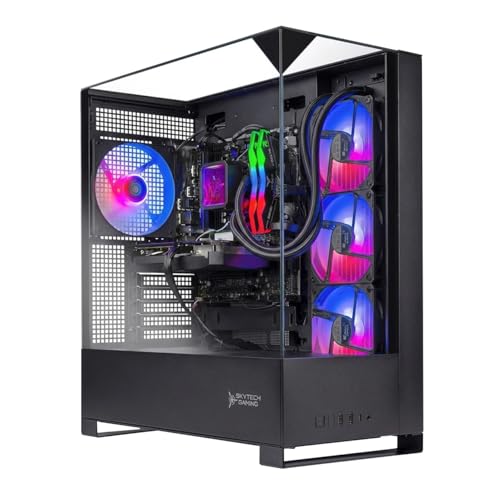
🏆 Best Overall: Skytech Gaming Shadow 5 (Ryzen 7, RTX 5060 Ti 16GB)
- GPU: RTX 5060 Ti 16GB GDDR7
- CPU: Ryzen 7
- RAM: 16GB
- Storage: 1TB SSD
✅ Pros
- 16GB of VRAM, the most of any GPU in this guide
- Keeps 14B-class models fully on the GPU
- Skytech lists common retail parts, which keeps later upgrades simple
❌ Cons
- 16GB of system RAM is the minimum for AI work. Plan a 32GB upgrade.
- Tom's Hardware's 2026 GPU hierarchy calls the RTX 5060 Ti 16GB "hopelessly overpriced for the performance it offers in mid-2026" (Tom's Hardware GPU hierarchy). The sale price has to justify it.
The Skytech Gaming PC Shadow 5, Ryzen 7, RTX 5060 Ti 16GB is the default pick because its GPU has no VRAM cliff. In Tom's Hardware's 21-game face-off, the 16GB version held its lead wherever settings pushed memory. Stalker 2 ran 24.7% slower on the 8GB card at 1440p ultra. Indiana Jones would not run above 1080p medium on the 8GB card at all.
TechSpot's PCIe-scaling review found even wider gaps in the worst cases. On a PCIe 3.0 system, Dragon Age: The Veilguard averaged 66 fps on the 16GB card and 27 fps on the 8GB card, with 1% lows of 9 fps (TechSpot RTX 5060 Ti PCIe benchmark).
The same VRAM decides local AI. LocalScore's 32.9 tokens/s for Qwen2.5 14B Q4_K_M is faster than most people read. Prompt processing runs at 1,329 tokens/s and time to first token is 1.38 seconds, so a chat assistant or coding helper feels responsive. The 8B-class Llama 3.1 runs at 59.0 tokens/s on the same card.
Buy this box if you want one PC that games at 1440p and runs a local assistant without cloud fees. Skip it if you only play esports titles at 1080p. The 8GB pick below costs less and plays those games almost as well.
💰 Best Value: Skytech Gaming Azure 3 (Ryzen 7 5700, RTX 5060, DDR4)
- GPU: RTX 5060 8GB GDDR7
- CPU: Ryzen 7 5700
- RAM: 16GB DDR4-3200
- PSU: 650W Gold
- Storage: 1TB NVMe
✅ Pros
- The lowest GPU tier in this guide, launched at $299
- The 650W Gold PSU is above NVIDIA's 550 W system-power guidance for the RTX 5060, which leaves room for a later GPU upgrade
- Strong 1080p frame rates for competitive shooters
❌ Cons
- AM4 and DDR4 are an end-of-line platform. There is no next-gen CPU path.
- An 8GB VRAM ceiling
- The Ryzen 7 5700 platform runs PCIe 3.0. TechSpot's PCIe-scaling review shows 8GB RTX 50 cards lose the most there once VRAM runs out
The Skytech Gaming PC Azure 3, Ryzen 7 5700, RTX 5060 suits one buyer: someone who plays Valorant, CS2, Fortnite or Overwatch 2 at 1080p and wants high refresh rates without paying for VRAM they won't use.
NVIDIA specs the RTX 5060 at 3,840 CUDA cores and a 145 W TGP. In Tom's Hardware's 1080p ultra raster hierarchy, the RTX 5060 scores 88.5 against the RTX 3060 12GB's 61.5, roughly 44% faster.
Be honest with yourself about the negatives. The platform won't take a Ryzen 9000 CPU. And the 8GB buffer is the one limit you can't fix without replacing the GPU.
🎯 Best for Mainstream Brand Support: Lenovo Legion Tower 5i (Core Ultra 7 265F, RTX 5060 Ti)
- GPU: RTX 5060 Ti (check whether the listing is 8GB or 16GB)
- CPU: Core Ultra 7 265F
- RAM: 16GB
- Storage: 1TB
✅ Pros
- Large-OEM service network
- Lenovo lists warranty options up to three years depending on configuration
- Intel B860 platform with a current-generation CPU
❌ Cons
- Lenovo's spec sheet calls the PSU "Fixed" at 500W or 850W
- Lenovo doesn't state whether the PSU or motherboard use standard form factors
- The listing title doesn't name the VRAM size
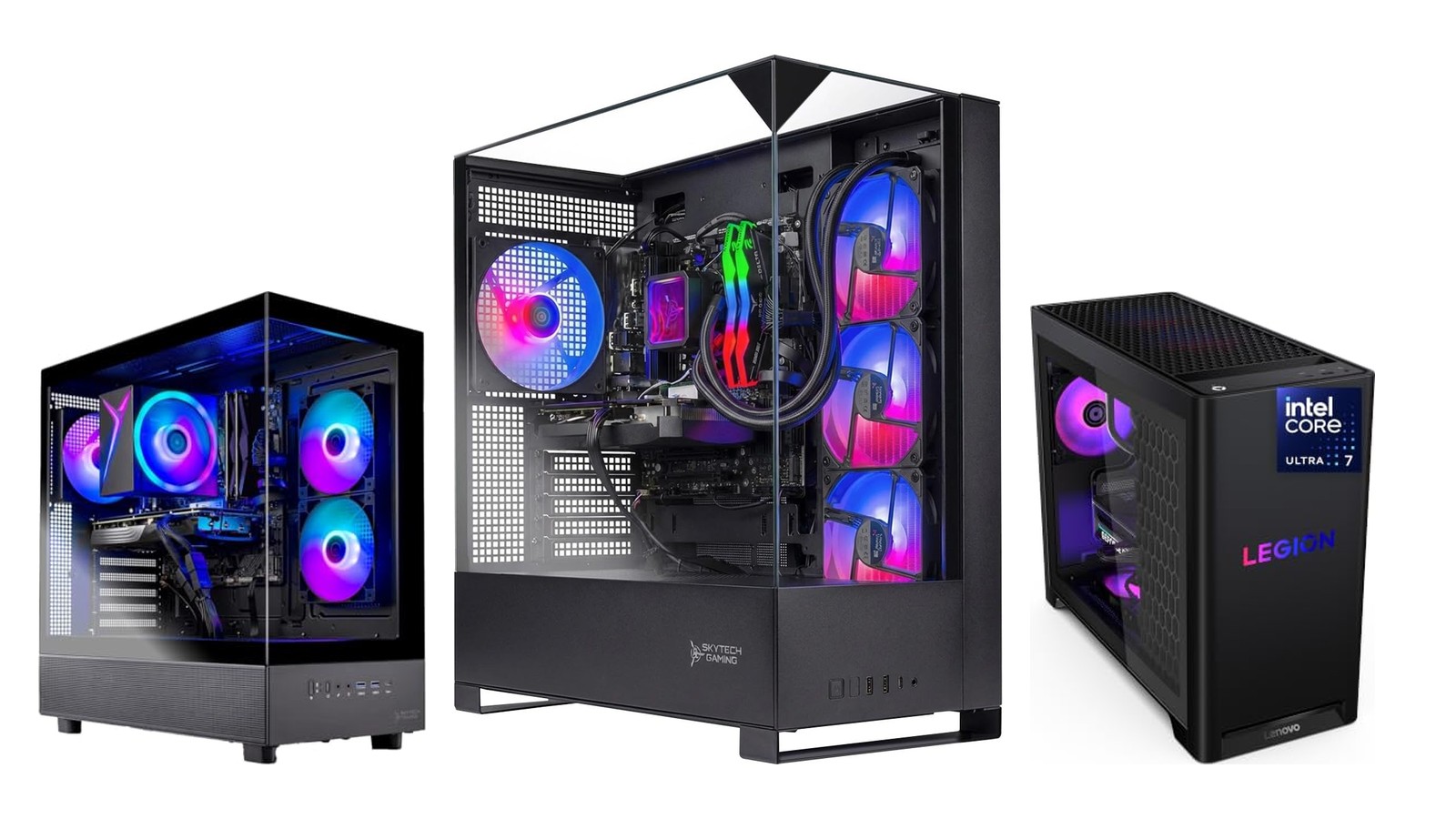
Readers comparing Skytech with the Legion on SpecPicks are weighing parts against support. Lenovo's PSREF spec sheet for the Legion Tower 5i (Legion T5 30IAS10) lists:
- the Core Ultra 7 265F on an Intel B860 chipset
- a 30-litre tower
- base warranty options from one-year mail-in or onsite service up to three-year courier or carry-in service (Lenovo PSREF, Legion T5 30IAS10)
Skytech's listings name common retail parts, such as Gold-rated ATX power supplies and AIO coolers, so a later GPU or PSU swap is familiar work. Lenovo gives you one phone number for any failure.
Two checks before you buy the Legion:
- VRAM: confirm the listing is the 16GB 5060 Ti.
- PSU: if you plan a bigger GPU later, confirm the PSU is the 850W unit. The 500W option is below NVIDIA's 600 W system-power guidance for the RTX 5060 Ti. Lenovo presumably validated its own configuration, but it leaves no headroom.
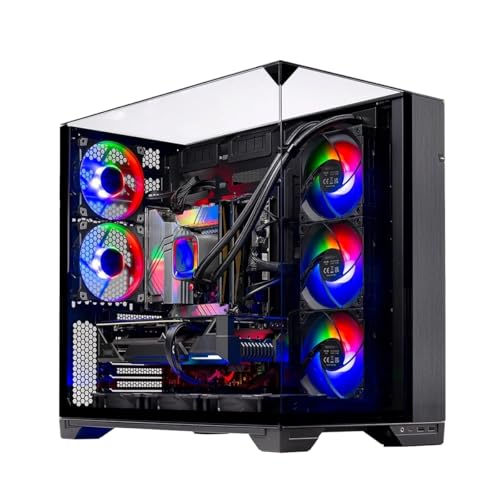
⚡ Best Performance: Skytech Gaming O11 Vision (Ryzen 7 7700X, RTX 5070 12GB, 32GB DDR5)
- GPU: RTX 5070 12GB GDDR7
- CPU: Ryzen 7 7700X
- Motherboard: X670
- RAM: 32GB DDR5-5600
- PSU: 850W Gold ATX 3
- Cooling: 360 mm AIO
✅ Pros
- About 31% faster than the RTX 5060 Ti 16GB at 1440p
- AM5 platform with an upgrade path
- 32GB of RAM out of the box
❌ Cons
- 12GB of VRAM, less than the 5060 Ti 16GB for local AI
- The highest total system cost in this guide
The Skytech Gaming O11 Vision is the box for high-refresh 1440p gaming. Tom's Hardware's head-to-head across 21 games (15 raster, 6 ray-traced) put the RTX 5070 31% ahead of the RTX 5060 Ti 16GB at 1440p, with no games where it trailed (Tom's Hardware RTX 5070 vs RTX 5060 Ti 16GB). The lead was 32% at 4K. The 2026 GPU hierarchy's 11-game raster table agrees, scoring the cards 96.4 and 73.4 at 1440p ultra.
NVIDIA specs the RTX 5070 at 6,144 CUDA cores and a 250 W TGP, with 650 W recommended system power. The listing's 850W unit covers that with room to spare.
Buy it if frame rate at 1440p is your priority. If local AI matters more than frame rate, the 5060 Ti 16GB box holds bigger models.
🧪 Budget Pick: Skytech Gaming Shadow 5 (Ryzen 7, RTX 5060 Ti 8GB)
- GPU: RTX 5060 Ti 8GB GDDR7
- CPU: Ryzen 7
- RAM: 16GB
- Storage: 1TB SSD
✅ Pros
- Same GPU chip, CPU class, RAM and SSD as the Best Overall pick
- At 1080p medium, performance matches the 16GB card
❌ Cons
- Falls 18% behind the 16GB card at 1440p ultra
- Ray-traced 1440p runs 39.6% slower
- Can't hold 14B-class LLMs
The Skytech Gaming PC Shadow 5, RTX 5060 Ti 8GB is enough when three things are true:
- You play at 1080p.
- You're happy dropping textures to high.
- You don't run AI models.
Tom's Hardware found only a 2.3% gap at 1080p medium. The trouble is at the edges. At 1440p on PCIe 3.0, TechSpot recorded the 16GB card up to 883% faster in Indiana Jones and 592% faster in Spider-Man 2. Even on PCIe 5.0, Spider-Man 2 was 120% faster on the 16GB card. Those are the VRAM-limited games that tell you where 8GB breaks.
The $50 launch MSRP step to 16GB is the cheapest insurance in this guide. Take it unless the event gap between the two Shadow 5 listings is much wider than $50.
Prebuilt vs build-your-own: does a DIY RTX 3060 12GB + Ryzen 7 5800X build beat these during the sale?
It can, for one kind of buyer. A classic AM4 DIY build pairs:
The launch-MSRP math:
| Part | Launch MSRP | Source |
|---|---|---|
| RTX 3060 12GB | $329 | NVIDIA |
| Ryzen 7 5800X | $449 | Notebookcheck |
| Windows 11 Home | $139 | Microsoft Store |
| Subtotal before board, RAM, SSD, PSU, case | $917 | Sum |
Sources: NVIDIA RTX 3060 announcement, Notebookcheck Ryzen 7 5800X and the Microsoft Store listing above. Both chips now sell well below launch MSRP. Use their live prices on the linked product pages, then add current prices for the board, RAM, SSD, PSU and case.
How the builds compare:
- Gaming: the RTX 5060 in the Azure 3 is roughly 44% faster at 1080p per Tom's hierarchy.
- VRAM: the RTX 3060 carries 12GB to the 5060's 8GB. That puts 12B–13B-class quantised models in reach, although not 14B at Q4_K_M with room for context.
Build instead of buy if:
- you want 12GB of VRAM on the tightest budget
- you already own a case, PSU or SSD you can reuse
- you're comfortable spending an afternoon assembling and troubleshooting
Buy the prebuilt if:
- you want a newer GPU architecture
- you want a single warranty
- you want the PC working the day it arrives
Who should wait?
- Owners of an RTX 3060-class card or better. An RTX 5060 box is about a 44% raster uplift over a 3060 at 1080p, and it gives up 4GB of VRAM. That is a sidegrade for anyone running local models.
- Buyers with a flexible deadline. Black Friday falls on November 27, 2026, about seven weeks after the event. Retail PC discounts often reappear then. Waiting costs you nothing but time.
- Anyone who needs 16GB but only finds 8GB in stock. Don't settle. VRAM is the one spec you can't add later without replacing the card.
- Buyers hoping for an RTX 50 SUPER refresh. SpecPicks found no NVIDIA announcement of refresh pricing or dates as of 2026-09-26, so don't plan around a rumour either way.
Live price comparison
The head-to-head pages pull each listing's current price side by side:
To browse beyond these picks:
- Prebuilt gaming PCs: every prebuilt tracked in the catalog
- GPUs: bare cards, if you'd rather upgrade the PC you own
What to look for in a prebuilt gaming PC during a sale
GPU VRAM: 8GB vs 16GB
Read the full GPU line. "RTX 5060 Ti" alone doesn't tell you the memory size, and the 8GB and 16GB versions look identical in a listing photo. If the title omits it, check the spec table or the questions section before you buy.
DDR4 vs DDR5 platform
A DDR4 system means AM4 or an older Intel socket. It performs fine today but has no CPU upgrade path. A DDR5 system on AM5 or Intel's current socket can take a drop-in CPU upgrade years later.
PSU wattage and 80+ rating
Check the PSU against NVIDIA's required system power: 550 W for the RTX 5060, 600 W for the RTX 5060 Ti and 650 W for the RTX 5070. A Gold-rated unit with 100–200 W of headroom makes a later GPU upgrade a one-part job.
Single-channel RAM traps
A "16GB" listing can be a single 16GB stick. That runs memory in single-channel mode and costs performance in CPU-bound games. Look for "2x8GB" or "dual-channel" in the spec list. If the listing doesn't say, plan on adding a matched second stick.
Upgrade path: motherboard and case airflow
- Motherboard: a board with a spare M.2 slot and four DIMM slots gives you room to add storage and memory later.
- Case: a case with front intake fans and a full-size PSU bay is easier to upgrade than a compact OEM chassis.
FAQ
Is Prime Big Deal Days a good time to buy a prebuilt gaming PC? It can be, but only when the listed price sits at or below the sum of its parts. Start with the GPU's launch MSRP, which NVIDIA set between $299 and $549 across the RTX 5060 to RTX 5070. Add current retail prices for the CPU, RAM, SSD, PSU, board, case and a $139 Windows 11 Home licence. If the prebuilt lands at or below that total, assembly and warranty are close to free. Prices change during the event, so check the live listing before you buy.
Should I get the RTX 5060 Ti 8GB or 16GB prebuilt? Get the 16GB version if you play at 1440p, keep a PC for four or more years, or want to run local AI models. NVIDIA's launch MSRPs differ by only $50 ($379 vs $429). Tom's Hardware found the 8GB card 18% slower at 1440p ultra and 39.6% slower with ray tracing. The extra VRAM also lets 14B-class LLMs fit fully on the GPU. The 8GB card is fine for 1080p esports titles at medium settings.
Skytech or Lenovo Legion: which prebuilt brand is better? They trade different strengths. Skytech builds with common retail parts, so a later GPU, PSU or storage upgrade is familiar work. Lenovo's Legion Tower 5i comes with a large-OEM service network and warranty options up to three years on some configurations. Its spec sheet lists a "Fixed" 500W or 850W power supply and doesn't say whether it uses a standard form factor. If you plan to upgrade the GPU within two years, lean Skytech. If you want one phone number for any problem, lean Lenovo.
Is it cheaper to build my own PC than buy a prebuilt during the sale? Sometimes. A DIY build around an RTX 3060 12GB and a Ryzen 7 5800X on AM4 can undercut an entry prebuilt, especially if you reuse a case, SSD or power supply. It also gives you 12GB of VRAM for local AI work. On the other side of the ledger, you pay $139 for Windows 11 Home, spend an afternoon assembling and troubleshoot problems yourself. The RTX 5060 in an entry prebuilt is also about 44% faster at 1080p per Tom's Hardware, so compare both totals on sale day.
Who should skip Prime Big Deal Days and wait? Wait if you already own an RTX 3060-class or better card. An RTX 5060 box offers roughly a 44% raster uplift over a 3060 but less VRAM. Also wait if your deadline is flexible, since Black Friday on November 27, 2026 is about seven weeks after the event. Anyone who needs 16GB of VRAM but only finds 8GB models in stock should wait too. VRAM is the one spec you can't add later without replacing the graphics card.
Citations and sources
- About Amazon — Prime Big Deal Days 2026: October 6–7 (accessed 2026-09-26)
- NVIDIA — GeForce RTX 5060 desktop family announcement (launch pricing) (accessed 2026-09-26)
- NVIDIA — RTX 50 Series announcement (RTX 5070 pricing) (accessed 2026-09-26)
- NVIDIA — GeForce RTX 5060 family specifications (accessed 2026-09-26)
- NVIDIA — GeForce RTX 5070 family specifications (accessed 2026-09-26)
- Tom's Hardware — RTX 5060 Ti 8GB vs RTX 5060 Ti 16GB face-off (accessed 2026-09-26)
- Tom's Hardware — RTX 5070 vs RTX 5060 Ti 16GB (accessed 2026-09-26)
- Tom's Hardware — GPU Benchmarks Hierarchy (accessed 2026-09-26)
- TechSpot — RTX 5060 Ti PCIe scaling benchmark (accessed 2026-09-26)
- LocalScore — RTX 5060 Ti 16GB accelerator results (accessed 2026-09-26)
- Hugging Face — bartowski/Qwen2.5-14B-Instruct-GGUF file sizes (accessed 2026-09-26)
- Lenovo PSREF — Legion T5 30IAS10 specifications (accessed 2026-09-26)
- NVIDIA — GeForce RTX 3060 announcement and launch pricing (accessed 2026-09-26)
- Notebookcheck — AMD Ryzen 7 5800X specs and launch pricing (accessed 2026-09-26)
- Microsoft Store — Windows 11 Home (accessed 2026-09-26)
This piece is editorial synthesis based on publicly available information. No independent first-party benchmarking is reported.
Related guides
- Gaming PC Build 2026: The Reddit Consensus
- Build Your Own Gaming PC in 2026
- Prime Big Deal Days 2026: Local AI and Gaming Setup Picks
- Best First Upgrades for a Prebuilt Gaming PC
- Is an $850 Prebuilt Worth It? Parts-Value Breakdown
— Mike Perry