Best Amazon Workstation Parts for a Quiet Home Office in 2026
Five parts for a machine that handles code, calls and spreadsheets without you hearing it.
By Mike Perry, Founder & Editor-in-Chief · Published 2026-09-08 · Updated 2026-09-26 · 15 min read
Our 2026 picks for a quiet home-office workstation: CPU, cooler, ultrawide, storage and input, with honest notes on dead sockets and real prices.
Quick Answer
Start with an AMD Ryzen 7 5800X at $254.90 and a Noctua NH-U12S at $79.95. That pairing gives you eight Zen 3 cores for compiles and calls, on a mature AM4 platform where boards and DDR4 are cheap, cooled by a tower that stays near-inaudible at desktop loads.
This guide is for a specific machine: one that handles code, spreadsheets, a dozen browser tabs, all-day video calls and the occasional Lightroom export — and does it quietly enough that you can record a podcast, take a call without fan noise on the mic, or sleep in the same room.
That last constraint changes the parts list more than people expect. A gaming build optimises for peak frame rate and tolerates noise under load, because you are wearing a headset. An office machine is the opposite: it idles or sits at low load for 90% of its life, and you hear it the entire time. The parts that matter are therefore not the ones a gaming guide would pick. Cooler quality outranks CPU tier. Case airflow outranks case looks. And the single loudest component in most prebuilt office machines — the cost-down stock cooler — is the first thing to replace.
The second thing this guide assumes is that you are buying on Amazon, with the constraints that implies: no used marketplace, no eBay retro hunting, no waiting for a microcentre open-box. That rules some genuinely good value out, and it rules in a few parts that are past their launch prime but still excellent buys because their platforms have matured and the surrounding components got cheap.
A note on honesty about price: several picks below sit on end-of-life sockets. That is not automatically bad — a dead socket with cheap boards and cheap memory can be the best total-cost buy on the market — but it is a real tradeoff and each pick below states it plainly rather than burying it. Where current catalogue pricing undermines the conventional recommendation, this guide says so.
Step 0 — diagnose the workload before you buy parts
Three thresholds decide which of the picks below actually matter for you. Work out which bucket you are in before you spend.
Core-count-bound. You compile, run containers, transcode, or keep VMs running. The test: does your CPU sit above 70% for minutes at a time during normal work? If yes, core count is your first-order variable, and the eight-core picks below are the floor rather than the ceiling.
Memory-bound. You keep 40+ browser tabs, run an IDE with heavy language servers, work with large spreadsheets or datasets, or run a VM alongside everything else. The test: does your machine swap or stutter when switching apps? If yes, buy RAM before you buy CPU. 32GB is the 2026 baseline for this profile and 64GB is not extravagant. A slower CPU with enough memory beats a faster one that is swapping, every time.
Acoustics-bound. Your machine is in a bedroom, a shared room, or a space you record in. The test: can you hear it from two metres during a video call? If yes, the cooler and case matter more than any silicon choice, and you should read the Best for Silence pick first.
Most home-office readers are acoustics-bound and think they are core-count-bound. If you are unsure, you are probably in that group — buy the good cooler.
Verdict: Best overall for a quiet home-office workstation. $254.90, 8 cores / 16 threads, 105W TDP.
Specs: Zen 3 architecture, 8 cores and 16 threads, 3.8 GHz base and 4.7 GHz boost, 32MB L3 cache, AM4 socket, 105W TDP. Full specifications are on AMD's product page.
Pros:
Sixteen threads handle compiles, containers and a video call simultaneously without the machine feeling busy.
AM4 motherboards and DDR4 memory are the cheapest mature platform on the market — the parts around this CPU are where you save.
Zen 3 brought a unified 8-core CCX with 32MB of shared L3, which is why this chip still performs well in latency-sensitive work six years on.
Cons:
105W TDP means it genuinely needs a good cooler — this is not a chip to pair with a stock heatsink if silence matters.
No integrated graphics. You need a discrete GPU, even for office work. Budget for that.
AM4 is end-of-life for new launches, though it received parts through the 5000-series X3D chips.
At $254.90 this is the pick for most readers. Eight full cores with SMT is the sweet spot where a home-office machine stops feeling constrained, and the platform savings on board and memory are worth more than the raw CPU spec suggests. Pair it with the NH-U12S below and 32GB of DDR4. See the full product details. Prices move frequently — verify before purchase.
#2: Intel Core i7-9700K
Verdict: Best value only if you already own an LGA1151 board. $259.00, 8 cores / 8 threads, 95W TDP.
Specs:Coffee Lake Refresh, 8 cores and 8 threads (no Hyper-Threading), 3.6 GHz base and 4.9 GHz boost, 12MB L3 cache, LGA1151, 95W TDP.
Pros:
4.9 GHz single-core boost is still quick in the lightly-threaded work that dominates office use — spreadsheet recalculation, UI responsiveness, single-threaded build steps.
A genuine drop-in upgrade if you have an existing Z390 or B365 machine, turning a hardware purchase into a $259 refresh instead of a full rebuild.
95W TDP is slightly easier to cool quietly than the 5800X.
Cons:
Eight threads, not sixteen. No Hyper-Threading is a real deficit in exactly the parallel workloads that justify an eight-core chip.
At $259.00 it currently costs more than the Ryzen 7 5800X. As a fresh purchase this is not a value pick, and we are not going to pretend otherwise.
LGA1151 has essentially no in-socket upgrade path left.
Here is the honest read. The conventional case for this chip is "cheaper platform, better value." At today's catalogue prices that case does not hold — it is five dollars more than a 5800X that has twice the threads and a socket with more life. Buy it in exactly one situation: you already own the board and memory, and $259 turns a working machine into a faster one with a fifteen-minute swap. In that scenario it is excellent. As the foundation of a new build, pick #1. See the full product details. Prices move frequently — verify before purchase.
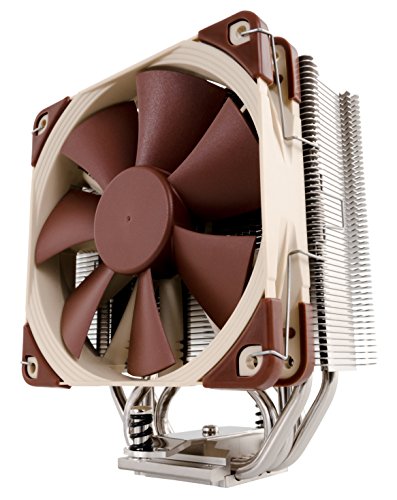
#3: Noctua NH-U12S
Verdict: Best for silence, and the highest-impact purchase on this list. $79.95, 120mm single tower.
Specs: Single 120mm tower, five heatpipes, one NF-F12 PWM fan rated around 22.4 dB(A) at maximum speed, 158mm overall height, six-year warranty. Noctua) supplies free mounting kits for new sockets on request.
Pros:
Around 22 dB(A) at full speed is below the noise floor of most rooms — at office loads the fan barely spins up at all.
158mm height clears most mid-tower cases, and the single-tower 120mm layout avoids the RAM clearance problems that plague 140mm designs.
Six-year warranty and free socket adapters mean it survives two or three system rebuilds. Amortised, it is the cheapest part here.
Cons:
The brown-and-beige colour scheme is divisive, and Noctua charges more for the monochrome version.
Single-tower 120mm is not the choice for a heavily overclocked high-TDP chip under sustained all-core load.
For a machine that must be inaudible, this is the part that does the work. Stock coolers are chosen by vendors to pass thermal validation at minimum cost, not to be pleasant — they hold clocks and get loud doing it. Swapping to an NH-U12S typically buys a few degrees and a large drop in perceived noise, and it is the change readers consistently report noticing most. Confirm your socket and RAM clearance first. See the full product details. Prices move frequently — verify before purchase.
#4: LG 34WN80C-B 34-inch UltraWide WQHD
Verdict: Best performance upgrade for document and IDE work. $499.99, 3440x1440 IPS with USB-C.
Specs: 34-inch 21:9 curved IPS panel, 3440x1440 resolution, 99% sRGB coverage, USB-C with 60W power delivery, height-adjustable stand.
Pros:
3440x1440 gives roughly two useful document columns with no bezel down the middle — the specific reason ultrawide suits code beside reference material.
USB-C with 60W power delivery means a laptop docks with one cable: video, data and charging.
IPS with 99% sRGB is accurate enough for photo work and comfortable for all-day text.
Cons:
60Hz. Fine for office work, noticeably not a gaming panel.
A 34-inch curved panel wants roughly 80cm of viewing distance — measure your desk depth before ordering.
At $499.99 it is the largest line item in this guide by a wide margin.
This is the "performance" pick because screen real estate does more for office productivity than any CPU upgrade at this tier. Going from one 1080p panel to 3440x1440 changes how you work; going from eight cores to twelve does not. If your budget only stretches to one upgrade and you are not core-count-bound, buy the monitor. See the full product details. Prices move frequently — verify before purchase.
#5: Fikwot FX815 512GB SATA SSD
Verdict: Budget pick for bulk storage. $75.99, 2.5-inch SATA III.
Specs: 512GB capacity, 2.5-inch form factor, SATA III 6Gb/s interface, sequential reads up to roughly 550 MB/s (the practical ceiling of the SATA interface).
Pros:
Drops into any 2.5-inch bay on any board from the last fifteen years — no M.2 slot, no PCIe lane budgeting, no heatsink.
For documents, code repositories and application data, indistinguishable from NVMe in daily use.
Leaves your M.2 slots free for the boot drive and a future upgrade.
Cons:
SATA III caps at roughly 550 MB/s. NVMe drives are six to ten times faster on large sequential transfers.
512GB is modest if you store video or VM images.
Where SATA loses, honestly: large sequential work — video scratch files, multi-gigabyte dataset loads, VM disk images. There the NVMe gap is large and real. Where it does not matter: booting, launching applications, opening documents, and compiling, all of which are dominated by small random reads where the two interfaces converge. Buy this as a second drive for capacity, not as your boot drive. See the full product details. Prices move frequently — verify before purchase.
Complete the build
Input. A Logitech MK270 wireless keyboard and mouse combo at $26.99 is the sensible default for an office machine: one USB receiver for both devices, long battery life, and membrane switches that are quieter than any mechanical keyboard — which matters if you are on calls. Spend more only if you type enough to have opinions about switches.
Memory. 32GB of DDR4-3200 is the target for the 5800X. Two sticks, not four, so you keep the dual-channel configuration and leave upgrade slots. If you are memory-bound per Step 0, go to 64GB before you touch anything else on this list.
Power supply. 550-650W of 80+ Gold from a reputable brand is ample for any configuration here plus a mid-range GPU. Buy the good PSU: it is the component whose failure takes others with it, and cheap units are also a common source of coil whine — which is exactly the noise a quiet build cannot tolerate.
Case. Prioritise a solid front panel with side intake or a mesh front with good filters, and at least two 140mm fan mounts. Large slow fans move the same air as small fast ones at much lower noise. Sound-dampening foam helps less than most people expect; airflow design helps more.
Graphics. The 5800X has no integrated graphics. Any current entry-level card handles multi-monitor office work; pick a fanless or semi-passive model to protect the acoustics you just paid for.
What to look for in a home-office workstation
Core count versus clock speed
Office work is bimodal. Interactive tasks — typing, scrolling, recalculating a sheet — are latency-sensitive and mostly single-threaded, so they reward high boost clocks. Background tasks — compiles, indexing, exports, container builds — scale with core count. You want both, which is why eight cores at a high boost clock is the durable answer at this tier rather than sixteen slow cores or four fast ones. Tom's Hardware maintains a CPU hierarchy that is a useful cross-check when comparing generations.
Memory capacity thresholds
Capacity matters far more than speed for this workload. 16GB is workable but tight in 2026 once an IDE, a browser and a call client are open. 32GB is the comfortable baseline. 64GB is for VMs and large datasets. The difference between DDR4-3200 and DDR4-3600 is measurable on a benchmark and invisible in daily work; the difference between 16GB and 32GB is felt hourly.
Acoustic targets in dBA
Roughly: 20 dB(A) is inaudible in a normal room, 25 dB(A) is noticeable in a quiet room, 30 dB(A) is clearly audible, and 35+ dB(A) is what a stock cooler under load sounds like. The scale is logarithmic and perceptual, so a 10 dB reduction reads as roughly "half as loud." Getting from 35 to 25 is the single most noticeable change you can make to a home-office machine.
Panel size and pixel density
For text, pixel density matters more than size. 3440x1440 across 34 inches lands around 110 PPI, which is comfortable without display scaling — the same density as a 27-inch 1440p panel. 4K on a 27-inch panel is sharper but needs scaling, which some professional applications still handle badly.
Upgrade headroom on a mature socket
A "dead" socket with cheap, plentiful parts often beats a current socket with expensive ones — provided you are honest that you are buying a fixed configuration. The question is not "can I upgrade?" but "will I?" Most office machines are replaced wholesale rather than upgraded piecemeal, which makes total platform cost today the number that matters.
Wikipedia — Noctua) — manufacturer background and socket-support policy referenced in pick #3. Accessed September 2026.
Prices are catalogue figures as of September 2026 and move frequently; acoustic and throughput figures are manufacturer ratings or interface ceilings rather than first-party measurements. This article is an editorial synthesis of manufacturer specifications, public benchmark aggregates and current catalogue pricing.
As an Amazon Associate, SpecPicks earns from qualifying purchases; we also earn on qualifying eBay purchases via the eBay Partner Network. Prices shown were last tracked at crawl time and may vary — check the listing for the current price.
📹 Watch a review
Friendly Fire: AMD Ryzen 7 5800X CPU Review & Benchmarks vs. 5600X & 5900X — Gamers Nexus on YouTube
Frequently asked questions
Is the Ryzen 7 5800X still worth buying in 2026 for a workstation?
For office, development and light content work it remains one of the best value-per-dollar eight-core parts available, because AM4 board and DDR4 memory prices have fallen far below current-platform equivalents. You give up PCIe 5.0 and the newest instruction extensions, neither of which affects a spreadsheet, an IDE or a video call. Buy it when total platform cost matters more than a multi-year CPU upgrade path on the same socket.
Am I buying into a dead socket with AM4 or LGA1151?
Both are end-of-life for new CPU launches, which is a real limitation and worth stating plainly. The practical counterpoint is that AM4 received parts through the 5000-series X3D chips, so there is still a meaningful in-socket upgrade left, while LGA1151 has essentially none. If you expect to swap CPUs within three years rather than replacing the whole machine, weight AM4 accordingly and treat the Intel pick as a fixed-configuration buy.
Do I need an AIO liquid cooler, or is a tower air cooler enough?
For a 105W-class desktop CPU under office and development loads, a well-regarded single-tower air cooler such as the NH-U12S has ample headroom and is quieter at idle than most 240mm AIOs, because it has one fan instead of three plus a pump. Liquid cooling earns its place on sustained all-core rendering or heavy overclocking. For a machine that must be inaudible in a quiet room, air is the better default.
Is a SATA SSD too slow for a workstation boot drive?
For boot, application launch and document work, SATA and NVMe feel nearly identical, because those workloads are dominated by small random reads where the gap narrows sharply. NVMe pulls clearly ahead on large sequential transfers such as video scratch files, virtual machine images and multi-gigabyte dataset loads. Buy SATA when capacity per dollar matters and your working set is documents and code; buy NVMe when you move large files daily.
Ultrawide or two separate monitors for office and development work?
A single 3440x1440 ultrawide gives you roughly two useful document columns with no bezel down the middle and one cable to dock, which is why it suits code plus reference material. Dual monitors still win when you need full-screen video conferencing on one panel while working on the other, or when you want portrait orientation for long documents. Desk depth also matters: a 34-inch curved panel wants about 80cm of viewing distance.