Affiliate disclosure: SpecPicks earns a commission on qualifying Amazon purchases made through links on this page. It doesn't change our picks or the price anchors below.
Step 0: Which tier do you actually need?
Before you open a single deal page, decide how much VRAM you need. For gaming, VRAM decides which texture settings you can run at 1440p and 4K. For local LLMs it's even stricter: the model's weights and its context (KV cache) have to fit in video memory, or performance falls off a cliff as layers spill into system RAM.
| VRAM | Gaming (as of 2026) | Local LLMs (4-bit quantized) | Right for |
|---|---|---|---|
| 8 GB | 1080p high, 1440p with texture compromises | 7B–8B models, short context | Gamers who don't plan to run AI |
| 12 GB | 1440p high, entry 4K with upscaling | 8B–14B models, moderate context | Budget local-AI builders |
| 16 GB | 1440p ultra, 4K with DLSS | 14B with long context, or chat plus image generation | One box for both jobs |
A 4-bit (Q4) 8B model takes about 5 GB for weights, and a Q4 14B model takes about 8.5–9 GB. Add a few gigabytes for context and the runtime, and you can see why 8 GB cards cap out at small models and why 16 GB gives you headroom.
Prebuilt vs GPU-only upgrade. A prebuilt is the right call when:
- Your current platform is old: DDR3 boards, pre-Ryzen 3000 or pre-10th-gen Intel CPUs, or a power supply under 550 W with no spare PCIe power connectors.
- You want one warranty and one return window for the whole system.
- You don't have a PC at all.
A prebuilt is not worth it when you already own a modern CPU, 16 GB or more of RAM, and a quality 650 W or larger PSU. In that case a GPU-only upgrade usually buys more performance per dollar, because you aren't paying twice for a case, SSD and Windows license.
Comparison: the five picks at a glance
| Pick | Best For | Key Spec | Pre-event Anchor (recorded Sept 25) | Verdict |
|---|---|---|---|---|
| Skytech Shadow 5 (RTX 5060 Ti 16GB) | Gaming + local AI in one box | 16 GB GDDR7, 16 GB DDR5, 1 TB SSD | $1,899.99 | Best Overall — buy below the anchor |
| Skytech Azure 3 (RTX 5060 8GB) | 1080p/1440p gaming only | 8 GB GDDR7, Ryzen 7 5700, 650 W Gold | $1,199.99 | Best Value for pure gamers |
| ZOTAC RTX 3060 Twin Edge OC 12GB | GPU-only local-LLM upgrade | 12 GB GDDR6, 192-bit | $499.99 | Wait unless it nears $329 MSRP |
| KOORUI 27" 4K Dual-Mode (G2741L) | 4K display for a 5060 Ti rig | 4K 160 Hz / FHD 320 Hz, HDMI 2.1 | $299.99 | Best Performance Display |
| SHW 55x28 Electric Standing Desk | Budget desk refresh | 55" x 28" top, memory presets, drawer | $189.87 | Budget Pick |
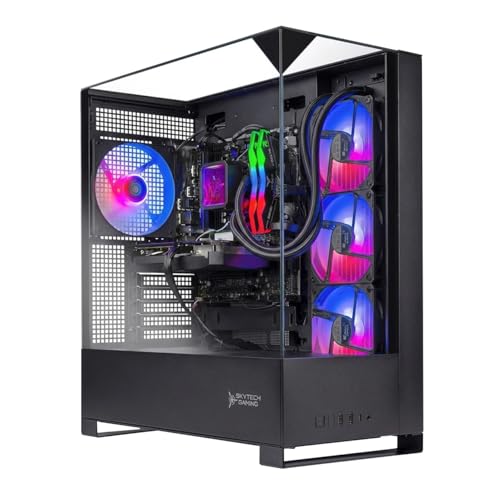
🏆 Best Overall: Skytech Gaming Shadow 5 (RTX 5060 Ti 16GB)
Pick: Skytech Gaming PC Shadow 5, Ryzen 7, RTX 5060 Ti 16GB · Pre-event anchor: $1,899.99 · Amazon rating: 4.4 stars
Pros
- 16 GB of VRAM holds 14B-class models at Q4 with room left for context
- DDR5 platform with a 1 TB NVMe SSD, so it's ready for games and model files out of the box
- DLSS 4 support extends its useful life at 1440p
Cons
- 16 GB of system RAM is the minimum for local AI; plan on 32 GB if you use CPU offload
- The CPU configuration varies between listings (see below)
The Shadow 5 is here because of one number: 16 GB. NVIDIA's own spec page lists the RTX 5060 Ti in 8 GB and 16 GB variants, both on 128-bit GDDR7 (NVIDIA RTX 5060 family). For gaming the two perform almost the same at 1080p. For local AI they're very different machines. The 16 GB card loads Qwen3 14B or Phi-4 14B at Q4 fully in VRAM with 8K–16K tokens of context. The 8 GB card has to offload layers to system RAM, which on a single desktop typically cuts generation speed by more than half.
On Tom's Hardware's GPU benchmarks hierarchy, the RTX 5060 Ti sits in the upper-mainstream band. It's a comfortable 1440p card with DLSS, and 4K is workable in lighter titles. That makes it a good partner for the 4K display pick below.
Writer's verification note (read before you buy): our catalog has a sibling Shadow 5 listing under the same ASIN that specifies a Ryzen 7 9700X, 750 W Gold PSU, 360 mm AIO cooler and DDR5-6000 at $1,499.99. Skytech rotates configurations under the Shadow 5 name. Open the live listing on October 6 and confirm the exact CPU, PSU wattage and RAM speed in the spec table. Don't rely on the title.
What counts as a good event price: anything under $1,709 (10% below the $1,899.99 anchor) is a real deal. $1,599 or less is a strong buy; this ASIN listed at $1,499.99 as recently as September 8. If the listing still shows $1,899.99 with a bigger "was" strikethrough, it hasn't moved. Skip it.
💰 Best Value: Skytech Gaming Azure 3 (RTX 5060 8GB)
Pick: Skytech Gaming PC Azure 3, Ryzen 7, RTX 5060 · Pre-event anchor: $1,199.99
The Azure 3 pairs an RTX 5060 8GB with a Ryzen 7 5700, 16 GB of DDR4-3200, a 1 TB NVMe SSD and a 650 W Gold PSU, according to its catalog listing. For 1080p high-refresh gaming and 1440p at medium-high settings with DLSS, it's plenty of machine, and it's $700 cheaper than the Shadow 5 at anchor prices.
Counter-case: local LLMs. 8 GB of VRAM is the Azure 3's ceiling, and you can't upgrade it without replacing the GPU. It runs 7B–8B models at Q4 with short context well. It does not run 14B models without offloading to slow DDR4 system memory. We covered that tradeoff in RTX 5060 8GB vs RTX 4070 12GB for Qwen3 14B. If you have any intention of running local models, spend the extra $200 on the Shadow 5 now instead of $400+ on a GPU swap later.
The AM4 platform is another consideration. The Ryzen 7 5700 is a capable 8-core chip, but AM4 is a finished socket. Your upgrade path ends at a Ryzen 7 5800X3D-class CPU.
Good event price: under $1,099. At $999 it's an easy recommendation for a gamer-only household.
🎯 Best for Local LLM Upgrades: ZOTAC RTX 3060 Twin Edge OC 12GB
Pick: ZOTAC Gaming GeForce RTX 3060 Twin Edge OC 12GB · Pre-event anchor: $499.99 · Amazon rating: 4.7 stars
If your current PC has a modern CPU and a 550 W+ PSU, the RTX 3060 12GB is still the cheapest NVIDIA route to 12 GB of VRAM. NVIDIA launched it at $329 with 12 GB of GDDR6 on a 192-bit bus (NVIDIA RTX 3060 family). That wider bus gives it 360 GB/s of memory bandwidth, and bandwidth is what sets token-generation speed for a model that fits in VRAM. Community llama.cpp results put 8B models at Q4 at roughly 40–55 tokens per second on this card, faster than you can read. See the RTX 3060 12GB benchmark page for per-model numbers.
Who should wait: almost everyone, at today's price. The current $499.99 listing is about 52% above the $329 launch MSRP. At that price the 12 GB card competes with newer 16 GB cards that NVIDIA launched with lower list prices. Buy only if the event price moves toward $329–$349. Above roughly $400, skip it and put the money toward a 16 GB card or the Shadow 5.
For the full budget-GPU argument, read Best Budget GPU for Local LLMs in 2026.
⚡ Best Performance Display: KOORUI 27" 4K Dual-Mode 160Hz/320Hz
Pick: KOORUI 27" 4K Gaming Monitor Dual Mode UHD 160Hz or FHD 320Hz · Pre-event anchor: $299.99 (listed at $349.99) · Amazon rating: 4.4 stars from 11,000+ reviews
This monitor switches between two modes: 4K at 160 Hz for single-player games and desktop work, and 1080p at 320 Hz for competitive shooters. It uses a Fast IPS panel with a 1 ms response time and carries HDR400, HDMI 2.1 and DisplayPort 1.4. The stand adjusts for height and pivot. At $299.99 it's one of the cheapest 4K high-refresh panels we track.
It's the right display for a 5060 Ti-class prebuilt. That GPU can drive 4K at 60–100+ fps in esports and older AAA titles with DLSS Performance, and you can drop to 1080p/320 Hz mode for competitive games where frame rate matters more than pixels.
Step-up alternate: the Samsung 27" Odyssey 4K UHD 144Hz at a $489.99 anchor. You get Samsung's panel QC, Black Equalizer, and a stand that doesn't wobble. You give up the dual-mode trick and pay about $190 more. We compared the two head-to-head in Best 4K Monitor for an RTX 3060: KOORUI vs Samsung Odyssey.
Good event price: KOORUI at $269 or less; Samsung below $429.
🧪 Budget Pick: SHW 55x28 Electric Standing Desk
Pick: SHW 55 x 28 Electric Height Adjustable Standing Desk w/Drawer · Pre-event anchor: $189.87 · Amazon rating: 4.5 stars from 21,000+ reviews
A 55 x 28-inch top is the smallest width we recommend for a gaming or AI desk. A 27-inch monitor on its stand takes about 24 inches of width. A mid-tower is about 8–9 inches wide. That leaves about 20 inches for a keyboard and mouse, which is enough, but not generous. The SHW adds memory presets, a drawer and hanging hooks.
Measure first:
- Width: at 55 inches you can fit one 27-inch display and a mid-tower on the desktop, or two 24-inch displays with the tower on the floor. Two 27-inch displays plus a tower won't fit.
- Depth: 28 inches keeps a 27-inch 4K display about 22–24 inches from your eyes, fine for 4K at 100–125% scaling.
- Weight: a single-motor desk in this price range is happiest well under its rated capacity. If the tower goes on top, keep the total load (tower + monitor + peripherals) under about 80 lb, and put heavy towers on the floor.
Good event price: $159–$169. Budget electric desks are a category where event discounts are common.
What to look for in a Prime Big Deal Days tech deal
Price-history anchors vs "list price" strikethroughs
A strikethrough price is set by the seller and is often a figure the product rarely sold at. Our catalog recorded the Shadow 5 at $1,499.99 on September 8 and $1,899.99 on September 25, under the same ASIN, so a "was" price on its own tells you little. The discount that matters is the one measured against what the product actually sold for recently, which is why this page publishes anchors. Use a 90-day price-history tracker as your second opinion.
VRAM tier before brand
If you plan to run local AI, pick a VRAM tier first: 8, 12 or 16 GB. Then shop within it. A deal on an 8 GB card is no deal if you need 16 GB next spring. Tom's Hardware's GPU hierarchy is a good cross-check for relative gaming performance within a tier.
Prebuilt PSU and RAM gotchas
- Single-channel RAM: some budget prebuilts ship 1 x 16 GB instead of 2 x 8 GB. Single-channel memory can cost 10–20% in CPU-bound games. Check the spec sheet or the product Q&A.
- PSU headroom: a 650 W Gold unit is fine for a 5060-class GPU. If you plan to upgrade to a 300 W+ GPU later, a 750 W unit saves you a PSU swap.
- Storage: 1 TB fills fast with two AAA games and a few 14B model files at 8–9 GB each. Budget for a second NVMe drive.
Return windows
Amazon's holiday return window typically extends returns for many items bought in the fall season into January, but confirm the policy on the order page. A long return window matters most for prebuilts and monitors, where dead pixels and DOA units show up in the first week.
Marketplace sellers vs Amazon-sold listings
"Ships from and sold by Amazon" means Amazon handles returns directly. Third-party marketplace sellers can price lower, but return terms, warranty registration and even the exact configuration can differ. On prebuilts especially, check that the seller is the manufacturer or Amazon.
Real-world numbers: what each tier buys you
| Setup | Est. total at Sept 25 anchors | 8B Q4 LLM | 14B Q4 LLM | Gaming target |
|---|---|---|---|---|
| Shadow 5 + KOORUI 4K + SHW desk | $2,389.85 | Fully in VRAM, fast | Fully in VRAM, 8K–16K context | 1440p ultra / 4K with DLSS |
| Azure 3 + KOORUI 4K + SHW desk | $1,689.85 | Fully in VRAM, short context | Offloaded to DDR4, slow | 1080p high / 1440p medium-high |
| Existing PC + RTX 3060 12GB | $499.99 (GPU only) | Fully in VRAM, ~40–55 tok/s | Fits at Q4 with limited context | 1080p high / 1440p medium |
The tokens-per-second figures are llama.cpp estimates for single-user generation. Your numbers will vary with quantization, context length and driver version.
Worked examples
The first-PC gamer who's curious about AI. A $2,200 total budget. Buy the Shadow 5 and the KOORUI together if both drop at least 10% below anchor. If only one moves, buy that one and wait for Black Friday on the other.
The AI tinkerer with a Ryzen 5 5600 and a GTX 1660. The platform is fine, and only the GPU is holding the machine back. Skip the prebuilts. Buy a 12 GB card only if it nears its $329 MSRP. Otherwise wait, or read Best GPU Upgrade From a GTX 1050 Ti for Local LLMs for other options.
The desk refresh. Monitor plus desk at anchor prices comes to about $490. At the event-price targets above, it's closer to $430, a $60 saving for doing nothing but waiting 12 days.
FAQ
When is Prime Big Deal Days 2026 and do I need Prime? Amazon's October event runs October 6–7, 2026, for 48 hours, starting at 12:01 a.m. PDT on October 6. Most event pricing requires an active Prime membership; non-members see the regular listing price. A Prime free trial started a few days before the event generally qualifies. Check the live listing on the day, because the badge showing the event price only appears on eligible offers.
How do I know if a Prime Big Deal Days price is actually good? Compare it to a real anchor, not the strikethrough "list price". Use the manufacturer's launch MSRP where one exists (NVIDIA launched the RTX 3060 12GB at $329) and the pre-event prices on this page as the second reference. A discount measured against an inflated list price is not a deal. Price trackers that show 90-day history are the most reliable check before you click buy.
Should I buy a prebuilt gaming PC or just upgrade my GPU during the sale? If your current PC has a modern CPU, at least 16 GB of RAM and a PSU with headroom, a GPU-only upgrade usually delivers more per dollar. Prebuilts make sense when the platform itself is old, such as DDR3 boards or pre-Ryzen 3000 CPUs, or when you want one warranty for the whole system. Check the prebuilt's PSU wattage and RAM configuration before you buy.
How much VRAM do I need if I also want to run local AI models? 8 GB handles 7B–8B models at 4-bit quantization with short context. 12 GB comfortably fits 8B–14B models. 16 GB leaves room for 14B models with longer context, or for image generation alongside chat. That tiering is why the RTX 5060 Ti 16GB prebuilt ranks above the 8 GB RTX 5060 system for readers who plan to run models locally.
Who should skip Prime Big Deal Days and wait for Black Friday? Wait if the item you want shows no movement from its pre-event anchor, or if it sits well above launch MSRP, as the RTX 3060 12GB currently does. Black Friday and Cyber Monday historically bring broader PC hardware discounts. Buying now makes sense only when the event price clearly beats the anchor and the return window covers the holiday period.
Sources
- About Amazon — Prime Big Deal Days 2026 is set for October 6–7 (accessed 2026-09-25)
- NVIDIA — GeForce RTX 5060 Family specifications (accessed 2026-09-25)
- NVIDIA — GeForce RTX 3060 Family specifications (accessed 2026-09-25)
- Tom's Hardware — GPU Benchmarks Hierarchy 2026 (accessed 2026-09-25)
Related guides
- Best Mini PC for Local LLMs in 2026
- Best Budget GPU for Local LLMs in 2026
- Skytech Prism 4 vs MSI Codex Z2: 1440p Prebuilt Showdown
- Best Parts for a Gaming PC That Also Runs Local LLMs
- Prebuilt Gaming PCs · Gaming Desks
— Mike Perry. We'll refresh this page during the event as prices move.