Raspberry Pi projects for 2025 fall into a handful of proven categories: retro gaming consoles, home automation hubs, media servers, camera/security builds, environmental monitoring, and lightweight on-device AI. The board's small footprint, GPIO header, and active open-source ecosystem make it a go-to for makers who want a working project in a weekend rather than a months-long build. This guide organizes the most common and best-documented ideas by skill level, with notes on which Pi model and accessories each one actually needs.
A note on scope: some project lists circulating online claim you can pair a Raspberry Pi with discrete AMD GPUs like the Radeon RX 6700 XT or an Instinct MI210 for AI inference or gaming. That isn't a real, documented consumer workflow — the Pi 5's single PCIe lane is meant for NVMe storage or capture HATs, not powering datacenter or gaming GPUs — so those ideas are left out here in favor of projects the community has actually built and documented.
Quick project picker
| Skill level | Project | What it needs |
|---|---|---|
| Beginner | Retro gaming console | Pi 4/5, microSD, HDMI cable, controller |
| Beginner | Smart home camera | Pi Camera Module, case, Wi-Fi |
| Beginner | Weather station | DHT22/BME280 sensor, breadboard |
| Intermediate | Home automation hub | Zigbee USB dongle, Home Assistant |
| Intermediate | NAS / media server | Pi 4/5, USB SSD or HAT, Jellyfin |
| Advanced | On-device AI vision | Pi 5, AI Camera or Coral USB Accelerator |
Beginner-friendly Raspberry Pi projects (no coding required)
Retro gaming console
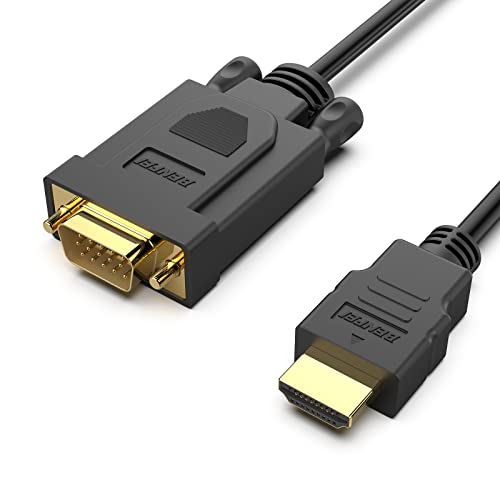
Imaging tools like Recalbox and RetroPie turn a Pi 4 or Pi 5 into a plug-and-play retro console covering everything from NES-era hardware through PS1-class systems, depending on the Pi model's horsepower. Per Recalbox's own documentation, setup is a matter of flashing an SD card, copying over legally-owned ROM files, and connecting a controller — no scripting needed. If you're hooking the console up to an older CRT or a VGA-only monitor for an authentic look, a HDMI-to-VGA adapter such as the BENFEI HDMI to VGA Gold-Plated Adapter (B075GZ8DX7, $5.19) or the Moread HDMI to VGA adapter (B00SW9JI9A, $6.99) bridges the gap without needing a dedicated VGA capture card. For longer cable runs between the Pi and a wall-mounted display, the BENFEI 10-foot HDMI to VGA cable (B07PFKJDKJ, $11.99) is a cheap way to keep the Pi tucked out of sight.
For guidance on which Pi board actually suits a first retro build — a full-size Pi 4 8GB versus a cheaper Pi Zero W — see our head-to-head comparison (/reviews/raspberry-pi-4-8gb-vs-pi-zero-w-first-project-2026). If emulation performance is the priority, our dedicated buying guide ranks the best Pi alternatives for emulation specifically (/reviews/best-raspberry-pi-alternative-for-emulation-2025).
Smart home security camera
Pairing a Pi with the official Raspberry Pi Camera Module gives you a low-cost network camera. Per Raspberry Pi's camera documentation, the module connects directly to the board's CSI port and can stream over the local network or trigger motion-based recording with software like MotionEyeOS. This is one of the more approachable projects because it requires almost no soldering — just the camera ribbon cable and a case with a lens cutout.
Portable weather station
A DHT22 or BME280 temperature/humidity sensor wired to the Pi's GPIO pins, combined with a small Python script to log readings, is a standard "first sensor project." It teaches GPIO basics without needing a full electronics background, and the data can be piped into a dashboard tool like Home Assistant or Grafana for a simple public-facing weather widget.
Intermediate projects: home automation and media
Home automation hub with Zigbee
A Pi running Home Assistant plus a USB Zigbee coordinator (such as a CC2652-based dongle) and the Zigbee2MQTT bridge software turns the board into a hub for Zigbee sensors, smart bulbs, and plugs — no cloud subscription required. Per Zigbee2MQTT's documentation, the software supports a wide range of third-party Zigbee devices without needing each manufacturer's own gateway. Our full home automation project guide covers the build in more depth (/reviews/raspberry-pi-home-automation-projects-2025), and if you're deciding whether a Pi or a purpose-built alternative board makes more sense for a dedicated Home Assistant server, we compare the options in a separate guide (/reviews/best-raspberry-pi-alternative-home-assistant-2026).
Media server / NAS
A Pi 4 or 5 with a USB SSD (or a PCIe NVMe HAT on the Pi 5) can run Jellyfin or Plex as a lightweight home media server. It handles direct-play streaming to most devices well; transcoding multiple simultaneous 4K streams is where the Pi's limited CPU starts to show. Our breakdown of what a Pi 4 8GB can realistically handle as a self-hosted Jellyfin box lays out the specific limits (/reviews/jellyfin-raspberry-pi-4-8gb-self-host-2026).
| Media server task | Pi 4/5 realistic fit |
|---|---|
| Direct-play to one device | Good |
| Direct-play to 2-3 devices | Workable |
| Transcoding one 1080p stream | Workable with hardware-accelerated codecs |
| Transcoding multiple 4K streams | Not recommended — CPU-bound |
Raspberry Pi AI projects: object detection and beyond
On-device AI on a Pi is real and well documented, but it runs on Pi-native or add-on accelerators — not desktop/datacenter GPUs. Per Raspberry Pi's official AI documentation, the Pi 5 pairs with the first-party AI Camera and the AI HAT+ (built around a Hailo neural processing unit) for on-device object detection and classification without needing a network connection to a cloud API. Google's Coral USB Accelerator is another common add-on: per Coral's own product documentation, the USB Accelerator adds a dedicated Edge TPU that runs TensorFlow Lite models at low power, and it's been a popular pairing with the Pi for years for tasks like real-time object detection.
Common Pi AI projects include:
- Object detection camera — Pi Camera + Coral USB Accelerator or the AI HAT+, running a pre-trained TensorFlow Lite model (per TensorFlow's own Lite documentation, models like MobileNet SSD are designed specifically for these constrained edge devices).
- Voice assistant — a Pi with a USB microphone running an open-source wake-word engine, feeding audio to a local or cloud speech-to-text pipeline.
- Simple NLP/chatbot experiments — small quantized language models can run on a Pi 5 for basic text tasks, though response latency is noticeably higher than on a desktop GPU.
If your project needs more raw AI throughput than a Pi plus an accelerator can offer, that's a sign to look at a small-form-factor x86 or Arm SBC with a real discrete or integrated GPU rather than trying to bolt a datacenter card onto a Pi's single PCIe lane — see our general Pi alternatives roundup for options in that direction (/reviews/best-raspberry-pi-alternatives-2025) and the budget-focused version if cost is the main constraint (/reviews/best-raspberry-pi-alternatives-cheap-2025).
Choosing the right Raspberry Pi model for your project
Not every project needs the current flagship board. A Pi Zero W is enough for a simple sensor logger or a low-traffic web server; a Pi 4 8GB or Pi 5 is worth the extra cost for retro emulation, media serving, or any AI accelerator project. Our comparison of the Pi 4 8GB against the Pi Zero W walks through which board fits which class of first project (/reviews/raspberry-pi-4-8gb-vs-pi-zero-w-first-project-2026), and if you're weighing a non-Raspberry-Pi board entirely, our Pi 5 alternatives guide covers the current field of RK3588 and similar SBCs (/reviews/best-raspberry-pi-5-alternative-2025).
| Project type | Recommended board |
|---|---|
| Simple sensor/logger | Pi Zero W |
| Retro gaming (up to PS1-era) | Pi 4 4GB/8GB |
| Retro gaming (demanding cores) or NAS | Pi 5 |
| On-device AI vision | Pi 5 + AI HAT+ or Coral Accelerator |
| Home automation hub | Pi 4 or Pi 5 |
Citations and sources
- Raspberry Pi AI documentation
- Home Assistant
- Recalbox
- Coral USB Accelerator product page
- Zigbee2MQTT documentation
- TensorFlow Lite documentation
- Raspberry Pi Camera Module documentation
This piece is editorial synthesis based on publicly available information. No independent first-party benchmarking is reported.