Shoppers searching for an "RTX 4090 AIO kit" in 2026 are usually after one of two things: a GeForce RTX 4090 card that ships from the factory with an all-in-one liquid cooler bolted on (common from board partners like ASUS, Gigabyte, and Zotac), or a hybrid cooling upgrade to retrofit onto an existing air-cooled RTX 4090. Both solve the same underlying problem — the RTX 4090's 450W reference TDP, confirmed on NVIDIA's official specification page, pushes triple-slot air coolers close to their thermal and acoustic limits once the card is loaded continuously, whether that's 4K gaming for hours or an overnight AI render queue.
This guide covers what the RTX 4090 actually costs and includes at launch spec, why an AIO changes the thermal picture, how it stacks up against AMD's RX 7900 XTX and NVIDIA's own RTX 5090, and the practical parts list — power cable, GPU support bracket, case, and display cable — needed to build around a liquid-cooled 4090 in 2026.
RTX 4090 Specs and Launch Pricing
The RTX 4090 launched in October 2022 as NVIDIA's Ada Lovelace flagship. Per NVIDIA's product page and the TechPowerUp GPU database entry, the Founders Edition specification is:
| Spec | RTX 4090 (Founders Edition) |
|---|---|
| Architecture | Ada Lovelace |
| CUDA cores | 16,384 |
| Memory | 24GB GDDR6X |
| TDP | 450W |
| Recommended PSU | 850W |
| Launch MSRP | $1,599 |
AIB partner cards with factory AIO or hybrid coolers historically carry a premium over the $1,599 Founders Edition baseline, and pricing on both new and used units has moved with GPU market conditions since 2022 — check current retailer listings rather than treating any single number as fixed. What doesn't change with cooler choice is the underlying 450W TDP and 850W PSU recommendation; an AIO changes how that heat is removed, not how much power the card draws.
Why Pair the RTX 4090 with an AIO Cooler
A liquid cooler's main advantage over the stock triple-fan air design is sustained performance under continuous load. Air coolers on a 450W card can see fan curves ramp aggressively during multi-hour sessions — long gaming marathons, batch AI image or video generation, or local LLM fine-tuning — where the GPU never gets an idle window to cool back down. An AIO's larger radiator surface area typically holds lower steady-state temperatures at a quieter noise floor than a comparable air cooler under the same sustained load, which is the main reason board partners and modders reach for hybrid designs on the highest-TDP SKUs in a generation.
That sustained-load benefit is most relevant for AI workloads that run the card near 100% utilization for extended periods. SpecPicks' coverage of RTX 4090 AI video generation performance and running DeepSeek-R1 32B locally on the RTX 4090 both involve multi-minute-to-multi-hour compute jobs where thermal headroom, not just raw silicon, determines whether the card holds its boost clock. The recent driver-side update covered in CUDA 13.3 and local LLM performance on RTX 3060–4090 is a reminder that software updates can also shift what a given card is capable of independent of cooling — worth checking before assuming a thermal bottleneck is the limiting factor.
RTX 4090 AIO vs Air-Cooled vs the Competition
An AIO doesn't change which GPU is the right buy — it changes how comfortably that GPU runs. For shoppers still deciding between the RTX 4090 and its closest rivals, here's how the flagship-class options compare on paper:
| Card | Architecture | Memory | TDP | Launch MSRP |
|---|---|---|---|---|
| RTX 4090 | Ada Lovelace | 24GB GDDR6X | 450W | $1,599 |
| RX 7900 XTX | RDNA 3 | 24GB GDDR6 | 355W | $999 |
| RTX 5090 | Blackwell | 32GB GDDR7 | 575W | $1,999 |
Specs per NVIDIA's and AMD's official product pages. AMD's RX 7900 XTX launched at a meaningfully lower price point with a lower TDP, making it a common budget-flagship pick for 4K gaming rigs that don't need CUDA-specific AI tooling — SpecPicks breaks down that tradeoff in RTX 4090 vs RX 7900 XTX. On the newer end, NVIDIA's RTX 5090 supersedes the 4090 as the current flagship with more VRAM and a higher power ceiling; whether that upgrade is worth it depends heavily on use case, covered in RTX 5090 vs RTX 4090 and, for esports-focused buyers specifically, RTX 5090 vs RTX 4090 at 1080p competitive. Budget-flagship shoppers weighing a step down in tier should also see RTX 5080 vs RTX 4090. For buyers considering Apple Silicon instead of a discrete GPU for local AI work, M3 Ultra vs RTX 4090 for local LLMs covers that comparison directly.
The practical takeaway: an RTX 4090 AIO kit makes the most sense for buyers who have already decided on the 4090 specifically — for CUDA/Tensor Core-dependent AI workloads, established driver support, or because it's available used at a lower price than a new RTX 5090 — and want to run it at sustained full load without the stock cooler's fan noise and thermal ramp.
Building a System Around a Liquid-Cooled RTX 4090
An AIO-cooled RTX 4090 has a few practical requirements a plain air-cooled build doesn't:
GPU support. Radiator tubing and the added weight of a hybrid cooler's pump housing put more strain on the PCIe slot than a standard card. A support bracket like the Cooler Master Atlas ARGB GPU Support Bracket ($49.99) helps offset PCB sag over time, whether the AIO is a factory unit or a retrofit kit.
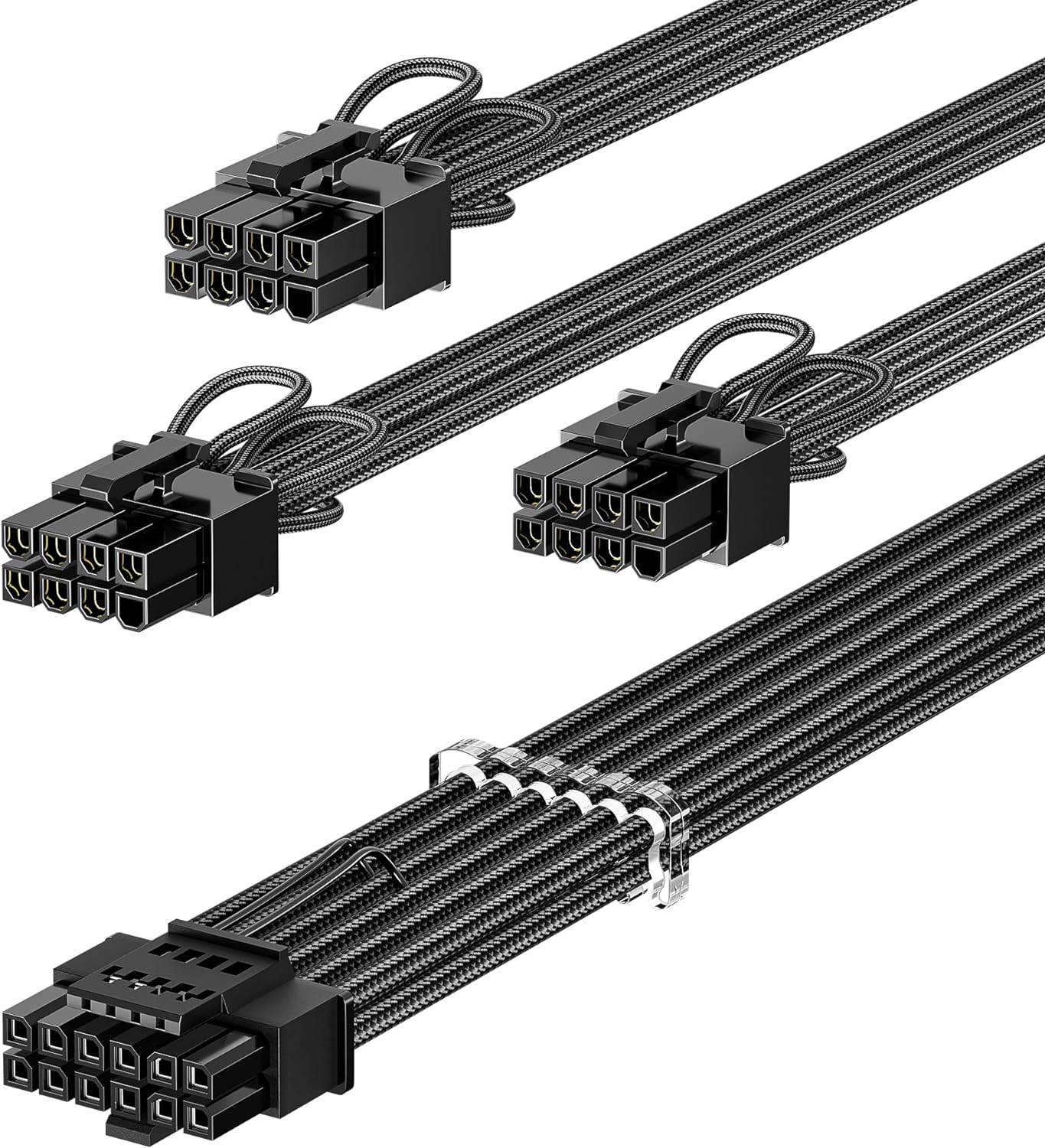
Power delivery. The RTX 4090's 450W TDP runs through a 12VHPWR (12+4 pin) connector on most cards. A dedicated cable — such as the Fasgear 600W PCIe 5.0 GPU Power Cable ($30.59) — routes more cleanly than a bundled adapter, which matters more in a liquid-cooled build where radiator and tubing placement already competes for case space.
Case clearance. A liquid-cooled 4090 needs a case that fits both the card and a radiator mount (typically 240mm–360mm depending on the kit). Mid-tower options like the Montech XR-W ($72.99) and Montech XR-B ($69.90), both ATX mid-towers with pre-installed ARGB fans, are sized for triple-fan radiators alongside a full-length GPU — worth checking the specific radiator dimensions of any AIO kit against a case's top or front mount before buying.
Display output. Driving a 4K high-refresh or 8K monitor off an RTX 4090 requires a cable rated for the bandwidth. The UGREEN 80Gbps DisplayPort 2.1 Cable ($23.48) supports 8K@60Hz and 4K@240Hz, ahead of what most bundled cables handle.
Who Should Buy an RTX 4090 AIO Kit in 2026
An RTX 4090 AIO kit is the right call for buyers who need sustained full-load performance — long AI generation batches, local LLM inference sessions, or extended 4K gaming — and want to avoid the noise and thermal ramp of a stock air cooler. It's not a meaningful upgrade path for buyers who already own an air-cooled RTX 4090 and use it in short sessions, and it doesn't change the underlying generational gap against the RTX 5090 covered above. Buyers not yet committed to the 4090 specifically should weigh the RX 7900 XTX's lower price and the RTX 5090's higher ceiling against what a liquid-cooled 4090 currently costs on the used and open-box market before deciding.
Citations and sources
- https://www.nvidia.com/en-us/geforce/graphics-cards/40-series/rtx-4090/
- https://www.nvidia.com/en-us/geforce/graphics-cards/40-series/rtx-4090/specifications/
- https://www.techpowerup.com/gpu-specs/geforce-rtx-4090.c3889
- https://www.amd.com/en/products/graphics/desktops/radeon/7000-series/amd-radeon-rx-7900-xtx.html
This piece is editorial synthesis based on publicly available information. No independent first-party benchmarking is reported.