The short answer: if "future-proofing" means raw headroom for tomorrow's games and AI workloads, the RTX 4090's 24GB of VRAM is the safer long-term bet. If it means access to NVIDIA's newest features, the RTX 5080's DLSS 4 support is the stronger argument. They're future-proofing against different things, and conflating the two is where most buying-guide confusion starts.
RTX 5080 vs RTX 4090: Specs Compared
| Spec | RTX 5080 | RTX 4090 |
|---|---|---|
| Architecture | Blackwell (GB203) | Ada Lovelace (AD102) |
| CUDA cores | 10,752 | 16,384 |
| Memory | 16GB GDDR7 | 24GB GDDR6X |
| Memory bus | 256-bit | 384-bit |
| Memory bandwidth | ~960 GB/s | ~1,008 GB/s |
| TDP | 360W | 450W |
| Launch MSRP | $999 | $1,599 |
| Launch date | January 2025 | October 2022 |
| DLSS 4 Multi Frame Generation | Yes | No (DLSS 4 upscaling only) |
Source: NVIDIA's official RTX 5080 and RTX 4090 product pages and TechPowerUp's GPU database — see Citations below.
On paper, this isn't a clean generational win. The RTX 5080 is a newer architecture with a newer memory standard (GDDR7), but it's built on a smaller die than the 4090 and shipped with fewer CUDA cores and less total VRAM. That's the core tension behind the "future-proofing" question: NVIDIA didn't replace the 4090 with something strictly bigger, it replaced it with something differently balanced.
The VRAM Question: Why 24GB Still Matters
VRAM capacity is the single spec that ages a GPU fastest. Texture packs, 4K asset streaming, and local AI model weights all scale with available memory, and a card that runs out of VRAM stutters or fails to load regardless of how fast its cores are. The RTX 4090's 24GB gives it meaningfully more headroom than the 5080's 16GB for memory-hungry use cases — high-resolution texture mods, large local LLM context windows, and multi-tasking between a game and background AI tools.
This is the same trade-off SpecPicks covers on the system-memory side in 48GB vs 64GB DDR5 for Gaming and AI: more headroom rarely helps today's workloads, but it directly determines which workloads you can run two or three years from now without hitting a wall. For readers cross-shopping the rest of NVIDIA's current stack, RTX 5090 vs RTX 3090 and RTX 5090 vs RX 9070 XT cover how the flagship-tier cards handle the same VRAM calculus at a higher price point.
Gaming Performance: Where Each Card Wins
In native rasterization — no upscaling, no frame generation — the RTX 4090's larger core count and memory bandwidth advantage tend to keep it ahead of the 5080 at 4K, with the margin varying by title and by how memory-bandwidth-bound a given game engine is. That gap narrows, and in some DLSS 4-supported titles reverses, once Multi Frame Generation is switched on for the 5080, since it's generating additional interpolated frames the 4090 architecturally cannot produce.
What that means practically: a buyer who plays primarily competitive, latency-sensitive titles (where frame generation adds input latency) gets less benefit from the 5080's headline feature and should weigh the 4090's raw throughput more heavily. A buyer who plays single-player, visually heavy titles with DLSS 4 support gets more real-world benefit from the 5080's feature set.
DLSS 4 and Multi Frame Generation: The Real Future-Proofing Argument
Per NVIDIA's DLSS documentation, DLSS 4's Multi Frame Generation is gated to RTX 50-series (Blackwell) hardware — it isn't available on the RTX 4090 even though the 4090 does get DLSS 4's improved transformer-model upscaling and Ray Reconstruction. That hardware gate is the strongest version of the 5080 future-proofing argument: as more titles add DLSS 4 support, the 5080 gains a growing library of games where it can out-frame the 4090, while the 4090 is capped at older frame-generation approaches indefinitely.
The counter-argument is that Multi Frame Generation is a software feature riding on hardware NVIDIA controls, and its value depends entirely on adoption — a 4090 doesn't lose any of its current capability while it waits.
Content Creation and AI Workloads
For content creation and local AI inference, VRAM capacity generally matters more than architecture generation. Workloads like large local language models, high-resolution video timelines, and 3D rendering with large scene data are typically memory-bound before they're compute-bound, which is why the 4090's 24GB continues to see recommendations in AI-workstation contexts despite being a two-generations-back architecture at this point. Readers building a dedicated AI or content rig should also see RTX 5090 vs RTX 3090 for how the top-end cards in each generation compare on this same axis.
Price and Availability in 2026
At launch MSRP, the RTX 5080 ($999) undercut the RTX 4090 ($1,599) by $600, per NVIDIA's pricing pages. That gap has narrowed and shifted since — NVIDIA has moved its current retail lineup to RTX 50-series cards, so new RTX 4090 stock has become scarcer and is increasingly sold through secondary channels or remaining retailer inventory rather than at original MSRP. Anyone comparing the two today should check current street pricing directly rather than relying on 2025 launch numbers, since the RTX 4090's relative value depends heavily on what a given listing is actually charging.
Power, Connectors, and Build Considerations
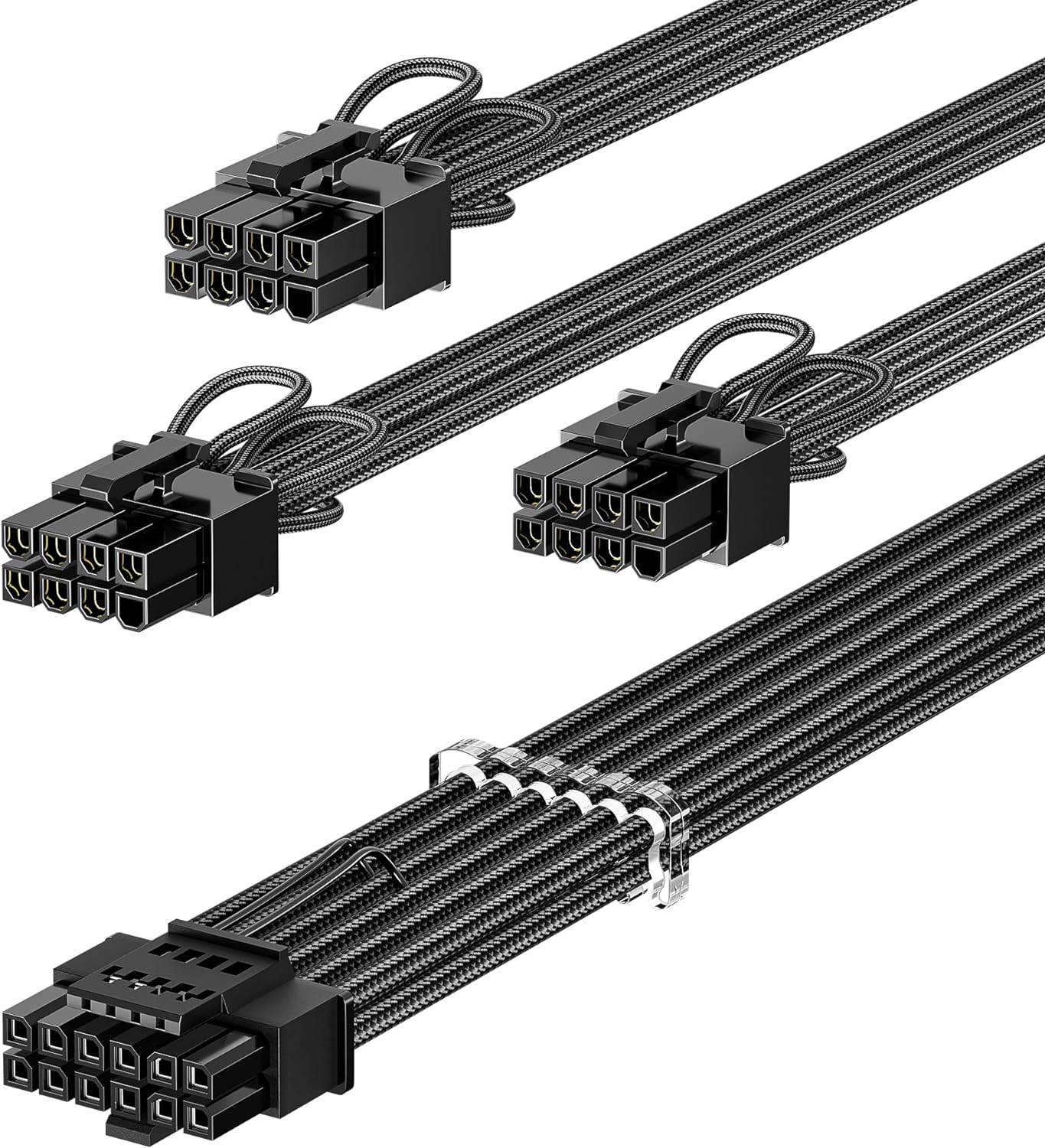
Both cards use the 16-pin (12+4) 12VHPWR-style power connector, so PSU and cable planning is similar either way. The RTX 4090's higher 450W TDP versus the 5080's 360W TDP (per NVIDIA's spec sheets) means a 4090 build generally wants a higher-headroom PSU and better case airflow. For either card, a sleeved PCIe 5.0 12VHPWR cable — like the Fasgear 600W PCIe 5.0 GPU power cable or the Fasgear 16-pin to 3x 8-pin PCIe 5.0 adapter — is worth budgeting for if the PSU doesn't already include a native 12VHPWR cable.
Buying a Prebuilt or Laptop Instead
Not everyone is building from parts. The Lenovo Legion Pro 7i Gen 10 pairs a mobile RTX 5080 with an Intel Ultra 9 275HX for buyers who want the newer architecture's DLSS 4 support in a laptop form factor — worth noting that mobile RTX 5080 performance is a different tier than the desktop card compared throughout this article. On the desktop side, the Skytech Gaming Azure 3 pairs a Ryzen 7 9800X3D with a current-gen RTX GPU as a ready-built option for buyers who'd rather skip sourcing individual parts, including the power cables discussed above.
Verdict: Which Should You Buy?
Neither card is the unambiguous future-proof choice — they're future-proof against different risks. Buy the RTX 4090 if the priority is VRAM headroom for AI, content creation, or texture-heavy modding, and if the price gap to a comparable RTX 5080 purchase isn't large. Buy the RTX 5080 if the priority is lower power draw, current warranty/availability, and growing access to DLSS 4 Multi Frame Generation in newer titles. Buyers deciding between other generational upgrades face a similar trade-off pattern — see 7800X3D vs 5700X3D: Is the AM5 Upgrade Worth It? and RX 580 in 2026: Still Worth It for 1080p Gaming? for how the same "newer features vs. more raw resource" calculus plays out at other price points.
FAQ
Is the RTX 5080 actually faster than the RTX 4090? Not consistently in native rasterization — the 4090 has more CUDA cores and bandwidth per NVIDIA's spec sheets. The 5080 closes or reverses the gap mainly with DLSS 4 Multi Frame Generation enabled.
Why does the older RTX 4090 have more VRAM than the newer RTX 5080? NVIDIA positioned the 5080 below its RTX 5090 flagship with a narrower 256-bit bus and 16GB GDDR7, while the 4090 kept the previous generation's flagship-tier 384-bit bus and 24GB GDDR6X.
Does DLSS 4 work on the RTX 4090? It gets DLSS 4's upscaling and Ray Reconstruction improvements, but Multi Frame Generation is limited to RTX 50-series hardware per NVIDIA's documentation.
Which card is better for AI and local LLM workloads? The RTX 4090's 24GB typically gives more headroom for local inference than the 5080's 16GB, since these workloads tend to be memory-bound.
Is the RTX 4090 still available to buy in 2026? New stock has thinned out as NVIDIA's current lineup shifted to RTX 50-series; remaining 4090 units are increasingly secondary-market or leftover retail inventory, so check current pricing before assuming it's the cheaper option.
Should I buy a prebuilt with an RTX 5080 instead of building my own? It's a reasonable option if you'd rather skip individual part sourcing — see the Lenovo Legion Pro 7i (laptop) and Skytech Gaming Azure 3 (desktop) linked above.
Citations and sources
- NVIDIA GeForce RTX 5080 official product page
- NVIDIA GeForce RTX 4090 official product page
- TechPowerUp GPU database: GeForce RTX 5080 specs
- TechPowerUp GPU database: GeForce RTX 4090 specs
- NVIDIA DLSS 4 technology overview
This piece is editorial synthesis based on publicly available information. No independent first-party benchmarking is reported.