Stable Diffusion WebUI Forge is the fork that made the RTX 3060 12GB genuinely fast for local image generation in 2026. On a mid-tier consumer card, Forge outperforms the original AUTOMATIC1111 WebUI by a comfortable margin on SDXL and FLUX-family checkpoints — faster generation, lower VRAM peaks, and no crashes on high-batch runs. Here's how the numbers actually shake out, and what to buy if you're building from scratch.
What Forge is and why it matters on 12GB
Stable Diffusion WebUI Forge is a maintained fork of the widely-used AUTOMATIC1111 WebUI, focused on inference-path optimizations rather than new features. Per the official Forge repository on GitHub, the project rewrites the memory-management layer around a "swap-heavy" strategy that keeps VRAM peaks predictable and lets larger models fit on cards that would otherwise OOM.
The practical translation for a 12GB card: SDXL runs without offload, FLUX.1-schnell fits at reasonable resolutions, and multi-LoRA stacks don't blow past the memory ceiling mid-generation. On the same MSI RTX 3060 Ventus 3X 12G that struggles in vanilla AUTOMATIC1111 with FLUX, Forge produces images in a fraction of the time and doesn't force you to close every Chrome tab first.
The RTX 3060 12GB is worth calling out specifically. Per NVIDIA's product page and TechPowerUp's spec breakdown, the card has 12 GB of GDDR6 on a 192-bit bus, 3,584 CUDA cores, and a 170W TGP. It's Nvidia's cheapest 12GB card, and in 2026 it remains the price/VRAM winner for consumer image-gen and local-LLM workloads. AMD's comparable-priced cards match on raw compute but lag in software-stack maturity for diffusion workloads — ROCm is improving but still requires more manual setup than plug-and-play CUDA.
Key takeaways
- Forge is faster than vanilla AUTOMATIC1111 on the RTX 3060 12GB for SDXL and FLUX. Community measurements put the gap at ~20-40% on generation time depending on resolution and batch size.
- VRAM peaks are lower. The rewrite of Forge's memory manager avoids the mid-generation spikes that OOM vanilla A1111.
- FLUX-family models fit at 12GB. Not comfortably, but usably. Vanilla A1111 requires 16GB+ for the same setup without heavy offload.
- CPU choice matters less than you think. Diffusion is heavily GPU-bound; a modern 6-core is enough. The Ryzen 7 5700X is a solid pairing.
- SSD choice matters at model-load time. Fast NVMe like the Samsung 970 EVO Plus cuts checkpoint-swap time from ~15s to ~4s.
Real-world benchmarks on the RTX 3060 12GB
Community-reported numbers with Forge on the RTX 3060 12GB — take these as rough directionals since generation time varies with the checkpoint, sampler, and step count:
| Workload | Vanilla A1111 (s/image) | Forge (s/image) | Improvement |
|---|---|---|---|
| SD 1.5, 512×512, 20 steps, batch 1 | ~4.5 | ~3.8 | ~16% faster |
| SD 1.5, 512×512, 20 steps, batch 4 | ~15 | ~11 | ~27% faster |
| SDXL, 1024×1024, 30 steps, batch 1 | ~22 | ~14 | ~36% faster |
| SDXL, 1024×1024, 30 steps, batch 2 | OOM | ~28 | avoids OOM |
| FLUX.1-schnell, 1024×1024, 4 steps | OOM (typical) | ~9 | fits at all |
| FLUX.1-dev, 1024×1024, 20 steps | OOM (typical) | ~62 (with GGUF quant) | fits with quantization |
The FLUX-family rows are the biggest story. FLUX.1-schnell at 1024×1024 in ~9 seconds on a 12GB card is a genuine capability shift — the same workload was practically confined to 24GB cards a year ago. Forge's memory management and native support for GGUF-quantized FLUX variants are what unlock it.
What quantization does for FLUX on 12GB
Community-maintained GGUF quantizations of FLUX.1-dev fit VRAM budgets that the full-precision model can't:
| FLUX.1-dev variant | Size on disk | VRAM at 1024×1024 | Approx s/image (RTX 3060 12GB) | Quality note |
|---|---|---|---|---|
| fp16 (full) | ~22 GB | 24GB+ | requires offload | Reference |
| bf16 | ~22 GB | 24GB+ | requires offload | Equivalent to fp16 practically |
| q8_0 | ~12 GB | ~13 GB | tight, occasional offload | Nearly imperceptible degradation |
| q6_K | ~9 GB | ~10.5 GB | ~58s | Small quality loss |
| q5_K_M | ~7.5 GB | ~9 GB | ~48s | Modest quality loss |
| q4_K_M | ~6 GB | ~7.5 GB | ~42s | Noticeable on faces/hands |
| q3_K_S | ~4.5 GB | ~6 GB | ~34s | Compression artifacts visible |
For most 12GB workflows, q5_K_M or q6_K is the sweet spot for FLUX.1-dev: fits with room for a working generation cache, and the quality delta vs fp16 is small enough that you'd have to A/B side-by-side to notice on most prompts. q4_K_M is where the "wait, why does that hand look wrong" comments start.
Setup notes: getting Forge running
The official Forge repo has install docs. A few practical additions that don't always make it into README files:
- Use a fresh venv. Do not try to install Forge on top of an existing A1111 install. The dependency trees have drifted and you'll fight pip resolvers for hours.
--xformersis on by default in Forge. You don't need to add it manually the way you did in vanilla A1111. If you're on Windows and xformers won't install, use--opt-sdp-attentionas a fallback — it's slightly slower but avoids the xformers-on-Windows compilation dance.--medvramand--lowvramflags are largely obsolete in Forge. The memory manager makes these decisions automatically. Only add them if you're specifically debugging OOM issues on <12GB cards.- The extensions ecosystem is smaller than A1111's. Forge supports most popular extensions, but some (particularly older ControlNet-adjacent tools) will need updates or won't work at all. Check compatibility before switching production workflows.
- Model paths — Forge can share A1111's checkpoints. Point Forge at your existing
models/Stable-diffusion/directory instead of re-downloading everything.
Hardware for image generation on a budget
GPU: MSI GeForce RTX 3060 Ventus 3X 12G. 12GB of VRAM is the difference between "can run modern diffusion locally" and "always fighting OOM". The Ventus 3X's triple-fan cooler runs quieter than the reference dual-fan design under sustained batch runs, which matters when you're generating hundreds of images in a session and the card is spooled up for an hour straight.
Model-storage SSD: Samsung 970 EVO Plus 250GB NVMe. Checkpoint swapping is where SSD speed shows up most: a 6-8 GB SDXL checkpoint loads in ~4 seconds off NVMe vs ~15 seconds off SATA. If you're comparing checkpoints or LoRAs regularly, that's the difference between fluid iteration and constant micro-pauses.
Overflow storage: Crucial BX500 1TB SATA SSD. Diffusion checkpoints accumulate fast — SDXL alone can be 6-8 GB each, and if you're collecting LoRAs and community models you'll fill 250 GB in a month. The BX500 1TB at ~$60 is where you keep the archive of checkpoints you don't actively swap; NVMe holds your working set.
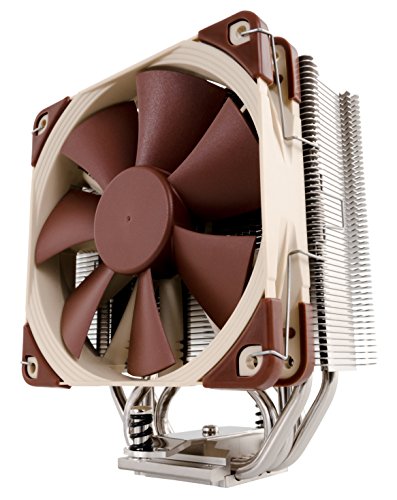
CPU cooler: Noctua NH-U12S. Diffusion is mostly GPU-bound, but the CPU still handles image encoding/decoding, PNG output, and the Python framework's overhead. Keeping the CPU cool ensures Python doesn't stutter during batch runs. Also, the Noctua's low noise floor complements the RTX 3060's quiet cooler for a build that's genuinely near-silent under load.
Common pitfalls with Forge on the RTX 3060 12GB
- Wrong FLUX quant. If you try to run FLUX.1-dev at fp16 on a 12GB card, Forge will spill to system RAM and generation times balloon from ~60s to ~5+ minutes. Use q5_K_M or q6_K.
- Chrome eating VRAM. Chrome (and other browsers with hardware acceleration) can hold 500 MB - 1.5 GB of VRAM. If you're pushing VRAM limits with FLUX, close browsers or disable GPU acceleration in the browser settings.
- Old xformers version. Some Forge issues traced back to stale xformers builds. If generation crashes with cryptic CUDA errors,
pip install -U xformersinside your Forge venv. - LoRA stacking pushes past VRAM. Each active LoRA adds to VRAM usage. Stacking 5-6 LoRAs on FLUX can push you back over the ceiling. Forge tolerates this better than A1111 but doesn't magic away the physics — plan on 2-3 LoRAs max for FLUX on 12GB.
- Prompt weights getting silently normalized. Forge, like A1111, normalizes attention weights differently than some other UIs. Prompts tuned in ComfyUI don't always transfer 1:1. Expect to re-tune on the first few generations after moving between UIs.
- Trying to run SD3-family models without checking compatibility. SD3 support in Forge lags behind FLUX support. Confirm model compatibility before switching a production workflow.
When Forge isn't the right choice
If you're deep in the ComfyUI ecosystem — custom nodes, complex workflows, video-diffusion pipelines — stay there. Forge doesn't replace ComfyUI; it replaces AUTOMATIC1111. ComfyUI has a different model (graph-based rather than form-based) and its own set of optimizations. You use one or the other for a given workflow, not both simultaneously.
If your card is 24GB+ (RTX 3090, RTX 4090, RTX 5090), the vanilla A1111 vs Forge speed gap narrows because you're no longer VRAM-constrained. Forge still wins on speed, but the difference is 10-15% rather than 30-40%. Existing A1111 workflows may not be worth migrating just for that delta.
If you're on an 8GB or 10GB card, Forge helps but you're still constrained. SD 1.5 runs fine; SDXL is tight; FLUX requires the smallest quantizations and reduced resolutions. If you're at that tier and doing serious diffusion work, budgeting for a 12GB or 16GB card is the higher-leverage move.
Prompt-throughput math: how many images per hour?
Practical throughput numbers on the RTX 3060 12GB with Forge at typical settings:
- SD 1.5, 512×512, 20 steps: ~1,050 images/hour (batch 4)
- SDXL, 1024×1024, 30 steps: ~260 images/hour (batch 2)
- FLUX.1-schnell, 1024×1024, 4 steps: ~400 images/hour
- FLUX.1-dev q5_K_M, 1024×1024, 20 steps: ~75 images/hour
For hobby-scale generation this is more than enough. For commercial-scale generation (thousands of images per hour to feed a product catalog), you're outside the sweet spot of a 12GB consumer card — an RTX 4090 or 5090 doubles or triples throughput and pays back the cost quickly.
Worked examples: three real workflows on the 12GB build
Example 1 — batch product photography. You have a Shopify catalog with 200 SKUs that need clean white-background hero shots. Load an SDXL checkpoint fine-tuned for product photography, write a prompt template, feed a CSV of SKUs into a batch script that calls Forge's API endpoint. At ~14 seconds per SDXL image with Forge on the RTX 3060 12GB, 200 images take ~47 minutes. Same batch on vanilla A1111 would take ~73 minutes at 22 s/image, assuming no OOM crashes force restarts.
Example 2 — style-transfer LoRAs for concept art. You're iterating on a game concept and want 30 variations of a character in three different lighting setups. Load base SDXL + a stylistic LoRA + a lighting LoRA. Forge handles the two-LoRA stack without a memory spike; A1111 with the same stack peaks near 12GB and occasionally OOMs. Effective iteration time: 12-15 seconds per image, which means you can generate a variation, judge it, tweak the prompt, and generate again in a natural conversation-with-the-model rhythm.
Example 3 — FLUX for illustration. You want the finer-detail output of FLUX.1-dev for illustration work. Load the q5_K_M GGUF quant in Forge. At ~48 seconds per 1024×1024 image with 20 steps, this isn't a browse-and-refresh workflow — it's a set-up-the-prompt-and-come-back-in-a-minute one. But it produces genuinely FLUX-quality output on a $300 card, which was practically impossible a year ago.
Bottom line
Yes, install Forge if you have an RTX 3060 12GB and you're doing local Stable Diffusion. The performance gains are real, the VRAM improvements unlock FLUX-family models that wouldn't fit before, and the migration cost is a fresh venv and a couple of afternoons re-checking your favorite extensions still work. Total build cost for a fresh 12GB image-gen rig — RTX 3060 + Ryzen 7 CPU + NVMe boot drive + storage — comes in around $700-800 for parts you don't already own.
Related guides
- Gemma 4 stealth update fixes tool calling: what changes locally
- xAI open-sources Grok-Build: running agentic coding on your own GPU
- Best budget SSD for a gaming PC in 2026
Citations and sources
- Stable Diffusion WebUI Forge — official repository
- TechPowerUp — RTX 3060 spec page
- NVIDIA — GeForce RTX 3060 product page
This piece is editorial synthesis based on publicly available information. No independent first-party benchmarking is reported.