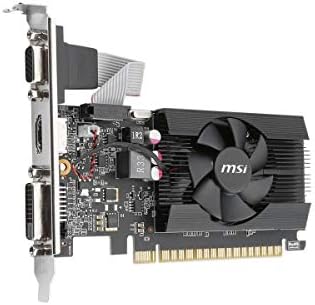

GIGABYTE GV-N1030D4-2GL NVIDIA GeForce GT 1030 Low Profile D4 2G Graphics Card
Bottom line: The GIGABYTE NVIDIA GeForce GT 1030 Low Profile D4 2G Graphics Card ($137.58 on Amazon as of 2026-10-20 22:18 UTC): 150 mm low-profile card fits SFF, HTPC, and slim OEM cases; main trade-off: DDR4 memory, not GDDR5 — noticeably less bandwidth for the same core.
As an Amazon Associate, SpecPicks earns from qualifying purchases. Full disclosure →
*Price sourced from Amazon.com. Last updated 2026-10-20. Price and availability subject to change.
Pros & Cons
Pros
- ✓ 150 mm low-profile card fits SFF, HTPC, and slim OEM cases
- ✓ HDMI plus DVI-D covers both modern panels and older DVI monitors
- ✓ Drives up to 4096x2160 at 60Hz for a single 4K desktop
- ✓ One-click OC via AORUS Graphics Engine lifts boost to 1417 MHz
Cons
- ✗ DDR4 memory, not GDDR5 — noticeably less bandwidth for the same core
- ✗ 64-bit memory bus is a hard ceiling on gaming throughput
- ✗ 2GB VRAM limits texture settings in anything recent
- ✗ No DisplayPort — DP-only monitors need an adapter
Manufacturer description
The GIGABYTE GT 1030 Low Profile D4 2G is a single-slot, 150 mm graphics card built for small-form-factor and retro PC builds where a modern GPU physically will not fit. It pairs the NVIDIA GeForce GT 1030 core with 2GB of DDR4 memory on a 64-bit bus, and it drives displays over HDMI and DVI-D at up to 4096x2160 at 60Hz. Clocks run at 1177 MHz base / 1417 MHz boost in OC mode and 1151 MHz base / 1379 MHz boost in gaming mode, switchable through the AORUS Graphics Engine's one-click overclock. That makes it a practical answer when you need dual-monitor output, video playback, or DVI-D…
SpecPicks Verdict
SpecPicks scored GIGABYTE NVIDIA GeForce GT 1030 Low Profile D4 2G Graphics Card using a rating × review-volume × price-fit model applied to published specs and reviews across the retro graphics cards category. Compare with similarly-priced alternatives in the retro graphics cards category before committing. Judge it on the specification table and the price rather than on sentiment: check the figures that decide your use case, then put it side-by-side with two or three close alternatives in the Compare tool before clicking through.
Common buyer scenarios for retro graphics cards of this kind: matching it to an existing build, replacing a failing part, or upgrading from a previous-generation equivalent. Check the spec table below against your current setup — particularly socket / form-factor / power-rating fields — and confirm compatibility on the retailer's listing before purchase. Prices and stock are set by the retailer and may have moved since this page was last updated.
Frequently Asked Questions
Will this run modern games?
No. The GT 1030 with 2GB of 64-bit DDR4 is an entry-level display card. Plan on desktop use, media playback, and older or very light titles rather than current AAA games.
Does it fit in a low-profile or small-form-factor case?
Yes. It uses a low-profile design with a 150 mm card length, which is the target size for SFF, HTPC, and slim OEM desktops. Confirm your case's bracket height and clearance before ordering.
What display outputs does it have?
One HDMI and one DVI-D. Maximum resolution is 4096x2160 at 60Hz. There is no DisplayPort output, so a DP monitor would need an adapter.
What are the actual clock speeds?
In OC mode it runs a 1177 MHz base and 1417 MHz boost; in gaming mode it runs 1151 MHz base and 1379 MHz boost. You switch between them with one click in the AORUS Graphics Engine.
How is the DDR4 version different from the GDDR5 GT 1030?
This card is the D4 variant, meaning 2GB of DDR4 rather than GDDR5. The GPU core is the same GT 1030, but DDR4 delivers less memory bandwidth, so expect lower performance than a GDDR5 GT 1030.
Key Features
- Powered by GeForce gt 1030
- Integrated with 2GB DDR4 64bit Memory
- Low profile design with 150 mm card length
- One-click overclocking via AORUS Graphics Engine. Max resolution:4096x2160, 60Hz.Avoid using unofficial software
- Boost: 1417 MHz/base: 1177 MHz in OC mode, boost: 1379 MHz/base: 1151 MHz in gaming mode
Full Specifications
| Boost | 1417 MHz/base: 1177 MHz in OC mode, boost: 1379 MHz/base: 1151 MHz in gaming mode |
|---|---|
| Brand | GIGABYTE |
| Weight | 2g |
| Model Name | GV-N1030D4-2GL |
| Unit Count | 1 Count |
| Model Number | GV-N1030D4-2GL |
| Compatibility | PC |
| Built-In Media | GRAPHIC CARD, USERS MANUAL |
| Item Type Name | GIGABYTE GeForce GT 1030 GV-N1030D4-2GL Low Profile D4 2G Computer Graphics Card |
| Number of Fans | 1 |
| GPU Clock Speed | 1417 megahertz |
| Mfr Part Number | GV-N1030D4-2GL |
| Number of Items | 1 |
| Number of Packs | 1 |
| Video Processor | NVIDIA |
| Antenna Location | Gaming |
| Graphics Card Ram | 2 GB |
| Graphics Ram Size | 2 GB |
| Graphics Ram Type | GDDR4 |
| Compatible Devices | Desktop |
| Full listing title | GIGABYTE GV-N1030D4-2GL NVIDIA GeForce GT 1030 Low Profile D4 2G Graphics Card, Compatible with PC, HDMI, DVI-D |
Ready to buy?
GIGABYTE GV-N1030D4-2GL NVIDIA GeForce GT 1030 Low Profile D4 2G Graphics Card, Compatible with PC, HDMI, DVI-D is listed on Amazon. Price, availability, shipping and returns are set by Amazon and its sellers — check the listing for current terms. SpecPicks earns a small commission on qualifying purchases — thank you for supporting independent review work.
*Price sourced from Amazon.com. Last updated 2026-10-20. Price and availability subject to change.
Related Retro Graphics Cards


More guides & deep dives from the SpecPicks archive
Browse all articles & guides →- Best 1440p Gaming GPUs in 2026
- RTX 4070 Super vs RX 7800 XT — Which to Buy in 2026
- Best Budget Gaming PC Build 2026 — ~$1,000 ($800 on Sale)
- Emulation Hardware in 2026: FPGA, Software, and Cart-Reader Ecosystems
- The Complete Voodoo5 5500 AGP Driver Guide (2026 Edition)
- How to Build a Windows 98 Retro PC in 2026
- Best Retro Handhelds in 2026 — From $35 to $500
More reviews from the SpecPicks archive
Browse all reviews →- Modern Retro Console Mods: 2026 Upgrade Guide
- Best CPU for Gaming in 2026: Intel vs AMD Showdown
- RTX 5090 AI Build Guide: CPU, RAM, PSU & Cooling for Local Inference
- Open WebUI + Ollama on an RTX 3060: The Self-Hosted ChatGPT Alternative for 2026
- Imaging Big-Box CD-ROMs to CompactFlash for a Windows 98 Retro PC
- Forza Horizon 6 on Steam Deck: Best Settings, Dock & Storage in 2026
- Qwen3 8B: Raspberry Pi 4 8GB vs RTX 3060 12GB (2026)
- Watching a Z80 Live From a Raspberry Pi RP2350
- Best Gaming Room Lighting in 2026: LED Strips and Ring Lights
- Upgrading a Ryzen 7 5800X + RTX 4080 Build in 2026
- Hy3-Preview vs DeepSeek V4 Flash: Where the New Open-Weights Model Actually Lands
- Ryzen 7 5700X vs 5800X for 1080p & 1440p Gaming in 2026
- Best USB Microphone for Streaming in 2026
- Best SSD for a Retro PC Build: CompactFlash vs SATA in 2026
- Meta's AI Bill Hits Billions: The Case for Local Inference on a $300 GPU
- vLLM 0.21 Adds Intel GPU Support: What It Means for Budget AI Rigs
- AMD Instinct MI300X vs Radeon RX 7600 XT: Datacenter vs Desk
- Best Single-Board Computers for Home Lab in 2026
- Continuous Blood Pressure Monitoring Without a Cuff in 2026
- ZOTAC vs MSI RTX 3060 12GB: Which Twin-Fan Card Should You Buy in 2026?
- Best Budget Gaming Mouse Pad for Esports in 2026
- Imaging a 90s IDE Hard Drive with a SATA/IDE-to-USB Adapter: The Retro-PC Data-Rescue Workflow
- Best Streaming Gear for New Streamers in 2026: 5 Picks to Start On-Air
- Building a New Gaming PC in 2026: The Complete Guide
Earliest SpecPicks reviews
Browse full archive →- Best GPU for Llama 3.1 8B (2026)
- Best GPU for Qwen 3 14B (2026)
- Best GPU for Qwen 3 32B (2026)
- Best GPU for Llama 3.1 70B (2026)
- Best GPU for DeepSeek-R1 32B (2026)
- Best GPU for Llama 3.1 405B (2026)
- How to run Llama 3.1 8B on NVIDIA GeForce RTX 5090
- How to run Qwen 3 14B on NVIDIA GeForce RTX 5090
- How to run Qwen 3 32B on NVIDIA GeForce RTX 5090
- How to run Llama 3.1 70B on NVIDIA GeForce RTX 5090
- How to run DeepSeek-R1 32B on NVIDIA GeForce RTX 5090
- How to run Llama 3.1 8B on NVIDIA GeForce RTX 4090