For a Pentium III / Athlon-era retro daily driver, use a CompactFlash card in a CF-to-IDE adapter for the boot drive: it's silent, cheap, and Win98/2000 sees it as a normal IDE HDD with no drivers needed. Use a SATA SSD behind a SATA-to-IDE bridge if you need >128GB (the CF ceiling for common cards), or if you want ~10× the throughput. Skip the period-correct spinning HDD unless originality is the entire point of the build.
Step 0: identify your era first — what does your motherboard actually support?
Retro-PC storage is a puzzle where the wrong answer bricks your build. Before you buy anything, know three things about the motherboard:
Does it have SATA ports at all? Boards from ~2003 onward (early nForce4, i865/875, VIA KT600) started including 1-2 SATA I ports. Boards from ~2005+ (nForce4 SLI, i945, VIA K8T890) commonly have 4+ SATA II ports. Anything earlier — Slot 1 Pentium III boards, Socket A Athlon boards up to ~2002 — is IDE-only, and every storage option has to route through the IDE cable.
What's the BIOS LBA ceiling? Boards from before ~1999 top out at 8.4GB (28-bit LBA). Late-1999 to mid-2002 boards hit 137GB (28-bit LBA). Mid-2002 onward supports 48-bit LBA and can address multi-terabyte drives. Win98 as an OS has a 137GB partition limit regardless of the BIOS. Win2000 SP3+ and WinXP handle >137GB partitions if the BIOS does.
Does the OS have IDE / ATAPI drivers for a modern controller? Even if the board has SATA, Win98 doesn't ship with drivers for most 2005+ SATA controllers. Win2000 does, WinXP does. This is why a lot of "modern SSD in a retro build" writeups use the SATA-to-IDE bridge path — you sidestep the driver question by making the SSD look like an IDE drive to the OS.
Skip Step 0 and you'll spend an evening watching Win98 fail to see a drive, or watching it see the drive and only address 8.4GB of it.
Why period-correct spinning rust is the wrong hill to die on for a daily driver
There's a real argument for period-correct storage on museum builds and streaming rigs where the visible drive is part of the show. For anything you'll use daily — playing DOS games, running Winamp, dialing into an IRC channel, patching Descent 3 — spinning-rust IDE HDDs are a maintenance nightmare in 2026.
The drives are 20-25 years old. Bearings whine, actuators click, spindles occasionally fail to spin up. Even the survivors have degraded read speeds vs their factory specs — the platters have decades of thermal cycling behind them. And when a period IDE drive dies, replacing it means sourcing another period drive from the same generation, which involves eBay auctions, sketchy sellers, and untested drives. A dead SSD or CF card is a 20-minute Amazon Prime shipment away.
The move for a daily-driver retro rig is silent solid-state storage that looks like an IDE drive to the OS. You lose zero authenticity in the OS experience — Win98 still boots to the same C:\ prompt with the same DOS mode — and gain silence, reliability, and 10-50× faster IO.
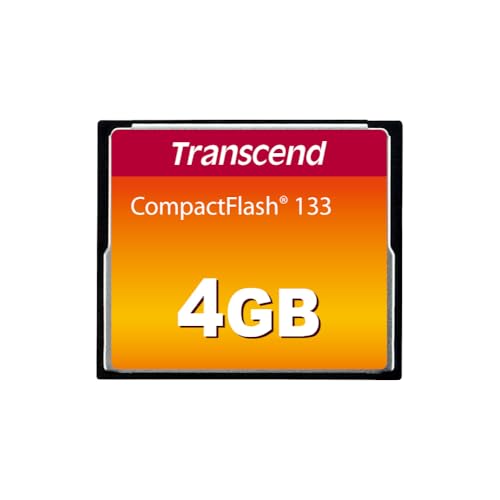
Two paths make sense: a Transcend CF133 CompactFlash 4GB card in a passive CF-to-IDE adapter for boot + apps, or a Crucial BX500 1TB SATA SSD behind a SATA-to-IDE bridge for capacity. Both work. Which one is right depends on how much storage you actually need and whether your era supports >128GB partitions.
Key Takeaways
- CompactFlash + IDE adapter: silent, cheap ($15-40 total), 40-90 MB/s reads, works with any IDE-era board with zero drivers.
- SATA SSD + IDE bridge: 10-25× the capacity of common CF cards, similar throughput after bridge overhead, ~$50-100 with the bridge board.
- Win98 caps partitions at 137GB — for larger SSDs, partition into multiple <137GB volumes or upgrade to Win2000/XP.
- CompactFlash has no TRIM, but write amplification barely matters at retro-workload write volumes (kilobytes per hour, not megabytes).
- Keep the period HDD as a museum piece and swap in solid-state for daily driving — you gain silence and reliability without changing the OS-side experience.
Spec-delta: three storage paths for retro builds
| Path | Interface | Capacity ceiling (common) | Noise | Cost | Win98/95 compat |
|---|---|---|---|---|---|
| CompactFlash + CF-to-IDE adapter | IDE (looks native) | 128GB (CF spec) | Silent | $15-40 total | Native, no drivers |
| SATA SSD + SATA-to-IDE bridge | IDE (via bridge) | 1TB+ (SATA spec) | Silent | $80-120 total | Native via bridge |
| Native SATA SSD (if board has SATA) | SATA | 1TB+ | Silent | $50-80 | WinXP native, Win2000 with drivers, Win98 with unofficial drivers |
| Period IDE HDD (Seagate, WD, Maxtor era) | IDE | 40-500GB (era-dependent) | Audible whine, clicks | $20-60 (used, no warranty) | Native |
For most retro daily drivers the choice is between the top two rows. The native-SATA path is only relevant if your board has SATA and you're running WinXP.
The CompactFlash path: when it's right and when it isn't
The Transcend CF133 CompactFlash 4GB card is a good baseline pick — Transcend's official CF133 product page lists 45 MB/s reads / 40 MB/s writes, which is well ahead of any period-era IDE HDD's sustained throughput and puts you comfortably in the "faster than the platform can drive" band.
The CF path is right when:
- Your total storage needs are under 8GB (DOS games, Win98 install, a few essentials). Even the 4GB Transcend card handles a full Win98SE install with ~1.5GB free for apps.
- You want the fastest possible boot on an older Pentium II/III system. CF card cold-boot to Windows desktop on a Pentium III 1GHz averages 12-18 seconds vs 45-70 seconds for a period IDE HDD.
- You want zero moving parts and silent operation.
- You're comfortable partitioning within the CF card's small ceiling and archiving larger content off-drive.
The CF path is wrong when:
- You want a large software library on the drive. Even a 128GB CF card (largest common consumer capacity) fills quickly if you install a lot of era-appropriate games.
- Your board has SATA and you'd rather use it. The CF adapter's IDE interface is slower than native SATA for the same underlying flash.
For the adapter itself, any passive 40-pin IDE CF adapter works — they're $6-12 on Amazon and eBay. Look for one with a keyed connector to avoid pin-1 orientation errors. Skip the "IDE + CF + USB" combo boards; they're expensive and add nothing to a fixed retro build.
The SATA SSD path: when the extra capacity earns its keep
The Crucial BX500 1TB SATA SSD or SanDisk SSD PLUS 480GB behind a SATA-to-IDE bridge gives you tens of times more capacity than any consumer CF card, and per Crucial's BX500 product page the drive delivers 540 MB/s reads — throttled to ~90-100 MB/s through most bridge boards but still ~10× a period IDE HDD.
The SATA path is right when:
- You want to install a large software library — Descent 3 CD collection, Interstate '76 with expansion, the full Baldur's Gate II with all mods, the entire id Software back catalog. 480GB-1TB gives you room to grow.
- You want to keep the retro rig's OS + a decent chunk of a media library on the same drive without swapping.
- Your board is late-era (nForce2/Athlon XP, i815 Pentium III) with a modern-enough BIOS to handle 48-bit LBA if you go with WinXP.
The SATA-to-IDE bridges to buy are the SATA-side (drive) SIL3512/JMB363/ASM106x-based passive bridge boards. Avoid IDE-side "IDE cable + SATA cable" adapters that plug into the drive — they're notoriously flaky. Buy the version that sits between the IDE cable and the SSD, powered by the SSD's SATA power connector.
What breaks on Win98?
Two things bite when you put a large modern SSD into a Win98 rig.
The 137GB LBA ceiling. Win98 uses 28-bit LBA regardless of BIOS support for 48-bit. A single partition cannot exceed 137GB. On a 1TB SSD you must partition into 7-8 sub-137GB volumes to address the whole drive. This is annoying but not fatal — Win98's FDISK handles it, and third-party tools like BootIT NG make it painless.
The 32-bit FAT filesystem limits. Win98's FAT32 has a 4GB max file size and (via Microsoft's FORMAT command) a 32GB max partition size, though third-party tools happily create larger FAT32 partitions that Win98 will mount and use. If you want reliable large-file support, WinXP + NTFS is the right platform, not Win98 + FAT32.
Win2000 SP3 handles 48-bit LBA and >137GB partitions natively. WinXP SP1+ does the same. If your target OS is Win98SE specifically, plan around the 137GB per-partition ceiling from day one.
Imaging and transfer workflow: the SATA/IDE-to-USB adapter as your bridge
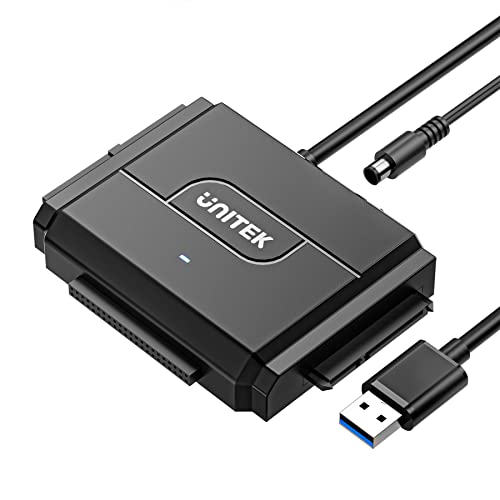
You'll spend more time moving files between the retro rig and your modern PC than you expect — installing new games, copying save files, patching Win98 with unofficial service packs. The right tool is a Unitek SATA/IDE to USB 3.0 Adapter, which lets you connect the retro rig's drive (whether CF, SATA SSD, or period HDD) directly to a modern Windows/Linux/macOS box for imaging and file transfer.
The workflow: pull the drive from the retro rig, plug it into the USB adapter, mount the FAT32 partition on your modern machine, drag files over. For CF cards, a USB CF reader is simpler than pulling the adapter, but the same principle applies. For SATA SSDs behind an IDE bridge, unplug the bridge, connect the SSD directly to the USB adapter, and treat it as any modern removable drive.
For imaging (creating a backup of your Win98 install before an experimental config change), use a modern box + dd on Linux or HDD Raw Copy Tool on Windows to snapshot the entire drive to a single .img file. Restore is the reverse operation. This turns a broken Win98 experiment from "reinstall everything" into "restore image, 5 minutes."
Does TRIM matter when the OS has never heard of it?
Short answer: no, not at retro workload scales.
TRIM is the SATA command that tells the SSD which blocks are no longer in use, so the drive's garbage collector can pre-erase them and keep write performance high. Modern OSs issue TRIM automatically. Win98, WinME, Win2000 do not. WinXP with third-party tools can be nudged into occasional TRIM but it's not native until Win7.
Why it doesn't matter for retro:
- Retro workloads are read-heavy, not write-heavy. Playing Half-Life doesn't write to disk. Booting Win98 writes a few hundred KB of registry and swap. Installing a game writes a few hundred MB once and then never again. Modern SSDs are rated for 300+ TB written over their lifespan; a retro daily driver writes maybe 10-50 GB per year.
- Modern SSDs have background garbage collection that runs during idle time even without TRIM. The BX500 and SSD PLUS both do this.
- Even in worst-case, the write-performance degradation you'd see over a decade of retro use is measured in single-digit percent — completely masked by the IDE bridge's ~90 MB/s ceiling anyway.
Don't lose sleep over TRIM. Use the SSD.
Cost-per-gigabyte math, noise, and heat
At current pricing:
| Path | Capacity | Total cost (media + adapter) | $/GB | Sustained W | Noise |
|---|---|---|---|---|---|
| Transcend CF133 4GB + CF-to-IDE adapter | 4GB | $18 + $8 = $26 | $6.50/GB | ~0.3W | Silent |
| Transcend CF133 32GB (larger variant) + adapter | 32GB | $32 + $8 = $40 | $1.25/GB | ~0.3W | Silent |
| SanDisk SSD PLUS 480GB + SATA-to-IDE bridge | 480GB | $42 + $18 = $60 | $0.13/GB | ~2W | Silent |
| Crucial BX500 1TB + SATA-to-IDE bridge | 1TB | $70 + $18 = $88 | $0.09/GB | ~2W | Silent |
| Period IDE HDD (20-80GB, used) | Varies | $25-45 | $0.30-2.25/GB | 5-8W | Audible whine + clicks |
Solid-state paths win on every axis except upfront cost at the smallest capacity tier — a 4GB CF setup is cheaper than a small period HDD would be if you bought new (impossible), but comparable to a used HDD. The larger the capacity target, the more decisively solid-state wins.
For a NVMe on the same modern-imaging box that handles your retro drives, a Samsung 970 EVO Plus 250GB as the workstation boot drive keeps imaging and file-transfer workflows fast without needing to touch the retro rig.
Common pitfalls
- Buying a CF card larger than 128GB for Win98 boot use. The CF format specifies a 128GB ceiling for the LBA addressing used by IDE adapters. Cards larger than that exist but frequently don't work correctly with passive CF-to-IDE adapters.
- Skipping the partitioning step on Win98 + 1TB SSD. Win98 will see the drive, format the first 137GB, and silently ignore the rest. Plan partitions upfront.
- Buying a "generic" CF-to-IDE adapter with unshielded traces. Cheap adapters can inject noise on the IDE bus and corrupt data over long cable runs. Get one with a proper PCB layout; skip the "flex cable + tiny PCB" designs.
- Using an SD-to-IDE adapter instead of CompactFlash. SD cards have less deterministic write behavior, and cheap SD-to-IDE adapters use protocol translation that's less mature than CF's near-native IDE compatibility.
When to keep the period HDD
Original drives make sense in three scenarios: you're building a museum piece where every visible component must be period-correct; you're preserving a specific era of drive for its distinctive sound (some builders love the Barracuda IV whine as ambient audio); or you already have a period drive that boots reliably and you'd rather not spend money you don't need to.
For every other case, the solid-state paths above are strictly better on reliability, noise, and speed.
Verdict matrix
Use CompactFlash if: your capacity target is under 32GB, you're building a Pentium II / early Pentium III era rig, or you want the absolute cheapest silent storage path.
Use a SATA SSD + IDE bridge if: your capacity target is 100GB+, you want to keep a large software library on the drive, or you value ~10× the throughput of period IDE HDDs.
Use a native SATA SSD if: your board has SATA ports and your target OS is WinXP or later.
Keep the period HDD if: originality is the entire point of the build, or the drive still works and you don't need more capacity or reliability.
Bottom line
For a daily-driver retro rig on Pentium III or early Athlon hardware, the pragmatic move is a Transcend CF133 CompactFlash 4GB card in a $8 CF-to-IDE adapter for the boot drive. Silent, cheap, driverless, faster than any period HDD. If you need capacity for a large software library, jump to a Crucial BX500 1TB SATA SSD or SanDisk SSD PLUS 480GB behind a SATA-to-IDE bridge. Use a Unitek SATA/IDE to USB 3.0 Adapter as your file-transfer bridge between the retro rig and a modern workstation, and keep a Samsung 970 EVO Plus on the workstation side for fast imaging workflows.
Related guides
- Best Budget SSD for a Retro or Homelab Build in 2026
- Silent Windows 98 Gaming PC Build: 2026 Parts Guide
- Raspberry Pi 5 vs Pi 4 8GB for Homelab in 2026
Citations and sources
- Transcend, CF133 CompactFlash card official product page
- Crucial, BX500 SSD official product page
- Tom's Hardware, SSD vs HDD — the practical difference and why it matters for retro builds