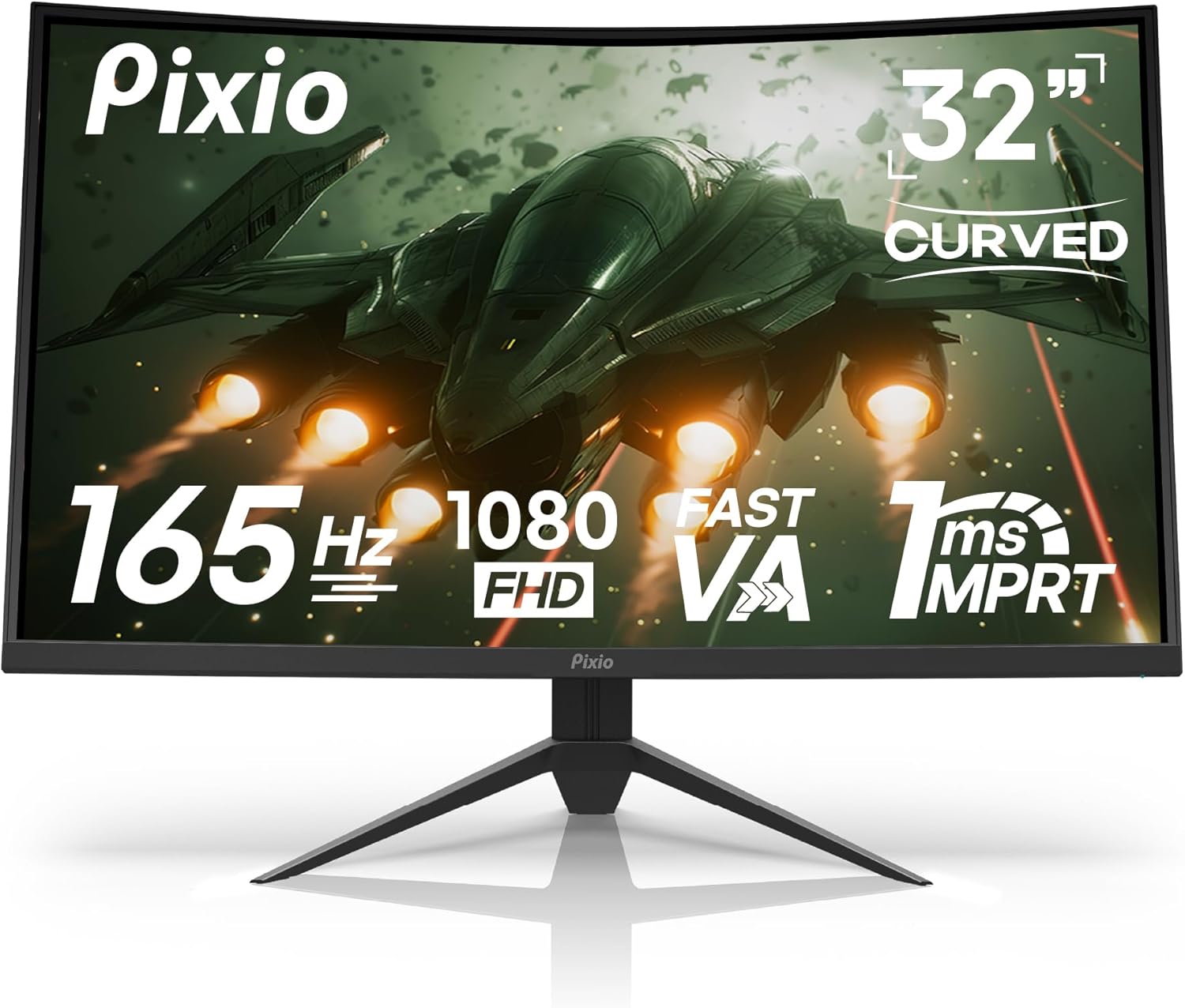
Pixio PXC325 32 inch 165Hz Refresh Rate FHD 1080p Resolution 1500R Curved VA Panel 1ms MPRT Response Time Adaptive Sync HDR Tilting Stand Gaming Monitor
Bottom line: The Pixio PXC325 32 inch 165Hz Refresh Rate FHD 1080p Resolution 1500R ($143.99 on Amazon as of 2026-10-06): 165Hz at native 1920x1080 over both DisplayPort 1.4 and HDMI 2.0; main trade-off: 1080p over 32 inches is roughly 69 PPI, so text looks coarse up close.
As an Amazon Associate, SpecPicks earns from qualifying purchases. Full disclosure →
*Price sourced from Amazon.com. Last updated 2026-10-06. Price and availability subject to change.
Pros & Cons
Pros
- ✓ 165Hz at native 1920x1080 over both DisplayPort 1.4 and HDMI 2.0
- ✓ 1500R curve on a 32-inch VA panel keeps screen edges in peripheral view
- ✓ 1ms MPRT targets ghost-free fast pans and flick shots
- ✓ Adaptive Sync prevents tearing when frame rates fall under 165 fps
Cons
- ✗ 1080p over 32 inches is roughly 69 PPI, so text looks coarse up close
- ✗ Listing calls it ultrawide, but it is a standard 16:9 1080p panel
- ✗ Tilt-only stand, no height, swivel, or pivot adjustment
- ✗ HDR listed without a nit rating or local dimming tier
Manufacturer description
The Pixio PXC325 is a 32-inch curved gaming monitor built around a 1500R VA panel running 1920x1080 at 165Hz. That tight 1500R radius bends the edges of the screen back toward you, which matters more at 32 inches than on a 24- or 27-inch display - peripheral detail stays in your field of view instead of falling away at the sides. Motion handling comes from the 165Hz refresh rate paired with a 1ms MPRT response figure, aimed at keeping fast camera pans and flick shots readable rather than smeared. Adaptive Sync is supported, so frame rates that fall short of 165 fps sync to the panel instead…
SpecPicks Verdict
SpecPicks scored Pixio PXC325 32 inch 165Hz Refresh Rate FHD 1080p Resolution 1500R… using a rating × review-volume × price-fit model applied to published specs and reviews across the displays & upscalers category. Pixio's displays & upscalers lineup sits within the broader category mid-tier; price and specs are the deciding factors over brand loyalty here. Judge it on the specification table and the price rather than on sentiment: check the figures that decide your use case, then put it side-by-side with two or three close alternatives in the Compare tool before clicking through.
Common buyer scenarios for displays & upscalers of this kind: matching it to an existing build, replacing a failing part, or upgrading from a previous-generation equivalent. Check the spec table below against your current setup — particularly socket / form-factor / power-rating fields — and confirm compatibility on the retailer's listing before purchase. Prices and stock are set by the retailer and may have moved since this page was last updated.
Frequently Asked Questions
Is the Pixio PXC325 an ultrawide monitor?
No. The product copy uses the word ultrawide, but the PXC325 is a 32-inch 1920x1080 panel with a 1500R curve - a standard 16:9 shape, not a 21:9 ultrawide.
Can I get the full 165Hz over HDMI, or do I need DisplayPort?
Either works. Pixio lists DisplayPort 1.4 and HDMI 2.0 inputs that each support up to 1920x1080 at 165Hz, so both cable types reach the panel's full refresh rate.
Does 1080p look pixelated on a screen this large?
1920x1080 spread across 32 inches is about 69 pixels per inch, noticeably coarser than a 27-inch 1440p display. Sitting farther back reduces how visible the pixel structure is.
Does the stand adjust for height?
Pixio specifies a tilting stand, so tilt is the only adjustment listed. Check the product listing for VESA mount details if you plan to use a monitor arm instead.
Will it work with a PS5 or Xbox Series X?
The HDMI 2.0 input accepts 1920x1080 at up to 165Hz, which covers 1080p and 1080p/120Hz console output modes. Confirm your console's supported resolutions and refresh rates first.
Key Features
- Curved 1500R Panel - Experience a more immersive and engaging gaming experienced with the curved panel monitor wrapping around your field of vision. You'll feel like you're right in the middle of the action, with no distractions.
- 165Hz Refresh Rate - Experience smoother gameplay and more immersive visuals in fast-paced games and high-action scenes with the 165Hz refresh rate of the Pixio PXC325 monitor.
- Vibrant HDR for Richer Colors - High Dynamic Range (HDR) support enhances color contrast, brightness, and detail, delivering more lifelike visuals with deeper blacks and brighter whites for an immersive viewing experience.
- 1ms MPRT Response Time - Eliminate ghosting and blurring with the 1ms MPRT response time of our monitor. Experience no motion blur, even in fast-paced games and videos. 1ms response time MPRT provides immersive viewing eperience by reducing motion blur and making images crisp and clear.
- Supports both HDMI and DisplayPort - Therea re two DisplayPort 1.4 and HDMI 2.0 connections, each supporting up to 1920x1080@165Hz. This assures maximum compatibility for PC desktops, laptops, consoles, or any device that supports DisplayPort or HDMI.
- The PXC325 is the perfect budget-friendly option for gamers who want a wide, curved gaming monitor with a high refresh rate. With its 1500R curved VA panel, 165Hz refresh rate, and 1ms MPRT response time, the PXC325 delivers immersive and responsive gameplay at a fraction of the cost of other ultrawide gaming monitors. If you're looking for an affordable ultrawide gaming monitor with a high refresh rate, the PXC325 is the perfect choice for you.
Full Specifications
| Brand | Pixio |
|---|---|
| Color | Black |
| Shape | Rectangular |
| Voltage | 19 volts |
| Brightness | 350 cd |
| Model Name | PXC325 |
| Resolution | FHD 1080p |
| Unit Count | 1 Count |
| Color Gamut | 132.38 |
| Screen Size | 32 inches |
| Aspect Ratio | 16:9 |
| Display Type | LCD |
| Model Number | PXC325 |
| Refresh Rate | 165 hertz |
| Adaptive Sync | FreeSync |
| Compatibility | PC |
| Mounting Type | Desk Mount |
| Response Time | 1 milliseconds |
| Screen Finish | Glossy |
| Viewing Angle | 178 degrees |
Ready to buy?
Pixio PXC325 32 inch 165Hz Refresh Rate FHD 1080p Resolution 1500R Curved VA Panel 1ms MPRT Response Time Adaptive Sync HDR Tilting Stand Gaming Monitor is listed on Amazon. Price, availability, shipping and returns are set by Amazon and its sellers — check the listing for current terms. SpecPicks earns a small commission on qualifying purchases — thank you for supporting independent review work.
*Price sourced from Amazon.com. Last updated 2026-10-06. Price and availability subject to change.
More guides & deep dives from the SpecPicks archive
Browse all articles & guides →- Best Retro Handhelds in 2026 — From $35 to $500
- Best Budget Gaming PC Build 2026 — ~$1,000 ($800 on Sale)
- The Complete Voodoo5 5500 AGP Driver Guide (2026 Edition)
- Best 1440p Gaming GPUs in 2026
- Emulation Hardware in 2026: FPGA, Software, and Cart-Reader Ecosystems
- How to Build a Windows 98 Retro PC in 2026
- RTX 4070 Super vs RX 7800 XT — Which to Buy in 2026
More reviews from the SpecPicks archive
Browse all reviews →- Open WebUI vs LM Studio: Best Local Chat Front-End for a 12GB GPU
- Revive a Dead Payphone with a Raspberry Pi Zero 2 W: Full Build Walkthrough
- Gemini 3.5 Flash vs Local LLM on RTX 3060 12GB: When Cloud Beats Self-Hosted
- Microsoft and Mistral Sign Multi-Billion Europe AI Infra Deal
- Using LLMs to Install Vintage GPU Drivers on Win98 and WinXP: A Field Report from Our Retro-Agent Fleet
- CompactFlash as a Hard Drive: The Win98 Retro Storage Guide
- Build a Pocket RetroPie Handheld on a Raspberry Pi Zero W (2026 BOM)
- RTX 3060 vs Arc B580 for 1440p Gaming: Which 12GB Card Wins?
- Linux Gaming Keeps Getting Faster: Windows APIs Land in the Kernel
- When Gemini Debugs Your Linux Boot: Agentic Sysadmin on a Local RTX 3060 Rig
- Best Gaming CPU Coolers Under $100 in 2026
- GeForce 4 Ti 4600 + Pentium 4 Northwood: Period-Correct 2002 Build Guide
- Microsoft + NVIDIA's 'Agent PC': What Local Hardware Does an On-Device AI Agent Actually Need in 2026?
- Genesis Mini vs SNES Classic vs Raspberry Pi 4: Which Retro Setup Wins in 2026?
- Why Stock GPU Pastes Last Longer Than Aftermarket Ones
- Best CPU Cooler for Ryzen 7 5800X Overclocking (2026)
- Sound Blaster Audigy FX vs Sound BlasterX G6: Picking a Card for Retro and Modern Dual-Boot
- AA-Briefcase's 800x Cost Spread: What It Means for Local Agentic Rigs
- Best Controller for Emulation and Retro Gaming on PC (2026)
- Ryzen 7 5800X vs Ryzen 5 5600G for a Budget Local-AI Workstation
- Best Gaming Monitor for Console + PC Dual Setup in 2026
- Budget Ollama Build Under $500: What Actually Runs in 2026
- Blue Yeti vs HyperX QuadCast 2 S: Best USB Mic for Streaming
- Gemma 4 Tool-Calling Fix: Re-test Function Calls Locally
Earliest SpecPicks reviews
Browse full archive →- Best GPU for Llama 3.1 8B (2026)
- Best GPU for Qwen 3 14B (2026)
- Best GPU for Qwen 3 32B (2026)
- Best GPU for Llama 3.1 70B (2026)
- Best GPU for DeepSeek-R1 32B (2026)
- Best GPU for Llama 3.1 405B (2026)
- How to run Llama 3.1 8B on NVIDIA GeForce RTX 5090
- How to run Qwen 3 14B on NVIDIA GeForce RTX 5090
- How to run Qwen 3 32B on NVIDIA GeForce RTX 5090
- How to run Llama 3.1 70B on NVIDIA GeForce RTX 5090
- How to run DeepSeek-R1 32B on NVIDIA GeForce RTX 5090
- How to run Llama 3.1 8B on NVIDIA GeForce RTX 4090